697 points · by rakel_rakel · 4mo ago · 449 comments
Anyway, I scrolled down to the graph and skipped the text. We are currently 4 std deviations above the mean with respect to El Niño temperature.
But there's also a historical line -4 std deviations from the mean. Was that an eventful year too? I can't tell and the graph is at such low resolution that the source URL isn't visible. If the graph and data is so important, shouldn't we care more about presentation? This is either super sloppy or deliberate obfuscation.
Look, I'm all for good reporting on climate. This just doesn't feel like it.
A 3.5-sigma event is a 1-in-1000 chance. Yet we have 2 of them in our data set that goes back only 40ish years? Something is suspect. Maybe I'm not accounting for the likelihood of a random walk excursion probability, but if a 3.5 sigma event isn't a 1-in-1000 event I have difficulty interpreting.
The appearance of two 3.5-sigma events suggests that the data is no longer being randomly generated around that mean, but is instead drifting away from that mean.
More concretely, if all the data were within 2-sigma, then you could invoke the null-hypothesis and refute climate change. Beyond 2-sigma (and even worse two 3.5-sigma events) refuting climate change becomes (much) less reasonable.
they gradually swapped in biased thermometers, or the thermometers were always biased to start showing temperature rise around 2026? what motivates thermometers to commit confirmation bias?
Alternatively, since the link that was posted is just an AI copyright theft site, use the original instead: https://climatecasino.substack.com/p/some-monsters-are-real
Discussion: https://news.ycombinator.com/item?id=48890533
"The human cancer is destructive to every living thing, as humans continue to eat the planet into oblivion. As someone who values “everything else,” I would be one of the first to rally behind the NTHE philosophy if it had any scientific basis at all. I want the human cancer gone from this planet."
https://climatecasino.substack.com/p/unfortunately-the-end-o...
It's on the same topic, possibly spurred by the CC. Yes it uses the same graph (which I presume CC also didn't make), but otherwise the content and writing is very different. It's less detailed, possibly LLM written, but also more approachable.
I guess re-posting about a salient topic is now just "AI copyright theft".
“Let's be clear. The planet is not in jeopardy. We are in jeopardy. We haven't got the power to destroy the planet - or to save it. But we might have the power to save ourselves.”
But I don't think it's all that interesting of an argument. When people say save/destroy the Earth, they mean humanity. Call that arrogance, but it's true.
Life (especially sentient animals), on the other hand…
He will learn the regret the day he dared say "hey, this graph means we're all gonna die if we don't do something! Look at it!" because we outsmarted him by refusing to look.
Not saying that the data is not concerning, or that climate warming isn't real, BTW. I'm just saying this particular graph feels fishy.
Calcium carbonate has the benefit of de acidifying the ocean.
You cannot deduce factual correctness from how "holy" the messenger is.
And expressing a number as some percentage more or less than another number is a great way to make it meaningless.
I must have confused it with another article, sorry.
If you wouldn't mind reviewing https://news.ycombinator.com/newsguidelines.html and taking the intended spirit of the site more to heart, we'd be grateful.
we should be pushing for backend changes that are invisible but actually make things better. that means massive subsidies to build out clean power and electrify everything. politicians right now are either doing "think of the corporations we need to leave it up to the market" or insane degrowth proposals or straight climate denial.
the only reason people hate some environmental policies is because they are the wrong ones. we need a wave of green populism thats been missing for decades to scrap unpopular things like ulez, combustion engine bans or individual carbon tax and focus on positive changes people want.
that could be: give away solar panels and two way heat pumps to low-income families, tax the profits of oil and gas companies, enforce right to repair, remove tariffs on chinese car makers if they create jobs in europe, fund train networks to get tickets cheaper than flying, invest in renewable energy to make electricity cheap. theres a lot of options. all of them will lead to some inflation and public debt but there are easy ways to offload that to the rich.
the point is changes that are good for the climate and good for (ordinary, working and middle class) people are better than changes that hurt or just appear to hurt people, even if they are a bit less effective.
That would have a bunch of advantages such as sounding familiar to leaders whose heyday was in the 1970s, of not making us feel bad about the state of the world, and occasionally giving financial kickbacks to government leaders.
Or... if you don't like this approach, maybe making changes in political leadership is the single most important thing to do.
So maybe just blaming this on a political viewpoint you don't like doesn't actually help anything?
https://www.reddit.com/r/charts/comments/1t5ud20/texas_vs_ca...
Their point is that unpopular climate policies are exactly what is pushing the general populace towards this sort of regressive climate policy you're describing. "Maybe we should make a change in political leadership" is not a productive contribution when the current leadership is the result of bad policy messaging. GP isn't opposing leadership change, they're explaining how to move towards it.
(As much as I'd like to believe that people will just gain an educated understanding of the issues and choose correctly, the unfortunate fact is that real-world politics doesn't work like that, and has to contend with the fact that populism is what wins elections)
Besides 'kickbacks' I don't think those reasons have much to do with it. The policy benefits the fossil fuel industries' investors / owners, and follows the rent-seeking, anti-free market theory and practice of many current capitalists (specifically, that's not about capitalism but a current powerful group of capitalists). Those capitalists strongly influence government.
The other effects you mention persuade the public.
EDIT: We might ask, if the above theory is true, why the same rent-seeking capitalists do use that strategy for renewable energy? Maybe those industries, dominated by many non-American companies, are hard to monopolize? But I'm wandering far into speculation.
There's no need to caveat benefits like this by income - the most popular social programs are almost always universal. Also the added bureaucracy of validating that someone lands in a category isn't worth the overhead. Why wouldn't we want everyone to install more solar panels and two way heat pumps?
Personally rather than giving someone benefits to pay for electricity I'd rather install solar on their roof.
So for a government, this needs not cost more than what they are doing now.
The problem is that most of these (and potentially all of these) ideas sound good, but achieve very little. Some (e.g. right to repair, sadly) will achieve almost nothing at all. This would be a scatter-gun approach at best; at worst, it creates the impression of doing something while actually doing very little.
I don't know what the best solution is. Arguably a genuine carbon tax (one that taxes large producers for the previously-externalised costs of greenhouse gas production, while providing tax cuts to the general population) is the single most effect means of enacting real change. However, Australia demonstrated that even a scheme that results in real, substantial income tax cuts while generating measurable, real reductions in emissions is vulnerable to a scare campaign by a committed, ultra-right attack dog politician.
I strongly suspect that our only potential way out of this now is via geoengineering, and that's fraught with dangers. I am also worried that a lack of government interest in climate change will eventually induce a highly wealthy individual to undertake geoengineering privately, without oversight, scientific input or regulation. But I cannot see the world stopping this any other way, other than by reversing the effects of climate change via nuclear winter.
I'd be curious as to why you say that. I feel that, right now, you would be correct. But if we could move society to a new paradigm where right-to-repair were the default, then cheap non-OEM parts manufacturers would bloom and repairing something would become much cheaper than replacing. Imagine if every object sold had to come with a manual describing how to repair common failures, and a support department to answer for other components.
Personal anecdote: My $700 oven has a microswitch that broke. The oven wouldn't work without it but the replacement part was all of $5. However the vast majority wouldn't know how to repair it.
Expand this to cellphones, computers, tables, wardrobes, cars, tractors and I feel it would have an impact. And... I suppose... my gut feeling is the biggest part of the problem is psychological. People are overwhelmed and don't know what they can do to help. Raising awareness is crucial, but just raising awareness obviously does nothing to reduce CO2 emissions - it's in second order effects when people start thinking harder about what they can do.
Another anecdote: I gave a seminar recently about energy to a small local environmental conference in a nearby town. My starting point was that nobody knows how to talk about energy - we can talk about length, size, weight, cost, speed, age, price, longevity and so, because we know the units - feet or meters, pounds or kilograms, dollars/euros/yen/etc, mph/kph/mps/etc and so on. But ask someone what is a "Joule" or what can you do with a "kilowatt-hour" and you get blank stares. The outcome? I learned of an attendee who drew lines on his kettle for 1-cup, 2-cups, and so on, and now boils only the necessary amount of water. That won't really move the needle on CO2, but it will raise awareness.
That's the reason why. That's just too big of an "if".
Any premise that is predicated on an artificially-induced complete paradigm (counter to the interests of capital, no less) shift to bear significant fruit is pretty much a non-starter. You need incredible buy in for that (which right-to-repair is just too niche to have), and established interests will still push against it every step of the way.
Maybe the EU could do it, but even then I'm skeptical.
> scrap unpopular things like ulez
"ulez"? I assume that you mean Ultra Low Emissions Zone, such as the ones in London or Milan? As I understand, for the people who live inside the zone, there has been a dramatic improvement in air quality. For the people who live outside and need to pay to drive in the ULEZ, I suggest they switch to a lower emission or electric vehicle to avoid or reduce their driving fees. In the case of London, the gov't should offer huge incentives to small businesses replace old dirty diesel trucks. > remove tariffs on chinese car makers if they create jobs in europe
I recommend that EU follow the path that the US followed. It maintains modest tarrifs on auto imports, but strongly encourages (cheap lending, tax rebates, etc.) foreign manufs to build and operate plants and R&D centers in the US. Since the late 1980s, this has been widely practiced by Japan, Germany, and Korea. As the US auto industry became less and less competitive, they were effectively replaced by autos built in the US by foreign companies. > fund train networks to get tickets cheaper than flying
I did a quick Google search. More than 70% of air passengers are travelling for leisure; some sources say as high as 88%. We should use a "green tax" on all air passengers to help fund anything and everything to reduce carbon footprint. How about 10-20 USD per ticket? In my mind, air travel in rich countries is way too cheap in this era.How is ulez unpopular? Its geographical, age or class axis. In some places: like the cities, its extremely popular and extremely unpopular in other places: just outside the cities, especially for people who can't afford electric vehicles. Just cos some people vandalise the cameras, don't make it inherently popular or not. Its just that a very few _really_ don't like it, to the extent they're willing to smash stuff up.
> give away solar panels and two way heat pumps to low-income families, tax the profits of oil and gas companies, enforce right to repair, remove tariffs on chinese car makers if they create jobs in europe, fund train networks to get tickets cheaper than flying, invest in renewable energy to make electricity cheap... there are easy ways to offload that to the rich.
The basic issue remains that if we don't punish people relative to their burning of carbon then we're never gonna deal with climate change. One human can undo the hard work of many in one casual or selfish act. By the sound of international debate on the subject we should probably be investing in geo-engineering instead if we care for outcomes.
For all the presumed benefits of a populist green movement, I doubt it would actually care enough about the root issue and easily yield to self-interest. Every electorate-level conversation about climate change always starts and ends with talking about someone _else's_ carbon usage, never our own. As a species we're simply not mature enough to note what habits we've deeply embedded in our culture that are inherently problematic, like supermarkets.
- Use car less; walk, cycle, or use public transport more - Eat meat & air-freighted food less; eat local/seasonal produce more - Treat household items as disposable less; repair what breaks and buy for longevity more
I am sure there are plenty more, but how to incentivise these things is a hard problem. One exception being food, where you could easily shift agricultural subsidies away from intensive factory farming and towards local/seasonal food (details may be more complex, but it's do-able!)
As a rule most people with a ~10 year old car which runs fine at low cost are going to be frustrated at an extra tax on their vehicle. (It is not like the manufacture of a new electric car is green.)
Ordinary People always were going to have to suffer to migrate off fossil fuels. Expecting them to like it is somewhat hopeful!
It's not just a talking point (see ded comment below), every time we try to publicly survey to implement traffic calming ideas in our city (UK) its a stalemate between in towners and out of towners. Usually the crowds turn up to alternating ballots which is fun. Only thing that upsets me is out of towners talking like literally nobody wants it, which clearly isn't true.
I mean if your commitment to climate change or air quality in cities ends at charging people with vehicles that pollute more to enter the city: then did you have any in the first place?
Europe cannot fix climate change on its own, and we already represent an increasingly small share of total emissions.
The question now is how we get other countries onboard fast, and if they continue to build out cheap coal-fired power stations what are we going to do about it? Something or nothing?
Unless we can get every nation onboard, we should switch strategies to one of managing the inevitable rather than hopeless trying to prevent it. Costly energy policies that reduce global emissions by roughly 0.5% (basically what will happen if the UK ever achieves net-zero) are a total waste of money and time.
Those who care about this issue need to get real and need to stop pretending that the solution is for a few more people in the UK putting solar panels on their roofs. Climate change is a global problem. If your solutions are domestic then they're not serious.
The UK (where I live) emits something like 0.5% of global CO2, but we're one of the largest economies in the world.
If we're going to do anything it seems we should really be doing everything we can to use our economic might to try to do something about that other 99.5%. Where as at the moment we're wasting our time obsessing about how we bring down that 0.5%, and providing an economic horror story for why no other country should replicate what we're doing.
Europe dismantled their own nuclear plants and are actively trying to ban electric vehicles from China.
Getting the rest of the world on board would be much easier when you (presumably are in Europe) are getting your domestic policies right.
How much would this change Niño surface temperatures, you reckon?
Nuclear benefits the politicians' vested supporters, major corporations. Renewables are smaller and not vested interests.
> Just let the engineers make the call.
That dangerously assumes that engineers don't have their own biases and corruption. It's hard to fathom that perspective given what everyone can see happening in Silicon Valley for years.
You think that won't do anything?
Republicans are an anti-tax and to some extent anti-debt constituency. Liberals are also fairly anti-tax, unless it’s limited to taxing the rich. There’s opposition now to all forms of new energy infrastructure: to oil/gas/nuclear from the left and many liberals, to wind/solar from the right.
There are no “easy ways.” Only hard fights, against both sometime allies and longtime political opponents.
Oh? Do tell.
We have plenty of centi-millionaire individuals in the world. Over ten thousand in the USA alone.
Then, the increase from 1.5° to 2° looks much, much larger than the increase from 0° to 0.5°.
So it's misleading in terms of making recent warming seem even worse than it is. Now, of course, you might argue that is justified in spirit because the negative consequences from warming grow faster than linear... but that doesn't make it any less misleading in terms of the temperature change it is communicating.
This is measuring change in degrees from a baseline.
https://www.linkedin.com/posts/tompickerell_this-graph-shoul...
The ones steering society choose to crash and ruin everything rather than to jeopardize their positions in power.
That obvious failure in morals and ethics, basic principles of adult responsibility really, is made possible by a lack of rational reflection in the populace.
Objective truth has to take precedence over subjective desires when it comes to existential questions. Currently it does not.
However, the constraints that most people have to contend with do not allow them to be more radical in their calls for change. You saw it in the Gilets Jaunes/Yellow Vests uprising in France, that was motivated not by the passion for IC engines but by the inability to weather the costs of taxation on older vehicles.
The real culprit is far and away corporations that benefit from activities that carry with them extreme effects on the climate, and who can influence both politics and media. The research (sorry for lack of link) that shows that political direction is largely controlled by moneyed interests is not ambiguous.
I do agree that the populace also deserves some of the blame however: regular renewals of electronic devices, and especially the continuing consumption of animal products, is a moral failure justified only by pleasure.
When you paint people as being "disallowed" from more radical actions, the same question of true importance arises? The current trajectory leads to Armageddon, plain and simple.
My point here thus is about the proper scale on which people place the topic.
It's not a "lifestyle choice" to doom humanity's children to ruin.
Placing responsibility with the irresponsible is a cop-out.
„Infinite growth is impossible on planet with finite resources” is nice buzzphrase, but upon closer inspection it makes literally zero sense. Fortunately people will never accept degrowthers’ postulates.
The economic reality is perfectly compatible with finite reality, because growth is not a function of resources.
An email is more economically valuable than a paper mail despite requiring much less resources (and leading to a much less CO2 emission)
This is a bold claim: I do not believe that if all remaining fossil fuels had vanished overnight that growth would remain identical.
I don't. Perpetual growth is incompatible with finite resources. Fortunately, human flourishing does not depend on infinite economic growth; there is, for example, enough food for everyone on the planet. Capitalism is just bad at allocating resources by any metric other than its own. (Yes yes, it's better that feudalism was. I think we can hold ourselves to a higher bar than that.)
We have to kill this thing before it kills us. There have to be better things to base an economy on (consent? reciprocity? Foresight?).
China ostensibly cares, their five year plans drawn up by committees of Engineers (Civil, Mechanical, Electrical) and Scientists are on an arc to minimise reliance on fossil fuels and transition to renewables (wind, solar), and nuclear.
There are strategic reasons for this, of course.
> Isnt China far worse thsn the US?
"It's complicated"
* Historically the US is responsible for a greater mass of the CO2 humans have added to the atmosphere.
* Currently, China is adding more per annum (and India is in the bleeding edge mix also, as is Australia) in absolute terms, but still less(?) in per capita terms (having a much much larger population).
* China is still using coal (although they are on the cusp of peaking their use) - that gets thrown at them a lot, the caveats are
-- China shut down a lot of badly polluting inefficient coal power plants.
-- China opened up a lot of more up to date less polluting but still coal power plants.
-- China is using these to power all manner of stuff including the build out of the largest renewable power components production line in the world.
-- Coal is set to be phased out "soon" (and it seems to be slowly going that way, see peaked comment above).
* A lot of China's CO2 emissions are a direct result of their mineral processing, production, and assembly of the rest of the world's consumption.
( eg: The case can be argued that the fall in US per capita CO2 emissions is a result of US consumption now being met by manufacturing that has moved from the US to China)
There are literal books and stacks of research papers arguing about each point mentioned above - and that's just skimming the surface.
That’s a really nice way of saying “their usage is currently at an all time high and will go up further”.
They don’t get to take credit for a potential future action.
I don’t know how China could possibly be considered worse except that they historically used coal, and are rapidly transitioning away.
That's fossil fuel industry funded psyops.
It feels like we are at the point where we should be talking a lot more about how live decent lives assuming that prevention and mitigation are unlikely.
I live in the PNW on the Canadian side of the border (PSW?) where people have argued that we might be a climate change safe haven due to plentiful water and a temperate climate. That hasn’t stopped us from having extreme weather events. In the past five years we have seen a heat wave that killed hundreds, floods that cut us off from the rest of Canada for weeks, concerns about water supply since our summer water supply relies on snowmelt, and we are getting less snow and more rain in the winter. Fire and dangerous smoke over huge parts of the province is now a given from mid July onwards.
The list goes on, but the point is that there is no avoiding its effects.
Then a hurricane went where it had never gone before and wrecked their entire neighborhood.
It’s hard to know exactly how a complex chaotic system is going to react when inputs change. And it only takes one outlier to cause a lot of harm on a local human scale.
This is why so much effort goes into computer modeling of the climate BTW. We know our emissions are changing the climate. But predicting local effects is damn hard.
> It's not a forecast. It's not a simulation of what might happen decades from now. These are...
It doesn't do a good job of establishing trends and its sample size is too low to discern how significant of an outlier this is.
Actually there is a similar outlier on the bottom of the graph, which suggests the current outlier might not actually be that significant. And that's definitely not the story intended by the author.
https://www.lyrebirddreaming.com/post/el-ni%C3%B1o-isn-t-an-...
It’s not easy right now because of the funding and political climate, but you can find work where success is measured by metrics like “gallons of diesel not burned.”
Start here: https://climatebase.org
You point at the actual problem yourself: political obstruction and funding going to the opposite.
The relevant issues here are ironically precisely those you can solve by discussing them on the internet.
They are caused by people not thinking right and having their emotions cross-wired.
They can be solved by correcting those errors in reasoning and setting evaluations right. Via discussion.
Rather than using reason to get people to surmount their "emotions" and to "think right", I'd argue we rather need to frame the issue in terms of their self-interest, and to try to persuade and convince not them but rather their tribal leaders.
We shouldn’t HAVE to do this, our politicians should represent our desires and our long term necessities. But that’s clearly not an easy problem to solve, and it sure doesn’t seem to be going in the right direction.
So RND to push the economy makes perfect sense to me as a way to fight this from the other direction.
There's is an interactive chart that's easier to understand
That's what El Niño is about: instead of declining after a peak in June, temperature plateaus and then rise again later in the year.
So the fact that the Pacific is much hotter than it was in 2015 is particularly scary, because it leads us to believe that it will also be this hotter than 2015 in November.
The graph has a key on the right hand side that clearly labels each colour of line, and the horizontal axis is scaled in months of each year. Scrolling down gets you notes and links to data sources.
In answer to another poster in this thread, the dataset only reaches back to 1983, I'm assuming because that is when they started monitoring these temperatures?
The baseline of 0.0 represents the average of all years. Anything above / below the baseline is a (standard) deviation from the average. The blue lines are the individual years since 1991 [1] while the red line is the year 2026.
If a line is above the baseline, then the sea-surface temperature was hotter on that day than average. If below, it was cooler than average.
The year 2026 is an outlier, dwarfing all the others starting around June / July. The Nino 3.4 sea-surface temperature is significantly hotter than any previous year during that time. New record, I guess?
[1]: I'm confused about the two date ranges given: 1982-2026 and 1991-2020. I'm assuming this graph is based on measurements from 1982-2026 to calculate the average, but the lines shown are only from 1991-2020, for some statistical reason I don't understand.
standard deviation is a measure that informs about the distribution. A high standard deviation means a "wide bell curve". A low standard deviation means that all values are closely clustered around the middle of the curve.
So if your value is 2 x standard deviation (for example) that means it is a relatively rare outlier, since 2 x standard deviation covers 95% of the bell curve. In particle physics I believe they require 5 standard deviations to confirm an observation.
Heh.. Maybe in future we'll see wars being fought not over access to fossil fuels, but over attempts to stop other countries from pumping more fossils out of the ground.
"What the planet is going to experience over the next 12 months is just a preview of the movie that’s coming. Godzilla is going to return, and return, and return and return … and as bad as the movie gets, we won’t be able to walk out of the theater."
That's the scary bit: no escape hatch. We're all in this together.
That's why international co-operation on climate change should NOT be opt-in. Your countries' freedom to emit greenhouse gasses ends where my countries' (future) safety is at stake.
In fact, any scheme like this will almost certainly be used to forcibly prevent development in already impoverished nations.
According to one comment on the site, the 3.5 means "3.5 times the SD", which makes much more sense to me.
I initially tried to make sense of "SD being 3.5 on that day of the year", which seems to be a wrong interpretation.
The title of the figure is ambiguous about what "SD" really means but I guess it is plotting the number of standard deviations of the 1991-2020 data measured from the mean of that data and plotted per day for the 1982-2026 data.
Here's the link that I read off the figure.
https://climatereanalyzer.org/clim/sst_daily/json_2clim/oiss...
Going up the URL path I get redirected to here:
https://climatereanalyzer.org/clim/sst_daily/?dm_id=world2
That shows measured temperature and 2026 as very hot (surprise) and in fact is the hottest to date for June+July. The standard deviation of that data is not 3.5 C but something less than 1.0 C. It is plausible that current temperature is about 3.5 sigma from the selected mean.
It's worth recognizing that the analysis is applying a biased conclusion prior to making the plot. It singles out post 2020 data to compare to pre-2020 data. and then concluding the held out data is a significant deviation with a cause. It almost certainly is but this is not a proper way to analyze data (unless one is pushing an agenda, be that for good or bad).
I think the sst_daily plot stands on its own without crafting this SD plot to emphasize the point. Especially when the accompanying text doesn't even explain it. It's a disingenuous message.
3.5 what, according to you?
You're reading this graph wrong: we're currently 3.63 standard deviation above the mean.
It's clearer on the original article[1] that this AI-generated blog is taking the graph from, the average temperature on the period at this time of the year is around 27.5°, the ocean is almost at 29.5°, just short of 2°C above average, and the standard deviation is 0.55°C.
[1]: https://climatecasino.substack.com/p/some-monsters-are-real
Edit: note that the original article is 6 days old, and we've unfortunately crossed the 2°C threshold right after it was posted, so the situation of even direr than described: https://climatereanalyzer.org/clim/sst_daily/?dm_id=nino3.4
I think this kind of writing is low quality.
This substack article also comes with additional graphs, a much better story flow (data is progressively introduced and explained before reaching the final plot), and was posted 2 days before the OP. I agree with GP that it is significantly superior to the OP (which is likely AI slop). Thanks for posting it.
Way, way, way, way overstated. The graph shows a comparison to an average over a few decades. Human civilization is thousands of years old. Does anyone have a graph of what all the El Ninos since the last Ice Age ended have looked like? Of course not. Nobody has that kind of temperature data.
This Wikipedia article has a graph of the last 2000 years: https://en.wikipedia.org/wiki/Global_surface_temperature
And yes, I am aware that earth has possibly been covered in ice/slush and also that the avg global temp has been 10C (or more) higher than it is now, but humans were not around for either scenario.
Reconstructed from proxies. Not all experts in the field agree on how reliable the proxies actually are, especially over such long time periods.
I'm embarrassed for my industry. I'm shocked how many climate denialists there are among engineers and programmers.
We migrate to renewables (solar, wind, geothermal, hydro) and less-polluting baseload (nuclear).
We run desalination plants with the energy.
We quit running farms in deserts (California almond farmers).
We take energy load and run CO2 scrubbers with leftover energy.
We put quotas on how much CO2 you can emit. None of this goofy selling CO2 credits. If you make more CO2, you buy local scrubbers and run them.
The problems aren't climate healing rules. The problem is governments and incumbent companies, and the idea we can't change things rapidly. Or the fact that a company might lose money (or make, GASP, less profit)
https://www.abc.net.au/news/2026-06-16/nsw-bureau-of-meterol...
Not that it lead to any particular action or recognition.
From: https://climatecasino.substack.com/p/some-monsters-are-real
[instrumental intro]
[bridge]
[VERSE 1: judges] Sanction the judges War crimes didn’t happen That’s all you need to know In this controversial matter.
Sanction the judges War crimes disappear Livestreamed in 4K Still don't see clear
[bridge] [instrumental]
[REFRAIN] That was a verse Now this is refrain Follow the narrative From truth refrain.
[bridge] [instrumental]
[VERSE 2: reality] Sanction reality It’s easier that way Moral clarity Concerns go away
Sanction reality Money will follow Don’t follow the money Morality hollow
[bridge] [instrumental]
[REFRAIN] That was a verse Now this is refrain Follow the narrative From truth refrain.
[bridge] [instrumental]
[VERSE 3: Albanese]
Sanction Albanese Her weapon is a pen Research and legalese Her reports contain
Sanction Albanese Political tool Rubio by Chinese He is sanctioned too
[bridge] [instrumental]
[REFRAIN] That was a verse Now this is refrain Follow the narrative From truth refrain.
[bridge] [instrumental]
[VERSE 4: Climate]
Sanction the climate But climate doesn’t care No speech, no objections It just comes in waves
Sanction the climate NASA is wrong Moon sixty nine Now facts are gone
[bridge] [instrumental]
[REFRAIN] That was a verse Now this is refrain Follow the narrative From truth refrain.
[bridge] [instrumental]
[Final verse]
The system was broke Sanctions were a joke Reality arrives Humanity thrives Your heart knows the truth It's beyond the proof
[bridge] [instrumental]
Your heart knows the truth It's beyond the proof
[bridge] [instrumental]
[instrumental drum and bass]
[outro]
It takes the form of a super El Nino the likes of what is happening right now.
https://www.agriculture.com/weather/news/dust-bowl-coming-in...
But I tend to dismiss findings like this that don't explain why they chose a very specific dates as the baseline.
https://www.whoi.edu/science/B/people/kamaral/1982-1983ElNin...
So maybe the data starts there in order to distort it, or to balance it, or maybe we started recording data properly in that year because El Niño got alarming. Seems relevant somehow anyway.
> The City of Cape Town began experiencing a drought in 2015, the first of three consecutive years of dry winters brought on possibly by the El Niño weather pattern and perhaps by climate change
https://en.wikipedia.org/wiki/Cape_Town_water_crisis
It's quite possible that this one could worse.
It's going to be a good summer, I can't wait.
I think I can guess the answer to this. It's an easy extrapolation of the past.
Stopped asking this question a long time ago.
It’s over.
The key problem is that AI have no “idea” of how to build an argument, so it just rephrases the same ideas over and over in different forms. There's no direction, no structure, it's just rambling.
And the band played on.
No AC is going to save European from that. In fact, it is American AC which is the main cause of it. They dumped all that energy and greenhouse gases and Europeans are the one impacted by these externalities.
Europeans dumped plenty of greenhouse gases themselves.
For some context: the conversation about climate change in general, and the recent heatwaves in particular, has been (quite cynically, but cleverly) reframed by far-right parties to be all about "we need to put AC in France to survive heatwaves".
This is smart because it addresses on the physical sensations of people (it's the third heatwave since end of may, and counting), it has an element of truth (AC is critically lacking in schools), it seems much more "down to earth" than the grand plans of "decarbonization", and it makes other political parties look out of touch (the left and greens have been criticizing AC because of the energy impact.)
Of course, this is both "smart" and incredibly cynical, given that the far right has been on the edge (or not so much on the edge) of climate denial for years. So year, "climate changes is not real" turned into "why didn't they put AC everywhere ?" then "vote for us, we'll put AC everywhere !"
This is also very short sighted.
But I guess no one has found a way to ask our future president (Marine Le Pen, twice convicted of embezzlement, waiting to know if she will have to run for President with a "jail from home" tracker, etc...) what exact amount of "putting AC and kicking immigrants out" is going to avoid Fontainebleau forest from burning.
(Also, since those people are incredibly "lucky", I can only imagine what will happen if we learn that the fire was volontary, and the arsonist was an immigrant... )
The only "consolation" is that El Nino is coming back, and she takes office on the 15th of may, so _she_ will have to deal with at least a couple heatwaves between 2027 and 2037...
Back in the day, everyone used fossil fuels to heat their homes. Back in those days, AC was frowned upon as inefficient, wasteful and decadent. Something only Americans did. The greens despised them for ecological reasons. The right despised them for moral reasons.
Then the public came to know about climate change and it was decided that people should transition to using heat pumps for heating their homes. Because heat pumps are efficient, green and a necessary sacrifice of money you have to do to combat climate change.
Now with this year's heat wave, suddenly there was a discussion even among the greens about having AC in buildings as a necessary adaptation to rising temperatures. And demands by the right to get rid of the AC stigma and deploy AC everywhere. And back in the corner, there were experts laughing out loud, because a heat pump is just an "evil" AC running in reverse. Has been all along. The only problem is that usually heat pumps were deployed in such a way that you couldn't use them to cool in the summer...
Which imho goes to show that the public urgently needs more scientific and technical literacy.
Yeah we are on track to get to a point where Earth heating up is irreversible before Artificial super intelligence can come to aid to solve it. In fact, our datacenter buildout using gas and coal as primary energy makes this worse.
I think about Fermi Paradox a lot. The tragedy of commons when it comes to capitalism may very well one of the reasons why Dinosaurs may have a longer species lifespan than Homosapiens.
The change happens too slowly, but reversal takes global coordination which humans as a species aren't great at. Especially when anyone not coordinating may be economically advantaged.
So being in New Orleans is a mixed bag for me.
- How independent are measurements of different years?
- Has there been a systematic change in the distribution mean?
- Has there been a systematic change in the distribution variance?
- Was there a good reason to assume that the temperature distribution would be normally distributed to begin with? (Maybe there are strong non-additive effects.)
In any case, it's clear that assuming the observed temperatures in the 1991-2020 range follow a normal distribution and temperatures outside that date range will follow the same distribution is a bad model of reality.
Why care for current iterations of nature, when we will all get to experience infinite varities of it as immortal digital consciousnesses?
The /s tag weakens the post. Glad to see I got downvotes--hopefully a few of these incredibly wealthy people in positions of power had to, for even a brief moment, consider their beliefs.
https://www.nytimes.com/2026/06/01/climate/ocean-observatori...
That there are deviations from the median is a normal statistical thing. Even deviations beyond 3 sigma. It happens. That's statistics. Those deviations might even be frequent more or less frequent than your statistics table says, because the data might not follow a gaussian normal distribution. See the graph, there is a -3.5 deviation in there...
What would be an interesting graph is: From 1982 to 2026 on the x-axis, plot the yearly maximum and minimum daily sigma and the median. Or just plot all the overlapping segments from the original graph as a continuous sequence. That way one could see periodicity, rising and falling of those values and the overall change over time. (Edit: see https://news.ycombinator.com/item?id=48890590 for much better graphs)
But that graph is useless to convey any information beyond "well this year the line goes up". The article also does nothing to really explain the statistical background. Quite the contrary.
The article shows things that the graph doesn't illustrate at all: Like "This is why graphs like this matter [...] What they show is that Earth is moving beyond the range within which modern human civilisation developed.". Like fucking hell it doesn't! The graph starts in 1982! Modern human civilization started in 1982?
Like "The tropical Pacific is thus no longer oscillating around a climate that existed a century ago. It's oscillating around a much warmer baseline.". Well, and why then does this graph start in 1982? Why can't you show that century?
Like "The red line is this year. It doesn't just set a new record. It has departed entirely from the range of previous observations.". No, it fucking doesn't!. Look at the graph, there is a line at -3.5 sigma! Well within range. And even so, it's statistics, outliers are to be expected.
What this article and this graph need is a permanent relocation to the trash can. And a lesson for the author in science. Real science, not misleading propaganda that hurts the cause more than it helps.
#LiarDreaming
it doesn't say what year is that though.
(Ignoring the complaints of others that they didn't calculate the mean from the whole graph).
What can scientists do? Even if they are 100% right and can prove it, they have no power to do anything. Governments of the top countries are puppets of the US, so there’s not much to do. Other governments are dealing with more mundane problems. And the “A fucked up planet affects everyone equally” is just not true. Billionaires can live in a fucked up planet just fine. They don’t even need people (as demonstrated by AI and its goal of replacing workers). They truly don’t care about us. And if the worst forecast for the planet is to come, they also won’t care (they would just live to their fullest while they can)
These are the types of solutions we should be cheering, because people voluntarily chose the less-CO2 product due to its appeal. No heavy handed laws required.
We could build out private solar farms though.
/The Ministy for the Future/ also contains a grassroots group that does something implementable by individuals and extremely effective.
The people who truly don't care are not in the US; they're China and India, whose per capita CO2 emissions are exploding to the upside. China alone makes up like a third of the world's emissions. They don't talk about cutting emissions but about slowing their growth, and yet people are upset at US politicians as the US is busy meeting climate goals it doesn't even profess (and which don't bind China). When you look at actual data, the people you're blaming aren't the ones you should be blaming.
- Per capita: US has the highest emissions: https://ourworldindata.org/grapher/co-emissions-per-capita
- Cumulative, US has the highest emissions: https://ourworldindata.org/grapher/cumulative-co-emissions?c...
As a European, we have the same thing going on, except we're usually saying "let the US and China do it first", but our cumulative baggage is also pretty big.
In some way, the US and EU are even MORE responsible for reducing emissions and cleaning up their mess, because they reaped all the benefits of a high GDP because of massive burning of fossil fuels without investing heavily into renewable infrastructure.
In the face of what is advertised as an existential global threat, the argument that the Chinese should be excused for failing to curb their emissions, on the grounds that others in the past also emitted, contradicts the idea that emissions pose an existential global threat.
Deploy solar everywhere. On roofs (inefficient), plug in solar, vertical solar, solar on reservoirs, highways. Everywhere. Use excess production!
Phase 1
1) Buy only EVs[1]
2) Use EVs as energy storage. Pay the EV owners because power price goes negative (or worst case charge at no cost).
3) This will immediately capture clean energy that is being curtailed (~20% or more)
4) Without 3 in place, we can't accelerate clean energy, because curtailment will increase, making it unproductive.
5) Pay the EV owners to supply power back to the grid. They now replace peaker plants, which is the most expensive part of electricity bills.
6) EV storage becomes the new grid, creating a gigantic energy reservoir. Extremely resilient energy storage. (think just like the kube/containers, cattle/pets, etc)
With the scale of EV car adoption, we'll get better and better at batteries, making them significantly cheaper. This will allow us to build battery swapping infrastructure for big vehicles. Most likely, this will be sodium or solid state.
Phase 2: All big vehicles (trucks/buses) can use battery swapping stations spread out everywhere. The battery swapping stations serve multiple functions, they are an essential part of the short term battery storage (multi-day), a layer above the EV storage. And they also provide the battery swap infrastructure. They get paid for being charged (negative price) and then again for the trucks using them. We shouln't build charging infrastructure for big vehicles, it is capital intensive, requires a lot of expensive machinery, real-time transmission capacity, real estate, wasted time, etc.
Long term/seasonal: Build Ammonia --> electricity emergency plants. We need ammonia at a massive scale anyways for fertilizer. The best outcome would be green ammonia (green hydrogen), using excess power from clean energy.
Industrial uses (heat): Green hydrogen on demand, freshly produced from solar. Hydrogen is the smallest molecule, explosive and corrosive, won't work with any storage.
All heating and cooling: Use heat pumps. Use CO2 as refrigerant and ban everything else. We are going to see 100x deployment of ACs everywhere, all of the third world will buy AC as their incomes increase.
[1] Govts could ban all ICE vehicles, but they wont. Fossil fuel lobby wont let them. For the fossil fuel shills who are invitably going to comment that EV doesn't work for them, please continue using your EV for your daily commute from Alberta to San Diego. There will be enough used ICE cars for the next 20 years.
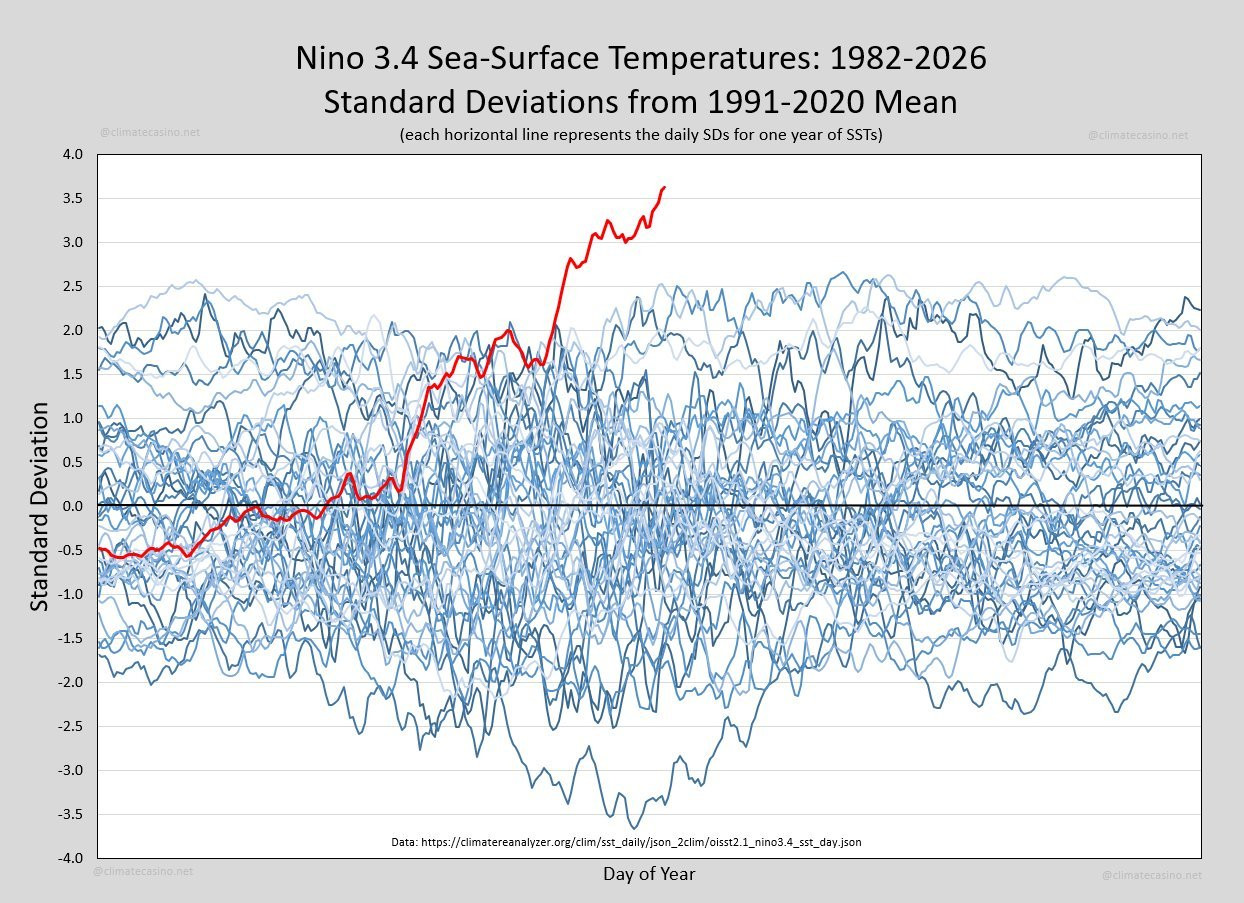
> This is why graphs like this matter. Not because they prove that catastrophe is inevitable, and not because they predict the precise sequence of events over coming years. Science rarely deals in absolutes. What they show is that Earth is moving beyond the range within which modern human civilisation developed. We’re entering climatic conditions that our infrastructure, ecosystems, economies and institutions were never designed to accommodate.
Reading helps. Also it's pretty clear from the "waaaaah" that you are not asking a good faith question but rather dismissing the article, without bringing any information or sources to back whatever point you are trying to make - ironic.
I know this because every prediction of climate doom turned out to be false.
Entire nations were going to disappear under rising sea levels. It has not happened. I'm not saying no land sinks, but sea levels are not rising rapidly enough to prevent Al Gore (author of "An Inconvenient Truth") from buying an ocean-front home. The same applies to John Kerry and dozens of other outspoken prophets of doom who warned us that rising sea levels would submerge entire nations. They used the proceeds of their fear-mongering to buy oceanfront homes.
I remember signs in Glacier National Park telling us the glaciers would be gone by the year 2,000. It has not happened.
This "signal" too will pass.
Kiribati and Tuvalu have measurable loss of land due to rising sea levels that is impacting people today. About 80% of the Maldives Islands will likely be uninhabitable within the next 25 years. The Marshall Islands have lost 18 out of their average 200cm above mean sea level height - roughly 6% of its land.
We have seen massive glacial retreat even in just the past 10 years, let alone the past 50. This is happening the world over, and at a rate that is not previously seen in the geological record (happy to argue this, thats my background). We are seeing large ice loss and lack of matching accumulation over Antarctica and Greenland - two great places to observe large scale processes. We just saw the Arctic stay largely unlocked for sea ice/shipping last season. The sum of these will take a moment to kick in, but the failure of conveyor currents will kick us all in the arse quite significantly and likely within our lifetime, and we have already seen hiccups.
Please check back in 5 years.
These are not projections. These are measurements.
These are known trends from the past century. The trend is accelerating in what seems to be an exponential pattern.
https://www.climate.gov/news-features/understanding-climate/...
We are experiencing record heat in northern Europe, with temperatures in line with what a couple of decades ago would be expected in north Africa during the summer.
Southern Europe is already experiencing massive droughts in major urban centers.
Nope. They color coded the maps differently, but the temperatures are in line with what is normal for that part of the world.
> Southern Europe is already experiencing massive droughts in major urban centers.
But a quick we search tells me: "Southern Europe is currently experiencing wetter-than-average conditions"
Where is rainfall down so much that there are "massive droughts" in Southern Europe?
> These are not projections. These are measurements.
Please check back in 5 years. The temperatures in the Niño 3.4 region of the equatorial Pacific will be below the 100-year average by then.
"Electric cars" is less likely tho because having a car at all is a money drain.
Policy changes are needed to address this problem. It’s a political problem that needs a political solution.
How much % of the world's population would have to do those things, for the graph to show a reversal of the trend? 10%? 50%? Everyone?
How does enforcing emissions regulations result in less productive cars?
Cars move about 1.5 people per trip on average. A big pickup or SUV is not any more productive doing this task than a mid sized car.
Even if you don't take it as prescriptive, it would be dumb not to take it as descriptive (i.e. what the other player will do in a situation)
Don’t worry about that, just recycle more!
It is about time we stop blaming the individual at the bottom of the ladder for the problems of society. And let me preempt you: society isn’t made up of individuals, but it is much greater than the sum of its parts.
Or to put it another way - which of those things is under our control? If one can do something more, then why not? Because billionaires? The climate doesn't blame anyone, it just exists; being to blame or not, doesn't matter when we're all in the same boat together.
Consumer demand doesn't determine whether to build coal vs solar vs nuclear. Public policy does. No new oil/gas/coal plants, period, and start working to shut down the ones we have. Electricity generation is the source of about a third of all CO2 emissions.
Consumer demand doesn't determine whether we do carbon capture, or reforestation. Those require public policy.
I’m the first to recycle, so you’re preaching to the choir. What I’m saying if we could do better than self-flagellating. Or rather, there is nothing our self-flagellation will achieve in the end.
We keep focusing on things that are easy to measure like how much meat does one person eat, rather than the real numbers that are effectively immeasurable. Am I a worse person for eating beef, yet not using LLMs nor driving a car, than a vegan would might do all those things? Only for my conscience to know. In the end, it all amounts to hypocrisy, and squabbling among the plebes, while the rich keep polluting the planet.
Eat less and different meat with a smaller footprint. Mostly poultry, eggs, also more organ meats, etc. Also combat fertiliser runoff, etc.
The methane output of a field of cattle isn't that dramatically different from a forest with deer, decomposing wood, etc. Methane is also a potent but temporary actor and tackling it primarily just buys us very little time which will be used as an excuse to keep pumping co2.
However we grow a good bhunch of the feed for that cattle and for ourselves with fossil fuel based fertilisers. We need to quit that. If we get rid of both that 8% co2 output for fertilisers and get rid of the manure as well because we ditch meat too much...
Well we'll solve a lot of related problems by drastically reducing the world's population with a gigantic famine.