Is x86 ready to ACE it?
CPU designs must evolve to keep up with changing workloads.
chipsandcheese.com
107 points · by mfiguiere · 4mo ago · 33 comments
The Chinese supercomputer uses custom CPUs designed in China, which implement the SME matrix extension of Armv9.3-A, while the fastest US supercomputers use GPUs.
The Chinese CPUs with SME have a lower energy efficiency than the best NVIDIA datacenter GPUs, and also a little lower than the best AMD datacenter GPUs, but not only they reached a greater absolute performance, but they also reach a much higher percentage of their theoretical maximum throughput, and this is likely to happen for all problems solved on them, because writing efficient programs is easier for CPUs than it is for GPUs.
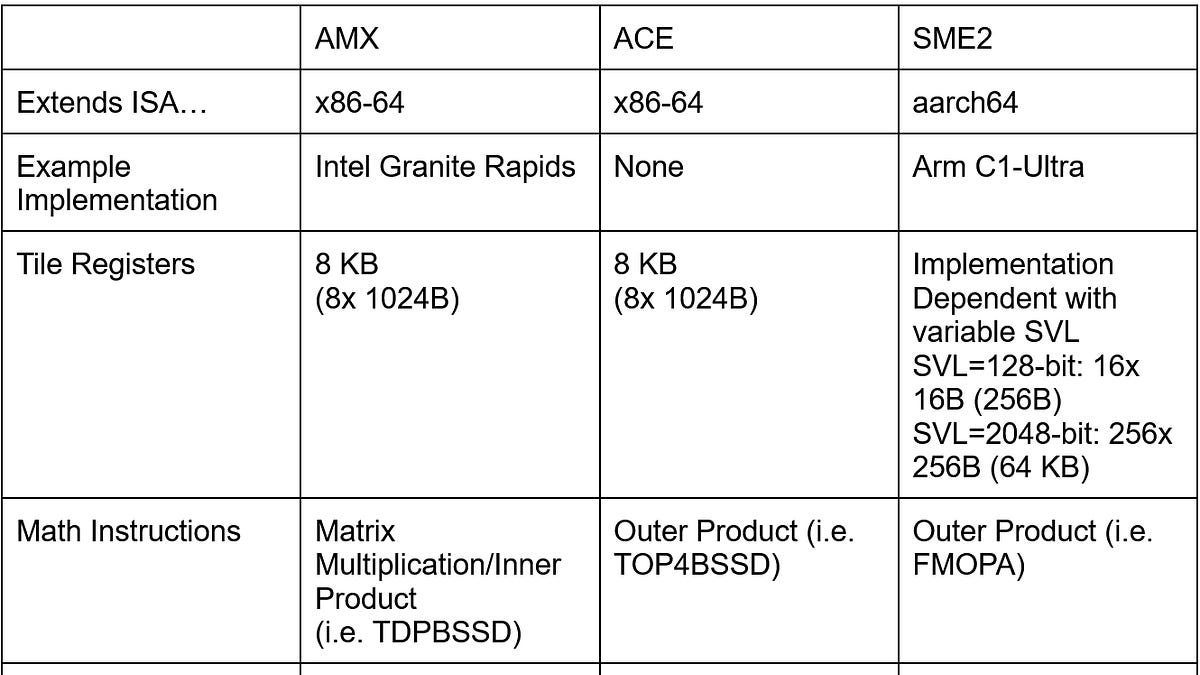
As discussed in TFA, the Arm SME and the Intel/AMD ACE are similar.
Thus server CPUs that have hundreds of cores and ISAs with matrix extensions can be very competitive in performance with GPUs, even if it is very likely that GPUs will always hold the records for the best energy efficiency.
The Chinese CPUs have fast HBM memory, with an 8 TB/s memory bandwidth per socket, equal to that of the latest AMD Instinct datacenter GPU and much greater than that of most less expensive GPUs. Very few consumer GPUs exceed a 1 TB/s memory bandwidth.
So at least where electric energy is cheap and abundant, running AI inference or training on server CPUs may be a competitive solution, especially when that computing cluster is also used for other purposes, not only for AI.
Funny thing, I can't find the article.
In the old days, when it was all about squeezing maximum performance from a given chip area budget you'd prefer using those transistors for some improvement of the general purpose parts, no matter how marginal. But now it's the thermal envelope, or power consumption of you prefer looking at it from that angle, and even slightly esoteric special purpose units can start making sense.
In the meantime x86 don't have much in the roadmap that compete well with ARM vendor's offering. And that was before Nvidia decided to join the fight.
My assumption is the determining factor in performance is going to ultimately be memory bandwidth.
> and if unified memory plus a basic GPU will render this dead in the water?
Yeah, generally I think that is the case. The main benefit this thing would have is power consumption will likely be lower than what it is to send this operation to the GPU.
FWIW, I wouldn't be surprised if you only have a couple threads using this at a time max since it looks an awful lot Apple's AMX/SME stuff. Those Apple execution units only have single engines shared about per cluster.
XSAVE lets you not bother saving register state that user space hasn't changed at the granularity of each large feature.
Source: https://x86ecosystem.org/wp-content/uploads/2026/03/ACE-Whit...
Now I wonder how many such "extension packages" Intel (and AMD?) have introduced since MMX (which I believe was the first, and interestingly enough didn't have an official meaning - https://en.wikipedia.org/wiki/MMX_(instruction_set)) in 1997?
Then click "...details for the "generations" of Intel's vector instructions."
Beware, it's dense acronym soup. :)
Last time I looked, anything remotely useful here was only on the Xeon chips, which means there'll be very few open source and even fewer non-corporate folks doing anything interesting with it.
AMD seems to be better at that, maybe there's hope.
In a past life, I taught young programmers you can, of course, make a phone number a numeric field in your database (and save a couple bytes by doing that!) but it'd only make sense if you wante to figure out the average phone number for all your clients so you could call them all at once.
There are extreme cases where it would actually make sense, but that I usually left to dig into in a later discussion.
I don't know enough about phone numbers to say whether you could encode them as an int anyway. In the UK all standard numbers start 0 and international codes start 00? Of course you could introduce a 'locale' and then 20 years later try to solve that mess with multiple ways of representing international numbers. Or maybe not teach young programmers that you can make the phone number a numeric field?
So it seems to me the solution is to save them as BCD...
I would also teach young programmers (about data) with the shorthand used above, things like "Do you want to add phone numbers? Multiply them? Utilize fractional components? Why are we storing these as numbers?"