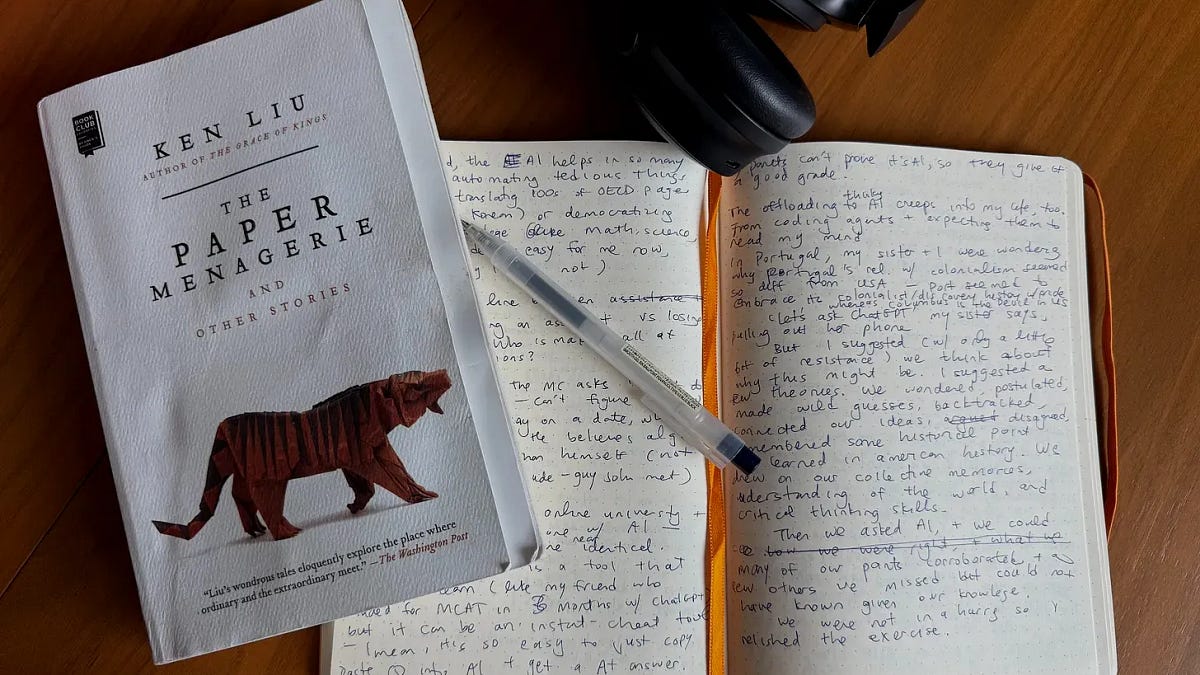
Are we offloading too much of our thinking to AI?
Reflections on autonomy and the value of thinking for ourselves
artfish.ai
526 points · by yenniejun111 · 4mo ago · 480 comments
But to latch onto the calculator argument: if you outsource adding numbers to a calculator, you're still you. On the flip side, if you use an LLM do most of your thinking, what's left? We have people here who use LLMs to raise their children, to manage relationships, to design products. So what's your unique contribution to this world - is it the prompt you once wrote? You're standing in front of a token-generating machine, pulling a lever, sometimes receiving gifts. Is that your edge, your unique experience, your purpose in life?
Many LLM maximalists say they use the tech to learn new things, but to what effect? Are you going to apply that knowledge of physics or computer science yourself, or will you just prompt the LLM again?
In my mind, it's pretty simple: I'm a human, LLMs are not. If a human writes a novel, it's inherently worth more because it's hard-earned and anchored to experiences we share. I want to support that. And I want to be a human who can write novels, the old-fashioned way. I'm not good at lifting weights or running, so my thinking is the only thing I have.
You can treat AI as a whispering earring - "What should we do now? How do we fix this? What do you think?" Or you can treat it like an exoskelton - "Implement kd-tree with metric space xyz for this problem, mapping this to that blah blah".
That's pre-thought execution automation that makes review much simpler - you already know the shape of the desired output. The whispering earring is atrophy.
Humanity is a weak hive mind species. You can, with effort, keep it from whispering it into your ears, if you really want that. But it's impossible to keep it from whispering in another ear attached to your hivemind. And the only difference in those ears is the propagation delay before it's rattling around in your own skull.
I will claim the CNC analogy though - I sometimes feel like a modern machinist just walking between machines and listening for screaming metal.
There's no such thing. You're probably thinking of a 100% "AI"-/regurgitated/ essay.
There's no such thing. You're probably thinking of "AI"-regurgitated essay.
You may be more free and independent, but you may also be unable to compete as everyone else easily gains wealth and success. Natural selection doesn't particularly care about freedom of consciousness.
Bleak.
Such people are extremely predictable.
You may have already noticed, before LLMs, cliché? Talking points that make a group identifiable? Words and phrases that act as applause lights or cognitive stop signs? (That last sentence itself being a pair of clichés that you can use to identify where I hang out online).
Anyway, point is, LLMs will give us a memetic monoculture before they turn us all into a world of correctly personalised Whispering Earring wearers. That makes them predictable, that makes them exploitable. It'll be like playing chess against someone you know is using a specific version of Stockfish: even though it would beat you if you tried to fight the system unaided, you can win by asking your own copy of the AI to go one step further ahead, and it will be accurate precisely because it's playing against itself and reacting to its own moves.
(Of course, the fact I've said this in writing means this is in the training data; in the general case this means the LLMs will know that and account for that, but I suspect comments like this won't shift the needle all that much compared to the aggregate output of 3 billion people reacting to short-form emotional manipulation A/B slop)
The danger isn't everyone but you getting wealthy. The danger is that wealth tends towards concentration. And it tends to concentrate around people who are already wealthy. The danger is, bluntly, that things will get worse for all but a few and most people will be so caught up in a red queen's race that they can't see how to stop.
Come to it with knowledge and understanding of a subject matter, asking for an implementation? That's different from going to it with no knowledge, asking for guidance on everything.
He sighed like he was taking responsibility for a grave sin and I should admire him for it, and said, "I don't know. I copied that from StackOverflow."
I've felt that AI is just an amplification of what we've all done and been through with SO answers.
And the way you achieve and maintain deep knowledge of the shape of the output you want is... well, to write and test it yourself. LLMs are a cognitohazard. If you aren't accustomed to programming without them (or even if you are) it's hard to see the line between using them to remove drudgery and relying on them to think for you.
The Whispering Earring story reminds me of that episode of Rick and Morty in which Morty gets a piece of crystal embedded in his forehead which allows him to perceive the moment of his death; he then begins steering his actions towards the future in which an elderly Jessica (his crush) tells him she loves him as he dies, down to individual articulated phonemes and muscle actions. In the end, it's revealed this future is not what Morty had hoped for.
But kudos for coming up with such an evocative analogy.
Many of the LLM maximalists I know don't have the skills or knowledge to excel in technology and need to use LLMs to do their job. It's seen as a cheat code to get work done.
As an example, A person I went to high school with that could barely figure out how to setup a Drupal site a few years ago, is now a frontier engineer at an AI startup. His Linkedin posts are filled with AI buzz words on a daily basis.
"It's inherently worth more because it's hard-earned and anchored to experiences we share. "
At some point, it will be impossible to tell the difference. Many people already can't tell if something was generated by AI.
So what if its indistinguishable - its not a product of human intellect or effort. I feel there is a large disconnect where people look at artful output such as music or writing as a thing no different than a box of paper clips. To them, "It's just there." They don't care how it got there, they just like the feeling they get from the consumption.
That's fast food thinking; It's engineered to be "tasty" in the sense that they put the right amount of chemicals into the food to tickle the right nerve endings. It's junk food that exists to turn a profit. Whereas even the local diner puts effort into its food and has a damn fine Greek menu and the best mozzarella sticks.
It's not all artisanal, made with love goodness just because human hands did it.
If it's indistinguishable, that could be because the user doesn't care to look closely, or it could be because it's just that well made now. For simple profile pictures, I genuinely stopped being able to tell if I'm looking at a real photo or not last year.
> That's fast food thinking; It's engineered to be "tasty" in the sense that they put the right amount of chemicals into the food to tickle the right nerve endings. It's junk food that exists to turn a profit. Whereas even the local diner puts effort into its food and has a damn fine Greek menu and the best mozzarella sticks.
The former is molecular gastronomy: https://en.wikipedia.org/wiki/Molecular_gastronomy
The digital version fast food we already have and is a little different, in that it's the tuning of "the algorithm" to addict us, while text and image models* seem to be trying to actually fool us.
* I suspect video and music models are trying to addict, but I'm not super sure either way.
You're simply drawing the line where it suits you.
I don't consider it pure human coding if you use anything but Notepad.
In my domain (web app CRUD), we build the same thing over and over and over. And it's not beautiful or interesting like furniture. It feels like with LLMs, all that repetitive stuff is gone and I can focus myself on the tricky problems.
Or are you just assuming you learned something because you made a finished product of some kind?
> At some point, it will be impossible to tell the difference. Many people already can't tell if something was generated by AI.
Nit: it won't be impossible, just so hard so most people won't bother or give up if they try, and society will settle into a mediocre, regressed state. Then wait a little while, and the next generation will justify their mediocrity as actually some kind of progress, and the people who knew better will be dead and unable to challenge that.
More technology != more progress. Just look what social media had done. At its best, it's like what came before, just more isolating.
"This guy couldn't do a thing we found easy, now he can! Boooo!"
Yes, I can now set up a Drupal website in a few hours. That is great for me.
Same goes for LLMs. I can use them for programming, and they're very convenient. But I still need to know what to ask it and make sure it stays within the confines of what I want. And without my knowledge I would have no clue if what it's trying do is correct, or safe.
Naturally, this assumes a workflow where you do actually look and modify the output yourself. But I'd argue that any non tech person is inevitably going to hit a wall where they can't debug themselves out of without getting a human involved.
A lot of Hacker news commenters tend to overestimate human ability without education. That is, the tend to believe that people are able to do a lot more without regular training than they actually are. They believe that "math" is some naturally ordained eventuality that humans just do, or likewise that "reasoning" is some immutable natural behavior. In truth these things are "unnatural" human reinforced structures that we have to learn and adapt our brains into.
I wonder how much better I could become as an adult at mental math. I did a math course a few years ago (Math Academy) and put some effort into improving my addition, subtraction, division, and multiplication, but I wish I'd done more up front. Even one-figure arithmetic is so fuzzy to me, like it's a hashtable where the keys don't line up to the right values. Can I unlearn that now? O(1) doesn't matter if the result is wrong.
> And without my knowledge I would have no clue if what it's trying do is correct, or safe.
I would contend you got the knowledge by typing the code yourself, that there's no other way to get it, and that if you stop typing the code yourself--and the slogging that entails--you'll lose the ability to prompt LLMs effectively.
It's not that I think the physiokinetic aspects of typing as an input mechanism hold some metaphysical distinction, but rather the level of engagement it forces with the code, and the units in which it does so. I'm not aware as yet of any viable replacement for that.
It's easy to trade on decades of software engineering experience with LLMs: with sufficient experience, everything goes around and comes around, almost any pattern is recognisable, the gratification is immediate, the benefits are now, while the costs and disasters are down the road.
However, the technology world is not static, and if you don't keep up with new frameworks, libraries, languages and other tech in that physical-mechanical "mind-body-keyboard" way that typing--or something substantially close to it--accomplishes, you will lose the ability to navigate that world fluently. To say it's just another abstraction layer and that the world didn't crumble after compilers is to miss something quite essential about how LLMs differ from compilers or high-level languages. The disengagement with the process of physically programming something quite specific will take down with it the ability, over time, to formulate useful prompts and competently review the output.
For sure, and I've tried picking up a new language with the use of LLMs, but the concepts just don't stick because I don't actually do the work. That's why I do try to limit my use of LLMs to fields I'm already closely familiar with, and also keep its output contained to actually reviewable chunks. Or things that are just tedious, like OCR and large text transformations.
If you were to ask it (especially with Claude's newer model, Fable 5) to draft an architecture design diagram, it would do a better job than any junior dev ever could. Sure, giving context is still necessary, but you can just speak in plain, normal English and it will understand. AI is getting scary good at system design.
I didn't say that, though.
> it would do a better job than any junior dev ever could. Sure, giving context is still necessary, but you can just speak in plain, normal English and it will understand. AI is getting scary good at system design.
Sure. But that's not my point. Don't you still want those juniors to be capable of creating those diagrams? So they can understand them? If the juniors don't get what the AI is outputting, why are you even creating the diagrams in the first place, right?
That's what this topic is about. Just like how calculators helped us do complex tasks, we still needed to understand math. Same with AI, you still need to be understand the topics you ask it to do.
I think that most of people misunderstand what calculator changed. Calculator didn't replace people doing math, calculator replaced mathematical tables, slide rulers and other already existing devices.
And regarding making people dumber ... Math teachers who saw this change said that there was a clear shift – students started to think less critically. With slide rulers and tables you had to think about answers – significant figures etc – with calculators you don't.
I would say that calculators definitely reduced my more simplistic mathematics skills but did open up some more advanced stuff. I wouldn't say it was a gain or a loss, just depends on what your needs are.
While I appreciate you laying it out so plainly, I disagree. A novel is a bunch of words and I don't care if they were written by one person, five, an AI, or infinite monkeys on typewriters. What's valuable in a novel (or a poem) is in the words.
I can maybe understand finding value in a machine-written novel if others also read it and enjoyed it, but having an LLM spit out a novel and reading it in isolation, that would be a complete waste of time to me.
You would care about that story, until you found out that this story is a lie, an old April’s fools joke that escaped confinement. The words are the same, but your reactions to the exact words have changed with new information about the source.
When we read personal stories it affects our emotions as we empathize with the author, or otherwise share the feelings that the author is trying to convey. When we find out there is no such author, our empathy and our notion of shared feelings vanishes with the new information even though the words stay the same.
This is something I have a lot of trouble explaining and generally don't try to because I've never actually studied this or anything. So I can only go from my 45 years experiencing of experiencing art along with others.
Of course if you are just putting on music to work to, this isn't going to matter much if at all, but...
Generally people do really seem to care about the person behind something they are experiencing. The simplest example I can give is one of those extremely well shot photos that very few people have taken from a sitting position of their feet dangling off a massive building. I would have a very hard time believing anyone claiming that such a photo wouldn't give them very different feelings if they knew it was a real person v not. Again, this is the simplest example I can think of but I think it goes much deeper with all sorts of art, ie, most people to some degree are attempting experiencing art through the person who created it whether they "know" it or not. This is evident when presented with something they don't like and say something like, "Who would make this?"
> When we read personal stories it affects our emotions as we empathize with the author, or otherwise share the feelings that the author is trying to convey. When we find out there is no such author, our empathy and our notion of shared feelings vanishes with the new information even though the words stay the same.
This isn't true for me. If I read an incredibly moving poem and later learned that it was written by someone casting the I Ching and picking words out of a hat, it would not affect how I felt about the poem.
No, I wouldn't. I don't live in Seattle, and I don't care about octopi. Why project what you think a reader cares about?
In the same way that I don't need the lumber in my house "hand sawed" for it to achieve my goal of creating a habitable space.
---
But more broadly, I do think there's space to at least question the use and role of AI.
Because while content can (and should) be addressed directly, there's a valid meta-conversation about the intent of producing content, and the results producing that content might have.
What goal does producing this content achieve?
What is the role of this content in society?
Is this content, on this scale, an appropriate thing to be making?
These are MUCH harder questions - often because we've shifted from concrete (content) to abstract (value judgements).
To go back to my housing analogy: We're no longer evaluating the benefits of hand-sawed vs power sawed timber. We're discussing whether our housing is built in the right spots, if we're building enough of it, and are we allocating it in the right ways.
This is irrelevant because we’re not using the source to judge the strength of an argument. Logical fallacies have only to do with the strength of a logical argument, nothing else.
To illustrate this, if I sell you some energy and you ask whether the energy comes from burning children or from a solar farm, I can’t say that it’s a logical fallacy for you to care because all energy powers your home just the same. You don’t owe any consideration to the content (energy) at all, because energy is not an argument that is subject to the source fallacy, to treat it as such is a fundamental category error.
Even to take your tack and say “We should consider the energy generated from burning children apart from its source, because we don’t want to fall prey to the source fallacy. However, the societal effects should also be taken into consideration…” shouldn’t be countenanced.
But since I know the human history of the road, it _feels_ different when I'm on it than other machine-built roads.
It's the same in a hand-made house. Knowing the human labor gives the house a different vibe.
If we look at 10 paintings and one was painted by a human master artist, it becomes, to me, more impressive than the AI works, even if it isn't the award-winner.
These sentiments are incredibly subjective, of course. Some people simply feel no difference between a hand-made brick and a machine-made brick other than the latter is likely cheaper and of higher material quality.
But for those of us looking for the indescribable _soul_ of the work, we fail to find it in those produced by machine.
I just visited Lowell National Park and watched the mechanical looms in action. The cloth they produced was blandly soulless, like all the cloth we use and wear and discard. The loom itself, on the other hand, was a hand-built mechanical work of art, and felt amazingly _human_ by compassion.
This isn't something we tend to value in the US, though. The closest we get is people hanging their kids' childhood art on the walls and buying custom art at great expense to increase social standing. And a few support-your-indy-artist types.
I don’t want a mathematical approximation of writing informed by feelings, knowledge, experiences, etc. anymore than I would want to see an “AI band” perform just because the music is supposedly great. There’s no personality, there’s nothing personal period.
I'd argue that most folks get plenty of value from the content itself, entirely separate from the intent, context, or even existence of the author.
I don't care about the motivations of the director to enjoy an action movie. I don't care about the life history of the author to enjoy a good fiction.
I think there is (and should be) space for content where people care, but I'd suggest it's the fringes (ex - majority of music is production grade pop, not meaningful songs, majority of books sales are erotic fiction, etc).
or even a bunch of characters, bunch of pixels and so on.
To me this is the wrong level of abstraction that is not sufficient to encode the meaning of literature.
Changes to that corpus that reflect the real world are going to come from incorporating future works created by humans. (LLM generated training data can reinforce fidelity to the current corpus but don't alter it.) The future still belongs to human creativity.
> What's valuable in a novel (or a poem) is in the words.
Even if the words are a lie? Misleading? False?
I'm not even talking about LLMs. What if it's propaganda designed to influence your thinking, possibly against your own interests; are those still valuable words that you'd cherish reading?
My point is that the source matters, intent matters, and authenticity matters. To me, anyway.
If a machine could truly provoke thoughts as well as a human author, then yeah it'd be worth reading its work, too.
I'd extend on this as well: the process of creating changes you. In a technical sense, where you approach a problem and the way you solve that problem informs you. Both your problem solving skills, creative skills, but also even understanding how a compromise works.
This is why I have minimal compunction about an experienced engineer using AI-assisted coding ("hey claude, define this data class") versus finding AI-art to be repugnant.
The act of creating an artistic work is both an expression, but also the act of ideating and then executing on that changes you. Experience, emotion, and other more intangible concepts.
You don't make. You ask the ai to make a song about some vague concept and then clap like a seal as it delivers you un-challenging and bias-confirming slop.
> I think there’s going to be a hollowing out ... All that matters to me is that I like the song.
Everyone consumes, and nobody makes everything. But you're describing a future in which nobody makes anything and we all just suckle directly on the soft serve machine.
How grim.
Otherwise, if you're going to keep consuming the exact slop content that you're looking for, you're going to stagnate as a person.
The act of creation not just creates, it informs you. For example, when placing a wall with CAD for architecture, maybe you realize that some walls on an non-level roof have visually unappealing or difficult wall/roof joints. And then you consider that for future designs? Or you pause and think further about how a person interacts with that room. You can see how the act of creation delivered meaningful feedback to you, as a person.
IDK that's just an example I could come up with, you should really ask an architect or ID guy
Except calculators have been a problem for decades, it's why they're not allowed in school when you're still learning. Without doing the math yourself and internalizing how it works, you won't develop the number sense to tell if the result makes sense (broken calculator, typo, wrong equation, etc).
I still remember my physics teacher using one of the student's test answers as an example of how he should have known it was wrong and gone back over it (I think it was a pendulum on an elevator, his result had negative gravity (so gravity going upwards)).
Number sense is such a nebulous concept, but it captures what I've seen people struggle with. A general sixth sense about where an equation should or shouldn't go, a feeling that random numbers don't appear quite random enough and might have a pattern, or even recognizing that having a pattern signifies some relationship that otherwise has no evidence.
I still remember giving Mathematica a relational equation of the atomic radius expectation values for it to integrate by parts and collect terms... at the time it failed to find the right integrating factor and gave gibberish. Probably works now.
That's also how you can tell if your calculator is "lying" to you (or you typed wrong). I guess I have a few similar tools in spaces where I'm more experienced to see when "hallucinations" and gibberish are being generated by LLMs. Of course having it "check sources" and evaluate its own solutions sometimes also works, if those are reliable, but you're on the hairy edge at that point.
My first thoughts were around trying to understand why these people would do that. What I see a lot around me, is people being afraid to fail, as it's some inherently dumb and bad thing, not realizing that sometimes failing is what makes you learn enough so you don't fail later, or builds resilience in other ways that later will be useful, for others or for yourself. Avoiding the path of harsh failure will put you down the path of mediocrity.
At the same time, the troubling allure is that the machine has ingested a million books and has better knowledge than me (e.g. in things like JavaScript or Japanese), so why not trust it about how to raise kids.
There's a difference between capability and mastery. If you have a calculator, you are capable of doing basic arithmetic (probably). If you can do fairly complex arithmetic in your head, that's mastery. If all you need is capability, it's fair to say that acquiring mastery might be wasted effort. However, if you want to go on to do advanced math, physics, etc., then mastery of basic arithmetic, calculus, algebra, etc. are necessary stepping stones. If you have to go back to calculators, math programs, textbooks, etc. every time for basic things while trying to formulate and manipulate equations, you're going to have a very hard time getting along.
Sure, rely on AI for things that you merely need as capabilities, but recognize that doing so prevents you from developing mastery required to progress to other things. If you don't want to progress to those things, then it's fine. If you do, then you should rethink your approach.
I try hard to keep a serious feature branch going on every project where I'm driving it in emacs or vscode or whatever. `gptel` is great for this because it can tool call for the docs, be a super search engine like Google used to be but you're keeping your reflexes up, keeping the comprehension debt under control.
For me this is almost exactly like being in an EM role: it's so easy to lose track of the details, you have all these other demands on your time, there's pressure to grow headcount, and the costs of letting the skills slip is all but invisible for a while. But before you know it you're rubber stamping stuff you don't really grasp, you're not able to help people who are having trouble in the codebase, it's all bad. And depending on why you got into this business, it can become pretty joyless to be totally out of the loop.
Now every engineer has to navigate this. It's going to be interesting.
*some of us. This is one of the differentiators (can’t find a better word right now). Some became software developers because they enjoy(ed) the process. Some became software developers because that was the way to make products that made money. Neither is more correct or genuine than the other, but neither can also claim to be a significant majority.
Same with GPS, though many folks have no idea how to navigate on their own anymore so often don’t notice when they’ve accidentally had a typo or chosen the wrong Springfield.
So I find using an LLM can be useful when I already have an idea of that the problem is.
At their request I reviewed a colleague’s plan for a project. I looked up some of the baseline parameters so I could understand the plan, than I made some comments w/questions about things I didn’t quite understand.
A couple of minutes late for our morning mtg I came in while my colleague was saying that I had found a bunch of things that Claude had not.
This is why they are bad news for new grads who haven’t yet learned the and pitfalls of their fields. And this was a senior person who just outsourced the work to the LLM.
For most people, GPS did not improve sense of direction, spellchecking did not help to write without making mistake, deepl did not help to be better in foreign languages. But replacing a bicycle by a motorcycle forces to acquire new skills without losing any, and we can find many example of symbiosis between "The man and the machine" (Lindbergh wrote a book named "WE"). AI could be something like that, after all it is human knowledge reachable in a conversational and contextual manner.
So AI can be used to learn: "tell me what's wrong in my code, or if it can be improved". I also tend to think that the more we code, the more we give AI valuable piece of knowledge to learn from, the best code it can produce, the less the produced code seems alien. It can be a win/win, all depend on the mindset. I like to code and even if I am skeptical about many aspects of AI I can share the workload with a robot, as an exercise or if the time or budget is constrained.
Even if you were, the best you could hope for is a career in entertainment ("sports"). The necessity for bodily strength was abolished in the industrial revolution of the 1800s and 1900s. Now the maximalists predictably say we have another "industrial revolution" that makes our intellect redundant. I don't believe that but if it were true, the question what defines the value of a human would become even more pressing, with less leeway as to what the answer might be. H. G. Wells needed The Time Machine to find a world like that.
Still, if enough people believe that LLMs do make our intellect redundant, it will trigger a cultural crisis similar to the one at the previous turn of the century when men struggled with their defining attribute (physical strength) being taken away by machines. The reverse centaur is over 100 years old, even if that name wasn't used then.
The ability to engage with math "critically" is fundamental to being able to use it constructively/creatively.
I think we're seeing the impact of LLMs more broadly in the drastic decline in incoming freshman academic competency levels, and will continue to observe people becoming measurably, meaningfully stupider until we clamp down on / outright ban LLM usage in education.
It's possible to set that latter value to be nonzero. You can't use free markets to set it because they necessarily cannot see what price to set, so you kinda have to guess, but IMO, it isn't zero, and I'd hazard to say it's positive.
We have of course abolished slavery since then.
Which is a weird way of saying I don't think we necessarily should put a monetary value to people. Instead we need to realize that money isn't everything in life. So much of life is unpriceable, and that's as it should be. Attempting to price the unpriceable necessarily makes a mockery of the unpriceable thing.
Yes, but also the prompts you give after, and the iterations you continue to do. Art is rarely something you build once and forget about. A lot of that going on in AI no doubt, but the builders who polish their work and strive for perfection are still the builders they were before AI.
You mention the novel writer and yes that person who's great at writing novels will create great art. But the ones that are 80% of the way their, but maybe can't nail the ending, or segue into different plot-lines, can now create great art and have AI get them there. Subconsciously, they will get better at those things by using AI and seeing the result.
I'm always reminded of that I, Robot scene where the scientist says "you must ask the right questions." And that is true now more than ever.
Cognitive offloading seems to be a feature of humans, we do it with spouses and people we work with.
I dont see why offloading some other stuff to an LLM is going to dehumanise someone.
Not sure why that matters tbh.
Cognitive Offloading is a human ability. We built a tool that can be used with it in absence of another person.
The argument seemed to be that Cognitive Offloading dehumanised a person, but now things have shifted to "Its only good with another human".
If its worthwhile we will do it, if its not worthwhile we wont.
If your answer is "not much", you gotta step up so that the answer is closer to "more than ever was".
You dug the holes in the ground with a shovel your entire life. Suddenly somebody gifts you a digger, nearly for free. If your reaction to this is "what's left for me now? anyone could just pull levers, no strength or skill needed!" not, "I could dig so much more and deeper holes with this digger!" then you need to chill, reflect, then fight your fear and perverse laziness and learn how to become the best person to pull the levers.
"Many book maximalists say they read books to learn new things, but to what effect?"
First we had verbal transmission, then books, then the Internet, now LLMs. And they all kind of do the same thing.
For me, the value of an LLM is it can take my imprecise query, scour its memory AND the Internet, and then return an answer (with citations if you ask) quicker than I can look for it "manually".
And I'm far from an LLM maximalist...
Why not? You're implying writing good prompts doesn't require effort or thought, which is false to me.
> Are you going to apply that knowledge of physics or computer science yourself, or will you just prompt the LLM again?
To write better prompt is a good reason to learn new things. It's so obvious that more knowledge and experience you have, the better results you get from LLMs.
I would also argue that they use LLMs to learn "about" new things, but not really the thing itself. I, myself, learned a lot about complex SQL queries just recently using LLMs. But I really don't know how to write complex queries myself.
People often confuse reading about a thing with knowing the thing.
If you use AI exactly like this I find no issue, but I fear most people are using the calculator without knowing the math and that's the real issue to me.
But the market doesnt reward that. Different consumers different markets, but (using a salad analogy) overall consumers dont care how a salad is made, only whether it tastes good and is cheap
It's not either/or. I think about designing a product in conjunction with AI "thinking" about it. Two heads are better than one.
Anyone who's spent time in professions in or adjacent to social work would say that a lot of their clients would frankly be better off outsourcing these decisions to LLMs.
I'm not saying this to be snarky, but maybe it's time to work on lifting weights and running. The worth of a novel is, of course, subjective, but most people would judge it based on the entertainment value it provides and not how much human effort went into it. Hobbies like fitness (which don't have an output that's meant to be consumed) seem like a safer harbor in this new era.
In my mind, it's pretty simple too and not dissimilar to what you say: we've got cognition, LLMs don't. When a human writes a novel, it doesn't look like a novel because the human has been trained by reading every single novel ever written in every single human language out there.
The human doesn't imitate the act of writing a novel: the human just writes a novel.
> But to latch onto the calculator argument: if you outsource adding numbers to a calculator, you're still you. On the flip side, if you use an LLM do most of your thinking, what's left?
Really not much. The IQ of an oyster more or less. But the LLM is not thinking, so it's not possible to "offload your thinking".
But tbh those who believe these LLMs are thinking machines and that it's normal to offload "thinking" to those non-thinking machines probably don't have very deep thoughts anyway.
So nothing of value is lost.
P.S: I happily not one but three AI subscriptions and use LLMs daily to code. Which is probably why I'm such a critic of AI. They're both useful and pathetically bad. They really write crappy code.
.... What?
You open up with the calculator argument. Great. Then state "on the flip side". Ok.
And then declare it very simple in your mind when there is _only_ the flip side.
The whole issue is the not-simple gray area and where each of us believes the line between empowered human and brainless idiot is drawn.
We had some contractors at the house doing some work. The contractors had been doing this work for a long time. I could tell they were good at what they did because I had some experience with that type of work when I was younger and they were way better than me.
We ran into an unusual situation (old house, old building techniques, overlapping old renovations) that they had never seen before. The contractors pulled up ChatGPT and started chatting with it. Eventually they came up with a solution with some good materials and techniques to make it work without turning it into a bigger tear out and complete rebuild project, and they got quick links to confirm it matched code.
This worked because they had the experience to judge the accuracy of the answers. They still checked the claims against the description of the materials we needed to order. After they did the work they had the experience to do it again, and it didn’t take them any guessing, trial and error, or searching through forums or Facebook groups (which are very popular with contractors) to get advice.
This is the right way to benefit from LLMs in learning something: Get the information then put it into practice so you learn it.
I worry when I see someone claim to learn something from an LLM but then the next turn is having the LLM do the work. It’s like skimming a math textbook but then skipping the exercises and never doing any quizzes. Every student in school learns that you have to practice to really understand something because reading the words is not enough. You have to work through it to internalize it.
LLMs can be very powerful tools in this way. They can also trick people into thinking they’re learning when they’re not. I think everyone has to go through that learning process about how to learn all over again like we all did with calculators in elementary school. There will be a lot of people who get trapped into being LLM promoters, whose output ceiling is limited by what LLMs can do as limited by their ability to recognize what’s right and wrong.
By now, almost everyone can think of someone they know who is happy to turn their brain off and press enter in Claude until it says the task is complete. I worry how this is going to intersect with the Reddit generation who grew up consuming doomer content about how jobs are just “bullshit jobs” and how your goal should be to do as little as possible at work, because there will come a time where those who spent their careers offloading their thinking to LLMs without doing the hard work of learning will not have much compelling reason to be hired over any other intern who can prompt Claude.
On the long term view I can see a lot of the LLM prompters getting replaced by LLMs doing the prompting. On social media like Reddit you can already see a lot of people gloating about how they just copy from Jira into Claude, push a PR, and then have Claude handle code review from their peers while they do nothing. Not hard to see that someone like that isn’t doing much that couldn’t be done by going one level deeper with Claude and letting it automate that person away. You have to put in some work to stay valuable.
You provide some context you are looking to expand on and let the LLM autocomplete provide you with relevant terms and concepts that have historically come up in that context and may or may not be actually useful. Then you do due diligence to learn about those related concepts, determine their applicability and distill it all down into a solution.
This quickly engages a lot of social circuitry we've already developed when it comes to questions of what constitutes the user truly learning and having skills, what is meritorious, and who deserves most of the credit.
For example:
* If the spell-checker for your paper was secretly another human, that wouldn't become cheating. (Ditto for a calculator.)
* If you prompt "write an introductory paragraph" for a paper and it was actually a human ghostwriter, you'd obviously be cheating.
* If an executive prompts "write a congratulatory e-mail for me" to an LLM, it's not worse than asking a human secretary to do it.
* If you say "I learned kung-fu" while hiring a [robot/human] to kick the spine out of your opponent, you're a liar either way.
But the idea that “outsourcing” to experts is somehow detrimental is one of the modern tropes I can’t stand. And I’m not sure I believe there’s a material difference between e.g. reading research about raising children versus asking an LLM that is grounded in (and cites) that research.
Maybe I’m a cynic, but I don’t think most of us have a unique contribution to the world. Emphasis on unique.
So why not leverage all resources in the effort to maximize happiness for ourselves and those around us?
Let the impl go.
On the other side, people pushing the intelligence is for losers narrative are already too stupid to create anything that benefits humanity or the planet, so might as well ignore them.
Diving deeper into technical understanding makes more sense to me at this point both as a way to make yourself more useful in the age of AI and also to use AI more effectively.
I regularly tell the kids to grab a text book on a subject that interests them and I do the same.
I’m willing to bet deep understanding is going to become a commodity soon.
The good managers I saw also had this ability. The managers I didn't enjoy working with / saw struggle were ones who either never had that ability, or had lost it a long time ago.
Note I'm speaking about line management. There's a world of difference between managing a dozen or so individual contributors vs managing senior managers / directors. However, managing LLMs is analogous to line management.
I agree, but in my opinion, your point about needing to know how things work still holds. It's less relevant as you move up to managing managers and larger orgs, but it never goes to zero if you're going to be successful.
So, i.e: comparing being a manager to real humans vs instructing a next-token generator dilutes the skill of being a good manager and leader.
Because it is one thing to feel like you have learned something and another thing to have actually learned it well enough to put it in use. There are so many YouTube tutorials on all kinds of subject that will make you feel like an expert in the field after watching, and then you start doing the thing they have supposedly taught you and you can't remember a darn thing, because your "learning" was only ever skin deep and never meaningfully tested or reinforced.
To me this is intuitively true based on anecdata. 2 examples
1) learning spanish - when I hear or read a phrase I don't know, I type it into the LLM and I learn a new word/phrase. Sure, I could have cracked open a spanish language dictionary, but tbh, I wasn't going to do that. Not to mention that dictionaries are translating word by word and not phrase by phrase.
2) growing vegetables in the garden. I literally watched YT tutorials and did what they did, and now I have vegetables that I didn't before. Yes, I could have probably could have gotten this from a botany book, but once again, I probably was not going to do this. I also was trouble shooting a lot in gemini
Here are the problems I traversed: - How much water should I give these per day? what's the watering schedule? - how much sun vs shade? - when do I move seedling to the ground outside? - Is trimming good? which parts and when do I trim? - [take a picture of weird growth] - Is this a disease on the plant? Or part of the plant naturally?
https://www.nature.com/articles/s41598-025-97652-6
I think there's a bigger question that would be hard to answer: what does a consistent long term diet of videos and quick answers do to a person's mind/understanding of the world?
Also, a lot of the published research is a year delayed - most I've read recently are using ChatGPT 4 or 4o. When it comes to giving high quality feedback, I think there was an inflection point around Opus 4.6.
For myself, I have found that I am better able to learn new topics than ever before because being able to have a conversation with a moderately competent but sometimes catastrophically wrong AI about any new subject is actually the perfect mix of helpful and unhelpful for learning.
I use a loop along these lines:
* Ask a question * Get an answer * Be skeptical of the answer * Investigate/reason about the answer * Critique the answer * Rinse and repeat
This kind of loop is far more useful to me than any textbook ever has been, because a textbook just drips information into my head. It's more likely to be accurate, but not guaranteed, and it doesn't encourage me to actually engage with the material in the way that a wrong AI answer does.
One of the many reasons I'm determined to remain a luddite wrt AI. I hate the idea of being a manager and have refused promotions to avoid it in the past. I don't want to manage automatons any more than I want to manage people. I want to do stuff, not manage.
It is not like you have to give them fun parts of the job.
While being a team lead for people I actually have to do the opposite. Get interesting parts to hand over to people to keep them happy and pick mundane not interesting boilerplate myself.
It feels like this message of “offloading mundane tasks so you will have more time to do fun parts” is being pushed so hard, but in reality the opposite is happening. Fun parts are being offloaded while I’m left doing the soul sucking and mundane parts
I've happy to take the tasks like SQL optimization which other would run away from, for instance, or the bash trickery mentioned elsewhere. People don't believe me, I've had looks of surprise and derision when “if you take on this role, you can give X to others and not have to worry about it” is responded to with “I like doing X, can't you ask one of the others to take on the other role and let me stay as I am?”…
It is increasingly looking like I have the choice: change to a role (automaton farmer) that I expect to hate, or leave dev, or maybe leave tech entirely and go wait tables or something. Those tables are starting to look very attractive.
How does the text generated by LLM make “our” understanding deeper compared to text written in the books?
An analogy that I think helps describe how I feel about it all:
AI is like having cheat codes in a video game. You don't have to try hard and develop a deep understanding of how the game works. You aren't challenged anymore and it doesn't feel like you earned winning the game.
It doesn't matter because nobody cares. Businesses truly do not care. You are a cog, a means to an end. It's only about "winning". Now it's no longer fun to play the game.
A cynical person would tell you that nothing has changed; this was always the way it was. AI didn't change anything in this regard. Maybe it just made it more apparent to you?
Which means as a human your only added value is on the edge of the distribution. Which means you need to be learning and doing more complex, deep topics.
Most people don't use AI to learn new stuff. They use it to do "the job" for them and they don't even understand the result. What is the point of a person if they don't bring any value to the table other than being a "resource" to generate prompts?
I saw every category, the ones that used AI to learn and actually answered my questions and knew what it wrote, the ones that mostly didn't use AI and so knew what they wrote, and finally the ones that used AI to do the assignment instead of learning and always responded a variant of "I don't know".
I really like what the other teacher said to a student that admitted never reading their code:
"I'm not even scolding you, You're literally saying you are completely unnecessary here"
So, how can someone become professional if they don’t learn from their own mistakes? In the case of AI; they will learn to become professional prompters and learn from the mistakes of bad prompts??? I prefer the former not the ladder.
You learn math before using a calculator to do the boring part.
You should learn code before using an AI to generate the boring part.
Even more so for LLMs because they are not deterministic like calculators.
AI will be treated like a God that talks to us, and you can't disagree with it, you can only try to change its mind. The most horrific form of mental oppression. And it's just a few years away.
I see it all the time now, people constantly outsourcing their thinking to LLM's and getting upset when you point out that it is wrong. I have people calling/emailing my work place about a service of product that we do not provide. But those folks simply cannot comprehend that the LLM is wrong and many have made the accusation that us at the business are wrong. There is a very strong feeling from many people now that it is the higher authority over professionals. It is a saddening position to be in.
We are only 3 1/2 years into this and it is already happening on a much larger scale than many think.
I find it's so easy to convince oneself they're doing the former when it's increasingly the latter. The thinking part is so often provided by default by the models, or is a single prompt away. The thoughts are so syntactically (though not stylistically) perfect that it's difficult to ignore them and reason greenfield.
What's the solution? Given how keen models are to short-circuit the thinking process it could be the only solution is to silo off tasks/ideas. Choosing which mental tasks to silo off is itself incredibly difficult especially when there's a pressure to deliver rapidly (and in quantity) on those tasks.
IOW - modern AI is simply an extension of the lack of thinking that characterizes the modern life... It just does it faster and uses a hulluva lot more energy.
Only a minority of jobs require the person to wrack their brains very hard. Most jobs just involve learning a routine and performing it on repeat.
The fear is that AI is also turning the jobs that required thinking into routine-on-repeat jobs (where the routine becomes I/O-ing things to an LLM).
I can totally see the job of a doctor (or more likely, NPs and PAs) devolving into just interviewing and visually examining a patient, feeding everything into an LLM, and doing what the LLM tells them. The next step is they wouldn't even be allowed to do anything else, for liability reasons. A world like this is right around the corner.
Are humans capable of profound creativity? Of course. Are they actually doing it? No, not very often.
If you find yourself consuming more than 5 minutes of content you don't find thoughtful per day, I would ask why. "Touch grass" seems to be the common advice to combat this.
Isn’t that just an incorrect interpretation of the descriptive experience sampling tests? The frequency of having inner monologue varies, but I don’t think it was shown that many people have anendophasia.
Even on Hacker News, when you see debates like 'X technology is good' or 'X technology is bad,' most of it seems to be about identity. And that identity often originates from the community they belong to.
The first identity usually starts with a community or the person who created it. Once the community forms, people under it often forget the original reasons and just accept it as their identity.
This is especially true for technology related issues, because the market share of a technology is directly tied to one's career, which makes it even more prone to becoming an identity issue.
I also do some 'thinking' in certain areas, but most of the time I don't. As my field gets deeper, it becomes harder to allocate cognitive resources to other areas. So in general, most people follow the crowd's opinion, but only maintain deep, thoughtful thinking, including 'taste,' in a few specific technical domains.
What I wanted to say in this post was essentially that I only do deep 'thinking' in a very narrow set of domains. For the rest, I outsource my thinking to the identity of the community I belong to.
Thank you for your kind comment, Redwood. However, commenting on that post would require deep engagement with others, and I'm a bit hesitant to do that.
It’s bad enough for rational reasoned discourse that we anthropomorphise LLMs, let’s please not then feed those words back into human discourse, further diluting their meaning. No one “hallucinates coherence”, hallucinations are by definition a perception which does not match reality.
> AI is simply an extension of
It may be an extension, but not “simply” as it also creates the problem where it didn’t exist. I’ve seen several reports (both on and offline) of people who used to engage in deep thinking (I’m talking scientists, postgrads, PhDs working at the edge of what we know) now worrying they are losing their ability to properly think due to their LLM use.
> It just does it faster and uses a hulluva lot more energy.
I hope we can agree that’s bad and that we should try to stop and even reverse it, not simply shrug our shoulders and go “ah well, we were already going to shit anyway, might as well fuck everything up faster”.
I don’t know how to put it well, but… Have you ever had a moment where you realized your perception of something was off and things weren’t as you thought they were?
Have you seen people dead sure of something you were positive as nonsense?
I have, ranging from simple small isolated situations to whole worldviews. I have personally held mental models that were broken, but felt consistent and true. I still sure do, just don’t know (hopefully, yet) how they’re mismatching the reality this time.
Call it “delusion” or “hallucination” or “misunderstanding” or something else - it’s still a thing and it happens in language-capable humans and machines alike.
I don't think modernity caused any sort of degradation.
You said it yourself, "thinking is hard work". It's rational to save energy. This might even have incentivized the emergence of mimesis in humans, which is arguably the foundation of our ability to cooperate at large scale.
https://en.wikipedia.org/wiki/Mimesis
Maybe a few of us do the hard work of thinking, and, if we figure out something novel and useful, huge numbers of people ape us uncritically. It's not an inspiring picture of humanity, but it's also not a reason to disparage anyone. More of a fact of life to be dealt with strategically.
Unknowable. And a callous notion.
everyone is just thinking about how to recall, remix and repeat.
Unfortunately this adds quite a bit of overhead and would make everything take a lot more time. It might be worth it though.
I've been planning forever to do something similar with length, duration, power, etc.
This is called "number sense". I'm pretty sure we do have evidence under searches for that term, it was well-enough known as a concept when I was in school decades ago and is the reason we don't use calculators when first learning math.
For math we ask the whole reasoning and not just the answer, but here what do you do ?
What I resorted to is a live code review with the student, and it becomes very quickly apparent if they know the code, know what the AI said about the code, or didn't bother to read the code at all.
But it's way more time and effort.
It works quite well. I do the math lessons during bath-time daily with my 6 yo. He's up to the point were he can add multiply pretty much any number by 2, 3 or 4 as long as the product is under 3 digits.
Going from adding single digits to multiplication of random 2-digit numbers by 4 with lessons only during bath-time (no paper or whiteboard) gives a child a great deal of confidence with numbers.
Computer science teaching really needs to be prepared to do the same progression as math, but even harsher because LLMs are not even deterministic.
You learn math without a calculator, then you learn how to do the boring parts with a calculator that you would still be able to do (slower) if needed.
I'm seeing some incredibly dumb stuff: researchers spending months on Claude trying to do insane deduplication, unrelated to their research question, using regex; whole research methodologies YOLO'd out of ChatGPT.
The results invariably chaotic, resulting in huge amounts of stress and wasted time.
Non-technical people are treating LLMs like an oracle, making big assumptions and decisions with little regard for their implications, because their clanker told them to.
It's scary out there. The lack of critical thinking I'm seeing in some of these projects is horrific. Not unique to the post-AI era, certainly, but on a whole new level. Bad things are undoubtedly happening everywhere, right now, because someone's just like "let's ask Claude".
Yesterday I noted in another comment that I am having lots of Lawyers and Writers ask me pointed questions about "docker" and "agents" that make them sound more like JR engineers.
It's two groups of people who, as a profession, spend a large amount of time reviewing their own work and the work of others with a critical eye. Writers edit, Lawyers review evidence and every bit of content that their oppositions produces. Both groups (when doing their job well) aren't just critically thinking, they are being diligent and dedicated.
Lots of people are treating LLM's like an oracle (technical ones as well). Because our culture values moving bricks faster, with out taking into account if they are going to the right place, or even if they are the right bricks. (See: https://www.business.com/articles/management-theory-of-frank... and https://en.wikipedia.org/wiki/Time_and_motion_study for why "bricks" matter).
It's not evenly distributed though. There are still areas for improvement in my experience. They still require a bit of handholding for example when doing SQL when large amount of data is involved. I'm sure they'll get better intuitions about indexes in the future. Although I don't think that's anything that couldn't be solved with a skill file today.
Especially given the comments I see here and on other tech and programming forums, I hate the direction things are going.
I still have some hope this will all fade, but the damage done will be worse the longer it goes on, I think.
They are just straight up admitting they don't know anything, and advocate fiercely for their agent's recommendation.
No one cares, no one tries to stop this behavior. It's seen as good, apparently. I admitted that I don't know enough to have an opinion at the moment, I certainly don't know how to judge the contradictory opinions of multiple frontier AIs, and I fear that just made me look incompetent.
Some benchmark that would take weeks to plan, code and set up is now hours and days - the time is now spent on the benchmark itself, not on temporary code.
If anything, I think most here outsource too little thinking to AI.
What am I supposed to be afraid of? Losing skills I no longer need to get the job done?
When I know upfront how to do anything, I just give all the instructions. But the OPs point was If we offload thinking too much, so that's why I was just thinking about this example when I need thinking - that's usually when I need to learn something new.
When I bring these things up, it will apologize, tell me I'm right, and adjust. But what if I didn't know enough to question it? Approaching from the other angle, maybe I'm actually wrong and it's a sycophant, as mentioned, trying to please the user?
On the topics where I'm having to correct it, I probably shouldn't bother asking in the first place. On topics where I'm not correcting it, is it because the AI was right, or I just don't know enough to call it out? This kind of thing worries me about AI being leaned on more and more as a teacher.
The rise of knowledge work made many people far less physically active because moving one's body was no longer a given part of one's job. This led to a lot of people (who assumed sports was exercise on top of one's work, not the only source of exercise) moving very little. This meant we needed to rediscover the importance of exercise as a pillar of health.
I think something similar will happen with knowledge work, where we have to do a lot less cognitive exercise due to AI (as well as the decline of reading and rise of short-form video), which will likely lead to eventual issues and subsequently, a rise in activities designed to replicate the cognitive exercise work used to provide.
There are some common traits about the thighs I use AI for. They are this that I either couldn't possibly do myself (because I'm biased, or unfamiliar, or have no access to the expertise) or that I would spend a lot of time while having little agency (mechanical translation). I am not replacing learning, thinking, or deciding. I think this is the key difference.
I feel like it's also making people even more lazy. It feels like people just ask questions without putting ANY effort in themselves beforehand to find the answer, like they assume everything is an AI and we're all just going to drop everything and give them a gushing answer. Like the whole concept of a manual or documentation for something seems like the biggest waste of time now, because it feels like no one reads it (or maybe haven't got the attention span to read anything anymore either?), or can be bothered reading it, or even bothered to look to see if there was any manual or documentation in the first place. Zero ability to think and do things for themselves. Granted yes, it has always been a bit like that, but I definitely feel like this sort of thing has been much worse since LLMs have been around.
I think about it a lot in conversations like this. The story does a much better job of telling it, so I won't summarize more than: It's a discussion about how technology changes culture and how its very hard to judge if that's a good or bad thing.
It's online https://web.archive.org/web/20140222103103/http://subterrane...
2. I just picked up Exhalation by Ted Chiang from SFPL like 3 hours ago, perfect timing it seems (although they only had a large font edition, which is somehow more difficult to read)
Perhaps the only way forward will be if we figure out how to merge with the AIs so we can keep up. Otherwise, a soma-filled world likely awaits. And unlike Brave New World, I think it might actually be a lot more pleasant, but still one with a different set of tradeoffs.
The article takes a position that assumes hallucinations do not occur, and then posits from that stance the question as to whether we rely on AI too much. We should be taking a step back before even asking that question and focusing on the part where AI does invent answers whole-cloth.
Somebody asked an AI how to interpret it.
As for now, autocomplete is only as good as the training data. Once humanity collectively stop being autonomous beings and generating novel ideas, it all comes to a halt. LLM suggested ideas and preferences are nothing more than some mashup/average of what came before. The ability to actually think may become a rare treasure.
In fact, when I use AI, I don't really use it for the things I actually enjoy doing. For example, I like making UI animations, and I don't use AI for that. I also don't use AI when I'm playing games I enjoy. But when I have to make something tedious like a login screen, I use AI. And after I write the code, I just throw the entire codebase at AI to write the documentation.
The problem is that this only lets me think about things I have a taste for.
Having taste and diving deep into it is good. Immersion is great. But on the flip side, you also need to do things that aren't your taste. That's more cognitively healthy. AI prevents that.
In that sense, I think AI's strength is that it creates an environment where you can dive deeper into the areas you like.
But the real question becomes how you use the cognitive surplus that's left after offloading tasks to AI.
I visit Korean, Chinese, Japanese, and USA sites, and honestly, most people, including myself, only have deep thinking about certain topics. Outside of those, we just follow the prevailing opinion.
So I'm not really sure. I don't think using AI makes me stop thinking. I just think it creates a bias that makes my thinking only focus on the parts I want to focus on.
Yeah, life always becomes more enjoyable when someone else did the job for you. Especially enjoyable, when your problems become smb's else problems.
E.g. your mother as a teacher is now solving a quality-control problem : "When i give A mark to this student, do I characterize their actual level or it was ai-generated." If it turns out in the future that this evaluation was wrong, it is a responsibility of a teacher and the reputation of the school that suffers. I talk here as a teacher myself and this "delegatative thinking" is currently at a disasterous scale. Unfortunately, this effect works one-way : if you are a prodigy, only a few people will know your alma mater. People will think about your personal hardwork. In the opposite case, especially if someone suffered because your ai-consulting sessions, people do not tend to blame your work style, they tend to complaint about the institution that quallified your intelligence. And then other people with simillar evaluations start suffering,too
The reality is that most humans do very little actual thinking of their own anyway, and, if you believe that what LLMs produce constitutes a form of intelligence, it does seem "more intelligent" than most humans.
So: is outsourcing thinking a net improvement for a majority of users?
I use several models, daily, and they seem "reasonably conditioned" that they are only input to my thinking and not "my thinking". I correct them constantly; they are wrong (in reasoning/logic, in actual facts) frequently. They are demonstrably "not smarter" than I am. And yet I know many people who can "do more" with them as a "thinking" tool. I can say that "the problem" is they can't spot the errors, but they can't or won't do that in their ordinary lives, either, so, again, is it a net improvement for them?
Interesting times and all that.
For example I send some doc asking for a feedback and someone without reading it generate a feedback with llm with so much ambiguity that I have to get back and wait couple of more days to get a reply.
One of the most silliest thing I see is a middle manager feeding Microsoft planner to Claude to generate a report and generate future steps and sometimes it makes no sense what he present couple of weeks ago because what he present today is contradicting to the one before.
At this point I feel it’s cheaper to replace them with AI. They are just physical vessels for AI.
It’s just not that maybe they were not good enough. But now they just fully depend on AI.
Whatever creativity/thinking/effort bandwidth that's available will now get shifted to a different place in the problem-solving effort bottleneck.
That's the hallmark of any delegation being effective. Do we see that happening with AI tools? Personally, I do see that working for me. Is it as good as the hype makes it to be or I wish it to be? maybe not, yet, for me. But that's the case with most things in life.
I think in the software trade you will definitely use your brain less. But in other trades, it removes the time sucks and gets you back to work.
They used an LLM to come up with a Hackathon idea. They tried to use LLM to get to the implementation part. One of the permissions they (/the LLM) were asking for wasn't even needed for their project. When I pointed that out, I got a response from them that starts with "You are right about the permissions".
Today they've successfully finished the project too.
Not sure what I even think/feel about this but it's definitely weird to think about this.
Knowing declarative you need to loop over elements and actually being able to write the for loop as procedural knowledge are two different shoes. I believe that this is the real danger.
Pilots have much automation in the cockpit but the pilot needs simulation hours actually flying not relying on the autopilot.
If you dont write code you will forget/loose much accuracy writing it, its just a matter of time.
And today, asking for help having landed in Windows log in hell, bit locker keys required, pin needs resetting but cannot do so as I have MWB Windows Firewall Control blocking all connections by default until I manually change the profile.
In both examples, Sonnet seemingly knew less than I did, going off snips on the internet regarding Ableton that are probably contradictory and lacking the required level of detail. No answer, no workaround.
For Windows, it keeps offering me impossible steps mostly requiring me already to be signed in, albeit it did highlight one potential winner to delete dead PIN info via CMD. But the reality is I can do what I need via a parallel install or bootable USB toolkit.
I chose Claude because I was tired... If the option hadn't been there, I would just have got on with fixing Windows myself. And I knew I would likely need to report a bug with Abletons forum.
Instead I wasted my intelligence and time instead communicating with the LLM. It leads me to believe there is an inevitably high risk of "acquired" dependence.
Note language on the page is visual spatial relationships and spoken language fosters triggers activity between structures in the brain.
We merely use language to communicate. And yeah but thanks, at my age having worked in EE, software dev and trained under various experts (friends and family who are chefs, doctors, aeronautics engineers) in their disciplines... at some point no one is saying anything interesting
Same old appeals to social conservatism of some form; not save the Constitution style but their job despite tech obsoleting jobs forever now. Their culture, despite history being littered with the detritus of dead cultures.
Just a bunch of parroting. Little thinking "oh shit every generation ever has had to deal with this."
Imo if we offloaded to much thinking to tech it was a long time ago; we started to stare at the web and stopped thinking not in language but about the evolving spatial relationships of the physical world
https://www.scientificamerican.com/article/you-dont-need-wor...
I think we can use AI similarly: asking AI for ideas that we haven't thought of before, and asking AI to connect the dots in new ways. To do these two effectively, though, we will need deep conceptual understanding of what we work on, and strong intuition to further refine the answers given by the AI.
That is, we don't offload our thinking. We just augment it with AI. It's like playing the game of ABC: given a letter, and name all the movies starting with it. One can be very familiar the movies but still fail to recall most of the titles. AI can exactly help with that type of recall.
[1] That's why OpenAI's model could solve the hardest problem (problem 6?) in 2025's IOI, but failed to solve the easiest one for human (problem 3?).
What is frightening is with something like neuralink that in a future hypothetical time would have very fast capability to keep informed and advised, you could be a zombie decision maker and nobody would really be able to tell. Even when you were pressed to why you made the decision, it's just another AI response, it's like a con artist or imposter dream scenario.
I noticed that atm, before these crazy hypotheticals potentially happen, the people that seem to take the time to understand things deeper are still way more valuable than those that just use tools more than not. Its obvious atm due to the lag in time and the way people respond in meetings, at least for now. :)
I want certain answers that the docs and the code are not giving me yet. Nothing is more irritating than working through a tutorial on a new framework and then throwing all that work out because that’s not really how one should use the framework. Nothing is more frustrating than having to get through a treatise on why this framework is The Solution before I can actually see code that uses the solution. And it’s beyond annoying when this End All Be All framework has a glaring omission that’s not obvious until you’ve built large amounts of your project on top of it.
Hand the docs and the example code to the LLM, and now I can get answers. “How can I do X?” Example code. “Then I need Z” Modified code. “How is this going to handle Q?” Explanation. “That doesn’t seem quite right. Give me a reference to the doc or code showing this.” Links.
Great, in 15 min, I have learned what I need to know, I can see that this solves a problem that I have, and I have discovered that I need an implementation of S to complement this solution.
That is usefulness. And it requires experience.
How can you push your brain go farther than ever, when you don't use it for the basic task?
Higher Math does not work without understanding "lower" Math, running long runs does not work without starting on shorter runs. Thinking about complicated staff will probly not work, if you can't think about the easy stuff.
One can not learn a language without vocabulary and skipping learning verbs in a foreign language, because dictionaries exists does not bring one closer to being able to speak.
The issue being, gratification is rarely a good guideline. It just means collapsing the gap between doing the thing and the idea of having done the thing. But that gap is where you actually learn things
I think the analogy to hyper-palatable, calorific food works well:
Humans adapted for a world with too little food. Then once there was too much, obesity and overeating became a problem for the first time. Self discipline is the cost we have to pay for this kind of abundance.
We now have a general-purpose way to offload mental effort, and are discovering in real-time the negative consequences of that.
I use AI for coding, but I feel I've moved past the honey-moon period and am now learning how to use it in a way that is not a detriment. If I care about the work I'm doing I don't want the AI to do it for me, even if it could. Deciding what work I want/should be doing myself vs what can be delegated is a new skill I, and I believe we all need to learn.
I've seen a lot of people talk about the obvious privacy and autonomy disaster it creates -- giving companies (and anyone who can legally compel or hack them) such intimate details or allowing yourself to be dependent on their services which they can withdraw or degrade at any time... Or where the model operators can bias the results based on bribes (ad payments) or their own agenda ... but really that's the start.
Another one what I haven't seen discussed is that use of an AI provides oracle access to your opponents. What I mean is that if I want to influence you, I can have an AI try variations of arguments against the model you're using (or if I don't know, a panel of models you might be using) until it can construct a super influential output. I can see what your model might recommend and anticipate your actions and change my actions to control yours. This can be done in a targeted way against individual people, or against populations e.g. by marketers.
There are reasons why this may be even more effective than it seems: It appears that models themselves are trained on each other, so in testing I see in family effects: GPT-4o mini seems much more convinced by essays written by GPT5 than ones written by GLM 5.2, while other models are more neutral (and my human review says the GPT5 essays are unambiguously worse in this trial). So I assume GPT5's writing was refined by review by in-family models and it's already somewhat of a super persuader against GPT-4o mini as a result.
The danger of oracle access is somewhat a symptom of AI monoculture resulting in a reasoning monoculture. If there were a billion highly distinct models widely used then it might be the only way to convince or predict a disproportionate portion of them would be to simply be right, and then we'd just be left with a operational security concern of making sure your opponents/competitors don't know what model(s) you use. But of course, that isn't the world we have today: people use a small number of models, and their behavior is generally pretty related due to architectural commonalities and cross distillation and such.
It goes like: "Here is this thing I wonder about", and the LLM is like "Yeah sure, consider these things that are super related to what you are doing, that you probably know nothing about yet (but you know... if you are interested...)".
And that goes in any direction, for any depth. Anything that is made trivial now, is just replaced by something more consequential a level or two higher. You can just get much better at things that matter more.
I wish I was kidding but I work with people doing this. I think it’s going to be a real mess in the future, we’re going to completely disintegrate the critical thinking portions of our brains.
Fortunately, I’m seeing more articles about this, some of us are noticing and raising the flag asking “is this a good idea?”
I find I'm not thinking less per say, just thinking about different things. Maybe you could argue there are CEOs who get too far out of touch with the reality on the ground and should get more directly involved in the work. However, I don't know how well one could argue that the CEO should do all of the work.
I see at least the current iteration LLMs and harnesses as me managing and coordinating them and thinking differently, not less.
AI makes me massively more productive as a quant, and more creative in the sense that it can often find calculations I don't know how to start, BUT the flip side of that is that I can also feel my skills atrophy and as such am trying to make sure I do maths exercises and so on. I don't worry about programming skills because programming isn't about code.
I've noticed it when interviewing interns. A surprising number seem unable to think on their feet or solve problems without immediately reaching for chatgpt. I don't necessarily expect you to be able to solve a problem entirely without tools, but you should be able to give me the outline of how to go about something and why you would go that way.
After all, if you are just going to spit out AI, I will just get AI to do your job...
But this varies from person to person
Some of us overthink already and offloading to AI just enables us to overthink more in other directions than we would if we didn't have ai
Furthermore, there are some clearly wrong questions where person asks AI to make some kind of numerical evaluation of some data. And evaluation is done entirely through inference - essentially a hallucination, instead of some one-off python script which can actually give deterministic calculated evaluation. Yet they accept the answer AI gives them.
I think partially it is because of the amount of data you can get out of an LLM and because it looks pretty good, a lot of people treat it as authoritative.
This means they send it around and then other people have to go through the work of actually validating it before being able to act on it.
So what this really means is that the person you go the information from offloaded their thinking to the AI, while cannibalizing on yours.
Anyway, hand-crafted take, artisanal, small-batch, no additives. The upside is I've learned how to type the em-dash and the en-dash and learned their proper syntactical use.
And just like people going to the gym to exercise their otherwise economically useless bodies, same thing will happen with the mind.
Folks, get over it.
AI as a tool for specific tasks is great, using AI for everything is like strapping yourself to a robot/exosuit and being puppeted around throughout the day.
AI is the current popular way (at least in these circles) and if it's too much or too little it might not matter. What will matter is if this offloading is making people unhappy and having any negative impact in civilization. I have no idea
Offload your execution, not your thinking.
When you cognitively surrender to AI, or to another person (be it a leader/manager, or a subordinate/report), you are asking for trouble.
- I don't care how you produce the words
- I expect you to use tools to be as efficient and productive as possible
- You are accountable for every word you produce
To use an analogy, imagine you are fluent in reading/writing/speaking a foreign language. Over time, if you don't regularly use that foreign language, or you use a tool to translate to that foreign language, you gradually lose fluency in that language. It may be more efficient for a translator to use a tool like Google Translate or similar to translate between languages, but there are clearly downsides to doing so, and proofreading the produced contents is not enough to compensate for those downsides, as reading what someone/something else wrote is easier than writing it yourself.
Outsourcing your thinking where the understanding doesn't exist is one risky spot to be in.
I am still doing as much as I can get away with it by myself. I was used to write tons of code before AI, so I can still pretend I am an eager adopter while still minimizing using it as much as I can.
Surely anyone dumb enough to think a chatbot is smarter than a human should indeed offload his thinking to a chatbot. Where is the problem?
and work on things that would usually be out of my element.
if you aren't thinking more than ever, you're using ai wrong.
these are the people who are now first against the wall when the revolution comes.
why would I want to hire you to work the three hours you feel like working per day (per week?) when I can have AI with a deeper knowledge set available 24x7?
Perhaps the question to ask is: who is making all of the final decisions for the things that really matter to you in your life?
No direct democracy, just people deciding for you. You can choose once every four years. Are we surprised of how easily we delegate decisions? May be AI can do it better
Annoyed, you go find a popular programming chatbot, and ask the question. The chatbot will give you answer, no matter how poorly worded or nonsensical your question, and it will do it cheerfully and confidently. It may even tell you how great your question or idea is. Granted, the answer will be worthless, both because the question was poorly worded and because the chatbot is simply spewing statistically probable text, but you won't know. You're a beginner, without experience to know correct from bullshit. You try to use the answer the chatbot gave you, and when it doesn't work, you go back to the chatbot. It will continue to cheerfully answer your questions as long as you have tokens to spend. The chatbot will never give up on trying to help you, it will never be rude, it won't complain.
And people wonder why chatbots are so popular.
It makes me sad, high-level thinking is the one thing that makes humans unique. That we're willing to let that atrophy while giving our power to mega corporations for the sake of convenience is a sad state of affairs. Like, Altman's idea that intelligence will be a "metered utility" should make people terrified! That's a dystopian future. "I can't climb out of poverty because I don't have money to pay the thinking machine"
I do think there's a potential irony in this though. The people screaming loudest about how if you're not using AI you're going to get "left behind"... are probably going to get left behind. Actual skills developed by real learning, I think, are going to become more rare and valuable, not less.
Personally, I'm hoping my side project turns into a business at some point. I can tell you there's a 0% chance I'd hire a vibe coder to work on it. I just don't need that skillset. I would hire professional fiction writers (it's a tool for them), people with technical expertise I lack, etc. The one skillset I do not care about is AI usage expertise, because it's just not valuable.
What I've found is that LLMs are excellent tools for:
- Spitting out white collar corporate speak that sounds plausible to other corporate speakers
- Hugely accelerating the process of going through academia which, except for a few specific cases, is essentially years of copy/pasting
- Writing code as long as such code as been written many times before
- Figuring out which one of the 10 ads and 12 misleading links in a web search is the one you're looking for
- Summarizing a book in ten paragraphs so you don't have to read it
...which turns out a lot of people defined as "thinking". I don't agree with that. But in either case, not "too much" is being offloaded: it's all of it.
It's hard to explain, but AI mostly doesn't get the nuance of my thinking right. I'll read a response and right away know it's a non-answer for my purposes. If I get a "hit" then it's often by luck. And so, I use it mostly for anything other than direct answers, such as research, etc. Beyond that, it's not much different than old school Google result. So, no, I don't offload my thinking.
...huh. It's a "startup", so it's not Meta capturing their employees' inputs. I wonder what it could be.
does a bear shit in the woods?
does rust have the worst community of all time?
Of all time? Nah.
That would be either emacs of vi. I'll let them fight with each other over which!
no worse then crossfit or vegans...
This happens frequently enough that it creates a real disincentive for me to use AI for anything that I already know how to do - and use it exclusively for things I don’t know how to do.
It’s deeply frustrating to realize you just wasted 20 minutes posting error messages into Claude when you could’ve just locked in and written it yourself.