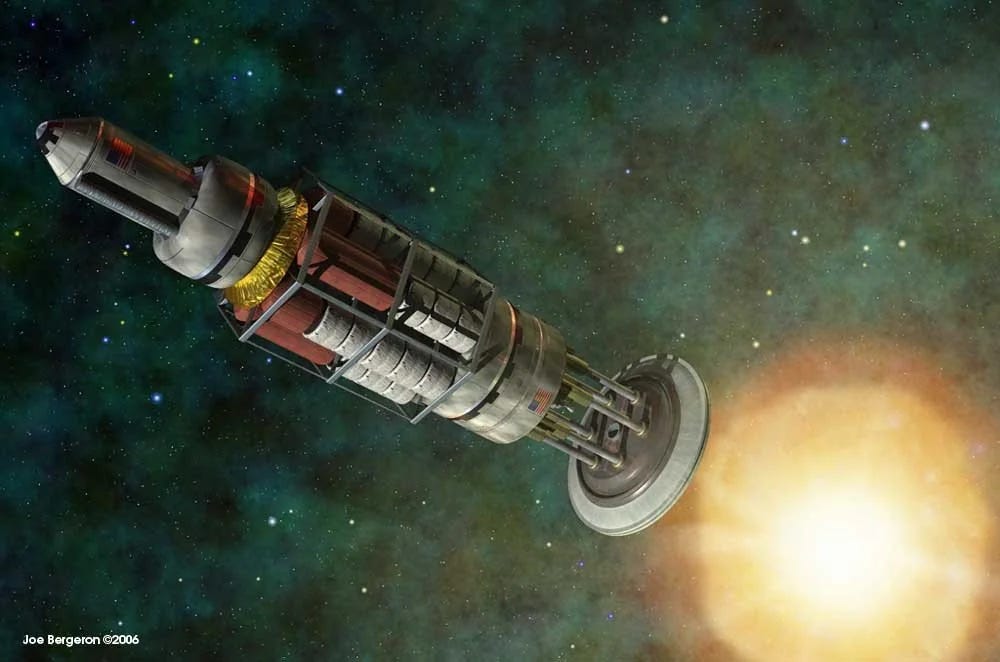
More Bounce to the Ounce!
A love letter to the rocket that everyone is too chicken to build
mceglowski.substack.com
141 points · by pavel_lishin · 4mo ago · 59 comments
The Rapatronic camera was used to take these kinds of pictures, and you can see that the actual blast front is around 20 meters across after 1 millisecond (!!) https://en.wikipedia.org/wiki/Rapatronic_camera
https://www.centauri-dreams.org/2024/04/17/medusa-deep-space...
Incredible ideas. Really, really lousy ending.
You don't say.
The more you know
This is among the reason I've thought nuclear waste should be disposed of in space. Send the stuff onto the moon; if future lunar inhabitants want to mine it for plutonium in the naturally radiation-soaked landscape that is the lunar surface, let them.
Congrats; you have come up with a way to make nuclear waste disposal 100x more dangerous and 1000x more expensive!
Reprocessing is very expensive; $1000/kg and up. Launch to space will likely become much cheaper than this as fully reusable launch vehicles become available. Even if the spent fuel must be armored against accident the cost of launching it to LEO, and then to the moon, is likely to become much cheaper than the cost of reprocessing it here on Earth.
Space disposal has the positive advantage that the seven very long lived fission products are removed from the biosphere, along with the very long lived actinides like Np-237.
Current costs to launch a kg to orbit are something like $2,000-$6,000.
If we're comparing it to you enriched amount, you'd have to launch 10kg, which means you'd have to hit $100/kg launch costs to break even. I'm not convinced that will ever be possible; that's on the order of a first class arline ticket for a 50kg person.
This also doesn't consider what you're getting for launching it into orbit. If the 100 year risk of a casket leaking is (say) x mrads into the environment, you're going to have to consider what the equivalent of vaporizing all of it into the atmosphere in the event of a failed launch is. the fallout (hah) from a failed launch of nuclear waste seems magnitudes more catastrophic than having the same stuff slowly leaking in the middle of a desert cave.
* The rocket blows up on the launchpad
* The rocket gets you part way up, then blows up during ascent
* The rocket fails before orbital insertion, and your nuclear payload re-enters the atmosphere at near-orbital velocity
In all of those cases, you need to have enough shielding to avoid spreading nuclear waste over a very large area -- that adds a lot of mass. And everyone whose jurisdiction you're launching over needs to trust you have enough shielding. And in the case where it fails during orbit insertion and re-enters the atmosphere, you don't have a lot of control on where the nuclear materials end up, which has proliferation issues.
I'm a fan of the nuclear lightbulb myself: https://en.wikipedia.org/wiki/Gas_core_reactor_rocket#Closed...
Sometimes I think that while it may be appealing to mine gold or platinum or whatever out of the solar system, what people really need to figure out how to do is mine uranium. While I could advocate with a straight face that maybe we need to freak out a bit less about lifting the occasional few dozen pounds of uranium into orbit, and point out that more radioactive material has already been launched than people realize, it is fair to observe that we probably can't afford to make lifting hundreds of pounds of fission fuel into orbit the sort of routine event it needs to be to really have a space civilization. One of the biggest major issues with any sort of space habitation is access to dense energy sources. You can smooth over a lot of other problems and get a lot more slack in the system if you have a lot of energy available to play with. Part of the challenge with current space technology is that you start out on the very edge of feasibility as it is.
https://idlewords.com/2006/04/argentina_on_two_steaks_a_day....
Also a big fan of https://idlewords.com/2010/03/scott_and_scurvy.htm
(Well that and a Qatar Airways misprice a couple of years back; but I would not have been motivated to jump on that occasion if I had not read the post.)