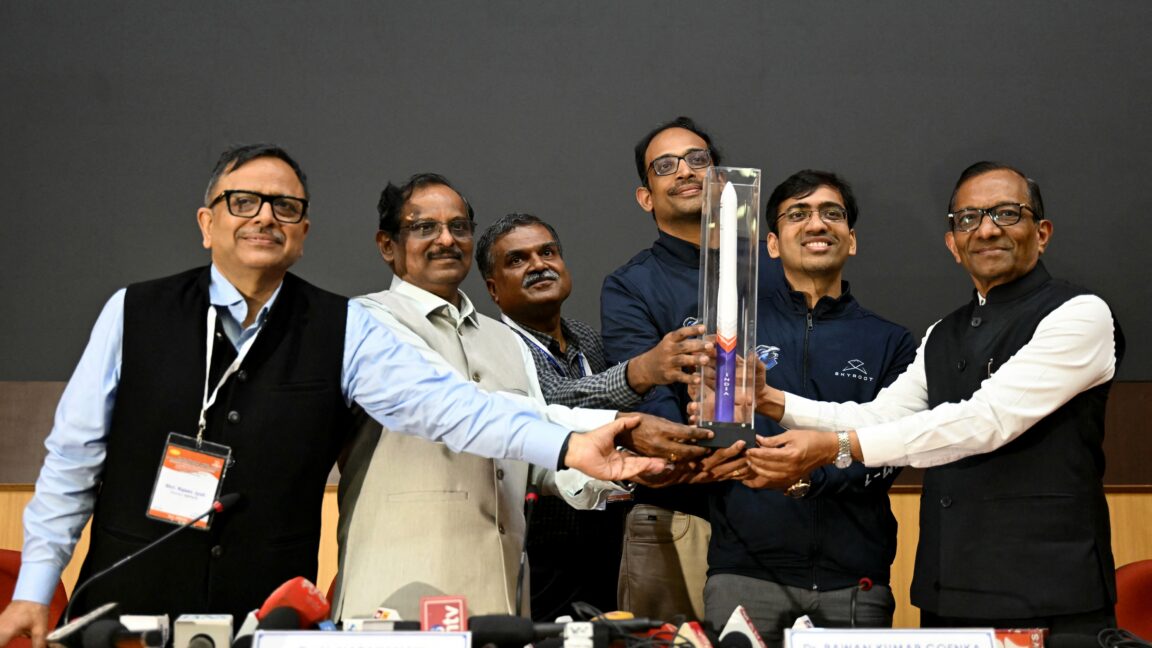
India's first privately developed rocket reaches orbit on dramatic debut launch
On the first attempt, reaching orbit, I never thought it was possible."
Ars Technica
684 points · by sohkamyung · 4mo ago · 219 comments
Agnikul is planning to launch semi-cryo kerosene rocket pretty soon. Their engine is 3d printed and use electric pump fed 25kN small engine. Planning to launch 4 clustered engines as first stage and already did suborbital test, with some parachute splash down reusability claims.
Astrobase is recent entrant. With decent funding and former ISRO scientists as core team, developing 800kN FFCS methalox engine. FFCS is called holy grail of liquid engines. They have acquired largest metal 3d engine and planning VTVL 1st stage reusability
Edit: can't reply
> But.. why?
Missile Defense and C4ISR [2]. Seconds matter, so most of the newer generation of missile defense systems are experimenting with how to offload compute at the edge to reduce C2 latency.
Most orbital sat startups in the US, China, and India are partially backed by military and intel oriented funds (eg. Starcloud and IQT/In-Q-Tel).
-----
[0] - https://www.nro.gov/news-media-featured-stories/news-media-p...
[1] - https://www.livemint.com/companies/news/agnikul-cosmos-iceye...
[2] - https://idsa.in/wp-content/uploads/2026/01/book-MISSION-SUDA...
1. How do you cool your chips? Vacuum is a thermal insulator, so radiators are required to remove heat. nVidia (or even ASICs) require much and specialised cooling.
2. How does one radiation harden a H100?
3. I'm also seeing where TCO for these are 78x their terrestrial equivalents [0]. Is that financial sustainable?
And there still remain issues with power supply, regulations, and bandwidth. This feels more like a thought experiment rather than an actual serious engineering or business case.
1 and 2 are still open questions, but these are not aimed to be commercial grade DCs - this is basically edge compute (think a handful of racks). 3 is not a problem for defense usecases. (EDIT: Discussion here seems to point out that data OP is using might be flawed [1]).
Ignoring the fact that just about every orbital data center startup in the US is funded by IQT and China's CMF has been doing something similar is bad from a defense perspective.
Based on dealflow, these aren't being targeted for consumer usecases in the short-term and whoever has been saying that is misleading.
> especially with the possibility of Kessler Syndrome...
India, Russia, China, and the US don't care about Kessler Syndrome - they have already launched and deployed ASATs. This also comes after India and China had a near collision in 2024 that was treated as an offensive action [0].
[0] - https://www.bloomberg.com/news/articles/2025-09-22/india-pla...
This is space 101 and honestly, at this point, I consider bringing this up as disqualifying from giving criticism on the topic.
> nVidia (or even ASICs) require much and specialised cooling.
Whatever. They generate N kW of heat, you need to shed N kW of heat, and you need to fit that within your budget. End of worry.
Pro tip: if you can slice your problem so that individual satellite needs to shed less than M kW of heat, where M corresponds to how much heat some existing, deployed satellite platform handles, you can just do your initial design around that satellite platform, replacing the "business payload" with yours.
This is e.g. how the unfairly criticized recent "satellite swarm TPUs" paper from Google handled it. Everyone who brought up cooling revealed themselves as not having read the first page and not having thought about it seriously for more than 30 seconds.
> 2. How does one radiation harden a H100?
See that paper for some ideas and considerations, as this is part of what they focused on, after solving cooling by sizing the per-satellite payload power needs to Starlink.
You can run a few cpus in space, you are a few seconds closer to the data to figure out something basic, but you cant do that much calculation. If you do much cpu intensive stuff, you just get hot quickly and you can't dissipate the heat. I'm sure new ways to cool down will be developed, but there's not even any experimental techniques, right?
https://en.wikipedia.org/wiki/Liquid_droplet_radiator
https://ntrs.nasa.gov/citations/19850005591
https://ntrs.nasa.gov/citations/19810062992
https://spectrum.ieee.org/orbital-data-centers-heat
2. By producing them on intel 18A, like Starfire:
https://duckduckgo.com/?q=intel+foundry+18A+starfire
( Or going for different substrates, like Gallium-arsenides, Gallium-nitrides, Silicon on Sapphire, by using https://en.wikipedia.org/wiki/Heterojunction_bipolar_transis... on https://en.wikipedia.org/wiki/Indium_phosphide 's , enabling insane speeds & photonics.
To be fabbed here, possibly:
https://www.nist.gov/news-events/news/2026/06/department-com...
Or whichever other new metamaterial may come along. )
Now imagine the medium of these liquid droplets to directly flow through micro-capillaries in on-die cooling channels.
Good Morning! Ring, Ding, Ding, Rrrrriiiinnnnng!
But.. why?
Musk bandwagon-hopping? Investor bamboozlery? (Same diff?)
Is my borderline childish understanding of basic physics THAT off because I cannot see the value or utility (beyond a small smear of niche edge cases) of space-based compute?
- ed, disclosure: You seem to have edited your response whilst I was typing mine, adding in valuable links. Thanks!
In the real world, "physics" is not necessarily the gating factor. There is a major concern about the environmental footprint of terrestrial data centers, to the point where major U.S. states are enacting moratoriums: https://www.governor.ny.gov/news/first-statewide-moratorium-.... These legal and social roadblocks must be accounted for in analyzing the viability of orbital data centers.
Don't worry, most of the people online didn't get the memo on this.
One of the major selling points of orbital compute is power supply - more specifically, it turns out that, compared to beaming power from space, it's projected to be cheaper to move compute upwell instead - atmosphere losses for beamed power are just too big. Of course this doesn't matter if you can get cheap, clean power from elsewhere (e.g. nuclear).
This is in general data center case. Here, GP says the motivation is reducing C2 RTT, which makes sense for military applications.
I am regularly assured by HN denizens that orbiting data centers will never work.
For C4ISR usecases they solve the latency problem and are worth the spend needed.
Everyone on HN is talking about a commercial usecase that isn't under serious consideration.
Oh, and everyone gets a white herman miller chair (or a very good clone).
Particularly for reusable liquid engines :)
ISRO has a very good track record of launching rockets with solid state engines. I do wonder if almost all of their expertise was used for the first three stages(and they are not 3d printed)? And how much more difficult it is to make the last stage as compared to the first three, which as I understand, was the stage designed and tested by skyroot itself(manufactured by Wipro 3D).
Maybe this helps: https://www.isro.gov.in/TechnologyTransfer.html
- is there a place that you recommend where they teach you how rockets work, what is involved in building one, the math and physics behind it, materials required etc etc?
Interestingly that's $5 million less than the the movie Interstellar cost to make.
No point, just perspective.
From what I know, its partially because of how taxation structures incentivize research as R&D tax breaks or similar don't particularly exist in India
All of this makes founders more likely to move abroad where such research is more valued which makes even less Indian deep tech startups and successes exist. This creates a vicious cycle.
I would also consider that Indian VC scene as compared to America undervalues quite decently even for B2B or even supposing identical companies and even then, Sequoia and some other American VC firms are still the most valued and I feel as if that given their expertise and contacts (other companies that the VC's have invested in being in America), there would be a slight push towards Europe/America in general. Another argument could very well be that in India CS engineer labour costs much less which is honestly some of the largest expertise for any company.
Though Indian VC scene is thriving and Bangalore is interesting but still Silicon valley is different.
There was a blog post which talked about VC dynamics and VC's value your product not on how much the real value they really see in the project is but rather on how much money you would require. So ironically, projects which require larger budgets/funds for researching, larger salaries to work would then have larger valuations.
Can they compete with reusable American rockets for $/kg by just building disposable but very cheap rockets?
After all, plenty of other disposable things have outcompeted non disposable versions... Diapers... Pens... Lighters... Vapes...
I'm no expert, but I suspect that even if you apply a generous discount for being in India, Skyroot's economics are still quite impressive.
Edits: clarity
I am unsure about private salaries but in govt. jobs, because it follows a rigid structure, the salary is still lower than what you might expect and is around the mark of 20-25 thousand dollars per year. It's similar to administrative services or depending on the position, equal to teachers/professors .
I have heard my cousin say that its hard for people to move outside because for example SpaceX/NASA couldn't hire non-American person because of laws and regulations due to security purposes.
From what I know, my cousin actually got some job offers when he had gone to give a speech recently from Management companies
20-25k$ in India isn't bad but strictly speaking, Computer science earns comparable in India at the same level.
The value of the job is mostly in govt rather than private and the benefit of it is that the work is much less stressful rather than private companies stress and just like how NASA has some prestige attached to it in America, same way goes for ISRO in India.
I wouldn't be too sure about the immigration part, when even a software engineer hire for a defence/defence adjacent job requires jumping through a number of bureaucratic hoops of security clearances. Even the companies with deep pockets don't always get the best people in the world -- they just get the best people that HR can actually hire.
Consider how many rocket development efforts squandered 10X to 100X the money, and >8 years, without making it to orbit.
Using solid fuel for their first 3 stages also makes it far easier. I'd take that as evidence of their management wisely picking a good shape for the org's learning curve. Vs. chasing the long-odds bragging rights & likely heartbreaks of a liquid-fuels-only version 1.0.
SpaceX might fail for any number of reasons in the next ten years, but I would bet a lot of money that it won't be because they got outcompeted by Skyroot.
There's another startup trying reusable rockets.
What do you mean by this?
It profiles: Astra, Firefly, Planet Labs, and Rocket Lab
- Low GDP per-capita, offset by immense scale, which means the central government can mobilize massive resources for national projects, but municipal bodies are financially starved (municipal revenues in India are < 1% of total tax collections, for context it's 6% in South Africa and 10% in Brazil). Cities are completely dependent on the state for money, unlike countries where cities control their own property and commercial taxes, so they raise very little on their own, and states have multiple other priorities so cities never get as much money as they need.
- Leading off the previous point - executive power over cities is very fragmented, most authority rests with state chief ministers and state-appointed bureaucrats rather than empowered local mayors, so city planning is subordinate to state-level political priorities. City management itself is divided among uncoordinated state-level bodies (separate agencies for roads, water, power, and transit). There's a lot of accountability voids where something goes wrong and everybody thinks it's a different body's responsibility. The poor coordination also means you'll have things like a road laid on Monday, and on Wednesday the water authority digs it up to fix pipes underneath.
- The Indian constitution guarantees freedom to move and reside anywhere, so it's not legally possible to control rural to urban migration like China did with its Hukou system. E.g. Bangalore adds anywhere from 350k to 600k people a year almost entirely from internal migration. Much faster than housing, transit, and civic utilities can keep up with.
Things are getting better, although slowly and unevenly:
- Mass transit is expanding rapidly
- Door-to-door solid waste collection now reaches roughly 98% of urban wards (tougher than you would think because the unrestricted migration tends to create a lot of ad-hoc unplanned settlements on the outer parts of cities)
- The central government is working on allowing cities to issue municipal bonds to raise their own funds.
- Bangalore now (as of last year) has a single body called the Greater Bangalore Authority that has statutory oversight over previously uncoordinated agencies that handle water, transport, power, transit etc. Other state governments with major cities are watching to see how it plays out, and will likely copy + adapt it to their own major cities based on how it goes.
https://news.ycombinator.com/item?id=48904776
The last bullet point in adithyareddy's comment below here also captures a similar point.
As for the rest of India, you can largely find the root causes of problems by tracing adverse selection effects among the elites that do remain, massive, conflicting vested interests and decades of horrible, incompetent policymaking.
If I were launching my first orbital vehicle and I didn't have a hyper developed space program already, I would want to equip it with something like Starlink so I would be able to communicate with it even when it wasn't in range of my ground station(s).
There's also the issue that a solid booster must be "fueled" before it reaches the pad, meaning you have ground crew working around a large quantity of explosive material. A Brazilian solid rocket exploded on the launch pad, killing 21 people.[1] Liquid rockets can be made inert until everyone is far away, then loaded with propellant.
A big advantage of solid rockets is that they can be stored for long periods and quickly launched. This is handy for use cases like ICBMs, but not particularly important for commercial launches.
Obviously solid rockets can't be relit.
Could that be the use of the 4th stage?
Above is the basic semantics, and it can be further optimized, such as by extending battery power for the second stage to use it for circularization, inserting a single purpose satellite-like pusher device above the responsibility boundary at the top of second stage and payload satellite and calling it the third stage, or just adding actual third stage above second stage, etc.
Adding more and more stages improve performance per Konstantin Tsiolkovsky's rocket equation, but it'll add risk factors and also obviously add more dead weights in electronics and engines and support equipment, so 2-3 stages is usually the good balance between performance and risk/costs. You can have as many stages as you want if you think you can handle it.
That makes there be a mathematically optimal number.
https://en.wikipedia.org/wiki/SM-65_Atlas
There's a reason all modern silo based (and submarine) ICBMs are solids.
Believe it or not, here in 2026, this is incorrect!
Those crazy Russians:
https://en.wikipedia.org/wiki/R-29RMU_Sineva
https://en.wikipedia.org/wiki/R-29RMU2_Lajner
UDMH + nitrogen tetroxide.
I would not want to be a Russian submariner. For all sorts of reasons.
For a proper MAD-based nuclear deterrence, yes, you want to be able to launch a massive retaliation while your enemies' missiles are still in the air. Submarine-launched missiles also require stable storage. But having first-strike capabilities, the ability to wipe out any city in the world in return for a few weeks' planning, seems like something militaries would find valuable.
But by definition if you can put something into a 350x350 km low earth orbit (something like 7800m/s total delta V) you could also deliver a re-entering payload from your launch site to any other spot on earth, within the limitations of the inclination you're launching to.
Even if your target doesn't have missile defence systems, any ally of theirs along the route can intercept too.
It isn't because of some purported Gandhian mindset. It's becuase India is in a pacing conflict with China and Pakistan, whereas China is in one with the US and historically the USSR. Assuming the Chagos Archipelago dispute gets resolved in the next decade (India and France backs it's return to Mauritius because Mauritius' police and military leadership are under direct Indian control [0] but the US prefers Chagos remaining under British control because we are closer aligned), India has no need to explicitly publicize ICBM capabilities that extend beyond China or Turkiye.
Additionally, publicly stating India has ICBM capabilities makes it harder to land transnational mining deals [1] because then discussions with Australia, Brazil, Canada, etc adopt a nuclear proliferation dimension as well as placing a target on India's private sector because of SpaceTech and DefenseTech's dual use implications.
[0] - https://thesecretariat.in/article/inside-raisina-hill-nsa-to...
[1] - https://www.ft.com/content/c5868e2f-8d19-4393-93be-2ad726a63...
If I, some rando on the internet, can theorize "that sure looks like it could be turned into a storable icbm that could deliver a nuke to hawaii or Tierra del Fuego or anywhere else on the globe" can make that guess, then any other major world power is likely far ahead of me in analysis.
Also well known that having the institutional knowledge and technical capability to build or adapt something in a fairly short time frame is almost as good as having the thing ready to go.
It can be hard when you are blindsided by negativity that seems to come out of nowhere. Hopefully this is helpful to us all https://rss.com/podcasts/the-narrative-networks-podcast/3017...