Towards a Theory of Bugs: The Ruliology of the Unexpected
Stephen Wolfram investigates developing a general
writings.stephenwolfram.com
71 points · by nsoonhui · 4mo ago · 46 comments
You want a program that does X. So you think about what a program that does X should look like, and write a program that does what you think should produce result X, but maybe you made some mistakes.
but about the following, to my mind completely different, situation:
You want a program that does X. So you write a bunch of random short programs and after a while you find one that looks on small examples as if it's doing X. You use that one, but maybe actually it doesn't always work.
The key difference here is that in the first case you try to make there not be bugs by understanding what the program is doing and in the second you try to make there not be bugs by looking at the program's output.
(Perhaps some super-extreme practitioners of test-driven development might argue for something like the latter. Perhaps some AI-driven programming is uncomfortably close to it. But it's not, generally, how people have produced and debugged software.)
Wolfram kinda tries to justify this perspective by saying:
"Fundamentally the only way to make sure a program will always do what you want is to understand everything it can do. But there’s a kind of paradox implicit in that: if you can really understand everything your program can do that basically means the program is doing something computationally reducible, and you probably in the end didn’t actually need to run the program with all its steps to get the result you wanted."
but I think this is silly (and suspect it's the result of Wolfram trying to shoehorn his pet notion of "computational (ir)reducibility" into places where it brings no actual insight). It happens all the time that you write a program that (at least in principle) you understand completely, but that you don't know a much cheaper way to do it.
So they replace everything with extensional contexts, ie., in/out sets -- where things are replaceable by their values. And then use the machinery of very simple mathematics to analyse the situation.
In ML, consider comparing two classifiers extensionally, so that two classifiers "are the same" if they partition some input data exactly the same vs., declaring them different if they do so by means of some differing internal representation.
Since intensional contexts are the archetypal feature of mental representations, they're rarely analysed well by computer scientists.
I double checked it with ChatGPT if anyone is interested in more details: https://chatgpt.com/s/t_6a6883385ab481919126c7b631000815
And if you want additional assurance (due to, e.g. the computation being very long) you could probably use some cryptographic techniques to produce a certificate that the output is as it should be, and you can check that certificate as many times as you want to avoid possible random hardware errors in the process of checking the certificate.
I actually think criticism is especially important in the case of high-profile public figures like Wolfram. Far more people in the general public know about him and his highly speculative and unproven theories, while at the same time thousands of serious scientists publishing important and influential work go relatively unrecognized.
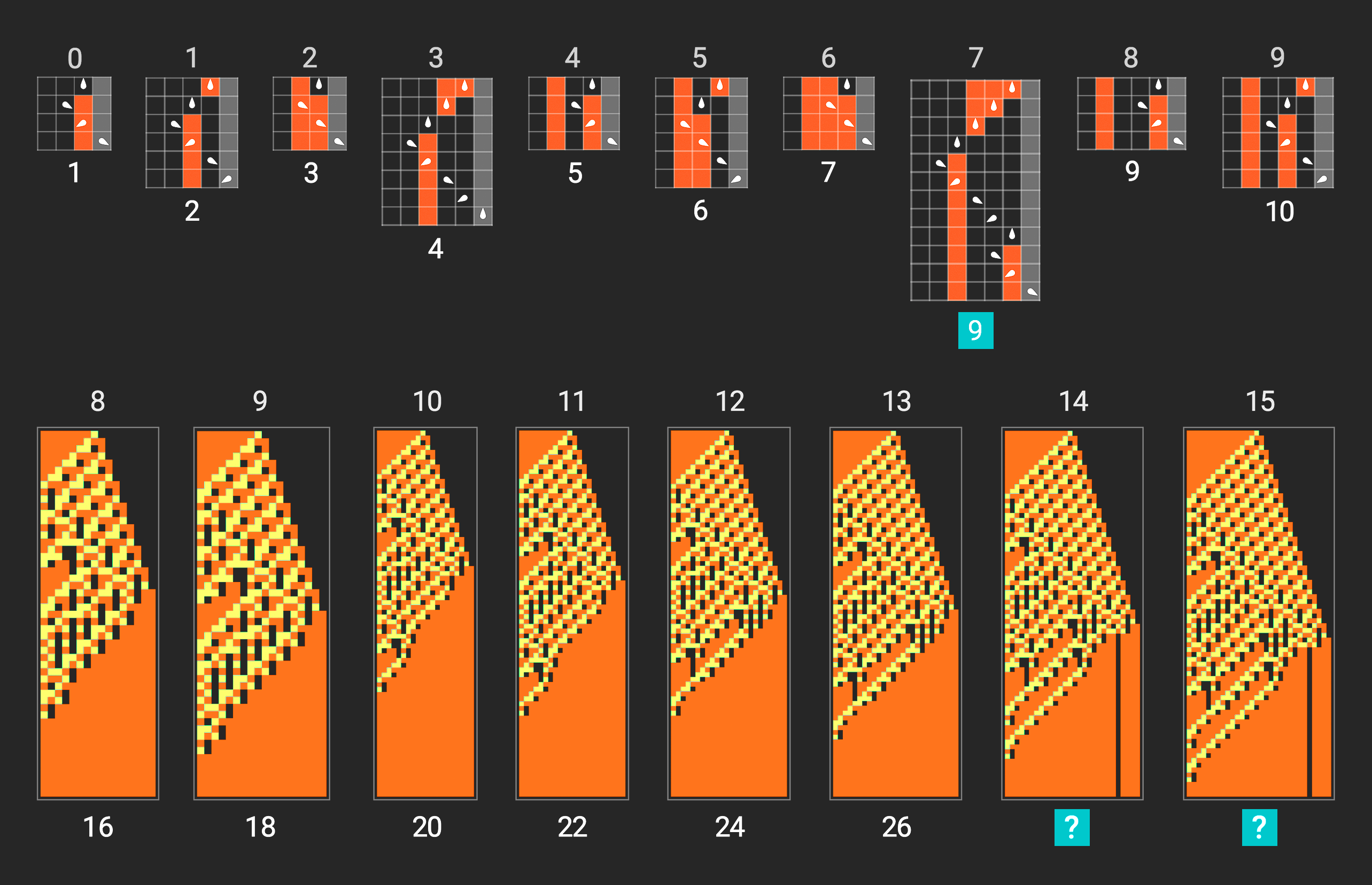
Here, before he starts, how do we know that the bugs in the Turing machine implementation of f(n)=n+1 are in any way representative of bugs in a normal computation? He seems to be generating random state machines and then evaluating them and picking ones which are nearly but not quite correct implementations of f(n)=n+1. Is that like a normal “honest” software bug? Is it like a deliberate software sabotage like you might look for when evaluating a software supply chain risk? Is it like the sort of vulnerability you might see when fuzzing? As far as I can see, there’s no reason to think it’s like any of these.
More broadly, since the “Principle of Computational Equivalence” and “computational irreducibility” are referred to as touchstones but are never actually defined or properly established how are we supposed to treat them? Interesting conjectures? Actual axioms? Something in between?
One thing I find tragic about Wolfram is that he found his holy grail, Rule 30, at the very beginning of his project and ever since he's found that every family of rules that he's look at that is sufficiently powerful has something like Rule 30 -- but always a bit more complex, complicated and not quite so beautiful, in fact often outright ugly...
... so he jumps into this sort of thing and samples of some of a ruliad, finds the usual things he finds in every ruliad, gets excited about it and thinks he has a "theory" and then moves on to something else and most of us are scratching our heads.
Whereas in stating the Principle of Computational Equivalence Wolfram says things like "... the evolution of weather systems can, in principle, compute the same things as a computer."[1]
Well, ... wtf? What does it mean to say the evolution of a weather system can compute something? Where do we even start on understanding this? I pick up a calculator and compute the volume of a cone. It's a sunny day outside. How do I "in principle" use that to check my calculation? It literally makes no sense whatsoever on its face as a claim but it is so slippery because of that "in principle" that it doesn't give me anything to hold onto that I could even test.
And that's before I even get started on the "underpants gnome" logical justification behind the claim, which seems to be:
1. Computers are complex
2. Weather is complex
3. Therefore they are "in some sense" equivalent
4. <don't worry about step 4>
5. Thus weather can "in principle" compute the same things as a computer.
I'm really not trying to misrepresent him, I'm just baffled.
[1] https://mathworld.wolfram.com/PrincipleofComputationalEquiva...
https://youtu.be/B_7RpP90rUk (at 3:00)
Especially with the more recent relative of the Halting Problem combined with the Church-Turing Theorem that found mathematical proof of a "0-day" sandbox escape in the Universal Turing Machine itself.
We have always lived in a house of glass. LLM agents automating trebuchets for rock throwing certainly seems like a bad idea to me and "let's simply eliminate all software vulnerabilities" an interesting bit of ostrich work (stick your head in the sand and hope it all gets better).
No, the real issue is that for the most we don’t want to put the necessary effort into proving the relevant properties, because it’s costly and time-consuming, and we think we can live with the risk. The issue is not some theoretical inability to do so.
Potentially Infinite Loops are a great power. We've learned in most programming languages the "Uncle Ben lesson" that with such great power, comes great responsibility. In most programming languages we don't want to remove the ability to infinitely loop, because we might need that power, we work on ways to limit that responsibility (loop guards and timeouts and cancellations and teardowns). But it will likely always be possible to see some code spin in a loop we can't tell is accidentally infinite or just a loop with a lot more work than we expected. The infinite spin wait will always be a risk in our code.
I think it has a lot to do with the Halting Problem.
It may be the only way to keep us all employed.
For me the ultimate proof that AI will have become super-intelligent is not that it will prove results that mathematicians can already deal with, it's that it will be able to look at a Turing machine and tell you "Yep, that's how it behaves, it follows these rules, and will never halt because this and that". I realize this is impossible in general, but if it's possible to some extent, where it is way better than the people over at busy beaver challenge, personally my mind will be blown.
So... he has this "strange" idea of what makes a program useful... I wonder what does he think about a program that displays system time? Totally predictable! So, should it be just replaced by the output?
On a more serious note, at least from a perspective of a system programmer, vast majority of programs don't do (intentionally) this kind of nodeterministic stuff. They are more of a complex way of displaying information obtained by the sensors, or a way to cause the physical parts of the system to change their configuration. They are totally predictable, yet they still are absolutely necessary for the computer system to function.
It's part of his GUT. You will likely become committed to the well when you encounter ruliad: https://writings.stephenwolfram.com/2021/11/the-concept-of-t...
While the article is focused on “low level” bugs, the key insight is that human understanding has limits, and bugs show up when the human is overconfident in their understanding, and unwilling to verify the code by running it on a sample of test cases. This does seem to help explain why “high level” bugs occur, where the reality somehow doesn’t match the assumption. Maybe a dependency is on the wrong version, a global variable isn’t initialized in certain cases, etc.
In a world of LLMs producing code that isn’t always understandable to humans, it does raise the question of how to enforce that AI code is bug free, and maybe forcing coding agents to stick to human abstractions is the missing piece.