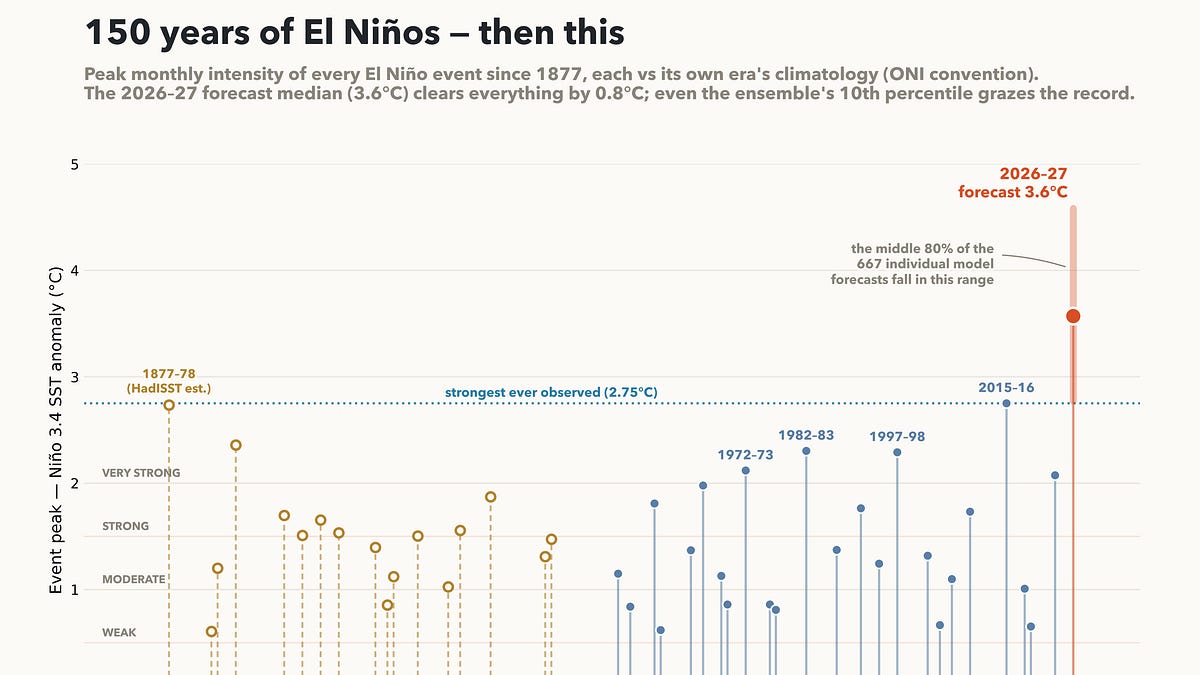
The Strongest El Niño Ever
With all the July runs in, dynamical models give a ~90% chance of a record-setting event
theclimatebrink.com
291 points · by ndsipa_pomu · 4mo ago · 347 comments
What does all this mean for global temperatures? Because global temperature lags ENSO by around three to five months, most of this event’s warming will land in 2027, which is now shaping up to be a genuinely alarming year and the warmest on record by a sizable margin
I’m certainly no climate scientist, but if I lived in Europe, I would absolutely be looking into how to get a solar energy system set up and at least one window air-conditioning unit if not a heat pump before next summer
No general A/C might be the case in regions that never needed it before (mild summers, cold winters), but their presence is increasing.
It can also be read as health-sensible reminder given the climate warnings. AC units demand is already up 26% year over year in my country (according to our biggest online retailer, a month ago). Will be a highly profitable year for manufacturers.
* Not aimed at all the wonderful, sane and reasonable people of the USA.
we (the EU, not Europe) are indeed phasing out coal (most countries are already done) and EVs are at 24% of the market (June 26) which is about 4x the US EV marketshare and rising fast.
> Europe mostly shifted their dirty work to Asia and North America
There is a carbon tariff (CBAM) for some imports, will be gradually expanded in the next few years.
That' not marginally better, that's way way better.
While US, China and rest of the world did nothing similar, just stood and let shit hit the fan hard. Gotta milk those petrodollars till the last cent because thats all that counts, fuck our children right. Yeah we are not going to burn ourselves further to the cinder to prove some anonymous yostrovs something he anyway refuses to see.
Sounds like a ‘mixed-meme’. I appreciate your concern, but confused thinking bringing heightened emotions is counterproductive.
https://dictionary.cambridge.org/us/dictionary/english/mixed...
"is it warm due to climate change? just install airco"
Seems pretty short-sighted to me.
Also, it overheated instantly.
But since modern buildings usually have huge windows, we're letting in about 1kw of heat from sunlight per square meter of window. That's 6kw for a 3x2m bay window, or about the equivalent of 6 electric heaters at full power.
Block that heat ouside of your house with all kind of shade you can get: trees, blinds, adjustable shades, rolling shutters...
Also, close every openings during the day, vent at night.
Also tangentially many Europeans seem to be confusing insulation with inertia, saying their house is correctly insulated against the heat when in fact it’s just a stone building that is taking more time to heat up. At the extreme you have European churches buildings that are very badly insulated but stay cold most of summer because of all the stone mass.
One thing Europeans have yet to realize is that good insulation only works when the nights are cold enough to evacuate the heat before it reaches the inside, and that during a strong heatwave there is no adaptation possible, AC is needed.
Edit: We cannot blame people for buildings things that worked when we had a stable climate but are no long suitable for all these extremes. We needed to fix the emissions issue 30-50 year ago to avoid this. We knew it and we collectively ignored it. I get your point, we could've "planned ahead" but if you build something that wasn't suitable / cost effective for the time it was built, you'd be out of business.
50 years ago no one was going to pay extra for a building that might be important in 100 years because we didn't stop burning fossil fuels in time.
Correct. And we'd be "out of business" too as a country if we decided alone to fix emissions. Other economies would have passed ours because burning oil is so damn useful.
Thing is, I don't feel we are changing much in this respect. Now the best idea we come up with is burning more fuel for aircon...
>Seems pretty short-sighted to me.
The same industries that got rich over those 50yr selling BS we didn't need because the government mandated it are gonna get rich over the next 50 installing smart ventilation and heat pump A/Cs and whatnot when the next pile of mandates to undo the ills of the prior ones gets written into the building code.
Seems pretty long sighted to me.
Wall-to-wall windows are great.
Floor-to-ceiling windows are stunning when you walk into an empty place that you're thinking about buying or renting, but when you're actually living there, windows that go down to the floor create a few feet of dead space. You can't really put any furniture there without feeling guilty about blocking the view you're paying for, and it's uncomfortable to walk up to the edge and look down - it makes you feel uneasy like you're standing on a cliff with your toes at the edge. It's much better for the window to end around waist high.
They're psychologically fine if both the floor and the ceiling extend beyond the window (e.g. it's on the ground floor, and the roof overhangs), but when they're used on every floor in a high rise apartment building, killing limited square footage and driving up energy bills, it's absolute madness.
If there had been screened windows that opened wide and faced in different directions, it would have been very comfortable by just leaving some windows open for cross-ventilation. Instead it had unscreened high-end “European” windows that could either crack open a bit at the top or could open wide, swinging inward and banging into obstacles (like the bed or anyone’s head who was trying to sleep!). And bugs would come in while the windows were open.
I found this to be rather disappointing.
Before you do that, do the cost effective thing: shadow and wind. Then you can add an aircon iff thats not enough.
For shadow, reftrofitting adjustable sunshade is pretty effective. Sunlight brings about 1kw per square meter of window. That like having your heater at full power when its already hot.
For wind: fans, preferably ceiling fans. Lowers perceived temperature by about 3.5 °C.
That is not correct. Heat, wind and humidity all contribute.
In a dry air with no wind, your body creates a "hot and humid" bubble around it if you are not moving. A fan helps.
Humid but neither cold nor hot air may not feel great, but not that bad.
Hot and humid air with no wind, now that's bad.
Edit: I know because I added shades and fans.
That's the neat part, you don't.
Europe has saved on CO2 emissions by moving production to China, and more recently to India and Southern Asia, moving energy generation for factories onto coal power, significantly INCREASING the rate at which climate change occurs.
China and India have made it very clear that, first, they will continue to do this. Also adding solar power, but not lowering coal power. They added that it is "inappropriate" to even ask them to do so (that was China).
Oh and thanks to reliance on Russian gas, and the Ukraine war, the EU is forced to move to coal and LNG supplies, which are even worse than coal. Plus, of course, that means that it's not just coal plants getting worse for climate change but almost all power plants in Europe.
To do something about it, due to Jevon's paradox the only countries that can lower CO2 emissions are the ones digging up fossil fuels. Saudi Arabia, Russia, Venezuela, US, Norway, the Netherlands, Britain. You have zero chance to convince any of them to stop doing it, burning and selling oil, not even Norway is doing that. And any oil or gas dug up and sold will be burned.
There never was any serious intent, not even on the part of the greens (at least not in Germany, I mean, they even published an article on the subject: eliminating nuclear power was more important than climate change in 2003). And if even they weren't willing to make it a priority, who exactly are you supposing will do it?
Even in 2026, even Germany, increased it's reliance on coal (they're keeping 10GW of additional coal power at the ready, on top of the 20% of Germany's power that's constantly using coal), similar measures have been taken in Japan, Italy, and India has even delayed maintenance on existing coal power plants to increase electricity production from them.
And of course, there's the basic physics part. Aside from a small rounding error climate change is cumulative. Which means once fossil fuels are burned the temperature will rise accordingly. Even if we stopped burning it won't get better.
To merely stop climate change from getting worse, just that, nothing more, we have to cut CO2 emissions worldwide by 99.7 (and some models say 99.97%, there's a surprising range there). That will just stop it from getting worse. It won't make it better. Anything less is not "a good effort" it simply makes things worse.
All policies taken so far to stop climate change have not just made things worse, but increased the rate at which it's getting worse. Doing nothing at all would have been a lot better (because it would have kept factories in the EU going, on much cleaner power).
Oh, and by the way, this was all perfectly clear and known 10 years ago, and nobody changed course. So ...
There is no remotely realistic solution in the current policy directions.
And geoengineering ... is not really allowed to be discussed. Or this argument is being put forward at the UN. Any (successful) geoengineering will have dramatic negative consequences for some states and people. And since that is considered unacceptable, because large portions of the human race are currently dependent on global warming continuing. We won't do that either. People's lives, jobs, work and so on depend on things continuing and we cannot demand they change.
So yeah, I'd get some solar panels and an air conditioner.
The cost estimates for eliminating Co2 emissions are also not very high. In the range of 1-2x total GDP. Would be doable if 3-5% of GDP is spent over the next 20-30 years.
I agree that all oil will be dug up and sold but there is a caveat: not at any price. If solar and wind continue their trajectory their dominance is inevitable.
Most heat pump installations in Europe are air-to-water systems fitted to use the existing piping in old homes and is used only for heating. Such installations can, in theory, be used for cooling, but very inefficiently.
I'm not sure thats true.
Most aircon in "warm" europe is standard split aircon
The "heatpump" shit that the UK is sorta looking at is as you describe. However its half the price to install "aircon" over heatpumps (because grants, amongst other things)
Like most recently refurbished offices will use normal aircon (certainly all the one I have worked in)
I've been doing some research into this, because I would ideally like to get this system so I can make use of the existing radiators in my old house, but I do also want to have the option of cooling my home. It does seem like Fan Coil Units (FCUs) are an option for this. Anyone have experience with these? Are they really inefficient compared to standard air-to-air units?
The possible real fixes are either to section off your water circuits in summer, and only run the properly cold water through FCUs, wall or ceiling loops.
Or to get a multisplit heat pump, use a normal refrigerant-air indoor unit to cool and a refrigerant-water indoor unit to heat the water loops.
You just have the added equipment and maintenance for the water/glycol loop vs an air to air system that only pipes refrigerant around. Fan coil units or VAV boxes are the usual terminal units for commercial HVAC systems that have a chilled and hot water loop, VAVs are used in a system with ducted AHUs and FCUs are used for apartments (stacked FCUs with vertical supply/return risers) or spaces not served by ducted air handlers for whatever reason.
Remember that 1.5 degrees Celsius is a nearly end-of-the-world scenario and we're currently about 1.1 degrees.
All that warming that we caused but didn't actually happen? Turns out the ocean saves it up.
No, it's not end of the world. 3C is where things start getting bad. 1.5C is the target for the 2015 Paris climate agreement to try and avoid hitting 2C.
We are looking at more severe droughts, flash floods, and rising oceans where we are at, but not the worst of it like mass 40C wet bulb heat domes which wipe out all life underneath them.
Average temperature moves in cycles. By confusing single-year temperatures with the 1.5C target, you're just going to make people think "crisis averted" once 2028 turns out to be cold.
Oh and it effectively doesn't matter: to merely stop global warming we need 99.7% less fossil fuel production (and that needs to include everything from Saudi oil to Japanese coal)
So why would it matter? Because we feel it? We are not willing to implement real policy when we feel it. We are not willing to implement real policy when we don't feel it.
And geoengineering ... while it at least has the possibility for someone to just do that without the agreement of everyone ... so at least there's the realistic option to do something, so many nations, so many people, have their lives utterly dependent on climate change continuing. So nobody's making serious plans for that either (because, realistically, it'll mean war if something like that is implemented. Which is still better than doing nothing imho)
Metaphorically relevant: https://en.wikipedia.org/wiki/Limnic_eruption
We are entering uncharted waters and I fear that at some point we will get an extreme extreme weather event and the worse thing is that we won't see it coming.
That core problem won't end this year or the next one, and it will keep disrupting global climate. And with it, agriculture, settlements, economy and civilization as we know it.
And the scariest part is what we do about it. Keep doing activities that rise global temperature and power up positive feedback loops, weakening or abolishing climate policies, and when things start to feel urgent will try things by the fast way with unclear outcomes.
- There is a global scale issue, but no consensus on this being a problem. Not at the global, continental, local or individual level. FFS, there are idiots proudly rolling coal.
- Leadership - in the rare places on earth where it is somewhat accountable - reflects this lack of consensus.
- Acknowledging the problem does not equal acting even on an individual level.
- There's lots of cognitive dissonance. Why am I even flying to the other side of the world next week?
We are cooked. Not so much us old farts, but the children.
I dont get this. I would regret having a kid maybe if he turns out to not be resilient and up to the challenges posed by the changing climate and the shitty political situation. But those are things I can work with him on. Opsec can be taught. Political dissent can be taught. This thing can be turned around when the political class has been disposed of.
I mean, predicting the climate must be one of the hardest numerical simulations you can run. Climate models are famously incomplete. But the results turned out to be way more accurate than I would have thought. That's some impressive modeling, and I would assume that models have only improved since then.
The most chilling thing (and not in a good way) about it is that popular science type repotrs for the general public usually indicate an interval between a good case and a bad case, with a nice line in between. In retrospect we have been pretty much perfectly tracking the bad case line ever since.
N=1 Mind, but I remember reading a spread in Australian Scientist that predicted Australia would become something of a rainless desert, storms bringing only lightning, by 2020 or so. Leaving only Melbourne, Adelaide and Tasmania somewhat habitable. Article went on to discuss how to calmly migrate the population south over the 13 or so years remaining, and what the government might do to dissuade climate refugees from pacific islands.
Since then I have a read a lot of people walking back the absolute death and destruction stuff, but "Extremier Extremes" seems to be the closest to a consensus position, one that the strongest El Nino ever supports completely.
What do you mean we are doing very little?
New capacity being electric is fine but we need to be actively removing fossil fuels from existing capacity, which isn't actually happening. We're just building new capacity on top of old existing fossil fuels. So sure, it's nice that a majority of new capacity is green, but we're still burning more fossil fuels year over year
They don’t really understand it in a factual, measurable way, but just are interesting in what the overall story is, and what it says about humanity failing.
Except those guys throwing soup at the fossil fuel HQs. They did a little.
So we're doing something, but those things are counterproductive to our planet's general well being. Apparently billionaires don't need an inhabitable Earth to live on.
AI data centers are what, half a percent of the world electricity consumption, if that, and an even smaller fraction of the total energy?
We're pushing ourselves into absolutely untold suffering the longer do nothing. I truly fear a famine like that and the more we go down this road, the closer we're getting.
Obviously its too late to avoid the worst, the only hope we have is to collectively cooperate to help each other get through it. Not sure that will happen but I believe that's the only way through.
A little known fact about Alan Kay is 17 years ago he was part of a group of "systems people" who published for the NFS about various systems including the climate. He helped write "Transitions and Tipping Points in Complex Environmental Systems" (https://nsf-gov-resources.nsf.gov/2022-12/Transitions-and-ti...). He wrote to me that "This, along with many other warnings from many other sources over many years, fell on deaf or disbelieving ears."
He agreed with my concern saying "And, yes, you are right that things will likely be really bad if the climate is allowed to crash past the tipping point."
But what he said following that shook me to my core. Kay said "If you think of a system as an upside-down coca cola bottle, it is easy to see that a little nudge can topple it, whereas considerably more energy is then required to put it back.".
What this means is to get CO2 back down to 350 ppm (we are at 428 ppm), we would need to expend more energy than we did getting it to 450 ppm. That means, we would have to expend more energy than humans have produced IN ALL OF HUMAN HISTORY in the next 10-20 years (30,000-45,000 EJ range) just to put the system back to where it's safe.
Ask yourself, where are we spending our energy right now as a species? On putting the system to a safe level or something else?
Do we even have the capability to do it? As we continue to expand our industrial capacity, we also use non-renewable resources like oil and metals we can't recycle. As we exploit them, we degrade our industrial capacity for the future. For a deeper analysis read Limits to Growth and work related to it.
Hey Claude, enter plan mode
So the answer to your question is it could be either or both or neither. Whatever happens is going to be on average more extreme than what you're used to.
So get some sturdy shade structure and an heat pump.
In the medium term, summers in Paris WILL be worse than this year
It will come a day that good years are the ones that are as mild as 2026
No need to fix the root cause, I’ll just fly somewhere cold during the summer /s
If it's useful to the conversation (and objective + with sources) post the key findings - IMO I think it's AI generated prose / subjective posts that will get blasted.
Considering the situation going into the 2015-2016 El Nino we were also in a multiyear drought with a rainfall deficit accumulated from 2010-2014 of over 31" (787 mm). That is just under the 20 year average annual precipitation total for my place - 36.3" (922 mm). We were missing almost a full year's rainfall over that 5 year period. I use a NOAA manual rain gauge of the type that can handle up to 11" (279.4mm) of rain before needing to be dumped. I have recently added a digital tipping gauge unit beside the manual gauge so I can have a clear comparison and track rain rates.
Anyway, if it works out like 2015 did then we went into the year with a deficit but it quickly began raining well above normal so that by mid-June we were already above the normal 20-year average rainfall total. Then it dried up with below normal rainfall from mid-June to late October. There was no rain at all between the first week of September and the last week of October. For the year though we were still 3" (76.2 mm) above the 20 year normal annual total when it started raining again.
Between the last week of October and the end of the year it rained an additional 28" (711 mm) and then it stopped and we fell behind again until finally catching up to normal accumulation in the second week of March 2016.
Currently our accumulation to date is almost 1" (25.4 mm) above the 20 year average annual total for this date. So, just as in 2015 we are a little above normal during summer. I expect that if it works out like 2015 then we can expect a lot more rain beginning in the fall, probably by October.
If I look back over the previous 5 years from 2021-2015, we are again running a rainfall deficit of 26.2" (665.5 mm). That is about 72% of rainfall expected in a normal year using my 20 year average accumulation. Nearly 3/4 of a year's rainfall behind at this point over a 5 year period. Interesting.
I suspect I will need to have some more rock hauled in to repair the driveway by the end of the year since it will all wash down the hill again.
<https://www.pmel.noaa.gov/elnino/impacts-of-el-nino>
Those include: hydrology (floods, drought), sea-surface temperatures (hotter or cooler, both of which impact local ecologies and fisheries), storms (weaker hurricane season in the Atlantic, due to high-altitude wind shear, stronger in other areas), and others: economic, fisheries, military, human health, marine life, and specific regional impacts.
Carbon capture technology would have to artificially replicate these millions-of-years-long processes, and do it on a scale of years to decades. The scale of carbon capture we need is entirely unfathomable, requiring processes that don't exist, because they have to work against entropy itself.
Carbon capture at the point of burning fossil fuels to abate further emissions might be economical. Capturing already released carbon dioxide from the atmosphere (concentration of ~0.04%) is a fiction pushed by fossil fuel companies to muddy the debate and distract from the urgency of immediately stopping the burning of fossil fuels.
That's why.
Edit: Also, as some other comment said, thermodynamics tell us that it would take an inordinate amount of energy to bring carbon back to safe levels. More than what we get from burning oil. It's about entropy and all that. So there's that.
We needed to reach zero emissions 20 years ago and today we should have strong negative emissions.
At this rate I don't think humanity will reach zero emissions before 2050. It's going to take a couple of very bad years for humanity to take this seriously.
I've lived in a hot subtropical climate most of my life. The best modes of cooling are, in order of comfort: shade, clothing, breeze, fans, A/C.
Our rather large home didn't have A/C when we bought it. But it did have a huge attic fan that kept the air moving throughout the entire house on hot days. That worked fine from the time the house was built in about 1930 to present (yes, it's still there). At one point we installed a few window units in designated rooms but they were never necessary.
shade - Even on a hot day it's very comfortable in tree-shaded areas. The trees cool the air.
clothes - wear light-colored clothes with fabrics that wick perspiration.
breeze - if you live in an area with a constant breeze, you'll be more comfortable. Sometimes that comes with a caveat: watch out for storms associated with coastal breezes (such as hurricanes).
fans - sometimes a small room fan is just right. Or if you live someplace where you can pay someone to wave a palm frond around you all day, so much the better.
A/C may seem to be the best but imo it isn't b/c it is not transparent: other people are always messing with the controls, there are insufficent/incorrectly-demarcated "zones" in a building, the humidity varies unsuitably, condensation forms in unexpected areas (even inside walls and under floors) and you don't find out for 12 years, etc.
Back in the 2000's, it was fine - maybe a few hot days in the summer, but bearable with shade, fans, proper clothing like you said.
But the last ten years or so, the summer has gotten to be more and more brutal. Heatwaves where it's 70-80% humidity and 100+F outside for more than a few days in a row. We have a portable A/C and find ourselves hooking it up more and more often.
You’re also losing a lot of water to evaporation from sweating if it is doing anything at all.
There is a reason why Singapore switched to AC pretty much everywhere except old hawker centers, and why it’s not alone.
That would be related to the wet-bulb temperature. If the wet-bulb temperature is more than about 30°C, then I'd consider the area to be uninhabitable. (A wet bulb temperature of 35°C is considered lethal).
Fans are surprisingly effective as most people are stationary and thus produce almost a bubble of high humidity around themselves. Fans disperse that localised high humidity and allow people to effectively reduce their temperature through sweating/evaporation.
And getting worse.
Personally, I much prefer this solution than ACs, because ACs sometimes affect my throat and make me feel tired.
1) return to preindustrial level of pollution, possibility less than 1/10000
2) make radical changes suggested by scientists, less than 1/100
3) continue with the current pace
The pyramid of pollution, which is directly proportional to the pyramid of wealth, is almost impossible to shrink as the latter is also inevitable.
Just brace for impact.
Other states seem a lot worse off. Water table is closer to where people live, there's a lack of topology to actually run water out in a lot of cases, there's been little investment in managing water for stormwater for property damage abatement or power or irrigation like in CA where the topology really incentivized massive investment in all of that over the last century.
Next year a super bloom then the following year massive wild fires.
rain -> fuel -> fire
The steering of the jet stream seems to have some qualitative changes in these conditions but also more chaos. It could steer storms anywhere along the coast, so different parts of CA, OR, and WA get different impact. Just in my lifetime in CA, I've witnessed some very wet El Niño winters but also some drier than average.
The biggest precipitation threat on the west coast seems to be a repeat of some of the biggest flooding events known historically or geologically. But, these are relatively infrequent and most of the record predates any understanding or tracking of the El Niño oscillation. So the correlation cannot be stated so clearly. These are atmospheric river events which seem to stall, producing heavy rains over the same area for a much longer period.
Just in the recent centuries of CA history, there have been massive floods in northern and southern regions in different month-long rain events. There have been improvements to flood control infrastructure since then. But, the only reason those events aren't known as the most costly is because there wasn't as much economic development here back when the floods happened.
Our usual storms sweep through an area the heaviest rains over just part of a day. Our varied terrain means that each individual storm also has very uneven rainfall amounts due to orographic intensification. Prominences with the right aspect towards the wind will get far more accumulation. Our watersheds can absorb quite a bit of this, but even those brief rains can cause localized flooding.
If the rain continues for many days in a row, we will see widespread mudslides and flooding of larger rivers, basins, etc. Some of the historically extreme events had rain persisting for over a month!
Edit: along with these "mega storm" scenarios, we also have evidence of "mega droughts". It's worrisome to imagine what challenges may come from a more energetic and chaotic climate.
El Niño is the “warm phase” of the El Niño-Southern Oscillation and features warmer than average ocean surface temperatures off the coast of Ecuador and Peru in the equatorial eastern Pacific Ocean.... Historically, the presence of El Niño conditions tilts the odds in favor of wetter than normal precipitation across the southern third of the state. The relationship between El Niño and cool season precipitation is weaker in the central and northern parts of the state.
Flooding is possible, particularly if dams exceed capacity, perhaps exacerbated by earlier snowmelt and peak runoff. Landslides are a more widespread, and less manageable problem, particularly as loose-material slopes are waterlogged. The deluge -> high growth -> heavy fuel load -> large wildfire -> landslide cycle is one that's become fairly well-known in California.
Levee failures within the Sacramento Delta or Central Valley could result in very large-scale flooding, affecting agriculture or communities.
The San Francisco Bay Area may see "king tides" and general flooding throughout the bay and delta region, particularly during December and January, and all the more so if high tides coincide with heavy river run-off. Remember that the entire Central Valley of California, nearly 500 miles long north-to-south, drains out through the Bay. Prevailing winds may create a wind setup or seiche which can result in flooding along a some but not all shorelines, or alternating across a body of water.
Aquifer fill rates are slow, and are generally predicated on large-scale flooding. Prior to modern flood control (dams, river channelisation, levee construction), in which much, and occasionally effectively all of California's Central Valley (as well as large riparian valley systems in Oregon and Washington) would flood.
See the Great Flood of 1862: <https://en.wikipedia.org/wiki/Great_Flood_of_1862>.
Reservoirs provide parlous slim protection against landslides of elevated slopes. Those are affected by upslope water saturation (the stuff that's on its way to fill your aquifers in coming months or years), not floodplain innundation. It's exacerbated by fire-cleared hillsides, particularly those which burn ferociously hot, killing plant roots and baking soil. Those fires are not historically typical, but have been the conditions experienced with greatly increased frequency since the 1990s.
Cattle don't graze chaparral, oak woodlands, or ponderosa or Douglas fir forests. Those have been what's been burning.
Your suggestions / assessments are at a far remove from reality.
We also have one of the more advanced waterwork system in the US to support Central Valley agriculture, so a lot of the worst aspects can be somewhat managed.
It's bad that such dramatic climate change is happening, but we're definetly lucky to live in the West Coast because we won't face the brunt of some of the worst aspects of the El Niño comparatively and have the infrastructure to deal with it.
Sadly, the brunt of climate change will be felt by the poorer half of the world.
The Lima Prieta Quake and the 1990s floods led to a lot of future proofing in Californian infra. The last major thing left is transmission weathering, which PGE and Sac are fighting over.
Also, most of our infra is state funded which gives us a lot of leeway.
Like I said before, it's bad that we're in this position and it's only going to get worse, but we're in one of the better places that can survive these kinds of shifts.
I hope we have something more to show than dozens of to-do apps when our children and grandchildren ask which important things made the massive use of AI necessary.
You don't.
https://www.ipcc.ch/report/ar6/syr/downloads/report/IPCC_AR6...
For example some scientists suggested installing sunshades but... Literally a sunshade: deploying an umbrella of sort, in space, so that less heat reaches the heart.
Now of course as we've been ruled by luminaries since decades, bringing us to the situation we're in now, I wouldn't be surprised if they managed to fuck up that too: for example by fuxxoring the sunshade and killing another sizeable percentage of the population by creating a new ice age.
But really I wonder: at what tipping point shall desperate measures be taken to try to fix things and what could those be? That sunshade doesn't seem that crazy or is it?
Due to the chaotic nature of these systems we are incapable of predicting the effect of our actions.
It could very well be that by artificially increasing cloud cover we cross a different tipping point with grave consequences (e.g. flooding, ecosystem collapse from lack of sunlight, or who knows what)
At that point, won't it be too late?
https://www.politico.com/news/2023/07/01/white-house-cautiou...
The fact that you see record breaking more often than log of time implies a drift in one direction.