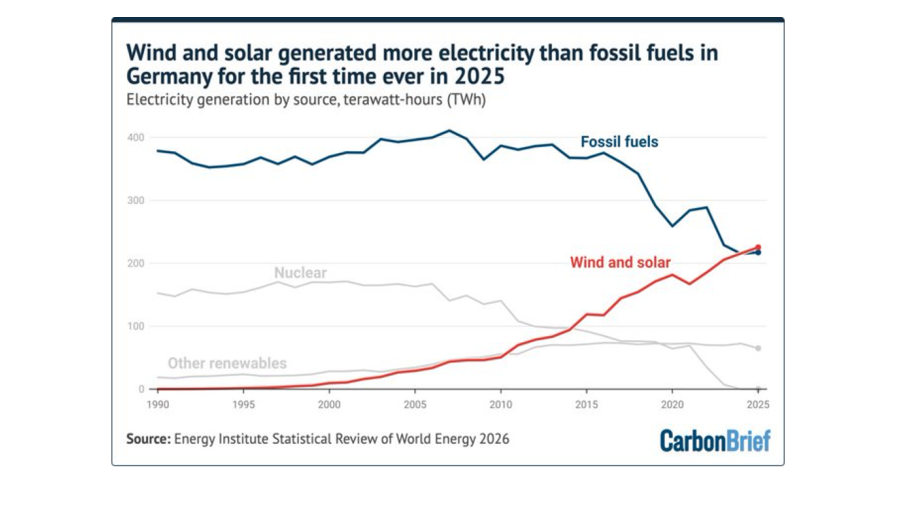
Wind and solar overtake fossil fuels in Germany for the first time ever
More of Germany
intellinews.com
380 points · by just_some_user · 3mo ago · 333 comments
It reminds me of the Voyager probes that left the solar system half a dozen times, each time taking a different definition of what marks the edge of the solar system.
Anyways, we are now getting to sensible metrics, which is good.
Moving away from fossil fuels is a big task, these are the first signs that things are happening.
And it is not just because of the negativity bias. Things that work as they should don't make the news. I mean, take Ukraine and Poland, both European countries of a similar scale, one is at war, the other is doing well, guess the one that makes the news.
I'd say the only consistent supplier of good news is science and technology (with maybe a 50/50 ratio of good to bad), and sports (for the winning team). Geopolitics is almost exclusively bad news, economics is mostly bad, the good news are often agreements that conclude a stream of bad news, such as wars and economic crisis, and then we stop talking about the thing, because it now works as it should. And then, there are crimes and disasters, which are obviously bad.
For an entire year, that year being 2025.
Also, yes, absolute generation from fossil fuels is declining quickly. The total generation is changing way more slowly than that share.
The discussion about fossil fuels vs renewables is a bit different within countries which produce fossil fuels than within those that don't.
Why aside? Germany had to burn gas and coal to compensate for the nuclear reactors they shut down, (and to import electricity from France which didn't shut down the reactors). Germany could've weathered the transition much better, and suffered without Russian gas much less had they not shut down their reactors.
Something is wrong with Germany. Go to Our World InData's Electricity Production per Capita page and have a look at Germany, Vietnam, and say Israel.
https://ourworldindata.org/grapher/per-capita-electricity-ge...
We have right to roam in nature here, which is quite rare across the world (and even compared to the few other countries that have something similar, the Swedish variant is stronger). I wouldn't trade that for anything.
Ummm
https://en.wikipedia.org/wiki/List_of_countries_by_average_a...
At least according to the list, Americans work ten weeks more a year than their German counterpart.
I would bet everything that life, at least right now, is comfy. But I don't see it as remotely sustainable.
https://tradingeconomics.com/germany/industrial-production-m...
Of course, stable is probably bad here. But it's not declining.
Maybe Porsche can survive by going independent, downsizing drastically, and selling 911's to the nostalgic faithful.
The main reason Germany was so hooked on gas wasn't because Hans Müller needed to run his Bosch washer-dryer and heat his home to a comfortable 24°C.
It was because natural gas is an great source of hydrogen, which in turn serves as feedstock for the production of all kinds of chemicals used in industry.
That was the engine of Germany's industry, not just energy. Energy has a whole spectrum of solutions - not the case with hydrogen.
Oh my, where ever else will we be able to find hydrogen, the (checks notes) tenth most common element on our planet ?
No, there's actually plenty of hydrogen, what people who say they "need" methane to make hydrogen actually mean is that they don't want to pay what this really costs.
Every First World country seems to be following the path from industrialisation, through deindustrialisation (which, when I was at school, was still called ‘structural change’), to a service-based society. It seems to be the price we pay for economic prosperity and cheap goods - and it is not the first time in Germany this happens.
Robots are the answer to reindustrialize the developed world, but that necessarily keeps industry smaller than services.
It's a political choice by our own politicians.
Are you sure? Jobs are no longer in industrial companies, and that isn't where the growth is. However when I look at the numbers I see heavy industry output is still growing.
Onshore wind and solar is about £40-50
Offshore wind about £60
Gas about £120
That’s generation cost, before subsidies and levees
But we still haven’t put in an emergency legislation to make it easier to build cheaper energy.
But those headlines are about the step where you find out who won these auctions because that's when that magic price number is known, wind power for £68.35 per MWh or whatever.
Going from the fun headline to actual contract signing in which there's a legal promise to actually try to make electricity and get paid, takes several months. After they've signed they begin the actual work, which still includes planning not just the mechanical aspects.
Just building a solar farm might take 12 months, and wind farms are often slower.
AR6 took place in 2024, you'd have read headlines back then about some excellent solar farms, getting paid about £50 per MWh. First, those are 2012 prices, for comparison reasons they choose a base year and then calculate inflation adjusted pricing in reality but I bet that £50 figure was what you saw in a headline, of course the solar farm didn't exist in 2012, so £50 per MWh was never the real price.
More importantly though, those solar farms weren't built in 2024. The plan when the bids went in, said 2026/27 for some and 2027/28 for the majority. A few of those AR6 solar farms (by no means the majority) were live in time for the July sunshine, in 2026. But you've already read headlines about AR7, and like I said maybe even AR8.
A big boost in practice is home install. A big business can take six years to do contract paperwork, get something signed off, build it and then commission it. A home owner is angry after six weeks without work done. Where are my fucking panels? You were going to install solar panels, make it happen! So lots of individuals and small businesses which own a building with a roof installed a few panels, they might add up to only 5kW each but if a million people do that it's 5GW of nameplate electricity generation, a sizeable fraction of UK usage for several hours per day.
For the remainder, the wage costs - more specifically - the overhead costs are the true killer. If you want to pay someone 80k a year in Germany, the actual costs are closer to 100k a year in purely salary overhead costs, not to mention the other bureaucratic overhead in Germany
There are thousands of such companies in Germany, called Energy-Intensive Industries.
Think chemicals, mining, materials, paper pulp, glass, ceramics etc.
Stats available here: https://www.destatis.de/DE/Themen/Branchen-Unternehmen/Indus... (unfortunately only available in German)
The challenge is to nake renewables reliable accross several days .
This is the most expensive part for needed storage and transmission lines ....
The amount of energy needed to test things is just intuitively huge. Boiling one liter of water takes the equivalent amount of energy as lifting 34 metric tons up a meter. Or to translate it to human scale: the same as walking a vertical climb of 1000m with a weight of 34kg.
But low grade heat cannot efficiently drive a heat engine to produce other, more useful and transferable versions of energy, like electricity. For that you need "high grade" heat.
The reason is, heat engines do not operate on heat. They operate on heat flow. You must have a high temperature side and a low temperature side, and you extract energy by taking heat out of the high side and injecting it to the low side, through various processes. By thermodynamics, this process has hard efficiency limits of around 35%, with that efficiency heavily affected by the delta between the hot and cold side.
The "low" heat side is often a great source of low grade heat, for industrial or communal purposes, but cannot be used to run an efficient heat engine. It's already "used up" essentially.
The efficiency of any heat engine is bounded by the Carnot cycle. In simplified form, it depends on the temperature differential between the cold and the hot parts. So if your hot part is at 300C (572 Kelvin), and the cold part is at 30C (300 Kelvin) then the absolutely best possible efficiency is around (572-300)/572*100% = 47%.
You see that it quickly becomes inefficient as the differential goes down. E.g. if you use 90C to store the heat, then the maximum efficiency is just 17%.
So in that regard heat is very useful in producing energy. But converting directly from heat to energy? Not so much as far as I know.
A single 1/4 beef hamburger emits 7-12 kg of carbon[1]. Compared to ~1.5kg of carbon driving your car 3 miles[2].
Not telling you to go full vegetarian, but I'm personally far less interested in a beef product unless you're going to guarantee its an extremely expert prepared steak. Most beef is mediocre.
1 - https://ourworldindata.org/environmental-impacts-of-food
2 - https://www.epa.gov/greenvehicles/greenhouse-gas-emissions-t...
We have dogs and cats as pets and we eat cows and pigs (in Western countries). As if cows and pigs didn't also have personalities, memories, parental bonds, the ability to feel pain. It's a mass wilful ignorance.
What's the difference between us and animals? I would argue that it's our ability to take ethical decisions and not inflict suffering even if it goes against our base instincts.
I always find it incredible some people equating animals with people. How do you not see the difference in human range of emotions, ability to do science, technology, arts, etc. Do you perhaps live in the city and don't really have any real contact to animal?
That's not to discount human lives, we all have worth aside from our abilities to create. But I don't think there's a sensible non-arbitrary hard line you can draw to separate humans from all other animals.
Unless you decide to go on a full mineral diet.
Plants don't cry out for days when their children are taken away from them. Plants don't remember your face, come up to you and want attention. Plants don't scream when they are killed (no matter what some edgy research shows).
Or to put it more simply, would you feel bad pulling a plant out the ground? I would imagine probably not. Would you feel bad pulling the lever and watching as a pig is lowered into a gas chamber? Or while slitting a cow's throat? I would imagine probably yes (hence why slaughterhouse employees have so many mental health issues and there is such high turnover).
not accusing, but in case any commenter is going down a slippery slope: what produces the most harm? people! why dont we just kill ourselves instead of cutting out beef? vegetarian options have never been more accessible, and increasingly so
its certainly regional and cultural in the US. there are many towns and cities i visit where its quite difficult to find menu items without meat. i expect it will change over time
https://www.merkur.de/reise/reduzieren-sollte-besser-reisen-...
Subbed pork, poultry, and eggs for the most part, some fish but that's not particularly cheap either.
Beef is too expensive for many Europeans because GDP per capita/standards of living are declining in many European countries. People in East Asia, the Middle East, Oceania and South America still eat plenty of beef too.
And it seems here its about 1/4 carbon per kg of food as beef:
>IE a chicken filet is about the carbon impact of 8oz of milk.
They said cheese not milk. Note that it takes more than 1 unit of milk to produce 1 unit of cheese. From this source I found, they estimate ~10 input units of milk per output unit of cheese [1].
Assuming both of these are true, and assuming that the cheese making process produces no carbon, then a chicken filet would have the same carbon impact as .8oz of cheese or roughly a single slice of cheese.
The cheese making process does produce carbon (e.g. heating the milk) but it also produces whey as a valuable byproduct.
Ah, I see, your graph says CO2-equivalent, not CO2. It's the methane.
If we could change culture and the global diet, there are many exciting low carbon foods being promoted, especially in aquaculture. Shellfish and seaweed do not rely on artificial fertilizer, fresh water, or people burning down the rain forest.
- healthier
- tasty
- cheaper
- a small contribution to keeping the planet livable for their children
- as a sign of respect for $DEITY/the planet/...
Many people will see some sense in at least one of the above arguments at one point in life.
I would never argue for banning red meat as it will certainly backfire and end up counterproductive.
Sure, get rid of factory farms and CAFO's, but I see nothing wrong with raising animals on family farms where they eat a nutritious diet in line with what they evolved to eat.
Grass for cows, pasture and bugs for poultry, silvopasture for pigs. Anyone who wants to go vegan for ethical or environmental reasons is fine, but I hate this idea that all of us have to fall in line with your crazy ideas.
Me either. It just means beef will become about 10x more expensive in places that don't have so much grassland or pastureland. Which is almost all of the places. You cool with that?
I'm just sharing my personal choices based on what I've learned.
What could be more American than that? :)
The reality is that the only way to feed people's insatiable demand for meat is to use factory farms. You can't factory farm without causing suffering to animals, and you can't factory farm without use of antibiotics, etc.
Also you say, 'evolved to eat'. Do you think people were eating meat every day throughout human history? This started after WWII with mass agriculture and factory farming. That's why so many cultures have beans and rice as their primary dish: it's a perfectly balanced protein.
If 'evolved to eat' is your primary concern then actually you should be eating meat like once or twice a month, max. Evolution doesn't happen in less than a century.
Yes people were eating meat most of the human history, because farming was invented much much later. If you have ever been in a temperate forest which covered most of the area of current Europe, northern America and northern Asia you would notice there isn't really much to eat besides wild game.
https://www.jpl.nasa.gov/news/new-nasa-study-tallies-carbon-...
>Stoked by Canada’s warmest and driest conditions in decades, extreme forest fires in 2023 released about 640 million metric tons of carbon
Forest fires are a natural part of the life cycle of many forested regions - particularly in Canada and the Western US.
Suppressing all fires as soon as possible means that dead, dry plant matter continues to build up for decades longer than it naturally would, creating a "tinderbox" effect where eventually you have vastly more intense and destructive forest fires than would typically have occurred if you'd just left nature alone in the first place. And because these fires have so much more concentrated fuel they also burn hotter and can make the recovery of the forest in the area take far longer to come back.
The correct answer is to regularly perform controlled burns in areas near human settlement and to mostly leave things alone in areas away from it. Much of Canada's land area is literally uninhabited and dozens if not hundreds of miles from the nearest road, much less actual settlement.
--------
Additionally: Strongly discourage new construction in the Wildland-Urban Interface (aka: low density settlement in a wooded setting, your typical picture-esque rural mountain home - that wood is meant to burn one day, taking your cute house with it). Beyond that, strict building codes for whatever does get built there + ordinances for maintaining the space around the home to reduce risk.
Although to a significant extent, property insurers are basically already taking on this role in recent years. I have family out in the hills in CO, their insurance rates are multiple times that of their property taxes and they are now quite strict on evaluating properties in terms of risk-mitigation. And failure to adhere to all of what they want to see means you're getting dropped by the insurer and you will have a very hard time getting a different company to pick you up.
------
Anyway, as another poster noted: The forest grows back and recaptures all that carbon in a few decades, making those fires basically carbon-neutral.
Probably impractical at scale though..
We'll expand the herd, and do mob grazing to maintain our species rich grasslands and our SSSI fields, while also providing the best beef to those that appreciate it, family first of course.
Grass fed and pasture fed, are not good enough. The cattle need a wide variety of food, which starts with more than grass or a monoculture pasture.
Nature needs animals as well. In fact it is essential.
Agricultural reform or innovation is certainly an avenue to explore; but this strange obsession with "stop eating red meat" is a bit too much.
That most red meat is very co2 expensive compared to getting the proteins from other sources is a relevant argument for many of us, and not a particularly 'strange obsession' for those of us caring about reducing our co2 footprint.
Grazing animals are part of a cycle. Any methane from digestion is broken down in the atmosphere and bound again to plant life and recycled. This is vastly different from drilling rock and letting out new carbon into the atmosphere at a drastic rate.
That goes to my second point; if you keep cows (or other animals) and feed them grain, and use artificial fertilizer and add other fossil-fuel dependent machinery on top of that - yes then that becomes a problem.
But it is mainly a problem if e.g. the population of cows drastically increases. In Europe and North America, it has decreased since at least the 50s; increasing in other parts of the world.
So regardless of the downvotes - "we have to stop eating red meat due to co2" is way too simplistic.
Most of the people pushing it are doing so because they believe it's immoral to eat meat, so they'll latch onto whatever excuse they can to try to stop people.
People drive cars, and people eat burgers. Is that the context you were looking for?
We've identified two ways to reduce carbon production. 1) reduce production per human. 2) reduce humans.
Only the first one is being argued for here. Conflating it with the second is just a confusion.
The invisible hand of the free market will take care of the rest. If red beef consumes too many resources then it will be too expensive to consume. Simple as that.
Unfortunately fossil fuels make a lot of money and people are hungry for more, so we can't do anything about it really. We can only shift blame and distract to pretend we care.
It would be bad enough with all the burping and farting but at least we would not destroy the rain forest so we could produce more soy for fodder
1. It's not the true Carbon or CO2 figure. It's weighted for other greenhouse gases. That's kind of an issue because methane naturally breaks down (into CO2 and water) over time. The methane issue comes up all the time in such estimates (eg leaks in natural gas pipelines) where methane is a worse greenhouse gas but temporary (7-12 years) and CO2 is essentially forever (until sequestration or photosynthesis);
2. Production method really matters here. American beef, for example, is primarily grain fed. That grain requires fertilizer (more natural gas) and distribution. Australian beef, for example, is largely fed on natural grasses and vegetation, typically until the last 60-120 days where it's transitioned to grain for marbling. American cattle is also heavily fed on corn, which really shouldn't exist in the quantities it does;
3. Ecosystems are complex. One of the big causes of the dust bowl, for example, was the destruction of the great bison herds. Replacing the natural grasses with crops like wheat was just the last straw. The point of the bison is that they're heavy, like up to 2000+ lb heavy, and they leave deep hoof prints on the plains. Water collects there when it rains and feeds cgrasses and the aquifers.
This has been backed up elsewhere too. China has had long projects to stop the desertification of the Gobi and spent a ton on planting trees with varied successes. You know what did work? Horses. They released horses and the same thing happened. Horse hoof prints allowed water to collect and grasses to grow and spread. Grasses, as it turned out, were key to stopping desertification, not trees.
So the point is that certain ecosystems need large herd herbivores to survive. So if you got rid of cattle entirely, what other second order effects would there be?
More practically, people just arne't going to give up meat. Sorry. Unless it become sprice prohibitve (as beef arguably is rapidly becoming now).
Wild bison live 15-20 years.
Cattle raised for beef ~18 months.
That's beyond the natural carbon cycle an existing ruminant population.
Also horses, in my reading of the data, actually have less of a methane impact. They have a different digestive system entirely.
On the methane point, methane, yes, is a greenhouse gas that breaks down over years (~12 years). But has far worse impact on climate while its in the atmosphere.
The carbon cycle is basic scientific fact yet confidently ignored by people who hate things like logging and meat.
I live close to a large meat processing facility, and it appears to be quite an energy intensive operation from the outside. Never been inside though, so I can't say for sure. But transporting live cattle, feed, water, slaughter, freeze, freeze+transport all might be pretty carbon heavy.
The problem is we have too much carbon dioxide in the atmosphere, not too much of various assorted carbon-based compounds on the planet.
If you compare e.g. with a country like Sweden or France they have been free from fossil fuels for electricity since the build outs in the 70s-80s.
Also Germany is an importer of significant electricity (e.g nuclear power from France).
But due to a stagnant economy and no increase in electricity demand - yes, I guess this milestone is now passed...
"Renewable alternatives cover half of 40% of fossil fuel demand" would be more accurate. Still a win, but it's not "overtaking fossil fuels" by any definition.
Also on other unrelated news German economy is rocketing to the bottom, their industry is dying with thousands of layoffs, closing factories, and complains on energy prices and they can't even maintain their rail and road networks for the first time since forever. The signs of decline are not even signs anymore they are bright neon signs. But at least we are taxing cows farting. While china is steamrolling ahead and we are regulated to death by bureaucrats.
I don't want to become china obviously, I love the environment especially in my village. But the 'green' craze is not it. It's just a scam to extract even more money that will go to friends and family of the various parasites we have as leaders. We were and still are the best in nuclear energy, we have infinite amounts of fossil fuels, and Europe contributes almost nothing to global warming, even if we removed the entire continent then the amount of air/sea pollution would drop by no more than 2%. And crippling our feat because the sheep fell for one more 'global warming' scam is not something I'm OK with.
For 40 years now we have increasingly richer wolves screaming global warming will kill us all in a year (while they fly on private jets to buy a coffee and have 9 seaside villas each) and increasingly more stupid sheep that enable them (and are poorer and more sad every single year). The temperatures are normal, that's how it has always been. And if they are not, me destroying the economy and civilization of my country is not going to stop that. You can try and gather cow farts though. I'm sure that will 'save' the environment.
North Sea oil and gas are long past its prime, Norwegian supply is already nearly as expensive as LNG shipped from half the world away. The ideal gas station is Siberia, but that is what it is currently.
So, dunno, what's left, the Arctic? Frack the polar bears?
https://www.dw.com/en/high-electricity-prices-a-threat-to-ge...
In other words it's been approximately 2.5 years since prices recovered. If Germany industry can be irrecoverably damaged by 3 years of high power bills, maybe there were deeper issues.
People always blame German politics, but German management is as responsible if not more responsible for the decline. They simply made bad management decisions for decades and they didn't see the future coming.
German rail has been an under-invested in mess since reunification, it's a long slide not a recent one. They are finally investing the kind of amounts in it they need to, to actually revive it to what it should be. It's going to be a long road to actually get there, of course.
Paywall but a decent read on that note: https://www.ft.com/content/db75e347-b13b-4753-8130-6301bb55c...
Not a long time ago I've seen a post arguing based on the data [1] that renewables are irrelevant and should not be taken seriously and fossils will the main source for the lifetime.
[1] https://ourworldindata.org/grapher/global-energy-substitutio...
For instance, if you just go by the number of joules in an electric car's battery versus the number of joules in a gasoline car's tank with the same range, you'll see that a 'normal' electric car gets around 15 kWh/100km whereas even a rather efficient gas car needs something more like 50kWh/100km. That's because gas combusion loses gigantic amounts of energy to heat and sound.
If you want to talk about 'total energy consumption' and compare solar/wind against fossil fuels, you should count the amount of energy in the sunlight that hits the surface of the solar panel, or the amount of wind energy hitting the turbine blade, rather than the amount of energy they deliver to the grid.
Still a long ways to go regardless, but much less bleak. And also, exponentially growing deployments of wind and solar are harder to spot on this 2-year old graph which goes only up to 2024.
Isn't a lot of energy used for heating, not work?
The challenge in heating is industrial heat, which is much hotter. Can't do that with heat pumps (yet?)
I've seen plans to run an engine in your furnace, thus creating both electric (at 20-30%, and capturing the rest as heat to the house. I've never seen this in the real world and experts who have looked as those systems said they won't enter a building that has one using that design. (it is possible to make a design they would trust, but they haven't seen any)
> Primary energy is based on the substitution method and measured in terawatt-hours.
[2] https://ourworldindata.org/grapher/primary-energy-source-bar...
This undoubtedly explains why the current US administration is openly hostile to it.
The good news is that batteries are deployed at almost the same scale as solar now on grids world wide. They can respond in more or less real-time to huge fluctuations in supply and demand and smooth out peaks and dips in those.
https://app.electricitymaps.com/map/zone/FR/live/fifteen_min... Anyone is free to compare France and Germany here.
Germany has 15.4 GW of hard coal generation, and 14.7 GW of lignite, for a total of 30.1 GW:
* https://www.cleanenergywire.org/factsheets/germanys-energy-c...
In 2010, before the shutdowns started, it had 21.5 GW of nuclear.
So if all the other rollouts (renewables, etc) had stayed the same, but the shutdown of nuclear and coal was swapped, Germany could have reduced its emission generation capacity by an extra 66%. (Focusing mainly on coal, since that is (AIUI) the worst of the carbon emitters.)
Secondly, energy != electricity. Coal is mostly used for central heating (a plant heats water, water is then transported to a whole neighborhood). Electricity is sometimes also produced, but usually not the primary reason for the plant to exist in the first place. Nuclear plants are usually used for generating electricity (in Germany). Germanys carbon problem is the heating infrastructure being dependant on fossil fuels (mostly gas), but it has no lack of electricity sources.
Thanks for stating your openmindedness re/ nuclear discussion, BTW, IME statements like this can really lift the whole level of discourse.
It raised some interesting questions about priorities.
The Greens actually prolonged their life time during Covid, after RWE, EON and EnBW argued that it does not make sense economically to let them run longer.
No insurer wanted to insure nuclear, and no energy company wanted to keep losing money on nuclear.
Since nuclear is the most expensive form of energy generation, it makes sense to switch it off first.
Schröder was talking about it in 2000:
* https://www.theguardian.com/world/2000/jun/15/johnhooper
* https://en.wikipedia.org/wiki/Gerhard_Schröder#Domestic_poli...
Oh, and he was appointed to Gazprom (and other Russian energy companies) after leaving politics:
* https://www.dw.com/en/former-chancellor-schröder-sworn-in-at...
(He did encourage renewables as well.)
> No insurer wanted to insure nuclear, and no energy company wanted to keep losing money on nuclear.
The German government(s) helped kickstart the global solar price drop by their subsidy programs in the early 2000s that allowed for economies of scale, so I'm surprised that—if they're really worried about climate change—they would not subsidize the alleged expenses of running the low-carbon generation of nuclear.
> Since nuclear is the most expensive form of energy generation, it makes sense to switch it off first.
It's so expensive that prices in France, which generates >60% of power with nuclear, are at the same levels (or lower) as Germany, while producing less carbon per kWh than Germany (a quarter from some articles I've found).
See perhaps:
> […] Alternatively, Germany could have kept the existing nuclear power in 2002 and possibly invest in new nuclear capacity. The analysis of these two alternatives shows that Germany could have reached its climate gas emission target by achieving a 73% cut in emissions on top of the achievements in 2022 and simultaneously cut the spending in half compared to Energiewende. Thus, Germany should have adopted an energy policy based on keeping and expanding nuclear power.
* https://www.tandfonline.com/doi/full/10.1080/14786451.2024.2...
Very few things in the power grid has insurance against major accidents. It is even doubtful for example if a forest fires caused by transmission lines will be repaid in full by the insurance of the power company, and to the degree that will pay all costs to property and land owners
The german green part certainly isn't perfect, but they had a plan. A plan that included far more renewable energies than currently build. The ones that orchestrated the ultimate end of nuclear energy while shutting down build up of renewables are the conservatives. Blaming someone for a half executed plan is childish. Especially when it is from a party that supposedly had economic competence yet killed tens of thousands of jobs.
Energie-Wende: Wachstum und Wohlstand ohne Erdöl und Uran [Energy transition: growth and prosperity without petroleum and uranium]
https://web.archive.org/web/20160914043645/http://www2.hu-be...
Ember Energy: Batteries and demand flexibility are ready to scale across the EU - https://ember-energy.org/latest-insights/batteries-and-deman... - June 24th, 2026 ("The EU battery fleet is projected to grow fourfold, from 37 GW in 2025 to 178 GW by 2030. As this growth unfolds, batteries reduce the need for regular gas backup. By 2030, EU batteries could deliver in a single hour over 80% of the power that all EU gas power plants combined can generate in the same period, up from about 20% in 2025.")
Largest battery storage in Germany set for partial commissioning - https://news.ycombinator.com/item?id=49104584 - July 2026 (0 comments)
Germany's solar installations drop while new battery storage hits record - https://news.ycombinator.com/item?id=48019046 - May 2026 (8 comments)
I wonder if they had maintained their nuclear infrastructure, if that would have held back renewable build-out, because of economics.
If it's really about protecting fossil fuel wealth, is there a long-term plan or are they just juicing quarterly earnings as long as they can? Is there a serious belief that wind/solar is a fad?
This isn't the kind of thought that begets rational discussion, but if you can avoid cynicism and sarcasm, I am curious to hear what the smart people of HN think.
The political movement that's currently leading the Republican party shouldn't be understood as "conservative". At least, certainly not in terms of the conservative values of respect for the rule of law, traditional mores and institutions, or personal integrity. The populist energy that passes for "conservative" is reactionary and much more concerned with scoring points on social media than governing sensibly.
To be fair, the populist left is also ascendant with its own set of bad ideas.
People will be inclined to latch on to anyone making an alternative suggestion: it’s a hoax, it will all be fine, the real problem is those people making you make sacrifices. It’s a relief to think that way, because the alternative is harrowing. It’s an easy sell for populists who are willing to say anything to get votes.
See also Covid: it’s easier to think of it as some kind of hoax than parse the true horror of the situation. Someone comes along and says it’s far less bad than the news is reporting, that these solutions aren’t necessary. You don’t need to feel guilty that you want to break isolation, find masking uncomfortable and find the jab unpleasant, because it’s all made up.
Part of the problem is you think there is unity in any large movement. There is not, only tiny movements with no political power have unity. There are multiple factions is always the right answer and you have to understand each. As a short cut, many (often the majority) are willing to live with those in their midst but don't actually care.
Fossil fuel companies have long supported conservative positions. This is their payback, they get support back.
Many do see renewables as the "left", and so they don't care to think, they just oppose anything the left does. (you often see the reverse)
In any case I think the reason comes down to money/power structures and short-term thinking. We have two corporate controlled parties with one that is wholly owned and the other which allows a tiny sliver of dissent. Fossil fuels will never completely go away but anything that questions the entire infrastructure (worldwide, including the need for bases in producing countries), is seen as a threat to the status quo. In this way I don't see it as any different than teams protecting their turf in a large company which stifles innovation.
In a country like the US somebody owns the coal. They didn't make that coal, but we decided they can own it anyway, and so even though they didn't make the coal and it's never going to be replaced, just destroyed for all time, they get to capture the economic value from that.
Nobody, even in the US, owns the wind, and a wind farm doesn't capture some finite wind and gradually use it up, there's more wind where that came from, essentially forever.
Solar is even worse, because it works at a tiny scale. Owning your own wind turbine almost never makes sense but owning some solar panels makes sense for most owner-occupiers, especially if you live outside a city.
I don't think Trump would care whether the guy handing him an "America's Best Ever President" trophy and a $5Bn check is a Californian Sunlight Baron or a Wyoming Coal Baron, but the problem is that there can't be a Californian Sunlight Baron. You can't own California's sunlight, that's not a thing.
It would never have occurred to me that the appeal of carbon based fuel over renewables is that carbon base fuels are not renewable. There is less of a moat. Huh!
It's almost all tribalism: the left is for it, so they're against it. They have a partially valid point that a lot of so-called environmentalists are anti-progress degrowthers, but the response should be to demonstrate that clean energy (including nuclear) is very good for growth. When conservatives do what they're supposed to and let market forces work, you see things like Texas producing more renewable energy than California.