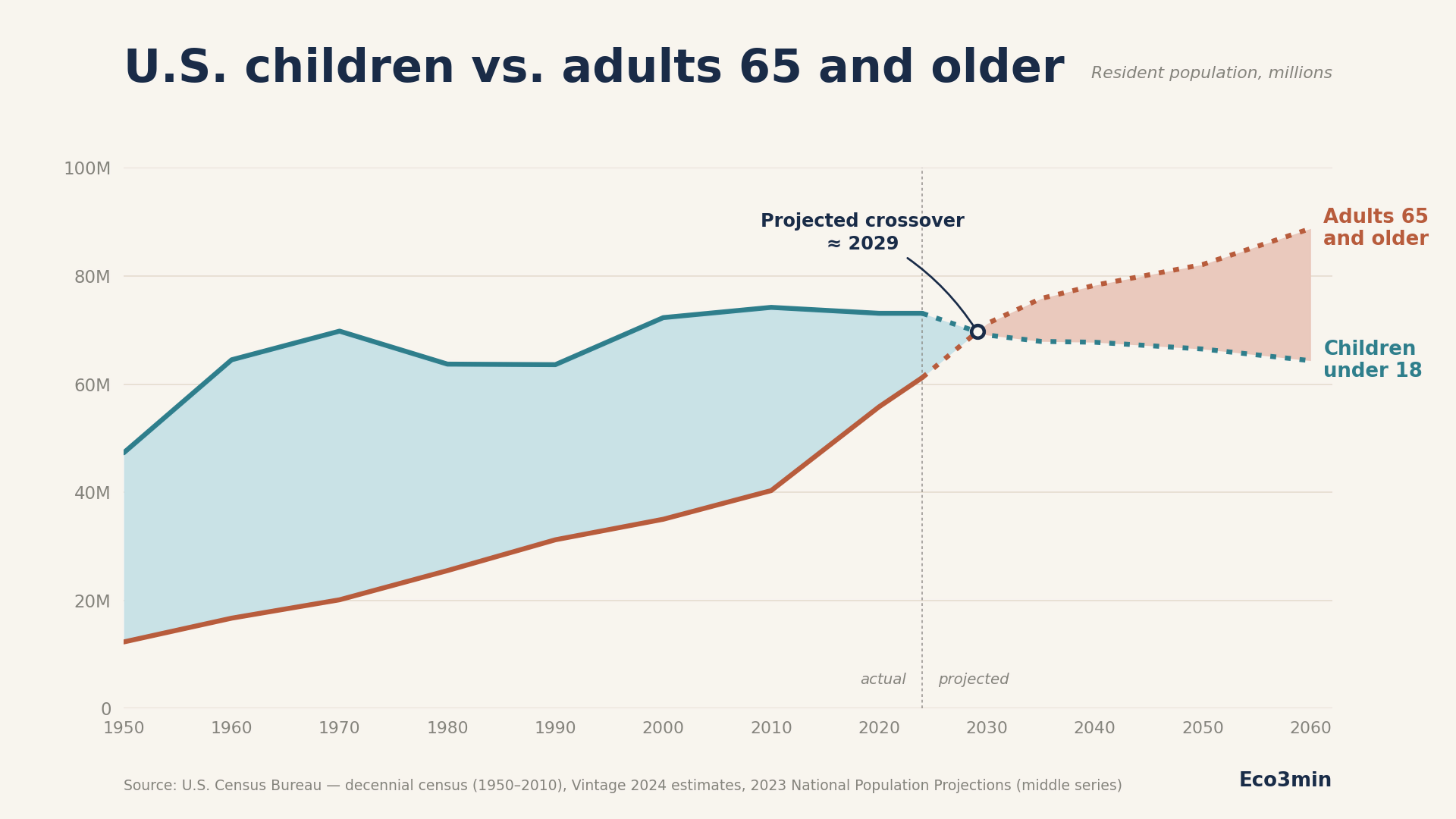
U.S. adults 65+ set to outnumber children by 2029
For the first time in U.S. history, adults 65 and older are projected to outnumber children under 18 around 2029. Interactive chart and full Census dataset.
Eco3min
95 points · by brandonb · 3mo ago · 175 comments
Maine, Vermont, and Florida
Since 2020: Delaware, Hawaii, Montana, New Hampshire, Oregon, Pennsylvania, Rhode Island, and West Virginia now also qualify.
Montana is a bit of a surprise there... so is Oregon for me.
Source: https://www.census.gov/newsroom/press-releases/2025/older-ad...
Florida being on that list made so much sense lol.
What kind of people will not wanting children likely select for?
At least two kinds come to mind:
1) People who love children and are willing to have them regardless of the impact on their financial situation.
2) People living in societies where women (and likely some men) lack a say in whether or not to have children.
The first kind could be very good.
The second is definitely not something we should look forward to.
I agree that these days, the bulk of the drive to procreate comes from your culture/memetics.
There is a "replacement" crisis but it's being addressed by pearl clutching and those advocating for forced birth.
Having children is expensive all the way around. And women's reproductive rights have enabled them to (rightfully) make their own choices about motherhood.
To state the obvious: children literally are the future of humanity and we need to address the issue accordingly. A lot of it would be via changing the economics of having a child, and the rest would be by making the world a "village to raise a child".
This is all eminently doable. We just need to agree on what that looks like and how to best invest in it.
Those who govern us see us as an economic zone to exploit, so perpetuating core social values isn’t really a concern. Although even countries who recognize this problem are having trouble finding a solution.
It may simply be that the future doesn’t look very much like the “developed world”. The only nations (or large subcultures like the Amish) that still have high fertility rates also have values and lifestyles that appear very foreign to us.
I’m not passing judgement, it’s just Darwin in action.
I have a thesis that people need stories to inform and inspire them. I also believe that this problem is technically solvable, and that the stories we have today are either backwards (the woman belongs at home making babies and taking care of daddy), or too hand-wavy (we just need to fund Head Start and make schools free).
I'm all for the latter approach but it doesn't address the fact that children are money, time, and energy vampires (albeit lovable and worthy of those things). We need more than that. Programs that augment school itself (the arts, scouting, DIY/maker stuff, etc). Those exist but are not evenly distributed and we need way more of it.
Lastly, the "village" part of encouraging communities to help families thrive instead of struggle; to make sure that kids have the options they need rather than turning to drugs, gangs, etc.
C'mon everybody, let's kumbaya!
Even Scandinavian countries and France, with generous parental benefits, have not materially increased their fertility rates.
At least in the US, protecting agency and autonomy that might be challenged is easily solved with the second amendment for defense, as well as long term and permanent birth control for those who would not like to have any children or more children. The potentially vulnerable reproductive age population shrinks perpetually year after year, continuously reducing potential attack surface.
https://news.ycombinator.com/item?id=48733976 (citations)
Maybe in a couple countries. But not for the world, and not for the west and definitely not for America.
As the population has grown poverty has decreased.
Energy is very easy to produce cleanly (nuclear, and solar is looking better and better). The barriers to doing so are political and financial, not technical. They will be made worse by having an aged-heavy population, which is less innovative, less willing to invest in the future, and less willing to try new things. And it makes a poorer society, obviously.
Malthus has been proved wrong at every juncture. Lack of children is about to bite us very, very hard.
Why is everyone so sure of this? My own instinct is just that we'll adapt to it and it will be fine.
It's just seems like the equivalent of making one of those charts that shows we're going to run out of [some critical resource] by [some date]. They are always wrong, without exception. Because as the resource becomes more scarce, we adapt our societies to become less dependent on it. You can't just extrapolate that trend lines or relationships between statistics like GDP and population continue into the distant future; it almost never works.
I don't have my own competing, grand prediction of how the distant future will pan out. But my thinking is that societies are extremely complex systems and when one variable is tweaked, generally all the other variables also adjust to compensate.
I'm not against growing populations, just not overly concerned about depopulation either.
First about behavior in old age. I'm pretty sure the majority of adults today don't want to live and think like their grandparents, so we can't say "less" anything. The circumstances are definitely changing enough that we already know it will be different.
The population decline is not happening in huge step changes. "About to bite us" is definitely hyperbole.
Could it have an effect like the Black Plague, where labor becomes more expensive?
This is like comparing apples to oranges to find a correlation, and arriving at an incorrect causation.
Falling populations are largely due to better education, specifically of women, as well as integration of women into the workforce, which has been one of the bigger drivers in curbing poverty. The latter is so significant in the west and the far east (double income households mean rising costs of living, meaning SAHM households become unviable in the West for the middle class), resulting in a significant population decrease.
But in places such as the Middle East or Africa, ever increasing populations have only meant even more financial trouble for those economies. Case in point Pakistan and Egypt. In other economies such as India (which I assume is one of the "couple countries" you mentioned), overall birth rates are falling significantly to near replacement level, and in the few states/regions with high birth rates, poverty is rampant and the people reliant on subsidies from other more prosperous regions.
The problem with most of the world is that while we are able to sustain a huge population as a whole globally, most of the population growth is extremely localized, resulting in population sparsity in some comfortable regions (Canada, the US, Central Asia, southern Russia) and population unsustainability in other regions completely unsuited to population growth (sub-Saharan Africa, Indonesia, the Middle East).
True, but not obviously a causal relationship.
That is such a privileged first-world take.
You haven't lived in overpopulated places.
Just try it for 1 fucking year and then see if you still wish that hell upon anyone.
I swear I'm starting to wonder if that's a take pushed by ultracapitalists so they can have an endless supply of labor and consumers, like the bans on abortion etc.
Some people have a massive ecological footprint. For instance, somebody who uses a private jet ~daily.
Other people have a negative ecological footprint: their actions either actively improve the ecology of the world or act to reduce the ecological footprint of others.
The difference between the two is many orders of magnitude. A world-wide population of 100 million daily private jet users likely has a larger ecological impact than 10 billion low-impact humans.
Population change takes decades or centuries for the ecological impact to happen.
Shifts in the ecological footprint of significant populations can cause shifts over a small number of years.
It will be (eventually) when the worldwide birth rate drop below replacement. And it's close to that now: https://data.worldbank.org/indicator/SP.DYN.TFRT.IN.
- Niger: 6.7 births per woman
- Somalia: 6.0
- Chad: 5.5
So it seems only Africa.
Killing USAID probably put a drag on that slowdown by reducing access to family planning resources, but we’ll have to see exactly how much in the coming years.
It's a titanic issue. Old people are expensive. They tax the young to pay for themselves. Now the system is running out of young to tax.
And that's the situation in rich and prosperous nations. I live in a developing country that has managed to be relatively poor and have a declining birth rate. It's so absurdly pathological it's not even funny. Symptoms include, for example, increased retirement ages. We will work well into our 70+ years of age, and we will be happy. Newer generations are already coping, they've already internalized the fact they will never actually retire. This is the stuff revolutions are made out of.
Yes, because the aging population increases healthcare spending to support them while the working age population shrinks, eroding the tax base. This is currently happening in Japan right now.
Africa doubled it's population in the last 28 years.
We can tax the rich, we're post scarcity, time to take a look at the rest of the world an come up with a better social safety net.
Productivity is growing much more slowly than the retiree-to-worker ratio. Workers are producing slightly more every year, but there are a lot more retirees to take care of every year. If this does not change, we will eventually see a collapse of social safety nets. Policy can only accelerate or delay that collapse.
In 20 years, will countries start to compete for young people? Tax breaks, benefits, etc. Will some countries thrive while others die off completely? The proportion of young people will be a huge issue regarding military strength, innovation, etc.
Could get very ugly.
Improving healthcare and medicine should be one of the core goals of civilization, so eventually we should have healthcare good enough to enable "practical immortality": No "aging" and no deaths save in extreme cases or physical accidents/violence.
In an ideal future, the majority of humans SHOULD be all over 100 years old! and hale and healthy as a 30 year old.
The problem is not "how long most people have been alive", maybe the problem is our unwillingness to reassess social assumptions established >2000 years ago:
That everyone has to "work", everyone has to "earn", everyone has to constantly "buy", and that everyone has to constantly pump out babies so they can also keep doing the same...
Frustratingly, (and counterintuitively), it won't help housing prices, because shrinking populations retreat to city centers. Spain, Italy, Japan, and Korea are full of $5,000 houses. Meanwhile, Madrid, Rome, Tokyo, and Seoul are more expensive than they've ever been.
As we get better at healthcare and life, we should expect to be productive and care for ourselves for longer. I hope that as I age I remain in favour of succeeding generations over my own self. Plant the tree whose shade we won’t see etc.
That would lower the retirement age for me. I was born in the mid-80s.
I know that was just a suggestion. We could go with something like "life expectancy at birth minus 5 years", which would raise the retirement age for me, but we're basically just admitting that retirement isn't a thing anymore if we do that. Hopefully the wealthiest nation on Earth can do better.
I think, whatever we do, we should recognize that the current retired generation holds more wealth than any other generation. If we want more kids in our society, maybe we need to get some of that wealth into the hands of people who can have more kids.
Without more productive capacity the extra $1.2k/mo would cause enormous inflation. Just a question of what the country is optimizing for, I suppose, but I think people would be unhappy with the result.
The combination of UBI and healthcare largely should. UBI serves as a better alternative to most such programs (and has much less administrative overhead).
Also, any form of UBI will likely result in substantial spending increases (trickle-up economics is well-established as actually working, incremental dollars handed to the average person are typically spent, not saved), as well as reducing structural friction in the labor market (people can change jobs more easily).
> Without more productive capacity
UBI will also likely result in more businesses/entrepreneurship, R&D, and other substantial improvements to productive capacity. Studies generally show that UBI does not cause people to substantially leave the job market.
This is the natural consequence of declining birth rates.. it's either that or immigration right now.
Encouraging people to have more children requires drastic changes in society which is difficult to implement.
In this case, I presume they're taxed on their continued employment and so they're still paying into the pension they're receiving benefits on? I don't see a problem if that's the case. They contributed to the pension with an agreed payment date and followed the process correctly. I can understand how you feel that it's unfair, but I really don't see a problem unless they stop paying into the pension or stop paying taxes on their continued employment.
That was a little over 100 years go. So, a long time, but not that long.
Countries with larger populations will see these guys commit civilizational suicide with enough time to recover one can hope. We won’t be funding USAID when the majority of Americans are drawing from Medicare though.
We've already seen 20 years of policy driven by people who don't care about families being started.
Their wealth is not liquid, but it's not relatively tiny.
>$93 trillion in assets[1]
>Total wealth: $167.26 trillion[2]
[1]https://investor.visa.com/news/news-details/2026/Visa-Resear...
[2]https://smartasset.com/financial-advisor/wealth-by-generatio...
We absolutely need an abundance agenda if we want people to have children. Reject the zero-sum investment thesis of NIMBY protectionism. Invest in density, efficiency, and antitrust. This is one of the most openly obvious self-owns in history. It's genuinely absurd.
We are all in this together. Make financial security easy for young people and we'll actually get children.
Of stack and packs lol
> We are all in this together.
When’s the last time I heard that one
Or spend less.
That's how we reduce the Earth's population!
(a) non-walkable neighborhoods with big houses, big roads and cars everywhere, versus
(b) smaller houses or apartments but fewer cars, walkable neighborhoods, and bikes (and other small mobility devices that small kids can use)
I can tell you where being a kid seems more fun. And I’ve personally been to both sorts of places recently and observed how the kids behave.
Sure, with big lots, kids have lots of space in their own backyards. And big cars make soccer-momming easier. But, when kids can easily and safely get somewhere else approximately on their own, the whole situation seems better.
And yes, I really did recently observe a pretty big family in one of the latter types of places. How does one parent herd a pile of kids from their small (but not that small) apartment to some destination without a giant car? They tell the bigger kids where they’re going and they take the smaller kids, and maybe the bigger kids get their ahead, and everyone gets to experience an appropriate amount of independence for their age.
There’s also nothing new here. Until quite recently in human history, in most societies, kids were quite free to explore on their own or in groups without adults. I think it’s unfortunate that we’ve built so many places that are unsafe for small children and not easily navigable by older children.
> Sure, with big lots, kids have lots of space in their own backyards. And big cars make soccer-momming easier. But, when kids can easily and safely get somewhere else approximately on their own, the whole situation seems better.
It seems better, but it's actually not better.
Besides, suburbs can be improved quite a bit by adding local parks, mandating sidewalks, etc. We're also on the cusp of the self-driving revolution, and pretty soon children will be able to just get into a cab by themselves.
> and everyone gets to experience an appropriate amount of independence for their size.
And how do you get to that point from 0 children?
Palo Alto has a surprisingly large number of children under 18 and under 5, and Palo Alto is fairly walkable as California cities go. Fresno and Bakersfield (not so walkable) are higher. There seems to be a larger fraction of young children in Brooklyn than in less subway-covered areas of the NYC metro area.
In general I suspect that children in the US are mildly skewed toward more suburban areas, but not strongly. There are plenty of children in dense areas.
But my claim wasn’t about where the children are — it’s about where the children can have more fun on the basis of the structure of the neighborhood.
I also saw a whole lot of families and children.
As I'm getting older and looking in the coming years at having children, the value of a tight, walkable community has risen exponentially to me.
I think "make society more child-friendly" is a good idea, but one that doesn't seem to have increased fertility that much. To me it seems that educated people living comfortable lives with access to birth control simply don't want to have that many children. If you look at the country stats, the most proven way to increase fertility is to take away education, women's rights, or birth control. And imo, the western world should adapt to low birth rates, instead of trying to prop them up.
I personally think it’s just opportunity cost. Children seem like a big deal with unclear benefit and so as people get the chance to substitute with other things they do so. For my part, we put a lot of work into having kids and we live in SF. If we leave, it’ll be because my daughters don’t have mobility here because crime and cars impede their independent movement.
Nope. It's just time and personal living space. It's THAT simple.
Go on, try to plan your day with transit and no car if you have 3 children (with 2-3 year age gaps). You'll find that this really works only if everything is concentrated, or if it's a full-time job for you. That's why we hear so much about "15-minute neighborhoods".
But when everything is concentrated, it becomes EXPENSIVE and you also lose any semblance of choice. You will likely have only one school, one daycare, one community center. You become hemmed in within that "walkable" neighborhood. That park nearby? It surely can look nice, but what if it's the only park within reasonable walking distance? So you don't even have an _option_ to go somewhere else with kids, without making it a full-day trip?
People like to laugh at Texas, about how riding an SUV to a walkable park is ridiculous. But is it, really?
The way to fix all of it? Suburbs and cars. Cars provide personal freedom and personal space. That's also why the US had a higher birth rate for much longer than Europe, and it started cratering once young people were forced (by the economy) to move into dense city cores.
If you think most families who live in a city only have access to "one" park or "one" daycare you must be joking. Things are denser in cities. What do you think all that dense stuff is? It's parks and daycare and stuff.
Maintaining a car payment, gas, garage, oil changes, etc is not "freedom". Surely it's fine for many people, but cars do not equal "freedom" in any sense of the word. Their use is entirely dependent on government spending, just like transit.
Walk in Tokyo and try to find children there.
There might a few more things going on there than just density, perhaps operating on a national level.