317 points · by moonikakiss · 3mo ago · 268 comments
- Spend most time prioritizing/discussing what to do.
- Once that's agreed, use Fable 5 High + 5.6 Sol XHigh come up with a design + plan. Agree on the high level plan. (Usually this just comes down to choosing where the change belongs on the spectrum between minimal patch <-> full redesign)
- Use Opus 5 or Sol Med to execute
- Auto-fix bugs and CI until green + thermonuclear review skill x3.
- Manual interrogation of change/nits
- Come up with QA plan and have Codex Computer Use execute on it
- Manually spot check the final result (usually a sizable diff, thousands of lines, complete feature E2E, etc)
I probably spend like $80 a day at least but I produce the output of 3 or 4 2022 engineers and probably at better quality. So it's easily worth it. Would I save money by switching to GLM 5.2 and such...perhaps? IDK. At our scale it's not worth the time spent building the eval harness to actually understand the performance tradeoff.
When I personally want tight code, I have to spend a considerable amount of time adjusting it manually:
- It needs to be trimmed down. In my experience, at least one agent I use struggles to produce minimalist designs, and it's very frustrating
- I need to consider whether there are solutions based on higher-level assumptions, that AIs typically miss
- I need to check whether there are off-the-shelf solutions - AIs like to reinvent the wheel
IMO, software production has become a mass-produced commodity in every sense - it's much more expensive to produce software manually, but the quality is not the same.
> software production has become a mass-produced commodity in every sense - it's much more expensive to produce software manually, but the quality is not the same.
Agreed.
Homer reunites with his long lost brother, who runs car company Powell Motors. Homer is ultimately tasked by his brother with helping to design a car for the “average man” that ultimately bankrupts the company for being wildly overengineered and costing too much ($82,000 in 1991-money).
Here’s the car: https://simpsons.fandom.com/wiki/The_Homer
For the vast majority of software out there, this quality gap simply doesn't matter. Not everything is big tech, needing internet scale. Most software built by developers at non-tech companies are simple line-of-business apps used by a handful to a few dozen or maybe a few hundred people to do a thing a bit better than the Excel spreadsheet that was used before.
And AI has essentially automated the development of this kind of software. Or rather, it has dramatically increased the ability of skilled developers to produce larger amounts of these kinds of systems.
Excel hardest hit.
You don't mean the majority of paid for software can behave non-deterministically? That's the value add of the human in the loop.
Which ones don't?
I used to play Wing Commander II. It was 30mb. Today, the software to adjust the colored lights on my keyboard requires literally a thousand times as much memory.
For who?
The public? The public has never liked buying software at any price.
Businesses? Businesses need higher quality software when it's relevant to their core competencies, so they hire people instead. Buying competing SaaS or depending too much on AI is throwing the baby out with the bathwater.
[1]: https://pluralistic.net/2024/04/24/naming-names/#prabhakar-r...
Same with a junior dev. They don't write long form spaghetti because they're trying to write more LOC. They do it because not doing it is hard, literally above their pay grade.
I use LLM every day, but they're still completely awful at architecture. I don't think this clear lack of ability is some conspiracy.
You will really have to weigh the cost of making the software against the expected revenue.
In such markets, what you produce is either worth nothing or worth millions of dollars. For as long as it's the case that well-constructed code (with or without LLM help) is more likely to be in the latter category, the economics of software don't really change.
Even before LLMs, you could've commissioned a half-assed clone of any app you wanted from a 3rd world consultancy for a few thousand dollars. LLMs are basically Bangalore-as-API.
Also just remember - minimalist code looks and feels great but customers do not read your code. I have caught myself many times providing "corrections" to abstractions that were already ~fine, just not perfect. The average SWE costs $200/hr. Careful you don't burn $50 worrying about code that will likely be rewritten or can be better abstracted when that's actually needed.
This is a pointless quibble but the hourly rate claim is not true--it's like ~$60 in the USA [0]. Maybe you meant at a specific Org but this is important context when comparing "pricing" between human and AI.
[0] https://www.salaryexpert.com/salary/job/software-developer/u...
And this is how I find out I'm woefully underpaid.
"Will I benefit from this code being minimalist before [date]", where [date] is whenever you think the agent will be good enough to come back and make the corrections you would make today.
How does a “small startup” end up with a multi million line “legacy” codebase? Something not mathing
And if you're saying (based on your other comments) that a 6 month window is enough to create a legacy codebase...that indicates a serious lack of experience or understanding as to what a legacy codebase is, or why they exist.
- Suggest a better approach that makes the AI say, “That’s much simpler. And you’re right. My original plan was over-engineered.”
A lot of my high costs is because I just throw Sol at everything. If I were more selective and brought in Luna or v4 Flash every once in a while, I think I'd be more like ~$400/month. That's why I'm not aligned with the notion that "tokens are subsidized so that's why people are using so much": its not that I'll have to adjust to using less, its just that I'd need to think before I prompt a bit and be more judicious. I could easily see my raw token counts doubling or tripling in the coming months. I don't think that will change as subsidization subsides; though maybe lab revenue will; intelligence per dollar is getting cheaper every week. Its solely a function of adaptation to process, which takes time.
The productivity gains per token are the single most asymmetrical thing I've ever seen in engineering. The engineers on our team are pretty effective with tokens; easily that 2x-4x output as you're seeing, spending $20-$200/day. Some of our security folks have also started contributing more-and-more code, and they're on the other side: they'll spend hundreds a day running in circles, eventually producing these +/-30k loc pull requests that take ages to get merged and are littered with issues. They weren't writing much code before, so arguably they're more productive by some multiplier greater than 1, but I think the drag on the rest of the team, and potential issues with what they produce, has overall created a net-negative situation. Inversely, some other company functions have produced a few one-off websites for things like sales processes, and those have been a huge win. The asymmetry is wild. There's almost a valley of incoming skill where if you know nothing about code, you'll leverage it well; if you know just a little bit, it makes you super dangerous; if you know a lot, you're the biggest winner. Really difficult situation to navigate.
Possibly, but the output of a 2022 engineer is about 1/10th of the output of a 2010 engineer, so it's an extremely low bar.
I would love to see what these tools create but outside slop there's never: This works, is in production, here's the code.
Any day now.
It was all generated in the last 4 months, so don’t come at me with the “but did they use a model from the last 6 months” nonsense.
I have had some $3,000 token days - even without Fable. I don't see how this is sustainable.
My personal 20x plans get so much usage for so cheap. The consumer subsidies are crazy, but alas I can't use them for work.
It actually gives me quite an uncanny feeling, bulldozing over years of human optimization work with a newer, "perfect" design. Like bringing an AK-47 back to the middle ages.
it's so hard to square such totalizing statements with my day to day experience with fable and sol, (every possible, improvement, really?? they are NOT omniscient) arguing with them/my colleagues' agents that no they have slowed down the system 200x with their terrible change, doing string operations on millions of db rows, trying to get it to understand that I don't care that it's calling it a "cache" if a cache hit is slower than what we had before.
These agents do let you learn codebases quickly, and produce code way faster. I don't look at IDEs all that often. But literally multiple times every single day I catch them doing something stupid.
I don't think its impossible that we could get better performance from the agents. I know ive tried all sorts of workflows and skills, few of which seem to have much effect on the things the models struggle with. I think a big part of it is encoding enough context for large codebases, and providing it with all the tools it needs to make it successful, things to automatically check its work, etc. But that's not automatic, in fact its generally a terrible judge of what it needs or what its bad at
Opus and I wrote a parallelized test harness and labeled groundtruth in around 2 hours.
In 2022 that would've likely been all I did for a couple sprints
But that's also why it's now easy to justify the cost of an Nvidia or Intel inference server with Kimi K3 locked and loaded :)
I'm in an infra team and for the last 2 weeks or so I've been trying to understand whether a particular workload will catch fire if a switch is flicked. I'm also new to the team so partly it is me wearing training wheels, familiarizing myself with the telemetry etc, but I will state that I'm not completely lousy at this stuff.
No model in my experience can do anything remotely comparable to the work "what happens to the workload if this switch is flicked" needs. They can't even design a reliable quick experiment to answer what cast should be applied to the binary trace_id in table A for the join to table B to work. They will happily do something idiotic and then conclude that the join does not work.
you should probably be doing this discussion work along with Fable 5. It will give good feedback if you're working on the correct things.
> Come up with QA plan and have Codex Computer Use execute on it
QA plan should be part of the above "design + plan", not after it. The implementer needs to be able to fully test before publishing a PR. This is true whether humans or agents are writing the code.
> Manually spot check the final result (usually a sizable diff, thousands of lines, complete feature E2E, etc)
unfortunately this is not really scalable with amount of code agents can produce, so you need independent (fresh context) agent reviewers to help. Ideally they only escalate to a human when really stuck.
> I probably spend like $80 a day at least
at a small startup you should be on the $200/month plan(s).
In my experience at the begining of the full agentic coding loop in our company we were more hands on with the codebase and had better judgement over the plans. Now it is quite often that the inital plan after executed needs more refinement and that made the plan review somewhat obsolete for us.
> I probably spend like $80 a day
This doesn’t sound like “unlimited”, I spend more than this out of pocket per day and I have a strict budget.
(and mid-to-long-term, often also short-term end up cheaper than weaker models)
this might change soon if we are reaching a certain capability threshold
but right now that's still the case
unless you are working on throw-away trivial stuff where iteration speed and trying many speculative things might give you an edge
no one’s AI spent will be in question working a single terminal with carefully planned out and executed process you do
Are you at least conversational in the subject matter? You're gonna have a good time just by paying attention and adjusting your workflow. If you're getting a lot of back and forth with it, its asking a lot of planning type questions, stop, step back, rethink the whole feature, and start again from the beginning with everything more fleshed out.
If you are in a brand new field, there's no way to bridge that divide. The issue is you don't know what is good or bad, or whether what you have learned is good or bad. You're in a sports car and you don't know how to drive much less what's track and what's field.
You can spend a lot of effort getting good at prompting towards writing tests and E2E tests to at least verify your app does what you expect it to, regardless of experience.
I actually have no doubt that I could replace my Opus 5 Low/Medium subagent profiles with Grok 4.5/GLM 5.2/Deepseek v4 Flash and perf would probably be pretty similar.
On top of that - highly recommend adding accurate cost counters to your statusline. You can't improve what you don't measure! (Or even have any intuition about).
mate, if youre not using subscription then youre spending waaaaaaay more. the plan itself with fable/sol will most likely have already cost more then $80 -- ime thats more like 500-2k/day of usage.
most harnesses let you see the usage in the status bar, i encourage you to enable it
Wait what? I don't understand these numbers. I spend $1k/day
Your story about being told to use AI for everything I was expecting you to be well over that
On what planet do people start paying for things without keeping an eye on the costs and no-one notices until you have spent a crazy amount? I don't understand. You are either paying a fixed amount which you are happy about in-advance or you are PAYG in which case you would ballpark how much it costs.
Otherwise it reads a bit like a fake problem, because it didn't really happen, you just foresaw it (as you should) and added a few guide rails.
1. Insanely discounted starter plans. Claude $200/mo plan is like $5k-$8k of API rate usage.
2. Very limited cost visibility, they make it hard to figure out where you spent money (unless you're on the enterprise plan which is for people with unlimited money).
3. Nobody, not even the model provider, knows what your request will cost before it returns. You're writing a blank check every time you hit enter.
4. When you run out you run out very suddenly and disruptively. It's very hard to tell a developer on the 28th of the month "sorry, code by hand until the 1st of next month" so you tend to grant exceptions.
5. The price is changing all the time. New models come in, old models come out, prices change, caching behavior changes, harnesses change, etc. The cost of doing a single task is not predictable even if the task does not change.
6. Basically no volume discounting. Anthropic offered us 2% off for committing to $1M+ per year at API rates.
I manage AI spend for my team at work and I try really hard to keep costs under control but it's absolutely herding cats. Much harder than any other spending I've ever had to manage at work.
Happy to give you (or anyone here) some trial credits if interested! Email address in my profile.
In addition, we're seeing people applying AI to more and more use cases, so token growth is very significant. Paired with consumption pricing, it's brought this problem to the forefront very quickly for lots of companies.
This is how AWS made its fortune.
Initially, you picked the Multi-ZA RDS db.t3.2xlarge instance because you figured "eh i have credits anyway". Two years later, someone looks at this and says "hey, this is expensive and I bet we can do everything we need on a machine half the size". But then they think "if i downsize it and that works, i'll get a thumbs up emoji on a slack thread. If i downsize it and it causes problems, i'll draw the ire of the whole team. I better leave it alone." And the truth is... by the time your company hits the end of those credits, you're probably at the point where that savings isn't gonna do much. Or maybe you are out of business.
And that is how almost every successful company that uses AWS eventually ends up paying six-figures or more annually.
> And that is how almost every successful company that uses AWS eventually ends up paying six-figures or more annually.
the best thing to do is avoid the first cigarette (but everyone at the office smokes, and if you want a promotion you'll smoke with them too)It is true that this problem can be mostly managed by the techniques we mention here. Those are actually pretty difficult to set up at scale, so many companies (including us) we only really did this in earnest once we started to see those large cost oscillations.
The main reason we shared this here is to maybe help other companies get infrastructure in place before massive cost swings rather than after.
What didn't happen is any analysis of cost/benefit up front. Many of the corporate decisions around AI have seemed characterized by companies blindly copying each other.
They’re not saying they regret doing it, or that it was a mistake.
They’re just saying they’ve gained experience and have leveraged the tools to an extent their usage can be optimized.
Pretty standard business or life iteration.
The AI rollout has in large part been about giving management an opportunity to say "fuck you" to engineering.
Engineering payroll needed to be slashed and the C-Suite was happy to let their managers get some lashes in on the uppity workers.
The point of AI is:
1. It's bad engineering and everyone knows it.
2. Management is pushing it through anyway.
3. Deal with it, asshole.
The ROI is besides the point. It's about breaking the spirit of engineering labor with irrational decisions made outside of their control.
Edit: It is just as much about affirming the exalted status of management in comparison to labor. It's a bitter reinscription of the status hierarchy in tech; Management is good and labor is bad; Management is considerate and labor is ignorant; Management is strong and labor is weak; Management is superior and labor is inferior.
> The ROI is besides the point. It's about breaking the spirit of engineering labor with irrational decisions made outside of their control.
it may be where you are at (not disagreeing at all with your experience), but where i am the management really are 'true believers' so to speak... they are all-in and mesmerized by the tech (call it fomo or whatever)If you have a 500k line codebase and even > 50% is written by agents, you are in a world of pain that won’t justify the costs longer term.
Now of course, there are products that just involve lots of code but are not actually complex. This is generally the project with like hundreds or thousands of features but most of the features are separate and don’t actually interact in complex ways. Think a task management app with hundreds of features like calendar, email integration etc. there I think agents gives you more bang for the buck. Just my thought, using agents at work.
Velocity and quality is through the roof, "10x" would be a regression at this point, the bottleneck is only figuring out what is relevant/good to deliver, the implementation is the output of the machine.
Have you ever listened to a politician talk for an hour and you can't remember what they talked about?
If some VC wanted to fund my crazy ideas for building personalized private versions of the internet because people are sick of the nightmare, I would vibe code the hell out of that; but at my current job I have existing customers to keep happy and make sure their financial data doesn't get lost or modified.
A bold claim to make with little to no supporting evidence
I would bet my entire Polymarket balance ($0) that some military contractors have already asked AIs on the public Internet to design software for them.
There’s not even a distant comparison US lab rn which is sad
One more datapoint for the thesis that OpenAI and anthropic aren’t viable, sustainable businesses, and cannot justify their $1T valuation and the level of compute commitment (reminder that OpenAI committed to >$750B in infra spending for 2030)
1. Codex, Claude and others try to switch models being used at their level itself to manage the cost and outcomes
2. Now company like data bricks develops one more layer on the top of it to do the same task, of finding the base harness and applicable model
Companies like Codex and Claude are focussing/investing heavily on to ensure that people are using their harness directly or instead use APIs. Unless Databricks has some agreement in place they are violating the TOS and openly publishing an article about it. Would be interesting if openAi or Anthropic come back and claim for the API usage prices and all the savings go away.
[0]: https://support.claude.com/en/articles/9797531-what-is-the-e...
[1]: https://support.claude.com/en/articles/9266767-what-is-the-t...
Anyone using the enterprise plan are charged the API pricing, however the article is not clear if Databricks is using enterprise plan or not which is why added the following disclaimer
> Unless Databricks has some agreement in place
June 15 changes would be the keyword to check, but at least in anthropics case it's... Complicated
I don't think people thing don't think enough about the exponentially growing costs with AI. The cost of tokens, the cost of bugs, the cost of technical debt, the cost of software bloat and slowdown, the cost on the RAM market, on the environment, the costs of the little lies and hallucinations that creep into our codebases, blogs, books, and search results.
What seems like a manageable margin suddenly starts growing and destroying everything.
> What seems like a manageable margin suddenly starts growing and destroying everything
probably where the 1 trillion+ dollar valuations are coming from.... lots of thick saas margins they can siphon/skim from the whole industry.Kudos to databricks, I also find it interesting that such different companies (Stripe, Ramp, Databricks) are all building the exact same internal tools.
I think building companies is going to look more generic in the future because intelligence is an API now.
Have you tried measuring Gemini? now that you have the router it should be a simple task. Thanks!
Without the insight into agent performance, any changes like this feel like a gamble to save $$ at the cost of developer productivity
I'm actually working on building generic repo-specific benchmarks at https://stet.sh ;)
In large user populations like at Databricks I think the ultimate answer will come from experimentation instead of offline evals. We are already doing this in small groups, exposing them to new candidate models and then measuring per-developer cost and perceived quality changes.
However, as a self-admitted eval true believer, I remain bullish that publicly available eval capabilities will catch up to current model intelligence, and start to be able to capture more and more of the subtle components of the agent experience, such as interactivity and code maintainability. Meta and Scale have some evals in the interactivity space that seem pretty promising https://arxiv.org/abs/2606.29957 https://labs.scale.com/papers/swe-interact.
Human usability of the agent should definitely remain the top priority, but IMO we focus too much on the subjective, and not enough on the measurable/objective now, and I think/hope we'll see more companies move in the direction of Databricks
Of course it has. But is that a good enough measure of value? What about the business and customer outcomes from all the extra lines of code and closed JIRA tickets? Was it worth it?
But the question remains, AI hasn't shown any explosion in growth/revenue for most companies. The effects seem muted.
agree, this works, undervalued!
look at minimal agents that protect the context window:
- pi (https://github.com/earendil-works/pi)
- smol (https://github.com/smol-env/smol)
some thoughts on the other tips (for coding):1) stronger models are more token efficient for open ended tasks because at the limit …
- stronger models can solve tasks that the weaker models can not solve
- stronger models make fewer mistakes, compose things better (cli, abstractions, …)
- navigate the code base better
- are better at removing and simplifying the code base again
that of course is difficult to benchmark, so most attention goes to simple benchmarks that show cheaper models can get similar results on 'closed' tasks with easy to 'eval' results2) dynamic request and task routing sounds great/obvious but is very very hard
- to benefit from caching you don't want to switch model or inference endpoint
- to _know_ a certain request can be routed to a weaker/cheaper model needs good context and a strong model to get right and often is still unknowable because the active coding session can go many ways and turn from trivial to challenging in a few turns, always in motion is the future, if you get it wrong you are back in the problem space of #1
using cheaper models and auto-routing do work well for 'closed' tasks where you have something repeatable and can evaluate whether a certain quality threshold is reached that you are comfortable withfor open ended coding sessions it is not so easy
that said: cheaper does not have to mean weaker, you want to look at the pareto frontier and stay up to date on new good models
there are many models like deepseek v4 flash and luna that are both cheaper and way better than most other models
I just spent 3 days reviewing the code of a vibe coding maximalist at work. They needed to touch 96 front-end files, ~50 back-end files. We now have `is_uk_company` spread throughout the entire codebase every time we need to output a date format. I would say 30% of the code can be replaced by a moderately more-wise approach of "you ain't gonna need this", 20% is actively polluting and/or harmful to the coherence of the feature.
I'm pretty sure this plan came from a braindump of a verbal meeting they had with our product team, using OpenAI's top models. There were 2 initial spreadsheets that were ABSOLUTELY INDECIPHERABLE, and now we have a new one labeled "FeatureX - Phase 2 to 4".
Just the date fields is a hilarious example of why I'm skeptical. Python (babel.date) and Javascript (the browser's locale) both have locale-aware date rendering. Using a library for country-based date and time parsing would have eliminated ~12 country-specific change sites... but instead we got `is_uk` and raw date format strings (`%d/%m/%y`) in-line inside already-enormous functions. Also, at a meta level, the backend code shouldn't usually be formatting the dates (data export may be an exception), we should be sending ISO dates and having the frontend format the code if anyone gives a crap.
I'm ~$500/day and I spent 3 days reviewing this stuff. Our CTO spent ~2 days this week reviewing this feature, I'm not sure what his daily rate would end up being. Just the date-formatting part cost me half a day... that's at least $250. A few hundred dollars on Xhigh tokens burned $2500-3500 in human review effort, and I was delayed from:
1. Getting an entire sentiment analysis feature deployed by helping our interns
2. Getting a load balancer solution working to automate a manual process
3. Improving our deterministic Cypress test suite
4. Getting a demo feature launched for our sales team that would bring in more money
Did you reject the PR or is that not a career-enhancing approach in your organization?
If my company told me yeah we’ve decided you don’t get Fable or Opus 5 because it’s too pricey, you gotta use GLM whatever, I’d be displeased.
My workflow is very simple:
1. develop requirements for code change
2. take manual notes for implementation, maybe use LLM for some discovery/investigation
3. present notes to frontier LLM
4. develop implementation plan (bulk of work)
5. let LLM rip
6. review diff, manually fixing/refactoring code as necessary, sometimes prompting for revisions
7. get automated LLM review
8. get human review
this reliably produces the work of 2-3 pre-AI senior engineers with a lower bug rate, equivalent performance, robust edge-case consideration, etc.
Does the LLM produce over-engineered solutions? All the time. I stop it from doing that, or manually fix it myself.
Does the LLM always adhere to the best system design? No, not at all. I often have to guide its design into a better, north-star aligned one.
I don't just sit in front of my terminal and say, "Ok Claude, build the app." It is a very iterative process, and not without its potential pitfalls.
But it is very, very productive.
1. Thinking about how to optimize AI spend is one more thing to think about when I have too many things to think about already;
2. If there’s even a minuscule chance that me selecting down the model results in a task getting delayed because for that particular thing the model happened to be “too dumb”, I’m just not going to do that. Because I’m evaluated for what I ship and saying, “oh, not happening this week because I downgraded to Haiku for the exploration phase, and that resulted in a faulty plan, so it slipped a day” just doesn’t cut it.
3. Why should I spend time thinking about costs, and risk being slower because of that, if the next guy doesn’t?
I think the more interesting lever is the fourth they mention: token efficiency.
> By the time costly LLM inference occurs, the user's initial statement accounts for only a negligible fraction of the data fed into the AI system, meaning costs are dominated by context the user did not explicitly include.
I think there’s still lots of low hanging fruit in regards to monitoring and improving agent work. Look at your sessions. Look at how much time and context is being spent on, say, a web search returning dozens of results when one good single-pager doc would’ve been better.
But overall, it's quite a task, and you really have to decide what you are prioritizing for. Do I want my agents doing lots of work, or (in my case), leaving some of my subscriptions available for me to do work.
Similar idea re using the same UI across all models, but the agent can modify the harness config as well as start/schedule sessions, etc. The Kanban board feature can be used to orchestrate agent driven workflows, and the agent itself can modify the Kanban lanes. Basically the agent can do all the same things you use the UI for.
Example prompt: “schedule a session using Opus 5 with max thinking for every feature in the PRD on the canvas. For every session make the prompt instruct the agent to review end to end test coverage for the feature and create a report on the canvas for test gaps that you find. Schedule the sessions overnight tonight spread evenly throughout the night, and have each session set to retry upon token exhaustion.”
I think it’s more meta than other meta-harnesses, but I’m biased because it’s my pet project.
I haven't gotten a chance to test the multi-agent capabilities, but the DeepSeek Flash prices are so low that I probably will soon.
Have you all attempted finetuning smaller OSS models on your repos for coding?
That said, this type of post needs to be read with product marketing context in mind.
> I think the most important aspect from it is the auto-routing
On the contrary, in white paper studies auto-routing is shown to destroy the single largest token cost they found, curiously not shown in their opening graphic. As they put it in their own words near the end:
"simple tuning of… caching settings… 50% reduction in … costs, with no observed quality degradation…"
They also aren't showing the harness called ‘pi’ which generally tops results (not only with ‘open’ models), and is consistent with Anthropic's recent "works better when we don't stuff 100k system prompts into context" about Opus 5. Recent models do better with less jank trying to prescribe behavior.
So then one wonders: why is this post written to say you should use a meta router but no mention that's offset by the cache busting, and show developers cost savings but no mention that Anthropic and OpenAI both have developer-facing utilization dashes already?
Perhaps it's so engineers can show enterprise procurement why they want to buy exactly what Databricks happens to have for sale.
Firstly, while routing is important, simple things like observability into the token costs of various features, which can drive optimization of better default parameters, are low hanging fruit everyone should do.
1. As for the cache busting, we're very aware of this. Had said this in a thread above too, so copying it here. We're going to do a followup blog detailing our routing approach, but we're designing it to be cache aware. The router takes in the task description and infers what models and harnesses are available and makes a recommendation up-front. So essentially the routing decision is made when the harness + model is kicked off and it's only changed halfway through if there's a major delta in complexity from the initial judgment. Therefore, most of the time the cache is maintained just as it would be before. This does have disadvantages too, but the cache is the dominating cost reduction force.
2. We do love Pi (we published this too: https://www.databricks.com/blog/benchmarking-coding-agents-d...), but we didn't mention it here because we're still in the process of making it available to devs internally. There's a lot that goes into this more than just cost (e.g. feature gaps vs. other common harnesses).
3. As for existing utilization dashboards, it's good that each tool has one, but we found that as we gave developers more freedom to use more tools, it was impossible to have a single source of truth. Without that, it's hard to really understand all-in AI spend and optimize it.
STRONG agree. Most devs, if they can see their costs, try. Even just putting it in a starship prompt goes a long way!
Observability supports effective, responsible, and accountable use, "cost controls" (as typically enterprise defined) supports bean counters. Ensuring Observability is recognized as a valid Control™ should be on every engineering executive's TODO list.
> the cache is the dominating cost reduction force
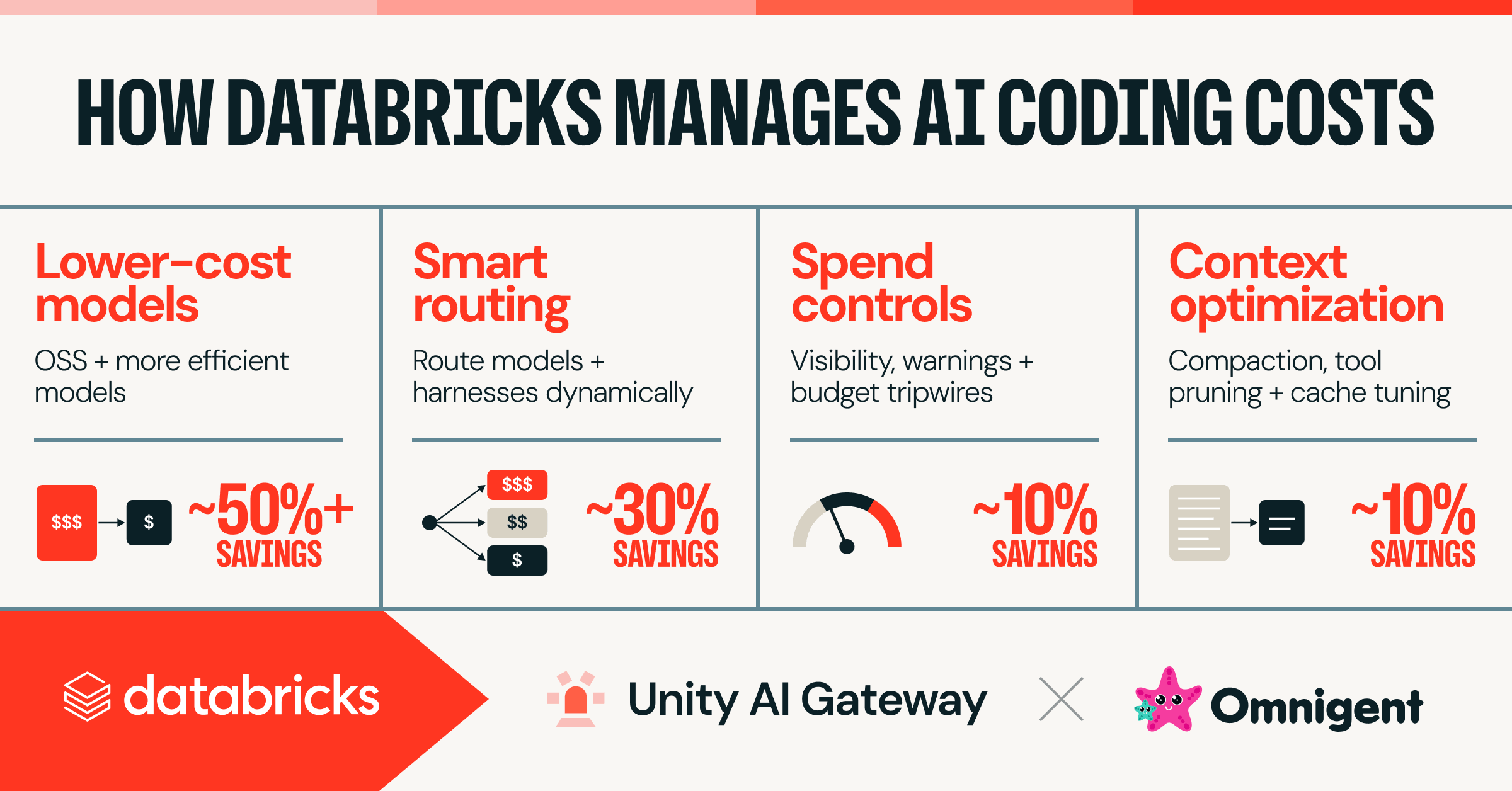
TY for the rich reply. As you're very aware of the cache issue, it might have been nice to have the word "cache" more prominent on your "Key Techniques" image (currently Lower Cost Models, Smart Routing, Spend Controls, Context Optimization; cache tuning buried at the end) or higher in the body sections.
It was mostly the image that prompted (ha) me to call out the marketing driven angle.
What’s the problem then?
Use a cheap ds4 or Luna and do the second model net net per one shot best case you save couple dollars per?
Anyway you'll likely get a more effective and up to date set of advice by skipping marketing pieces and pointing your favorite frontier model at /r/LocalLLaMA in deep research mode and asking it to synthesize the latest advice, or even try ideas out for itself and let you know what works for your own session history.
“use price controls”
Truly revolutionary stuff.
I feel like I have an advantage over big companies, if I can use the best models on a subscription and not worry about costs much, when they can't do the same as outlined in the article.
Maintaining the cache is extremely, extremely important, so we're iterating fast but that's a major factor we track in the router's development. Couple things I'd look at:
1. The cache is generally reset after a compaction - this is the best time to make a switch if you want.
2. In many cases, the max duration of a cache is 1h, so if a session is being resumed after a long time, that's also a good time to re-assess the complexity.
We're iterating fast here and learning a lot! Definitely a lot to think about it in this area.
An AI-edited post by the way.
bad engineer + llm = bad engineer.
https://www.databricks.com/blog/introducing-omnigent-meta-ha...
We're calling the layer coordinating harnesses "meta-harness'