243 points · by BaselAshraf81 · 3mo ago · 103 comments
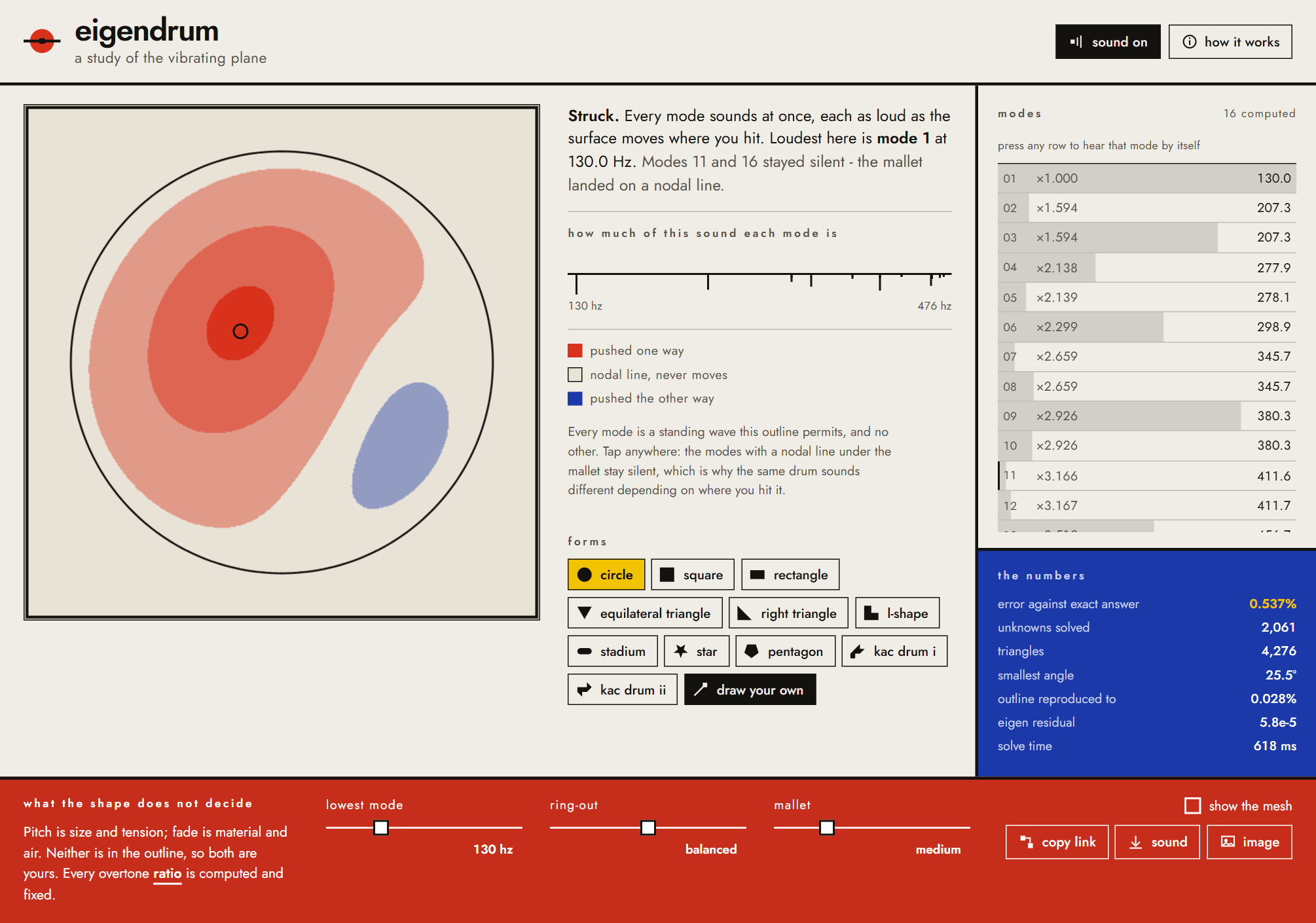
How it works: * Solves -∇²u = λu using finite element analysis (Kφ = λMφ) on a triangle mesh. * Validated to <0.1% error against closed-form solutions for circles (Bessel zeros) and rectangles. * Sound model factors in strike location, Rayleigh damping, and mallet width. * Includes Kac drums I & II to demonstrate identical sound spectra from different geometries. * No frameworks, build steps, or dependencies.
Repo and tests: https://github.com/BaselAshraf81/eigendrum
Happy to answer any questions about the FEM solver or Web Audio setup!
https://eigendrum.com/#s=__Ap66fz1em9-NXp7_6a6-0AJu1AAiTv6gK...
A ruder variation of that is "dat slaat als een … op een drumstel", or "that hits like a … on a drum set".
For some reason I felt like sharing this trivia.
Q: Generating higher quality sounds with a specified duration (e.g. within a 300ms margin) -- is it possible with your approach, is it hard, how would you go about that?
I'm asking because a few years back I had an idea for a breathwork/meditation app that would allow you to connect / control the breath duration using a gong sound. Example pattern: 4s in, 4s wait, 8-10s out. Next: use a feedback loop with the real user breathing pattern, slowly extend towards the goal.
Ended up with scaling it down to a "dot to stare at" + basic gong, because I realised how ridiculously chromatically complex the sound is. (my approach was to synthesise an envelope with a shape determined by time -- pity the fool who thought it was easy or even made sense!)
https://untested.sonnet.io/notes/projects-and-apps-i-built-f...
I got +100k people visiting it and still a couple dozen daily users running a 5+ min session, so I'm happy with it. But, the itch is still there, so I'd love to revisit my old nemesis so to speak :)
Also, if you want to chat about this, hit me up sonnet.io/posts/hi !
There are very few exceptions. Kac's drum paper is one. It's so nicely written!
Sadly http is not supported, it forces https for what I understand (from the title) to be a little web toy
Edit: same issue on Firefox desktop on Linux. It gets the redirect from github.io and then a ciphersuite mismatch. I now guess the host got some faulty update and it's not a me issue
Let me know if you still face any issues.
EDIT: The DNSSEC validation error was caused by a cached TTL mismatch during the nameserver migration. I've temporarily disabled DNSSEC while it clears up and am getting it sorted out.
It would be interesting if you could simulate and then print (or laser cut) your own instrument on demand.
Observation: I never saw the link between Wave Equation Solvers, Finite Element Analysis (Eigenvalues, Eigenvectors, etc.) and Cymatics -- until I visited the above web page!
Related:
Cymatics: Chladni Plate - Sound, Vibration and Sand:
https://www.youtube.com/watch?v=tFAcYruShow
Cymatics:
Also you can draw your own drums! What! That's so cool
thinking about it, each drum here would have totally different ideal scales to the others.
this is cool.
Also if you use an ad blocker, which I highly recommend, you wouldn’t have seen any of the ads or other stuff most of the comments can’t seem to figure out how to avoid.
It’s sad though that such a non-corporate site has such nasty ads though.
It does for me. But I do use an ad blocker (Wipr 2).
have you seen https://differentinstruments.com/ ?
I am genuinely curious, how?
I don't really care as much about the resume but I have to, I just graduated college.
My open source journey is starting and I want my creativity to be heard and seen.
Hope I answered your question :)
You can prove that changing the material has no effect on the relative frequencies: \lambda_2 / \lambda_1, \lambda_3 / \lambda_1, etc. are completely independent of the material.
The shape is the determining factor; changing the materials (and hence the wave speed) just dilates the whole spectrum.
Ring out controls how fast the higher modes decay (basically stiff vs soft material), The mallet width controls how many modes a strike can even reach, since a real mallet can't drive the high frequency ones very hard.
No labeled presets like "wood" or "metal" though, just raw sliders. Would be a fun addition if someone wants to map a few physically sensible combos to buttons. PRs Welcome!
Overall a cool tool, but pretty annoying. I point it out not really to criticize this project, but because I see a trend in software that has a holier-than-thou sort of paternalistic tone. LLMs are obviously rife with this, but I also see interfaces from some humans that give me the vibe of a snooty Parisian waiter.
If you find it interesting, a star on the GitHub repo helps a lot.
And don't forget to follow me on github, I build cool stuff!
What you have now is ridiculous.
You might want to do a human editing pass on the copy. This reads like it came right out of your Claude Code session.
"what the shape does not decide: Pitch is size and tension; fade is material and air. Neither is in the outline, so both are yours."