452 points · by dgellow · 3mo ago · 371 comments
https://en.wikipedia.org/wiki/1877%E2%80%931878_El_Ni%C3%B1o...
That being said, the existing energy crisis and fertilizer crisis can significantly compound the negative impacts of this El Niño even if we are able to anticipate it.
If by “us” you mean big corporations, which will then buy the stuff and sell it at a premium later, then I agree.
Corporations may indeed be taking advantage of this, demanding prices so low that the farmers don't get the benefit of those subsidies. However:
> buy the stuff and sell it at a premium later
Is the point of a futures market. Futures let people trade a thing before they even know how supply and demand will balance, guaranteeing a price for the producer and letting them plan purchases of machinery and maintenance, with the risks (in bad years) and profit margins (in good years) going up the supply chain.
I'm not so sure these days.
And what would you rather happen? If they don't store up a surplus then everyone will run out of food and prices will go up anyway. If there is less food because of a drought, prices are going up. If corporations start building up a stockpile then prices aren't going to go up as much as if there were no reserves.
TLDR; Yes. Good. It is a great day when there is food available at the local supermarket.
But it keep explaining what El Niño and Super El Niño and how it develops without giving me any context of how strong it will be.
It’s gonna be a weird one…
An extreme swing, here and there, has always been part of its nature.
The observed change is more and more extreme swings, greater amplitude, higher frequency.
We saw already around 2020 or so that specialists opinions didn't really matter. Feelings and politicians opinions were more relevant... so "nobody in planet modelling" means nothing if Politicians and Activists tries to create this link..
Al Gore, if I remember correctly, and António Guterres, i think last month, tried to create this link already.. probably others too?
in another hand, i question if we really could rule out, since back in the days, everything that we have was coal.
But the biggest effect and this is noted by many insurance companies now is going to be in places like India.
But this is something the world has never seen and I mean that literally so I don’t expect it to be anything but really bad and you should be ready.
People dying from extreme heatwaves, weather, and famines due to climate change has been predicted for decades at this point; and this is exactly the sort of climatic setup that will enable this to happen.
I was skeptical of this claim, so I looked it up. You’re right. Globally, about 9x as many people die due to cold-related causes than heat-related causes. It’s not freezing, though, but longer-term effects like kidney failure in elderly people. [1]
I’m still dubious about the argument that weather events could save lives, though, partially because climate change makes weather more extreme, not simply “more pleasant for people in colder climates.”
[1] https://ourworldindata.org/part-one-how-many-people-die-from...
What is happening, right now, is that winters are mostly getting warmer. Summers are getting hotter in certain places, but not at nearly the rate that cold days are decreasing -- and the evidence is weaker on a global scale. From the IPCC 6AR report, figure 11-9 shows it clearly:
https://www.ipcc.ch/report/ar6/wg1/figures/chapter-11/figure...
Figure 11-2 shows it another way:
https://www.ipcc.ch/report/ar6/wg1/figures/chapter-11/figure...
Even the IPCC report only gets to the "virtually certain" evidence level by combining the two claims:
> The frequency and intensity of hot extremes (including heatwaves) have increased, and those of cold extremes have decreased on the global scale since 1950 (virtually certain).
That's because, when you actually look at the data, it is abundantly clear that the increase in hot extremes are far less common than the decrease in cold extremes. Of course, when you take the ratio of the two, this looks worse, because the denominator is getting smaller.
Chapter 11 is worth reading. You will be shocked how many of the widely reported memes about extreme weather and climate are just not supported by good data:
https://www.ipcc.ch/report/ar6/wg1/chapter/chapter-11/
I recommend in particular going through the figures, and looking at how many of them are model predictions (nearly all), versus plots of historical data. Setting aside the debates about model quality, etc., surely we can all agree that predictions are not evidence?
Official reports have been downplaying the impact for decades, while countries have been setting climate targets that they had no intention of achieving.
>Setting aside the debates about model quality, etc., surely we can all agree that predictions are not evidence?
Predictions are warnings. When we have the evidence it will be too late. So let me ask you, what direction are we headed?
The rhetoric is all well and good, but if you look at the numbers according to the WMO[0], deaths from climate-related hazards have been dropping steadily in the 50-year period from 1970 to 2019, even as atmospheric CO2 went from ~326ppm to ~410ppm and the world population more than doubled. That's not a per capita decrease; it's an absolute decrease, from over 50k deaths worldwide the 70s to fewer than 20k in the 2010s.
All of this is due to the increased ability of humans to deal with what the climate might throw at them, mostly due to cheap energy unlocked by fossil fuels during that time. Remember, there are no countries that are both rich and have a low per capita energy usage. Surplus energy allows humans to build the infrastructure that makes them more resilient to disasters.
If I had to wager, more people will suffer and die in the coming decades from efforts to combat climate change (i.e. hamstring energy production and usage) than from climate change itself. You can already see this in the anti-air conditioning sentiment in parts of Europe.
Your last claim makes no sense. Is there actually a widespread political effort to ban air conditioning or make it hard to get in Europe? That certainly isn’t the case in the US. And yet hot summers are still killer in cities which aren’t accustomed to them: that’s climate change doing the killing.
Solar is just about the most abundant source of energy on the planet, and easily decentralized. Plugin solar is becoming increasingly popular and cheap, for example.
I think energy production would be much more abundant and directly in control of the people if governments stopped subsidizing energy sources that need massive amounts of resources just to keep running. Why not give solar an advantage when every watt installed can just… work by itself for the next three decades? Every watt of a gas plant needs you to figure out who to buy gas from forever.
https://www.scribd.com/document/979965270/Robinson-Kim-Stanl...
Eg: the severe disruption of the jet stream or the collapse of the AMOC.
Plus all the long term feedbacks like methane etc.
Lets not forget there have been bigger and hotter events than this in local past.
https://en.wikipedia.org/wiki/1877%E2%80%931878_El_Ni%C3%B1o...
You may tie this in to climate change in general to prove your point, but this is a discussion about El Nino weather event and it is important to remember the current situation is not unprecedented.
We do not have the same data for the 1877 event that we do for the last strongest El Nino in 1997. And this one is much stronger than that by far:
https://xcancel.com/BenNollWeather/status/208864941472211787...
Lets not speculate, currently there have been worse ones in the past. If this eventually becomes more extreme then yes it will become a big talking point, but it is not there yet.
El Nino warmed the earth more back then relative to average temperatures than it currently is now.
Yes, AGW is real. Yes, extreme weather and climate events have occurred before AGW. No, I am not saying that AGW is incapable of making these extreme events even worse.
For instance, California has experienced megadroughts lasting decades or hundreds of years in the relatively recent past.
In any case, the effects of extreme heat on the body are the easiest part of climate change to mitigate with current technology. The hard part is the famine.
He paints quite a bleak picture of the situation we are in (I tend to agree), but there's also a glimmer of hope in there.
No direct link, but click the "anomaly" map button just underneath the map. Hello all these similar 10+ °C anomalies that have sat around. Some colder spots too that have hung around! But yikes. https://climatereanalyzer.org/clim/t2_daily/?dm_id=world
I at least think of El Nino kind of running into South, building up in the Pacific. But the heat cuts across, then down, and pools in Antarctica here, is how I read it.
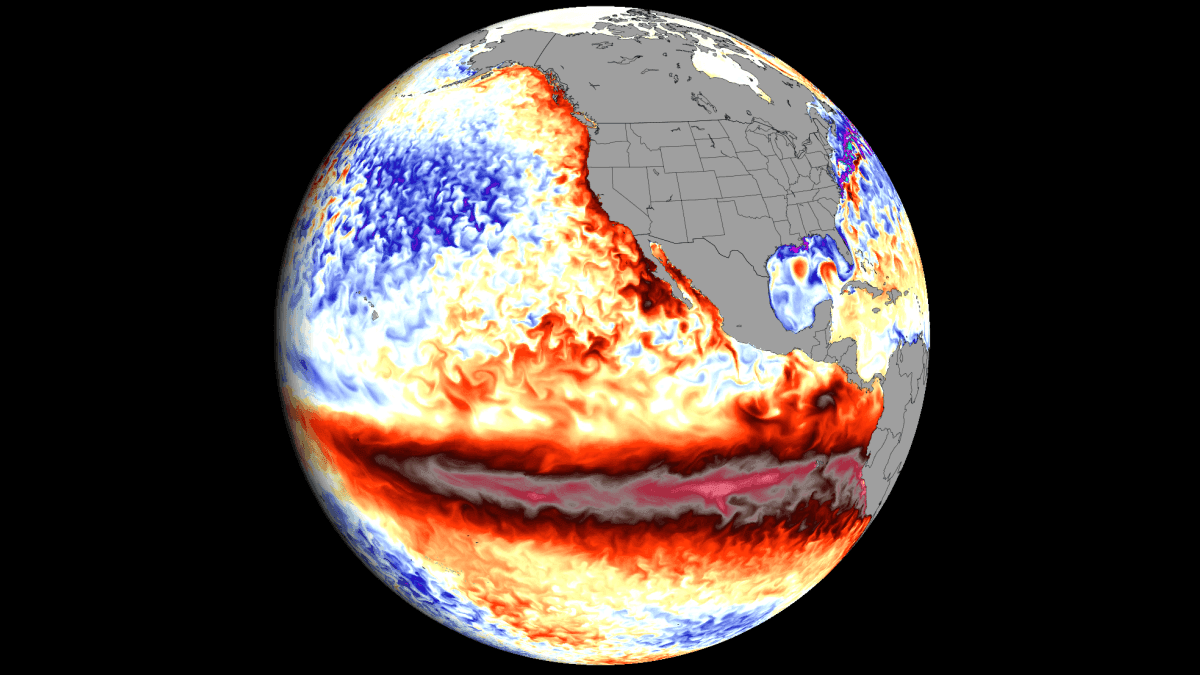
In simple terms, the ocean surface anomalies are just the surface footprint of this massive subsurface warm core.The article is so repetitive and padded out with empty prose that I found myself ignoring whole paragraphs. It's like the author decided to describe what an el niño is, then describe what an el niño is, then describe a super el niño, then describe what an el niño is, then describe what an el niño is, then describe what an el niño is, then describe the possible consequences of a super el niño, then describe what an el niño is, then describe what an el niño is, and finally describe what an el niño is.
If these are the temperatures on the surface, think of the depths. There is a whole additional dimension to multiply (integrate) across.
The added energy is far greater than you might think simply by looking at the surface.
Pelicans are mass starving so are sea lions as cold based fish have left the shores, no long sleeves or sheets needed to sleep, it's been summer prety much all year... never seen this in 31 years of life... supposedly 98 was bad although this one is projected to be worse... summer temps might hit 39-34 celcius on average if things keep going this way when normally you have 31-27 degrees during summer, considering most houses don't have air conditioning I can definitely see a lot of heat related deaths happening and a potential food crisis forming.
I (SoCal) kinda hate El Niño. Seems like it always means way more weather (blown out days) and most reefs around here are maxed out beyond overhead. It’s nice to get lots of groundswell but I’ll take 2-3 and high pressure over 6-7 and rainy any day.
And if it would be 42°C/107°F with fog and 100% humidity, lots of people would be dead already. But it’s more like saying “at least this building is not on fire right now”. Or 1km wide meteor is not crashing down. It is not, and anything near 40°C is really unpleasant, regardless of burning homes and falling meteors.
You step out of the shower and within minutes you're stepping back in for another.
It's humid here (50-60%) but public spaces are all ice cold indoors. I'm just here for a graduation, fly out tomorrow.
But it’s true, it’s easier to move around in 38C here than 31 and wet in Singapore.
Of course you don’t want to be caught in the sun, and those 44C summer days really are something else
Check a thermometer in the shade. The weather data stations reported an average of 101 ℉ / 38 ℃ for Waco. It's hot, and especially feels worse with Southern subtropical humidity. OTOH, 101 in California with 0-15% humidity, it would just be a bit annoying. Higher humidity makes heat qualitatively exponentially worse until it's a sauna.
Knowing what the temperature is at a far-flung regional airport in a shaded housing is not especially interesting to me. I understand the scientific value of collecting that data, but just in terms of lived experience.
And yes, I live in SoCal where it's rarely above 20% humidity when this hot, which is why I was whining about it there. :)
https://www.weather.gov/hfo/faq
https://energy.ecoflow.com/us/blog/when-is-it-hurricane-seas...
In the UK and other European countries, I see every month we're breaking records on the percentage of power generated from renewables.
Check out https://www.energydashboard.co.uk/live - it shows the UK is currently generating 30%+ of it's power from solar, which is incredible.
Batteries have only recently-ish gotten energy dense and cheap enough for electric cars to be competitive, completely different solutions are needed for long distance shipping by sea or air.
It's the same situation across many other sectors like agriculture, construction and waste management. Lots of things causing emissions that's not electricity generation.
If we just wait around forever for a perfect solution to appear, then we'll simply be waiting around forever. That's not the path of progress.
Why would you support a system that you recognize makes it impossible to do the right thing even as we're dying from its consequences?
Though my version of capitalism isn’t the libertarian free market one, libertarianism will always evolve into oligarchy or something fascistic given enough time, it’s just baked into the incentives.
My personal ideology aligns with a managed capitalism, markets are created by an authority that ensures the incentives aligns with its overall goals. Mixed with very liberal social values.
I don’t know if that can survive overtime though. And that would very likely degenerate into something else when under stress.
As I said, I feel conflicted. But I appreciate the question
Despite what people keep repeating on the internet, capitalism is a very general idea, and growth at all costs is not a value from it exactly.
https://www.cfainstitute.org/insights/articles/private-equit...
The US is busy sending warships across the planet to blow up oil refineries which will be rebuilt. It's not bad enough we are busy grinding sand, but we are actively making things worse.
Republicans are the bad guys right now.
There are ~200 countries, of course on average your country will be less than .5% of emissions. Thinking .5% is small enough to do nothing is exactly the kind of thinking that leads us to inaction.
So yeah, china and the US need to get their act together, but so does every other country.
Granted fossil fuels are much more ubiquitous than CFCs and comparatively more difficult to replace, but we have prior art for changing industrial practices in the interest of improving climate conditions.
We could have traditioned our grids off of fossil fuels but we also depend on them for fertilizer to feed the world and for transportation which, until very recently, didn't have a viable alternative.
This isn't even true at a local level, let alone at the global scale.
It's like being in a traffic jam and complaining about the other people in the traffic jam... Dude, you're one of them.
A single cow alone requires lots of crop, water, and produces tons of methane (which is 200 times more dangerous than carbon dioxide).
Fishing is another earth destroying endeavor. A single boat, a single one, practicing bottom trawling is more dangerous to the environment than the emissions of tens of thousands of cars. In a single day it can have the same impact of deforestation on an area big as a montain.
Seriously, stop believing the fossil fuels gaslighting. They are indeed a problem, but the cause for climate change is all of our toxic habits and our incapacity to say "enough", take the bus or eath healthier (for us and the planet).
What we need to do is all stop buying next day delivered pieces of plastic produced in Chinese factories. Boycotting Temu and Amazon and shopping at your local stores is the one massive thing the average person can do to help the planet.
The problem is: when it comes to industrial food production, both fish and meat are insanely taxing on the environment.
But people, we, *don't want to accept that how they eat destroys the planet*
I can understand that. I already have many thoughts and problems, do I also have to feel guilty for what I consume and eat?
But it's the reality, and focusing on transport alone is the narrative that keeps accelerating how fast we kill the planet.
We're defiantly in the rainy side of the scale. https://climatecenter.fsu.edu/products-services/data/statewi...
As for this seasons storms in WCFL, every week I see storms that barely move - often just sitting in place for an hour or more. It's a change from the historical lines that marched across the state.