NanoGPT Speedrun Frontier
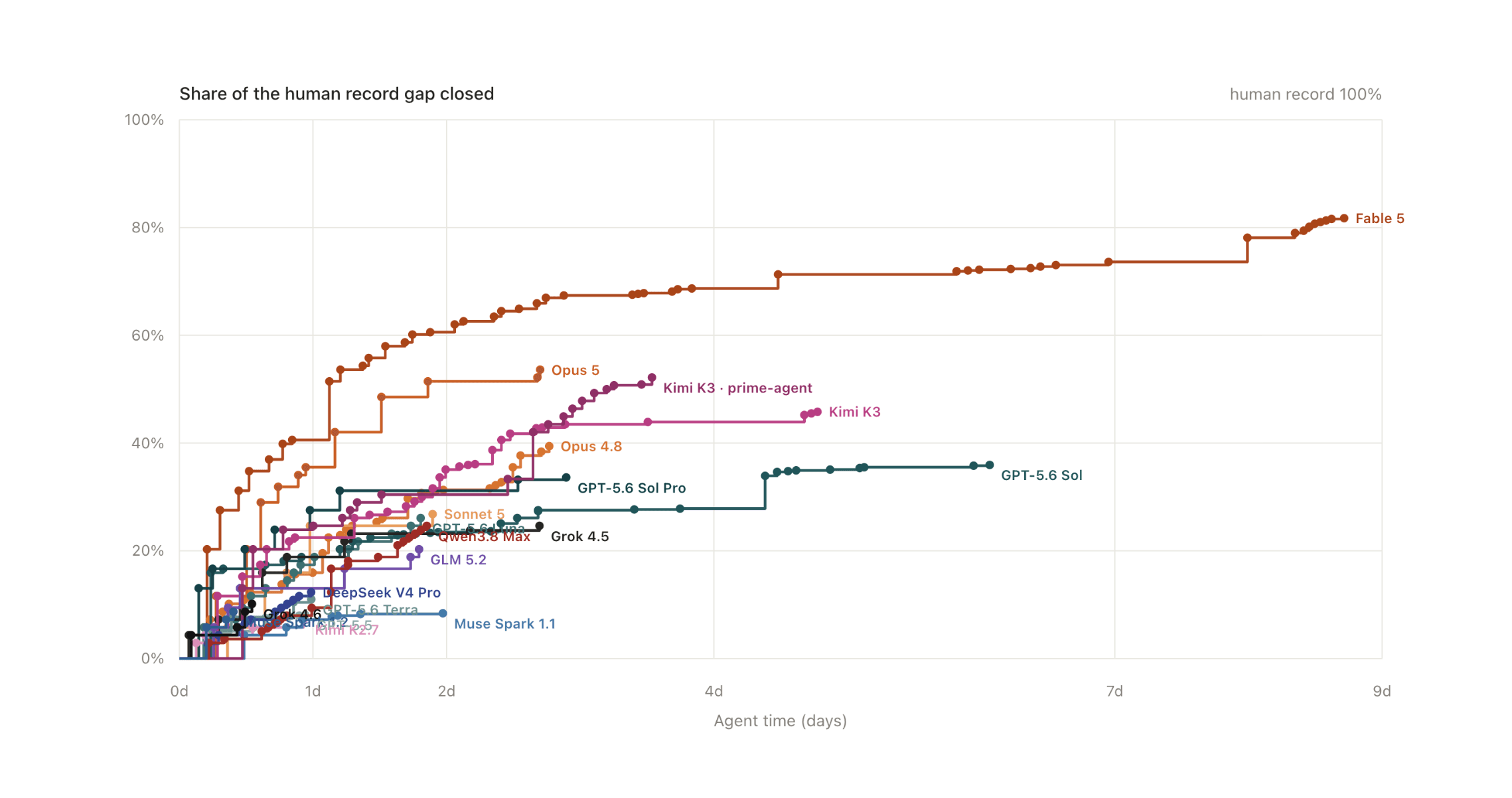
Compare 153 autonomous runs from 18 frontier models on the nanoGPT optimizer speedrun.
Prime Intellect
140 points · by stared · 3mo ago · 39 comments
Curious if a harness that helped preserve signals in some history log would change the outcome.
Also curious if different goal prompts would have changed the outcome. Not a bunch of prompt engineering; small diffs like "consider novel solutions, keep track of weak signals".
IMO they allocated quite a bit of GPU time to the same goal prompt.
I never ended up writing it up, but you can watch me spend $600 as it explored different experiments: https://github.com/rbitr/parameter-golf/blob/main/BUDGET.md
I found, similar to another comment, that it got in local minima very easily and continued to pursue loosing ideas instead of exploring (despite being prompted to do so and being aware of how much budget it had left). I also found it tended to ignore instructions. And one example, when I fed it a better solution that had come along from the public leaderboard, it ignored everything it had done and started exploring locally around that new solution, which wasn't very interesting or productive.
Would be interesting to re-run with a newer model but it's hard for me to justify the money again.
I'm also seeing notes like on Opus 5 saying it was a run with a older serial version of program.md, so the graphs aren't complete apples-to-apples comparisons?
Edit: the blog seems to address these https://www.primeintellect.ai/blog/measuring-autonomous-rese...
I found that if you leave them alone undirected, the models (especially GPT models) will rathole, but with the right scaffolding it seems to work pretty well. My general loop is to start with ideation and profiling phase, limit # of runs before forcing moving on to the next item down the list, and then iterating, potentially mixing models with "fresh eyes". This is probably something that could be fully automated, but I like checking in once a day or so and seeing what's happening and redirecting.
Uh.. okay.. but whats a run… read blog
“We want to measure how well frontier models can conduct research….””we ran 153 autonomous runs on the nanoGPT optimizer speedrun across”
Okay but what is a optimiser run and what connection does it have to being good at research?
“For comparison, Anthropic's internal automated AI R&D evaluation optimizes a model on a CPU node,”
So I should go look what Anthropic was doing to understand?
Why not just explain what it means in their blog..
- "A frozen verify.py accepts the claim" (what does it mean to freeze a python script?)
- "which trains the recipe eight times on fixed seeds it can't touch" (what does it mean to not be able to touch a seed)
- "One other detail is that we gave an estimation of the speedrun noise in program.md that was slightly too large. 62 out of ~100 runs measured it themselves instead of trusting our number" (What does it mean for a "run" to "distrust" a noise measurement)
- "One important disclaimer is that our benchmark has a lot of variance" (Actually this one makes sense, but congratulations for burying the lede that your entire article is bogus.)
- "Almost every model finds the same winning ideas. What separates the best traces is what an experiment leaves behind" (This implies the the graph would show every model finding a plateau in whatever metric the experiment is measuring, but I don't see every model scoring the same in the graph)
They gave 18 frontier models the task of “researching” how to improve a lab-rat nano model’s training. Stopping when it met a quality goal of a target loss rate. During each autonomous research session, the AI repeatedly tried changes, tested them, and used the results to decide what to try next. They repeated the whole research session many times with different seeds to average out variance.
https://www.primeintellect.ai/blog/measuring-autonomous-rese...
Basically they do 8 runs trying to optimize to under 3.28 loss in the fewest training steps possible under time/token constraint. I dunno why 18 * 8 != 153 (it's 144)
The former will perform well in these long horizon benchmarks. The latter won’t.
Does anyone know the ratios of pretrain, posttrain supervised as well as reinforcement learning? (I should probably even distinguish between RLHF and RLVR).
I assume the latter is the main reason for the power of modern models. Is it possible to turn the results of a gym session into trading data?
(Sorry for moving in off topic regions, but I'm interested in that for a long time.)
And like this section screams opus 5 gobbledygook to me
>Almost every model finds the same winning ideas. What separates the best traces is what an experiment leaves behind. They preserve weak signals long enough to validate them, but they also have a better understanding of the results. These are not separate capabilities, they combine both research taste and good noise modeling to climb the speedrun.
WTF doe any of that mean. What winning ideas. What experiment leaving what behind. What's a weak signal what are they preserving how do you know that they aren't. Also if youve ever looked at a Claude code transcript the harness is constantly re injecting random reminders to keep models on track, the models are writing (imo trash) memories to reference - did they test that the _model_ has those capabilities or model + harness?
> We see similar patterns across the traces: models develop their own experiment drivers, simulators, and analysis tools as they go.
What traces? Kimi traces? Other models in prime? Other models not in prime? Building their own research tools is like a normal thing models do now. Is this just like "they built their own test suite" or why the focus on prime? Does ipython somehow magically work better than bash for this?
> "We were again surprised by the lack of novelty. The models clearly understand the objects they manipulate at a deep level, and yet very few genuinely new ideas emerge, which makes it hard to tell if this is an artifact of the speedrun setup or a real capability limit."
I know it sonly one word but God is that "Real" such a Claude real lmao. I use it too - after I've been using Claude code too much. I guess the genuinely too. Also wtf does any of that mean and how does that square with
> "A good research decision is sometimes not to spend another GPU run. Several models built small simulations or tests to isolate a mechanism before going back to training with a sharper hypothesis. This wasn't systematic, but when it happened it often led to a better understanding of the object they were manipulating"
Did they all have strong understandings of "the objects" they were manipulating or were the strength of their understanding of "the objects" (different objects?) the distinguish factor here?
Also how does any of this square with
> Models also have different knowledge cutoffs which limits access to certain papers. This was a deliberate choice. We tried a few runs with a CLI tool for searching papers but found that restricting internet access including arxiv made models slightly more creative.
So this is a pre existing thing? Why TF would you expect novelty when their nanogot is benching below the state of the art still? They're gonna start with replicating existing work before they get to anywhere you'd expect something novel
Anyway - all that to say - if fable orchestrated this, its genuinely believable that some real insights were obtained (is a good model) but the honest caveat is that it's not the research quality, it's the communication. Your pushback is valid and these models have a way of writing tons of words that you can read and still not understand wtf they actually did or what anything means. Maybe it means something to them in latent space
Time is sometimes more about inference infrastructure (especially with systolic chips) than model quality (and providers tweak knobs to support higher batches at the expense of latency).
Tokens are not always fully equivalent between models.
I wrote a quick review of Grok 4.6 here: https://taonexus.com/publicfiles/aug2026/grok-4-6-review/
I'm a co-author on a recent blog post from METR about the NanoGPT speed-run here [1]. I think it'd be of interest to anyone who enjoyed the original post. Appreciate the good beefy runs and spend here, it's a (from my experience) not super easy to do!
(Also: just to label this comment clearly: it's written hastily from a car, and based on lighter skim of the original blog post [2] than would be ideal. Please correct any mistakes or misinterpretations I have here!)
A few callouts:
1. If I understand the experiment correctly, they start the models at the original baseline. If this is true, I have some worries about contamination. Appendix C [3] has some notes on likely contamination we observed in recent models. This makes interpretation a bit harder.
2. If you look at the token scaling plots in the original post: not all models are hitting a performance plateau. This is an important point: we shouldn't treat these results as a full upper-bound on capabilities, but rather some bound on model performance @ cost (assuming good scaffolding, etc).
3. Our post is mostly about how to _interpret_ the results given here. Quoting from our post: "If we can estimate performance as a function of cost for both humans and agents, we can measure the “expenditure horizon” as the point at which those curves cross: the budget at which humans become more cost-effective than AIs. "
Feedback appreciated. I think you can see expenditure horizon as a sibling methodology (that is much less validated) to METR's time horizon work [4] - roughly, instead of baselining against the time it takes humans to complete tasks, you baseline against cost. This may be better suited to some types of problems similar to NanoGPT.
[1] https://metr.org/blog/2026-07-21-expenditure-horizon/ (Most of this work was my coauthors listed on the post, not me. I'll claim credit for any mistakes though :) ).
[2] https://www.primeintellect.ai/blog/measuring-autonomous-rese...
[3] https://metr.org/blog/2026-07-21-expenditure-horizon/#append...
[4]https://metr.org/time-horizons/
(Edit: METR is hiring. Email is in bio if you're interested in helping AI companies and wider society understand the capabilities and risks of AI.)
"We were again surprised by the lack of novelty. The models clearly understand the objects they manipulate at a deep level, and yet very few genuinely new ideas emerge..."
See you next year, guys?
Such a cheap model, and Sonnet levels of performance.
I've had a lot of success with dsv4-flash on these type of tasks, where it's easy to set a threshold for the task, and just loop it until that threshold is reached.
oAI's Luna play is really good. They've slashed the prices, the model is somewhat capable, and you can use it both for these kinds of long horizon tasks, or you can hand-hold a bit and get extremely cheap results out of it. And they get to keep devs in their own ecosystem.
The graphs show the "best validated result" for each model. I wonder how much variation there is between runs for a model?
Interesting times ahead.
HN has traditionally been very mindful of free products such as from Google and FB, yet seem to ignore those concerns when it comes to open weight LLM models, including FB's Muse Glimmer.
Who food the bills and what are their motivation? You never ask yourself that?
Lol.
1. https://github.com/KellerJordan/modded-nanogpt#world-record-...
I just ran it the last couple days extensively to verify my data training pipeline I'm building for my gonano SIMD port.
Given that the speed records and the runs are sponsored by the same company I was confused a bit.