Who Pays — what the tariffs are costing Americans
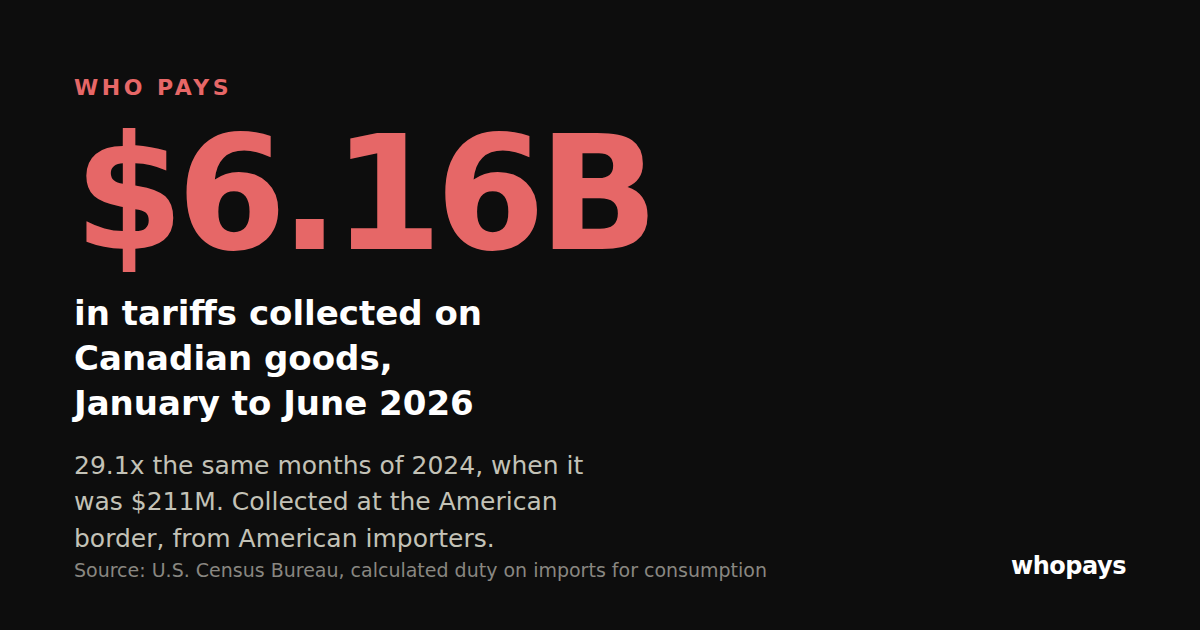
$6.2 billion in tariffs collected on Canadian goods so far this year, 29 times the 2024 figure. Counted from US customs data, state by state.
Who Pays
231 points · by mikestorrent · 3mo ago · 307 comments
This seems illogical. You can't simultaneously claim that the US is paying higher prices for Canadian goods because of US-imposed tariffs and then turn around and say only that Americans are paying a tax on buying Canadian goods on Canadian-imposed tariffs. Both countries are either paying higher prices or paying higher taxes. Canada's tariffs must also be viewed as America is taxing Canada back, or else neither can be viewed that way.
Separately you can go back prior to 2024, for example, and discuss monopolization of Canadian companies and import duties on American products which also must be treated in the same fashion for this analysis - Canadian imposed tariffs on dairy (I don't care about dairy other than it being an obvious example) would have to be claimed to be an American tax on Canadians for this to be consistent.
Whatever claim you would levy here, equally applies to Canada minus the dollar volumes depending on which country imports more and what products are imported since Canada is also implementing additional (because they've had tariffs for a while) tariffs on specific goods/services.
  “[Canada] has a large dairy producing constituency that it wants to protect, so they put a cap on imports that can be accessed at a competitive rate. That's what we call a ‘TRQ’ (tariff rate quota),” says Becky Rasdall Vargas, senior vice president of trade and workforce policy at the International Dairy Foods Association. Under the TRQ, Canada accepts a certain amount of dairy products duty-free, without tariffs.

  "Rather, Rasdall Vargas blames the dispute on “a systemic set of failures” by Canadian administrators that intentionally prevent American dairy exports from reaching the import cap. These protectionist measures are intended to support Canadian dairy farmers. One rule, for example, requires that Canadian dairy processors be the primary recipients of American dairy products.

  “If you’re a U.S. exporter, you're going to want to sell to your customers, not to a competitor,” she says. “Another one is that retailers aren't eligible to obtain an import license quota in Canada. There are layers upon layers of rules that ultimately prevent U.S. exporters from being able to fill those quotas.”
[1] https://www.farmprogress.com/farm-policy/the-real-story-behi...
That's why the USA has never reached the tarriff limit. The big producers there would just dump 20 million litres at once if they could. They aren't interested in 1 or two.
And if they were able to do that, the Canadian producers would go under. So its kinda simple, the Dairy Supply system is there to protect the Canadian Dairy industry. If it was removed, we would be flooded with cheap, low-quality US milk.
The entire Canadian dairy industry produces less milk than Wisconsin alone. Why does the US need the Canadian market? A: They don't, they just want it anyways.
We have cows too, and farmers.
I'm a Canadian who is pretty unhappy with our protectionist dairy lobby, and thinks there probably is a bunch of unfair trade barriers erected on our side by the dairy lobby.
I'm probably more open to this line of argument than the majority of Canadians. However, when I see an American who has literally anything to do with their federal government start making these arguments, I more or less have to assume it's either a lie, or at best a truth that's going to be twisted, blown out of proportion, and used to undermine the sovereignty of my country.
The furthest I would go right now would be to support a relaxation of our dairy protections in dialogue with the EU, and then whatever scheme we arrive at can then be applied to trade with the USA at a later date (including requiring dairy imported from the USA to meet EU-level food safety standards).
The USA simply cannot be trusted to be anything like good-faith negotiators.
(I would emphasize that I don't think this is bad in some cosmic sense, and Canadians have every right to keep the shelves stocked with Canadian butter only if they would like.)
For example Canadian tariffs increase prices and their retaliatory tariffs also reduce demand for Canadian products leading to job losses.
It's really a singular achievement to piss off such a good neighbor so badly.
Correct. But Canada didn't start this trade war, all it can do is respond to it.
And the correct way to respond to a bully, fraud, and liar is tit-for-tat. Tax his exports, tax your irreplaceable exports. Tax and block his digital and media services.
Not only for foreign goods. If there's a tax on imported X, domestic X producers can now charge more because the foreign producers must raise their prices to pay for the tax.
Another way to look at it is that any tariff reduces foreign competition, with all the knock-on effects that implies.
Whether or not that is true, I have no idea. One would expect there to be enough diversity of trade that on the balance it cannot be that lopsided, but maybe that's wrong. It is certainly possible for one side of a trade war to be hurt both coming and going, without any logical inconsistency.
It is. When Canada imposes retaliatory tariffs, it is of course a tax on Canadians. Though it is also a market inducement, and one of the complaints of the admin is that Canada's retaliatory vehicle tariffs -- literally mirroring the tariffs the US applied to Canada -- caused a 22% drop in imports.
> import duties on American products which also must be treated in the same fashion for this analysis - Canadian imposed tariffs on dairy
Can you tell us if those import duties are in the room with us? Because you know they didn't exist, right?
There have been $0 in tariffs on US dairy. The tariffs only come into play when the US imports pass a certain volume -- and precisely the same tariffs happen in both directions -- and the US hasn't. Now the US has complained that there are administrative barriers, and maybe so, but they sure aren't clear on what they are, and lie about everything constantly.
Prior to this trade war, there was essentially 0% tariffs on products from the US. And the only reason there is a trade "deficit" is because of massive amounts of Alberta oil that the US desperately needs. I mean, it's hilarious that Trump was literally celebrating bringing back Keystone XL, and increasing the flow of Alberta oil, while simultaneously complaining essentially about that very same oil.
This is, as the WSJ named it, the stupidest trade war in history. All for yet another distraction, as Trump's entire base just desperately need to puff their little chests and celebrate when they think he is punching down on someone. Even if it makes their lives worse and their lot worse.
> There have been $0 in tariffs on US dairy. The tariffs only come into play when the US imports pass a certain volume
So there are tariffs on US dairy... Maybe the US can just say well once 50 cars are shipped in from Canada we impose 300% duties. I'm not part of team Trump here or anything, but these kinds of arguments are semantics - at the end of the day neither Canada, China, the EU, or others who claim to be free-trade economies (in some sense) are really living up to the hype, whether that's outright tariffs, or complicated regulatory or policy schemes to circle around what amounts to a tax on foreign produced goods.
> This is, as the WSJ named it, the stupidest trade war in history.
Wall Street (and the WSJ) also helped move American jobs overseas. So are you aligning with corporate America's viewpoint on trade? They also want much lower corporate taxes. :)
> All for yet another distraction, as Trump's entire base just desperately need to puff their little chests and celebrate when they think he is punching down on someone. Even if it makes their lives worse and their lot worse.
I don't know that this is a distraction and it would be a mistake to dismiss these concerns out of hand as chest-pumping.
>Let's set the framing correctly because I think we're starting off on the wrong foot. The US is not in a desperate need of any product from Canada. Nice to have and super important? Yea. Desperate? No. Not by any stretch of the imagination.
Literally yesterday:
“This country desperately needs aluminum,” Trump said. “Selfishly, we need aluminum in this country. We don’t have it. We get it all from Canada for the most part, and we need it badly.”
Note that Trump said this within hours of claiming "we don't need anything from Canada". What else does the country need that Trump has lied about (that you seem to have bought hook, line, and sinker)? Have you considered another source of information?
Well you can start with potash (very much a critical need according to the United States Ambassador to Canada), and oil (according to the US voters), electricity (according to several million American households).
That's not even to mention current and future supplies of critical minerals. Remember how much Trump panicked when China cut off critical minerals? You'd better hope that doesn't happen again.
aluminium, potash, and electricity are more than "nice to have"s
The US oil stockpile is rapidly declining, it is desperately buying up bonds to try to prop up the market ($40T debt, deficit spiralling, and now your orange goblin is talking about using the military to prop up the bond market...which good God), and now Vance is running around trying to make lemonade out of lemons and talking up how no longer being the reserve currency is a great thing. Utter idiocracy.
Canada needs absolutely nothing from the US.
> I'm not part of team Trump here or anything, but these kinds of arguments are semantics
It isn't semantics when $0 in tariffs were applied. What an utterly stupid argument. And this was all precisely negotiated into USMCA -- you know, the trade deal that your hero called the best trade deal ever -- for which we gave concessions.
Trump takes advantage of his base being catastrophically stupid and misinformed, and what a case in point.
>I don't know that this is a distraction
It is 100% a distraction, for a monumentally stupid base.
Personally I want USMCA torn up, as a Canadian. Loads of Americans are catastrophically stupid -- the most impossibly misinformed group of people on this planet -- about how privileged you have been, and what you have to lose.
Also, we've never had fully free trade. You can whine about dairy, we can whine about unfair lumber tariffs. These are all part of CUMSA, an agreement that has been illegally violated every damn day under Trump's regime. Let's just cut to the chase. If Trump won't honour CUMSA why make any deal with him? There is no reason he'll honour any new agreement either. He was the one who negotiated CUMSA in the first place.
I don’t disagree. I just wanted to point out the framing needs to be consistent, which I think you agree with.
I also agree with you with respect to free trade. Every exporter is a free trade proponent. Curious how when it comes to imports or protecting domestic industries all of a sudden every country in the planet puts up some sort of protectionist barrier.
The statutory requirements of Section 338—specifically requiring a formal finding of discriminatory disadvantage against U.S. goods (hard to prove under CUSMA’s preferential framework) and strictly "offsetting" remedies—make the sweeping 50% broad-based tariffs legally vulnerable.
Likely Outcome in Court: A federal court will likely grant an injunction temporarily staying the tariffs pending a full review, or strike them down entirely as exceeding executive statutory authority under Article I of the Constitution.
Aside from that, the "obvious" dairy tariffs you speak of are almost entirely theoretical. Those are anti-dumping tariffs that kick-in only when a certain threshold has been met. It never has.
That's not to say there aren't trade barriers. The US side argues that there are market barriers that make reaching those quotas impossible [0]. It's a fair point and worth discussing. But let's call it what it is: it's a dispute about opening up a potential new market. Nobody has been over-charged and no American farmers have been "ripped off" (quoting DJT).
If the end result is the same, do the details matter? Absolutely. Being overcharged or ripped off is something that gets people heated, (which is exactly why Trump uses that inflammatory language). Being denied market access because of administrative hurdles to a small-ish niche in a relatively small market like Canada? Not so much.
Please don't repeat the falsehood that dairy tariffs are an "obvious" example of where Canada has imposed fees on American companies. The truth is more nuanced.
[0] https://www.farmprogress.com/farm-policy/the-real-story-behi...
What about others' contention that the reason why the quota hasn't been hit is that it's a pain to make use of?
Trump is taxing Americans when he imposes tariffs. Canada is taxing Canadians when they impose retaliatory tariffs.
And FWIW, most economists think retaliatory tariffs are stupid - on net they cause more harm to the retaliating country than if there were no retaliation. But the politics around tariffs are stupid too. It's all stupid.
This is wrong, because you're using the extremely broad concept of "harm" for a specific monetary loss. There are many more things at play here than just money gained/lost.
You can't divorce these tariffs from their geopolitical context, which is Trump threatening to annex Canada.
This whole trade war with Canada has to be one of the dumbest fucking things I have ever witnessed, and that's saying a lot given the complete incompetence and buffoonery of the current US administration. First they had to imitate Idiocracy with the the WFC fight on the White House lawn, now they're imitating South Park by killing relations with Canada. Heck, a big joke in the original South Park movie was that it was so inconceivable that of all countries Canada is the one we'd have a war with, but Trump just wants to speed run to every country on the planet hating our guts.
Summary quote from IMDB: "The U.S. President, low in the opinion polls, gets talked into raising his popularity by trying to start a cold war against Canada."
Sure that's fair, but on the other hand that's what was written and the framing I think is unfair and inconsistent. Of course, others may go along happily reading it and thinking wow we created these tariffs to raise prices and Canada decided to tax us!? That's worth clearing up and being honest about, in my view.
Imagine someone writes another article and frames it as though Americans are taxing Canadians with tariffs. Surely folks would want to "clear that up" wouldn't they?
Yes - you are technically correct that each country is taxing its own citizens/businesses with tariffs. I also agree that phrasing is more honest than what the article states
But for interconnected supply chains, the result can get pretty muddled.
Ex -
Canada sells wood to a US company. US applies tariff.
That US company sells a component made of that wood back to a Canadian company. Canada applies tariff.
That Canadian company uses that component to produce a good that's sold to US consumers. US applies tariff.
etc...
For the end purchasers of the finished product - the net increase in price (the final "tax" you pay) might be a summation of various tariffs applied by both countries as they interact with each other.
The price increases at the final sale are additive, regardless of which country is capturing the tariff as tax. The real result is that the product is just more expensive to make when tariffs are in place, and so must be sold at a higher price based on the total tax applied to all parts of the product (regardless of where in the chain it was US/Canada/China/Other/Etc actually capturing a tariff).
Ex - you will pay more because of US tariffs, and more again because of Canadian tariffs in response to US tariffs.
You'd think that, strategically, a decapitation strike is the worst thing that could happen for a nation. However, that would be incorrect: the worst thing that could happen is this, a vain and incompetent buffoon installed in the top leadership position. With no leader you're just not making decisions, but the organization can continue operating under autonomous cells. With a hyperactive incompetent leader you're speedrunning every conceivable bad decision and everyone just has to look on in horror.
Well, Canada repeatedly elected Justin Trudeau (now departed)... so both countries have made some... interesting decisions...
So what do you do when your government is effectively bankrupt? You’ve accumulated more debt than you can realistically repay without imposing enormous economic pain, but you still need to keep the country functioning. One historical answer is an inflationary cycle combined with a trade war.
You impose tariffs on foreign goods, which creates government revenue while also making imported goods more expensive. You then blame the resulting price increases on foreign competitors and trading partners. But the tariffs themselves are inflationary because businesses ultimately pass much of those higher costs on to consumers.
As prices rise, nominal tax revenues also rise because governments are collecting taxes on larger dollar amounts. Meanwhile, governments have an incentive to continue borrowing, spending, and potentially expanding the money supply to deal with their fiscal problems. More money chasing higher-priced goods creates further inflation.
The critical part is what inflation does to existing debt. If you owe $1 trillion in debt today, but inflation dramatically reduces the purchasing power of the dollar over time, that $1 trillion becomes much easier to repay in real terms. The nominal debt remains the same, but its real economic burden shrinks.
So you can end up with a feedback loop: tariffs increase prices, higher prices increase nominal tax receipts, fiscal pressure encourages more borrowing and monetary expansion, monetary expansion fuels more inflation, and inflation gradually erodes the real value of the government's existing debt.
In other words, rather than explicitly defaulting on the debt, you can effectively "inflate it away." The creditors get paid back in dollars, but those dollars are worth substantially less than the dollars they originally lent.
The danger is that this isn't free money. The cost is ultimately transferred to consumers, savers, wage earners, and holders of government debt through reduced purchasing power. And once inflation expectations become entrenched, controlling the cycle can become extremely difficult without causing a recession or other severe economic disruption.
What happens to consumer spending and associated tax revenue when imported goods cost significantly more? Let's take a hypothetical German auto brand that has no factories in the US (BMW, MB, VW have factories, not sure if Audi and Porsche are grandfathered in because of VW).
If a car that cost $100K before and now is $125K, it seems that the demographic that could afford that $100K will shrug and pay the higher price. Now, that's the well-off folks, a bit immune in this economy.
What other consumer goods with imposed new tariffs will cause less spending and shrink the economy instead? It seems that tariffs are a net loss, besides I guess in cases when they are used to prevent dumping.
Capitalism will keep producing things where they make sense not where politicians want.
Exceptions make sense only to protect industries that are absolutely vital and critical for security. Ship building should be one of those for countries like US or UK.
Or when you want to kickstart an industry and need to protect it for a limited amount of time (Koreans and the Japanese both did so with some of their industrial sectors, but it was always time limited).
This administration thinks it can make every industry thrive through tariffs.
I don't see how it can work, even for a country with the resources of the US.
Yet, protectionism for that, as practiced in the US (ie. jones act), was a massive failure. There might still theoretically a domestic shipbuilding sector, but it's bloated, inefficient, and as a result is totally not up to the task of standing up to China, which does have a competent shipbuilding sector.
Exactly. The tarriffs are but a part of the attack on the previous status quo.
The current Admin is hostile to neoliberalism, globalism, the maritime order, sole superpower, international comity, etc.
We've been heading towards a multi-polar world order for a while. It is what it is.
The current Admin is speed running the transition. There is no theory, workdview, vision for whatever comes next. Or how to get there. Just cronyism and patronage.
The prior Admin, whatever its faults, had a plan for navigating the transition, unwinding neoliberalism, to invest in domestic capacity and supply chains. (And it was working.)
But now the plan is calvinball.
What do we need that shouldn't make domesticially?
Learn from my mistake:
* $19.99 item cost
* $21.25 shipping
* $2.99 tax
* $31.94 import fees (billed directly by UPS)
Total cost: $76.17
We purchased a Subaru Outback right around the first round of tarrifs. We were in the market for the base trim, no bells & whistles. We ended up getting the highest trim bc all the remaining base trims were post-tarrifs and and cost $3.5k more than the pre-tarrif higher trim that was already in the lot.
Mind you the Subaru outback was assembled in IL, USA so it is not just imported entirely from Japan.
And that's not considering all the other "consuming" we do (which is quite limited being outdoor ppl).
The average car on the road is ~15 years old. The actual lifetime is likely higher. Therefore for proper tariff accounting, your subaru's contribution to this year's tariffs should be 3500/15 = $233, not $3.5k. Not to mention much of the items people buy are either:
1. domestically produced (this includes housing, the biggest cost for most people)
2. tariff exempt (think oil)
3. produced abroad, but have fat markups
Not everyone is buying brand new cars
Which is to say that anybody with a $200 subscription and access to Namecheap and Netlify could have built the site in one hour flat. There's no longer any need for an NGO, media nonprofit, or lobbying group to build such things; the effort required has been reduced to near-zero, so anybody can do it.
Right but actually creating the thing is only half the story. You need to fact check it (especially with LLMs) promote it, approach journalists to bring it to their attention, etc etc etc.
In many ways making a web site has always been the easy part.
That's true... but with every day that passes it's increasingly less true. Today's best high-end LLMs are highly optimized towards fact checking themselves and each other. The winning move is to get a report from Claude and have both Kimi K3 and GPT-5.6-Pro adverserially review it. Then synthesize a fixed version with any one of them. Then adverserially review it again in incognito mode.
This sounds like a lot of work, but it takes literally two minutes of effort and it works amazingly well.
Well it's not very hard these days with social media. All you need to do is post on HN with a compelling enough headline and people will upvote it even if it's AI slop.
It's basically just documenting the utter stupidity of a trade war with a close ally with whom we are tightly coupled economically.
Because I don't want to click through to every data source to verify every figure and need some baseline level of trust about whether they've been correctly used.
If there's an error, I want to be able to contact the author somehow.
The answer I keep coming back to is I know zero people who considered that.
Does the US have a trade imbalance that causes problems, particularly in our manufacturing sector? Yes. Can tariffs kind of help with that? Also yes. Really, you need to instill some sort of sense of duty to country in business leaders, which is a far heavier lift, but this at least puts a number to it.
Does picking a tariff fight with Canada, our closest cultural ally, solve the above problem to the point where it justifies the costs? Hell no.
America then refines it and exports it as finished product or uses it internally -- one of the reasons why America has relatively cheap gasoline prices.
This "trade imbalance" is a massive benefit to America.
So just to expand on why that's the case. As a net producer of energy right now, the US produces more than it consumes. This is why it get's pointed out, that as a net producer, the trade deficit with Canada is also a surplus (or reduction in deficit) on the other side with other countries. Yes it may not be the same physical barrel that is exported vs consumed, but in a fungible way they're commodities. If you separate out that portion, we (Canada) then buy more goods from the US then we sell. And that's also just the goods trade, not including services which the US also sells more of to Canada than the other way around.
I have a trade imbalance with the local grocery store: I buy lots of vegetables, but they don't buy mine.
My employer has a trade imbalance with me: They buy lots of my labor, but I never buy any of theirs.
The term has become unhelpfully pejorative, the "imbalance" is often desirable and beneficial.
Not to mention, Canada can make nukes if it wants to. It just doesn't. It gave them up, but still has the plans.
Canada relies on US and is isolated from the rest of the world, US can strangle it economically if need be until it folds.
They can also cause divisions inside the country and disrupt it.. we're seeing this already in Alberta.
Canada is vulnerable.
Tariffs will not bring back manufacturing. They increase prices of inputs, reduce incentive for competitiveness and invite retaliation. Look how well tariffs have worked for Brazil and Argentina or for the US under Smoot Hawley.
The geopolitical calculations regarding China and the socioeconomic conditions of working class people in the Midwestern and Northeastern United States would beg to differ.
You need to have at least some control of your own manufacturing destiny for national security reasons, and you need somewhere for people with a high school diploma to work or they start dying deaths of despair.
The job situation is unfortunate but these jobs will not come. China has lost more jobs to automation than the US has to China. If we want people to prosper we need to build housing where the economy is and encourage people to move there.
While we have lost tons of factory jobs, we have created lots of service jobs that require similar skills. There has been a boom around jobs like solar installation, HVAC and similar. They just aren't as visible because it's a little bit everywhere, rather than a company or industry town.
This idea that we have lost manufacturing and we need some push to onshore it all again is... well... another manufactured problem that isn't.
Goods are imported because business is a competition and consumers prefer cheap imported goods. Its not like american executives flatly want to offshore, if a competitor does and they dont their customers will leave. The only solution business leaders can have here is collusion, which is illegal. If we want goods to be manufactured domestically it is on us as consumers to buy domestic products over cheap imported ones.
Buying and selling don't need to be equal between buyers and sellers, and it's really just an incoherent idea.
Canada has things that our economy needs desperately (e.g. potash).
Yes, because Canada has a lot of cheap oil which America wants. If you deduct oil, the trade deficit runs the other way.
If I were king of Canada, I would restrict supplies of such materials needed by red states.
Some things are bigger than money.
... which, come to think of it, is something that the current administration doesn't understand, at least from a "personal net worth" standpoint, and explains why this is happening to begin with.
I was born in America. About half of my ancestors lived in Canada on both sides of my family, I know my Canadian cousins, I spent time in Canada growing up/was taught Canadian history as well as American history, I have a Canadian education and half of my professional network is Canadian, etc. I'm eligible for dual citizenship and am pursuing it now, as are other members of my family, whereas we never bothered before because the separation never seemed to matter. With the recent change in Canadian citizenship laws, I'd estimate at least 25% of the Great Lakes population is eligible for dual citizenship at this point.
One of my parents and some of my siblings are Ojibwe/Anishinaabe. My paternal cousins are all French Catholic. (My dad's parents were Protestant but my aunt married into an old French Catholic family and converted.)
I don't even really know how I would separate out the two nations' influence, and that's true of a lot of people, especially those of us whose families have lived here since before America and Canada existed.
The bigger problem is, when consumers have the choice between cheap crap from Aliexpress et al and (vastly) more expensive made-in-<own country>, usually only the affluent who want to show off will be able to choose the latter.
And that is a socially explosive thing in the long term... the masses, especially the rural ones, really do not like it if they feel that they can only afford subpar crap while the "rich urban librul elite" gets access to the good stuff.
That is the stuff that in the best case fuels populist movements, in the worst case revolutions.
(And on top of that, often enough "made-in-<own country>" is bordering the legally required limit on domestic production or is outright just slapping a label and repackaging the Thing)
It isn't just "which Americans consider trade with Canada to be a real issue," it is "which Americans think Canada should become a territory of the United States."
It's just plainly absurd. It is inexplicable to me that Congress doesn't act. And infuriating to me that my representatives in Congress don't do more (even though they are in the opposition.)
I can ship UPS instead and then push the tariff back where it belongs, but nobody wants to pay 4x for shipping and then get another bill afterwards. US Customers already screamed bloody murder about a total $4 duty fee, which anyone in Canada would kill for on an international purchase.
First, when you list something like a financial figure, you must also include the relevant time period. E.g. you say 16.0B in taxes collected by Canada from American exporters. But you don't list the time period.
Second, you say 313 are taxed today. What is this in reference to? Goods? People? Companies? Percentage?
The labels need some serious love.
Take this snippet for example:
  American exporters
  $16.0B of what American exporters sell to Canada sits in headings Canada taxes today, 10.5% of the total. From 8 September it is $26.5B.
  See whose jobs
"See whose jobs" is even more confusing. Nothing about jobs was mentioned. It's talking, presumably about an increase in a tariff collected by Canada. I can understand this will affect certain jobs, but "See whose jobs" just confuses the situation more. I cannot figure out for the life of me what's going on.
Here's another example when you click the "nuclear option" it jumps, without context beyond "Canada’s energy supply is a fourth exposure, and a different kind" to this:
  The nuclear option

  Canada has not done this, and nothing here predicts it will. But tariffs are the smaller lever.
  Flip the switch to see which states buy their energy from Canada, and whether they have anywhere else to buy it.

  Crude cost per gallon
  $1.86
  what everyone else charges, up 26¢ a gallon

  Both figures are prices the United States actually paid   this year: $67.17 a barrel to Canada, $77.92 a barrel
  to everyone else, across 704 million Canadian barrels. Careful with the gap, though. It is not a pump price,
  since refining, distribution, tax and margin all sit on top of the crude. Nor is it really a discount: Canadian
  barrels are mostly heavy crude, and heavy crude sells below lighter grades wherever it goes, so a lot of the
  difference is just the grade. What replacing one with the other would cost is a question this page does
  not have the data to answer.
My guess would be it's refering to the Harmonized System[1], used to classify goods on import and export declarations:
The HS is organized into 21 Sections, which are subdivided into 96 Chapters (Chapters 1 to 97 with Chapter 77 reserved for potential future use by the HS). The 96 HS Chapters are further subdivided into 1,228 headings and 5,612 subheadings in the current 2022 edition of the HS.
Most countries have additional subdivisions, for example in US the HS is used as a basis for the Harmonized Tariff Schedule[2].
The classification is used to determine tariffs, taxes and restrictions, but those are often applied to the broader groups, so covering say all imported aluminum, rather than say aluminum of a particular kind for use in a particular sector.
> Whatever this means, how does it jump to $26.5B from $16.0B on a single date?
Because Canada announced it will impose tariffs on more types of goods on that day, ie more headings, affecting more of the exported value.
[1]: https://en.wikipedia.org/wiki/Harmonized_System#Structure
The language is very like Claude Code with Opus 5: no prepositions, unclear references, ambiguous, bad phrase transitions, ...
And the css is exactly the same that Claude Code uses for its artifacts and documentation.
You also might want to consider archiving the data if you aren't already given this administration's tendency to remove data that doesn't further their agenda.
If Carney was serious he'd fly to Beijing and shake Chinese hands. That would utterly terrify the few responsible adults left in Washington to back the fuck down.
"Canada is taxing you back" frames a Canadian tariff as a charge on Americans when it's really charge on Canadian importers.
The site reached the front page of HN because it confirms the mainstream opinion here, which is "go team go," anti-Trump admin US.
I'm not pro-Trump admin btw; But I am anti political team sports on HN and will continue saying so until HN reverts to its previous culture of objectivity that we had before this culture of blindly signal-boosting anything that portrays the current boogieman as bad.
I share your disdain for political team sportism. But not everything is indecipherable without requiring that lens, and that is unusually often the case with this particular administration.
this administration has three boxes it reaches into to sprinkle around daily
[CHAOS] [CORRUPTION] [CRUELTY]
hope everyone is enjoying the billion spent on golden statues in DC while you can't afford to put gas in your car
but don't worry, he still gets to fly around in his billion dollar QatarForceOne while taking $2 Million golf outings each weekend
The Senate, literally by design, does not represent the will of the people. Add things like gerrymandering on top and the uphill climb required of Democrats to capture the Senate keeps getting higher and higher.
how's all those cabinet members working out for you?
that's 100% Senate, regardless what you think of its representation
we can argue the details later if we somehow survive this decade
btw all the nuclear treaties like weapons in space have been allowed to expire
and he's looking at invading Cuba and Greenland if only for the chaos
without full control over Congress the next two years are going to make the first two pale in comparison
This strategy is going to fail and when it does countries will trade much more one with others currencies and less with USA and USD. When that happens the American house of cards will collapse because it will no longer be possible to print trillions of dollars and count on other countries to absorb them trusting in the American policies and agreements.
The printing dollars formula facing low single-digit inflation is coming to an end.
U all can downvote me like on the credit-card thread but this is the reality for those outside the big American walls.
1. The U.S. economy is large, but insular. Most trade is between states, not with other countries. This is why most countries shrug and accept tariffs on their goods. For them, trade with the U.S. is not as big of a deal as it's portrayed, so it's not worth risking "fireworks" over. Canada and Mexico are rare exceptions to this. Canada, particularly, is reliant on international trade and trade with the U.S.. That's why they are fighting back for a deal that's better than slow death.
2. Canada is the #1 export market for a lot of American goods. e.g. Autos. Trump is determined to destroy Canada's auto manufacturing sector and bring it all to the U.S.. That might sound good to Americans, but they need to realize that this will necessarily mean they'll lose their #1 export market. If tariff's freeze Canada out of the American market and the Canadian auto industry dies, there will be no incentive to maintain the trade barriers against Chinese autos. Thanks to heavy automation, China is producing better autos than North America can at a fraction of the cost. American autos will be more expensive than ever after a forced retreat from Mexico and Canada and will be totally unable to compete on price and quality. Then there will be the lasting hostility to American products that Trump has caused.
3. Americans should closely examine some of the demands that were in the deal Canada just walked away from. One was for Canada to follow U.S. trade policy with other countries, no questions asked, no variations allowed. e.g. If the U.S. decides Tuvalu needs to be tariffed, Canada would be obligated to as well. Canada would also need to ask permission to sign trade deals with other countries. This would have been a complete surrender of sovereignty and would have reduced Canada's international trade policy to that of an American vassal. Not even an American state! This was a completely unacceptable proposal that was likely introduced to sabotage the negotiations. Howard Lutnick's last minute arrival and direct financial interest in generating more tariff refunds is not getting enough attention.
4. Americans are mostly ignorant of the fact that one of the biggest trade wars of the last century is going on with their Northern neighbour. Of those who are aware, the overwhelming majority are not supportive. Canadians are universally aware of it and overwhelmingly in support of Carney. Canadians have been cutting travel to the U.S. and buying fewer American goods for over a year. Now they're going to do it harder, and many won't stop even after the trade-war ends. Kids are watching their parents read labels in the grocery store to make sure they're not buying American goods and asking why. Trump can negotiate a new trade deal with Carney but he can't negotiate away the sense of betrayal Canadians now feel.
5. People are saying that Canada is too small to win this trade war, but this is not even remotely true. In Canada the war is supported because it's a matter of sovereignty, which is priceless. In the U.S., it's fracturing the Republican party. In Canada, people are voluntarily boycotting American goods and services, as well as travel to the U.S.. In the U.S., there are looming mid-terms that rising costs from a fresh trade-war could help decide. The most recent tariffs imposed by Trump were likely aimed at forcing an agreement he could tout as a "huge victory" right when he needed it. Instead, he has an embarrassing fiasco blowing up in his face. He's so short on ideas that he's threatening to rename lakes! The U.S. may be big, but U.S. leadership is small, inept, and poised to lose it's hold on power. Carney has signalled that he's ready to maintain this trade-war for the two years and change needed for Trump to leave office, but a few months may be all that's required.
Anyone who says this is an idiot. People have sacrificed far more for far less. As you pointed out this is existential for canada. It is just so, so hard to win a fight that the other side sees as existential when you dont.
Which is to say, if Canada sorts out inter provincial trade, pivot to domestic goods/services and sell commodities globally at benchmark prices it on paper come out ahead. Nvm associated brain drain via US integration killed what was left of Canadian tier1 industries (not much to be done). Or half reason CAN has to sell cheap to US is US lobbying (read political meddling / foreign influence) on infra/pipelines. Or discount NORAD which LBH missiles over polar orbit aren't stopping at Canada, as if Canada needs to free ride on NA security architecture.
TLDR is Canada always loser of even happy vassal arrangement, the carrot was always stale but it dint' need to be sweet with how big US stick is. But stick not big enough to force CAN to deepthroat new rotten carrot arrangement. At least not yet.
The whole story about why the talks failed:
https://www.nytimes.com/2026/08/25/world/canada/trump-carney...
US having veto over Canada trade negotiations, dictating language policy which could cause Quebec to cede from Canada, and stop the "buy Canadian" policy put after the last tariff round etc. It not even a stick anymore it is a proper gun which blow in the face of any Canadian who agrees to these terms.
Most Canadians believe that even if we signed an updated deal, Trump would just break it. He's done it already with a lot of these tariffs. So why even bother? What's the point, of negotiating and dealing with liars and cheats? EG, the US.
Just look at the bridge deal. We negotiate a deal, build a bridge for billions, then at the last minute? Rip up a signed agreement and reneg. After the money is spent. It's pathetic. I expect better from used car salesmen. It doesn't matter why, for what reason, it reflects 100% on the US, it's not just one man.
We don't trust the US any more. It lies. It cheats. It scams. We used to buy US weapons, but now we don't trust that, either. I can imagine spending 200B on weapons, and then the software just stops working.
The US used to be the most trusted, beloved nation by Canadians. I think many Canadians would trust Iran, China, Russia more than the US now, to keep a deal.
And that?
That's a pathetic outcome, from a pathetic administration.
If you're playing a single football game, the lesser winner is the loser. However, the economy is not a single football game. In real life the lesser winner is still a winner.
Generally believed by orthodox economics whose credibility is not so hot. CUSFTA, NFTA, USMCA... there was brief decade in 90s with CUSFTA integration where rising water lift all boats, but realistically Canadian growth in 00s was on the back of commodity supercyclic and inflated real estate. In real life the winner takes home $10000 cheque, the second/third winners take home participation ribbons, and sometimes they come home battered and bloodied (US buyouts in highend because CAN champions lack of scale never could compete once barriers gone ). In real life the lesser winner still has to look at opportunity cost of playing the game in the first place. Was there a more profitable game where runners up get $5000? Which is not to say participation trophy was not the optimal play, i.e. the opportunity cost of not joining common industrial base might have been more detrimental, maybe global capital wouldn't enter Canada in first place, maybe not playing = atrophy at home. But surviving + participation prize winner not the same as a take cheque home winner.
Is hacker news going to be at the table?
The wild part is that I'm quite academic, Waltz, Mearsheimer, Morgenthau are on my wall.
Okay let's get flagged for saying the uncomfortable silent part(chatGPT joke)...
Canada suffers more than the United States.
And a lot of Canada's trade MOUs with other countries basically requires they have this special privilege. So there's gonna be fallout everywhere.
I wouldn't personally want to own Canadian dollars right now but I think they'll get this figured out.
This talking point keeps getting repeated on HN. Always without sources because the only source is a dubious White House "report" that is nothing more than a manufactured reason for buying an expensive new AI system (probably from a big donor). https://www.whitehouse.gov/wp-content/uploads/2026/08/The-Gr...
That same report equally names the European Union, India, Israel, Japan, Mexico, South Korea, and Taiwan alongside Canada. So literally every modern western economy is making this "pretty easy"? Yeah, ok.
Here's a NYT article from April about the difficulty in preventing transhipping.
https://www.nytimes.com/2026/04/07/us/politics/tariffs-trade...
I'm not saying trans-shipping doesn't happen. I'm sure it does. But your framing was entirely baseless.
canada is very unfortunately caught in the trade war between the USA and canada
Re: Canadian dollars, it's the US dollar that I believe is the more salient concern [0]
[0] https://www.morningstar.com/news/dow-jones/20260825307/bitco...
If you're suggesting that Canada is facilitating the covert smuggling of Chinese steel and aluminum then I'd require a bit more evidence. It's become fashionable for the US government to level such accusations, but as we saw with claims about fentanyl, it's all bunk.
Ottawa is fighting Anchluss. The MAGA wing is entirely serious about annexing Canada.
Carney, for a change, is right. Canada is being attacked.
The rest is too woke, too British, and too CCP oriented to work with.
Wow, that's some amazing propaganda you've bought in to there...
He posted a picture of him taking over Canada and arresting Carney today.
That is not propaganda. And if you say it's "joking", if you threaten to shoot your friend multiple times, you'll find they don't consider it a joke.
Ukraine was used as a pawn to anger Russia. What did Russia try to do and continue to do so?
Canada has been used as a pawn to threaten America by China, and Canada is trying to pivot from the USA to China?
Ukraine is a sovereign country, free to decide for themselves which military and economic bloc best suits them.
Russia rolled tanks into Ukraine after denying they were planning to attack, airdropped special forces into Kyiv after denying they were planning to attack, repeatedly threatened the use of nuclear weapons even though they're not willing to admit to being at war and Ukraine doesn't have nukes, tried to assassinate then candidate-PM Yushchenko in 2004, annexed Crimea, committed a bunch of warcrimes while doing so, and they did all this even though Ukraine only gave up its nuclear arsenal under the condition that its sovereignty would be respected.
> Canada has been used as a pawn to threaten America by China, and Canada is trying to pivot from the USA to China?
Canada's primary pivot is away from the USA, not towards China, e.g. Canada also deepening ties with the EU.
Asking them to change French programming laws, and stopping the "Buy Canadian goods" law etc.