276 points · by totetsu · 3mo ago · 210 comments
We had floods in Sikkim, which is practically a "stone throw" away from a world-level map point of view. I was there then. There was past research but everyone was so surprised. Activists talking about that event 10 years prior. Published reports.
Yet, we do nothing to move people away. To pause and think what the hell is going wrong. Just keep hustling and pretend shit is not going to go wrong. I am tired of our* culture.
our: all of us, I am not only talking about India, Nepal or China here.
Someone said that it's because we humans are very good at reacting at immediate danger and very bad at reacting at risks building up slowly.
I don't know if it is true, but by today still voting for parties denying climate change all the way and that have done nothing in past years to prevent this type of risks is crazy.
I have a tiny lithium battery on a desk in my lab that started swelling about a week ago. I've been meaning to go to the recycle place every day since then to drop it off, but nothing exploded yet, so here I sit with a slightly swollen battery some meters away from me.
I'd say you're just about right :)
This month a 'hunger stone' appeared in the Danube, indicating the levels for pre-20th century famine.
And various other markers in many countries for 'the water reached this level', ironically, on the side of existing buildings.
Yet we build closer and closer to rivers because (flash) flood events happen rarely, and typically not in our lifetime.
That's changing. Even though I'm 64, I suspect that I'll be seeing a lot of "not in my lifetime" stuff happening, before I pop my clogs.
As a friend says, "Our collective cognitive dissonance is something I would not want to climb with a bike."
We failed.
Humans are really good at stealing, lying, beating their wives and all sorts of other bad shit too but you don't see people going around saying "aw shucks, it's just nature, whatcha gonna do". One of the benefits of society is to tame human nature in such a way that we all benefit more than we lose and those benefits let us outcompete the adjacent society whether that's the cavemen or a nation state.
Whichever society figures out how to marginalize the voice of the unprincipled, the emotional, those who lie with plausible deniability for their own (often not even financial, just in their own damn head) self interest and overall detriment will mop the floor with the rest of them.
The entire Himalayan foothills area (which includes what, at least 6 different major countries off the top of my head) are potentially impacted by something like this.
Most of these areas are barely surviving, and extremely poor, and often very disconnected from the rest of the country due to the terrain.
Realistically, what do you think they could have done to prevent this, given the likely 1/1000 or lower chance it would happen to them specifically?
Use science based zoning and not build or populate known hazardous areas.
The ultra narrow valley surrounded by steep walls should set off one's self preservation senses.
It did when I saw the first video from this disaster. Normally you don't hang out too long in a couloir.
There are only a handful of areas on the planet without known disaster exposure risk. Maybe zero, really.
https://timesofindia.indiatimes.com/city/chandigarh/kiratpur...
https://citizenmatters.in/shimla-illegal-construction-urbani...
https://timesofindia.indiatimes.com/city/shimla/muck-in-rive...
https://www.thehindu.com/news/national/himachal-pradesh/supr...
"Florida Gov. DeSantis signs bill that deletes climate change from state law" <https://www.npr.org/2024/05/17/1252012825/florida-gov-desant...> (2024)
"North Carolina Literally Passed Laws Against Science on Sea-Level Rises" <https://www.sciencealert.com/you-can-t-outlaw-hurricanes-how...> (2018)
The way I justify it in my mind is that, by all accounts, there's never been a global civilization of any kind on this planet before. Especially not one with sentient primates connected by instant telecommunications and powered by capitalism. There is no existence proof that this can work. So when it seems like it is failing, I take solace in that maybe it's not even possible.
I'm really not sure if any combination of political and economic systems could have avoided the mess we find ourselves in. Capitalism and free enterprise powered by fossil fuels does seem like it strapped a booster rocket to our inherent greed and inability to live in balance with our surrounding ecosystems, and now we've got an unhealthy combination of massive momentum and no political will to redirect human development towards sustainability. It's going to be chaos because global civilization seems to be uncontrollable and voracious. So, buckle up?
Aleksey Yurchak coined a term Hupernormalisation and it works here too.
We know the reality, yet leaders keep telling us via TV, social media... that everything is fine.
We know that they know that we know.
Fake world? Matrix? Escape from the freedom?
https://deming.org/wp-content/uploads/2020/06/inconvienent-t...
On the other hand, there's also a market for generating outrage and panic, sometimes justified, sometimes not.
So not the best metric for what majority of people want.
Also the wants are manufactured in many parts.
From wiki:
It argues that following the global economic crises of the 1970s, governments, financiers and technological utopians gave up on trying to shape the complex "real world" and instead established a simpler "fake world" for the benefit of multi-national corporations that is kept stable by neoliberal governments
So I don't think it'a new thing, but maybe it's getting worse
The century of the self must be recommended also.
How else will they make easy money from illegal and unsafe constructions.
There is always the "it was the will of god" excuse.
This will continue till we wisen up and elect the right people, select the right people.
This is part of the problem:
The problem is not necessarily democracy, but rather the insight the lack of bandwidth in voting ballots. A few bits every 4 years or whatever? Contrast this with the rate of modification in the law of a jurisdiction. Define the "democratic grade" as the ratio of binding democratic input in bits/per year to the changes in the binding law in bits/per year.
The problems aren't the concepts of democracy, but that humanity was sold a muzzle with a nameplate stating "democracy".
One may argue that it was necessary in the era where most democracies were initiated, until large enough fractions of the population become educated, but justified or not, its hard to defend today.
Every time you spread the message that we just need to "vote right" you too are in a novel way a part of the problem.
When the political class are questioned they utter inanities like people should be grateful that God Ganga maia waters have come to bless their lands and homes.
It is a racket. This will continue till we start electing people who respect the scientific methods and their conclusions.
Yes and that is broadly the safe option. One can build on geological stable high grounds. They are rather and more difficult to build on. We know what happens when we don't.
> Sure, politicians and contractors could do better
It's not mistake of the "oops a typo" variety.
They are knowingly making a freakton of money by endangering the people who ought to know better. I agree sometimes the poor might not have viable alternatives that they can fund with their own bank balance but it seems this is where the governments should step in to fund alternatives. But why do that when there is easy money to be made.
But these people who want to make a buck building garbage somewhere it won't last are largely counterbalanced by the equal and opposite people who seek to financially benefit at society's expense by harnessing the screeching of the useful idiots to get sprinkler systems mandated in garden sheds and mail order carports require engineered plans.
They're basically two sides of the same "slimy people who'll lie for a buck" coin.
For example, there were recent floods, is a location were previous governments had not developed. Now the current government rather than taking accountability are claiming that affected houses should be grateful that they have been touched by the river god.
Difficult to believe, but some people fall for the propaganda.
https://timesofindia.indiatimes.com/city/chandigarh/kiratpur...
https://citizenmatters.in/shimla-illegal-construction-urbani...
https://timesofindia.indiatimes.com/city/shimla/muck-in-rive...
https://www.thehindu.com/news/national/himachal-pradesh/supr...
Why do they have to be “moved”? They are perfectly capable of moving themselves as I can attest to seeing them flooding into my country by the thousands. “The people” make their own choices.
Rather, the entire front face of a glacier at high elevation sheared off, likely millions of tonnes of material at least, crashed down a steep runnel, slammed into the opposing slope on the other side of the valley at the bottom, made that partially collapse, dammed the river for several minutes, and then all descended at high speed as the dam failed, with the results we see.
Some reportage is still saying there was an earthquake - there wasn’t - the landslide itself was the source of the seismic waves.
https://earthquake.usgs.gov/earthquakes/eventpage/us7000tbwb...
USGS is a fact finding organization. They do not regulate. They have been around since 1879. The land surveys they have done made huge impact on society. The reliability of surveys that they have facilitated has made an impact on industrial civilization that few will understand or ever hear about.
For context that's not where the flood happened, there's a massive mountain range in between those vallies reaching over 8000m (Shishapangma).
In earth science there are thousands of worst case scenario models published, but it's hard to actually predict reality.
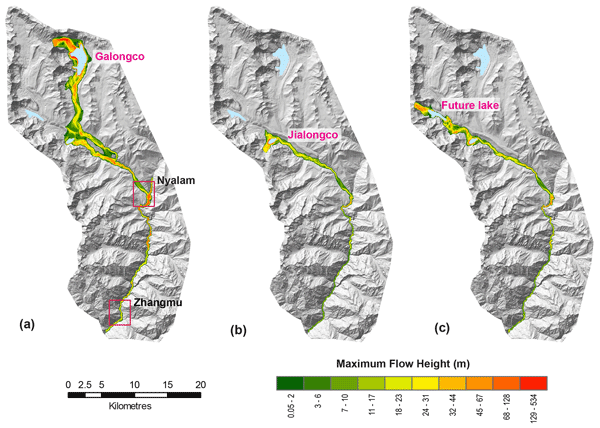
[1] referenced as Allen et al. (2019), https://doi.org/10.1016/j.scib.2019.03.011
[2] https://ars.els-cdn.com/content/image/1-s2.0-S20959273193015...
Looks like a warning siren could have saved some lives. But apparently this was a black swan.
What is your definition of black swan? This paper is from 2022 and scientists have been warning about climate change for decades. It's not like this possibility wasn't anticipated. It seems likely we'll see more glacial events as the atmosphere warms.
It usually takes entire icebergs calving off to produce such seismic events and intense monsoons to create such flooding.
I've been reviewing what coverage I can find of the present event in Nepal/China, in context with Section 5.1, "Comprehensive approach to disaster risk management", of TFA.
It seems that what would be required would be:
- Active surveillance of glacial lake formation.
- Active mitigation of glacial lakes, reducing risk.
- Warning and response infrastructure, procedures, and protocols along the likly flood path.
From video of what I presume are among the worst-hit areas (see: <https://twitterwebviewer.com/?tweet=2092542957060841592>), there appear to have been at best a few seconds of warning. Very robust structures are demolished virtually instantly. Even had people been sheltering within those structures, or headed up-slope above the water flow, either structural integrity would prove insufficient, or response time inadequate to reach a safe elevation above the debris flow. The latter problem is compounded by what appears to be an extraordinarily strong air blast (likely hurricane-strength or greater) as well as massive amounts of airborne debris, much of it rock.
Terrain is severely constrained in the region, and the only buildable regions are in river valleys themselves. The Gyirong Port border crossing is located deep within a river channel, and despite robust construction simply could not survive the event.
See:
<https://en.wikipedia.org/wiki/Gyirong_Port> (Wikipedia article on the port.)
Map / satellite view: <https://www.google.com/maps/@28.2792579,85.3752907,1341m/dat...>
(Take a few minutes to examine the region around the port itself ... there are several communities and businesses all well within the disaster zone, and I suspect that obliteration to those matches or exceeds what was captured on video at the crossing itself.)
From the first video at this Twitter post, a camera situated roughly 20m above the base terrain did not survive the event (though it transmitted for roughly a minute).
A second camera (I believe near the same location) shows similarly catastrophic damage, and no chance for anyone at base level to climb to a safe elevation before being overtaken by the debris flow.
Wikipedia notes "Floodwaters reached settlements as high as 270 feet (80 m) above the river level", citing <https://english.onlinekhabar.com/rasuwa-flood-in-pictures.ht...>.
Climbing that far would require 4--8 minutes for even a highly-fit person. Available response time in the videos I've seen is on the order of 1--2 minutes. Anyone beginning within the debris zone is already walking dead.
As the Cowboy Junkies said:
But if there's on thing in my life
That these years have taught
It's that you can always see it coming
But you can never stop it
Anticipation isn't sufficient. Other than entirely abandoning such locations during all periods of high risk, loss of life is likely, and catastrophic property and infrastructure damage inevitable.<https://en.wikipedia.org/wiki/Lake_Agassiz>
<https://www.nature.com/articles/nature08954>
<https://www.sciencedirect.com/science/article/abs/pii/S00335...>
- The site captured in the video, the Gyirong Port border crossing between China and Nepal, was struck by the flood roughly seven minutes after the presumed avalanche thought to have triggered the event.
- Flood inundation is seen up to 800 m (2,600 ft) above river level, and the camera position in the video at approximately 20--25m (roughly 6--8 stories) above ground level was engaged in the debris flow.
- It would take a fit person 4--8 minutes to climb even 250m or so above ground level, presuming instant notification and a clear evacuation path. Even with an instant warning of upstream conditions survival was overwhelmingly unlikely.
- Subsequent footage appears to show complete obliteration off all structures, with no trace remaining. This is based on preliminary imagery, without precise location information, and in a landscape changed beyond all recognition.
- Astoundingly, two survivors from the Port are mentioned in Wikipedia presently.
Though yes, one of the peculiarities of flood risk is that elevation equals safety. That's modulo a number of other factors though.
In particular, with an event of this magnitude, wind blast is a major effect. Toward the end of one video a line of buses in a car park is seen shifting backward, I suspect due to wind. These can reach well above hurricane force, and of course carries its own debris and threats, where even grass and straw can penetrate deeply. There's also the risk of secondary landslides and the like in steep terrain. One of the regions affected by this event has an etymology from "mud wall", which may be a reference to the geology of the canyon walls themselves. Those could easily be unstable.
Best option is to be lucky and not be there when things go horribly wrong.
Rescue operations in Nepal are in good hands, but this is sadly because those same response orgs had to respond to a similarly brutal cloud burst floods back in 2013 [0], 2021 [1] and 2025 [2].
It also shows the very real and brutal effect climate change is already having, and will only get worse.
[0] - https://en.wikipedia.org/wiki/2013_North_India_floods
[1] - https://en.wikipedia.org/wiki/2021_Uttarakhand_flood
[2] - https://en.wikipedia.org/wiki/2025_Kishtwar_district_flash_f...
That’s just pure horror, nightmare material
You could probably count 100+ people in the death zone of the border crossing video alone. The final death toll will be terrible, with most never found.
For indians, you also have the religious aspect because the immigration center you go to to visit Mt Kailash is there.
That immigration building was the white one that got completely shredded in the popular video going around.
https://en.wikipedia.org/wiki/1970_Huascar%C3%A1n_debris_ava...
Similar death toll. Also Orion.
>During the last deglaciation that followed the end of the Last Glacial Maximum, geologists estimate that a cycle of flooding and reformation of the lake lasted an average of 55 years and that the floods occurred dozens of times over the 2,000 years between 15,000 and 13,000 years ago. U.S. Geological Survey hydrologist Jim O'Connor and Spain's Museo Nacional de Ciencias Naturales scientist Gerardo Benito have found evidence of at least twenty-five massive floods, the largest discharging about 10 cubic kilometers per hour (2.7 million m³/s, 13 times that of the Amazon River).
https://en.wikipedia.org/wiki/Channeled_Scablands
https://en.wikipedia.org/wiki/Missoula_floods
Also it's interesting if you start reading about Native American flood stories, these were not just tales or legends but telling actual historic events that the ancestors experienced.
https://en.wikipedia.org/wiki/Missoula_floods#Early_flood_st...
From rock climbing, I have a sense of erosion features and their scale. Turbulent flow can carve out huecos in sandstone. They look like someone used a 2ft ice cream scooper on the rock.
Now trying to scale up that model to the size of scablands is hard to wrap my head around.
This is one of the few interesting things I've learn from the rogan podcast.
exceptionaly brutal cctv footage from the tibet/nepal border, so many people that there is a tiny chance that perhaps one of them was tossed clear, but of the rest there will be no remains. other videos shows that the flood "water" is so thick with mud that it is sheering off in sheets and one more shows it ripping out a concrete bridge that then floats away on top. *disturbing video
<https://english.news.cn/20260827/a8eb0a7aedb34d9181793f5fbc0...>
Otherwise China report 3 dead and 558 missing, not clear if at the port itself or the surrounding county, or how accurate counts of those present at the port might be.
Not sure this is confirmed at this time.
fixed, but some things are better off wrong perhaps
Not long after that, Ethiopia was in the news for... anyone?
Lots and lots of ignoring scientists. Nothing new here.
Cassandra
But do you have a statistics on how often these predictions are wrong?
I mentioned a personal anecdote, and a personal observation that things people think are new; are not, in fact, new. Us old people do that a lot. We've seen a lot of stuff.
The usual HN rude demand for "statistics," which almost certainly exist; both pro and con my observation, was made. Basically "Do a whole lot of work I don't feel like doing, and if you don't, you're wrong! (Nyah-Nyah)"
I said no. You show me yours (I know they can, if they look). It was a casual statement, on my part, and I really don't care about being right. It's not worth it, to me. If someone else has something to prove, go for it. I won't defend my position. I left (dropped out of, actually) High School, a long time ago, and what other people think of me, doesn't really drive me, anymore. I'll happily cede the point. If I decide they're right, I may even admit it.
In any case, exchanges like this get quite amusing.
Since you don't have them, I have to suppose you just like being on a high horse...
"As placed in the press by the same think tanks upselling tobacco" - yes.
Paid for and spun as media confusion by powerful oil and resource extractors, such as but not limited to the Koch brothers, yes.
As a reaction to the late 1960 papers on CO2 impacts being taken seriously by world forums - yes.
But an actual significant number of atmospheric scientists and global modellers "panicking" about glacial expansion of the ice age we're currently in (you know, an ice age being any era during which ice covers the poles) ... uhhh, no.
Mainly as that didn't happen.
I remember them referencing global cooling on science Friday on NPR as late as 2005
https://www.reddit.com/r/skeptic/comments/1hajzg9/here_is_th...
The cooling was from nuclear war.
If one simply concluded that with current climate changes, it's not safe for humans to live under that risk, how many villages and cities would find themselves uninhabitable all of a sudden?
The events, even with increased frequency, are relatively rare (perhaps a few times a decade), quite sudden, utterly overwhelming, and destructive to virtually everything in their path.
The only assured safety practice would be to keep out of the danger zone entirely, and even this is challenging:
- There's very little habitable or arable land, and much of that is in river valleys (e.g., in the heart of the risk zone).
- Many mountainous regions are poor, and Nepal particularly so. Governmental and institutional resources are highly constrained, corruption, opportunism, and risk-taking behaviours are common.
- It's not possible to construct around the risks, as even the most robust structures are utterly demolished. Post-incident imagery shows bare land scrubbed clean near Gyirong Port, for example. Underground shelter might be possible. But ...
- Response times are on the order of seconds to minutes. The elapsed time from the glacial collapse (captured by seismometers) to the debris wall striking Gyirong Port was roughly seven minutes. That's about as much time as would be necessary to climb to a safe(r) elevation or enter an underground shelter. Even then, survivors would have to wait to be dug out, potentially days or weeks later.
- Flood run-ups of as high as 800m (2,6000 ft) were reported within 7-8 km of the start of the incident. Even further down the river valley flood depths hit 9m (27 ft) within 30 minutes. Depending on local topography it would be necessary to move a considerable horizontal distance to reach a safe vertical elevation. Though there's an inverse relation between narrowness of a channel and the direct kinetic risk, in the case of this event, even a fairly broad floodplain would have presented considerable risk, and refuge structures would have to be exceptionally robust to survive and provide protection.
Monitoring of potential risks, advanced warning (that is, of a potential situation rather than a current one), and evacuation of the affected area would be necessary.
Anything constructed within the risk area would have to be seen as a sacrifice zone. Ironically the Gyirong Port was substantially rebuilt this past January following similar, though lesser floods about a year ago which wiped out the Friendship Bridge between China and Nepal. Infrastructure such as roads and bridges might be elevated above river level, but would otherwise have to be rebuilt following events.
Advance warnings are disruptive and often turn out not to reflect a manifest threat. With time, public and business response tends to be to deprecate and ignore such warnings. The region has a literacy rate below 70%, as well as being both an international trade route and tourist region, further complicating communications, awareness, and compliance with emergency preparation and response efforts.
This isn't to say that nothing can be done, but there are no easy choices, and local poverty will make even modest efforts challenging.
https://www.dogmanray.com/true-stories/orion/
https://greatergood.com/blogs/news/heroic-dog-rocky-saves-63...
It would have been more apt if his name was Sirius.
Sadly it's not uncommon to see teenage and young men groups to seek out puppies and pregnant strays to stone to death in Himachal and Uttarakhand (two states in Himalayan India). Properly vaccinated they can be protectors.
As I've heard tell, this was a glacial collapse into and blocking a river, which then built up a head of pressure behind it, bursting to release a hammer blow of river water and debris that travelled a great distance.
Similar things can happen due to landslides into rivers; it depends on the topology of the land, here long narrow valleys carved out by heavy water flows.
The warning being, don't live in a natural "drainpipe".
In mountainous regions that's often not much of an option, there's a lot of vertical sides and valley bottoms.
From what I've understood, the collapsing glacier either contained enough liquid water or melted enough from the impact that it continued flowing downstream. It covered ~20 horizontal kilometers in about 7 minutes before hitting the border crossing.
We do know that a glacier substantially collapsed.
What contributed to the amount of water in the debris flow isn't clear. Speculation, from trained geologists, is that the friction of the glacier flow itself contributed to melt. I'm speculating that recent rains or higher temperatures might have contributed to melting on the glacier (and have seen some commentary speculating about this).
Speculating on my part: There might also have been accumulated water below the glacier, liberated by the ice flow, or perhaps groundwater which was evacuated along with other material. Events seem to have precipitated too quickly (roughly 7 minutes from galcial collapse to Gyirong Port inundation) for the collapse to have formed, then broken, a dam on tributary waterways upstream of the port.
GLOF is a recognised threat, but this event seems to have been at best only partially explained by that, and may be an entirely different mechanism. The follow-on studies should be fascinating, in the way that horrific disasters often are.