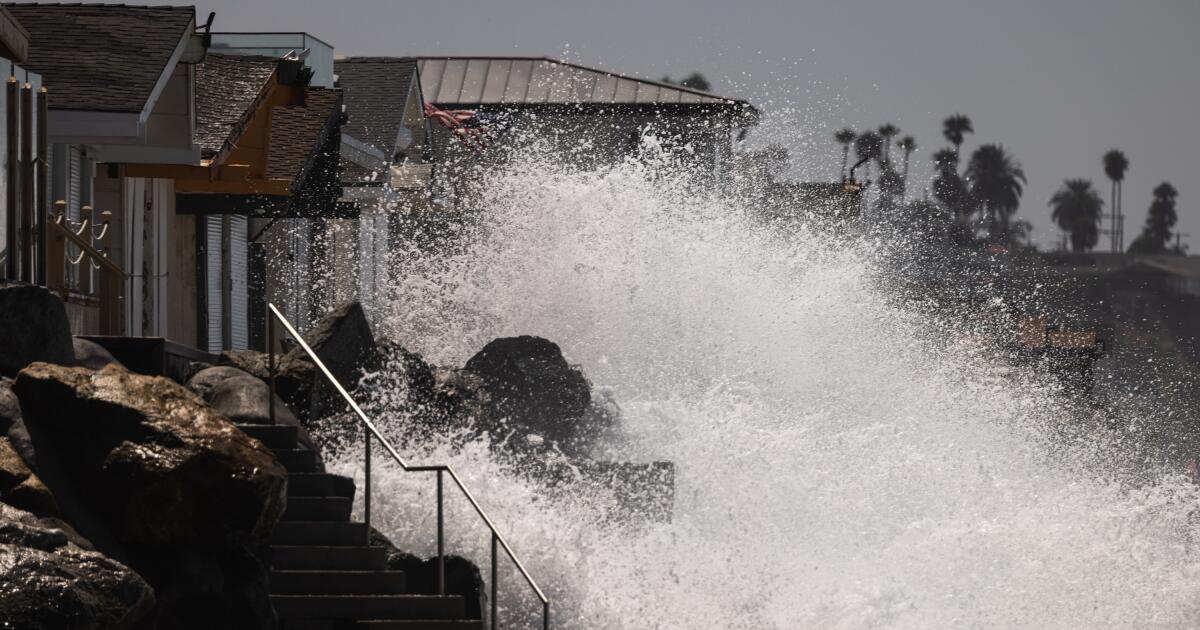
Highest-ever ocean temperature measured as powerful El Niño forms
Scientists have recorded the highest temperature ever measured in the world’s oceans
Los Angeles Times
173 points · by measurablefunc · 2mo ago · 220 comments
Look at Asia.
The US is still one of the leading CO2 emitters, both per capita and in absolute terms. And for cumulative past emissions, it's not even close.
The expectation is not a mere 18% decrease but something closer to halving emissions just to be on a per capita level comparable to the EU or China.
It doesn't mean China doesn't need to make efforts. China's emissions are yet to be stabilized.
But the US need to make their share, and at least honor and (re-)ratify past climate agreements, if anything to dampen the economic arms race between China and the US.
Since 2005, a huge amount of US manufacturing and resource processing (both large emitters) have been outsourced (largely to Asia, and more specifically China). Our economy doesn't function without these imported emissions, yet they don't count as "US emissions". Even excluding these emissions, the US makes up 4% of the world population and emits 13% of world emissions. Asia makes up 60% of the world's population and emits 52% (more than 3x less per-capita than the US). If you actually consider that the countries in Asia are vastly diverse, you'll find the large majority of these emissions are from China (from said manufacturing and resource processing), and India for example emits far less than its share of the population.
This also completely ignores that the effects of warming are from cumulative emissions (not just point-in-time emissions) because CO2 doesn't just disappear every year. As a share of historical emissions, Europe comes off far worse than Asia per capita, and the US even worse than Europe.
Even despite this, at least China (and the rest of Asia to a lesser extent) is investing in clean energy. China produces > 80% of the world's solar panels and > 70% of the world's lithium batteries. Meanwhile, in the US the administration is doubling down on subsidies for fossil fuels and issuing stop-work orders on renewable energy projects already under construction.
And because I know I have to give this disclaimer these days: I am no apologist for everything else wrong with China and their authoritarian government. But I can't bear this attitude of absolving ourselves of blame for climate change because some other continent has a bigger number than us.
US approaches 15t/CO2 per capita. Every single country in Asia is under 9t, China and India included. This is despite the US having outsourced most of its heavy manufacturing to, of course, Asia.
Blaming Asia alone and refusing any responsibility is a massive cop out.
Yes it is. I don’t know why you picked Russia to compare to. Russia’s government heavily intervenes in markets to keep prices low, including subsidizing refineries and banning exports at times. The fact that our prices are as low as theirs means our gas is cheap.
The big problem starting in the South Of France, or in the US south, especially Nevada and Arizona. Intolerable temperatures a few weeks every year, not a constant problem.
Note: the general consensus is that the 2026-2036 period will see little if any warming (meaning currently El Nino is pushing hard, but that will stop, and then it'll be dragging the temperature down for a while, which won't cause a drop, but will keep things more-or-less constant). So you have time to decide.
At the turn of the century the CIA predicted climate change and water being the primary drivers of conflict in the 20s.
We are already seeing the US deposing Venezuela’s government and taking their energy as US’s intentional fossil fuel dependency bites.
Things will only get worse unless radical changes are made. We have to move faster than the skeptics and entrenched interests desire.
To save the planet some people are going to lose their wealth power and position. Despite their protestations it’s entirely logical, just and necessary.
That's not a well built building though. Our flat in warmer location in Europe does not get over 27C unless it's over 33C outside, and that withou the AC active.
Are you irrigating an enormous yard?
Some marginal plants strategically placed and Nymphaeas can shadow the water (reduce the amount of heat that reaches the water), but you would have a very different kind of pool then and they have their own maintenance issues.
If your area allows the culture of columnar cactus and succulents, use it near the pool to provide shadow. They will rarely trow anything into the water and may be beautiful to see by itself. Look for the less vicious species like Euphorbia or Pilosocereus azureus that are strongly vertical while young, refreshing to see (blue is blue) and will not pose any problem if cultured in a wooden raised bed. The idea would be to make a short wall using the cactus as logs placed a few dm apart to allow the wind passing trough. You will need to avoid the access to cats protecting the dirt with a mesh, aizoaceae, gravel or rocks. Allow a lot of space for the roots. A small pot will not really work.
Cactus or succulents allowed to grow on the roof or near the house will act also as fire retardants (but not fire supressors) as they accumulate water.
Comparing ratios of bills is confusing. This statement would be unsurprising if you drove 10 miles per week in a Prius. It would be very confusing if you were filling up your tank every week and spending $1000/month on a water bill.
Don’t you think this was important information to include in your post? Your whole point was built on spending more on water than gas, but then we had to read the comments to discover that you don’t commute and you have water-hungry situations like a pool and HOA mandated landscaping?
One day we woke up, had breakfast and the power line had failed. I quickly imagined what happens if it lasts more than a few hours, checked the heatmap, found an area that wasn't dark orange, and told everyone to pack - we're leaving. We headed towards Half Moon Bay. It's a little over an hour drive, but it took us another forty minutes to find a beach with a room for parking - entire coast was packed with the heat escapees like us. The beach was full of stinking kelp, there were tons of flies - they've tormented our stay, but we had little choice. We thought we were lucky to find a spot with not too many people, only to realize there was a carcass of a dead sea lion and it was dead-cat-stenchy. At least, being next to the ocean offered some relief from the heat. Later that afternoon, our neighbors called us to tell us that they were sitting in their minivan, at an empty parking lot. The power was still out, and to have a dignified dinner, they've grabbed some food and convened in the car, which had a working AC. But they didn't want it to look weird, so they drove away from their street, away from curious neighbors and friends.
Next summer wildfires came back. This time bigger than ever. Dealing with both smoke and COVID restrictions together felt like too much, and we decided to move. We headed East, our first stop was Barstow, CA - we decided to rest a night. It's pretty far from where the actual fires were raging, yet when we woke up, we were greeted with what looked like snow at first. It was ash. Our car was covered with it. We kept driving. The sky was black from the smoke. It only started clearing out when we crossed into New Mexico. We were all terrified to realize the scale of that disastrous event. Which has now become "a seasonal climate occurrence" - it's almost guaranteed that each year something will massively burn somewhere in the West Coast. And the fuck are we doing about that? Entertaining a clown with renaming a lake.
I am. We all are. We are an invasive, parasitic species, and regardless of where we live or our lifestyle, we still are a great threat to the environment. I'm sorry that my mere existence is a huge inconvenience to all sorts of animals, including you.
On a macro scale all you can really do is vote for national level candidates that care about these issues. Luckily it’s not hard to see which ones do and which ones don’t.
I even roll my eyes at my city council spending even one second on climate change policy (and they have spent whole meetings on it). Our city of 80,000 people could disappear from the face of the planet and it would not make a bit of difference.
Working on your own carbon footprint is a $100M marketing trick played on you by oil companies like BP.
Leah Stokes' new book offers instead a "carbon wave" -- how to evaluate and maximize your impact at a local, state, national, and global level. Here's a LinkedIn post. She's got a new book coming out about this: https://www.linkedin.com/feed/update/urn:li:share:7496265286...
Every meeting minute spent on discussing climate change is another minute not spent on authorizing things like Flock or permitting data centers. That's nothing to roll your eyes about
that's the difference between you and the public servants that you roll your eyes at.
Now he's more worried about which toilets people use.
I think that, if people who believe in climate change want to be convincing, it would be more effective to avoid blaming specific instances of weather on climate change without strong justification. Especially when the weather isn’t even abnormal.
Los Angeles, especially inland and in the valley, is hot in the summer. It was hot in the summer 30 years ago and it’s still hot in the summer. It’s the typical hot season right now, and the valley appears to be only slightly above season average temperatures today, and coastal LA seeks be slightly cooler than average. Apparently it will be unseasonably cool in a couple days.
More tropical storms are approaching LA and that’s increasing humidity is why it’s sweltering.
"Forecasters attributed the punishing humidity to the remnants of Tropical Storm Iselle moving over the state, as well as unusually warm ocean temperatures due to a combination of a months-long marine heat wave, a powerful El Niño and climate change.
"Dew points in the Los Angeles Basin have been “really high,” hovering around 70 degrees in many places, with a few coastal areas like Redondo Beach and Torrance reaching a dew point of 73 to 75 on Friday, said Ryan Kittell, meteorologist with the National Weather Service in Oxnard. The metric measures the moisture content in the air."
https://www.latimes.com/california/story/2026-08-28/forget-f...
When nuclear power became a thing in the seventies, there was massive planning around a presumed nuclear-powered future. The largest energy storage facilities in the US were all built around that time. This turned out to be a mirage as the cost of nuclear went up with the safety expectations of the electorate, while petrochemical prices dropped. But this time it's not prices we're predicting, it's temperature, which is much more reliable.
We can't go cherrypicking environmental problems. That way we roll from one crisis into the next. There's so many issues we're causing, like entire ecosystems going extinct. Sooner or later that will lead to crises too. We have to stop externalising.
And yes the electorate wants to be safe and for good reason. Even Fukushima polluted a lot. It's not just about death tolls.
Those materials are mined also. At least forethought is given to handling/disposal for nuclear since it’s a known issue.
> We can't go cherrypicking environmental problems.
Huh? Local pollution with solid waste vs dispersing that waste into the global atmosphere is the same to you?
> Even Fukushima polluted a lot. It's not just about death tolls.
Right, 20_000 deaths from the tsunami is no big deal, the pollution is!
Since you're ignoring any and all statistics wholesale, I hope you never fly — 9/11 was terrible after all, so aviation is clearly unsafe.
To put it plainly, everyone wants the problem to go away without having to change anything about their lifestyle.
If you insist on finding a way to criticize leftists on the climate file, a much better tack would be pointing out how some environmentalists have opposed nuclear power or densification.
Maybe 10ish years ago the left was all on board with individual action, but now it has heavily shifted to "I can drive my SUV because it's on Big Oil to fix the climate"
At some point we finally will need to admit that they were not fools for saying that.
Fresh water is vanishing. Nuclear plants need water (and absence of arsonists) to not go out of control. They will need ten years (or most) to be built. At this point the place may be in the way to be flooded by the sea, or in the way to became a desert. Can a new nuclear plant return their investment if they will be operative only for ten years more before to turn into a rusty reef?. Probably not.
Had we spent this pile of money into renewables, we would be in a much better position.
The way individuals can meaningfully contribute is by supporting politicians that will make policies and rules and regulations the meaningfully encourage that collective action, and when they have a choice between more than one corporation for some product or service that are not too different as far as impact on the lifestyle goes choosing the one that is better from a climate change point of view.
The politicians and the corporations (encouraged by incentives and regulations by the politicians) can then bring about changes that will make it so the lifestyle changes for individuals that help with climate change also improve the individual's situations so people voluntarily make them in large numbers.
For example there are a lot of people in the US who would be better off if their next car was an EV except the public charging infrastructure isn't good enough for their needs. Build a lot more public chargers that support 800V cars and many of these people will pick an EV. This is something government can bring about.
For an average individual it is perfectly fine, to use a sports analogy, to play the game as it is now while supporting league wide changes to the rules to make it a better game in the future.
Sorry but this is absolute nonsense.
What we eat matters. A huge amount of what people eat is unnecessarily excessive in terms of resources required to create it. Beef and dairy, most meat, are good examples of this.
An individual can reduce their contribution to climate change by up to 30% by simply forgoing meat and dairy. That percentage obviously varies quite a lot, but it can be huge.
Add in that food waste is a huge problem and this makes more sense.
And we do feel hopeless and helpless. And the only thing we can do is to promote and advocate for science. It was a scientist who made us stop adding lead to gasoline. It was because of scientists we were able to stop ozone layer destruction. It was a scientist who invented the catalytic converter. It was a scientist who broke the asbestos industry's decades of denial and a scientist who broke big tobacco.
We didn't have to "change our lifestyle" - scientists proved bad things happening and politicians listened. The current imbalance in the political system is that the right simply just wants to ignore the science. And even half the country shitting their souls out in explosive diarrhea won't change it. Therefore the right have no right to representation, because the survival of our species is at stake. We need to vote them out.
Of course... Every year where the consequences weren't in sight, saying we should consume less, buy less, eat less meat, I have been called 'degrowther' and it has been explained to me that I would increase human suffering because it would reduce the economy size. Ok, fair, I just wanted to help future human, but if you don't plan to have any, you do you.
Now I'm told I think it's corporations that should fix it. Of course.
By the way, I still think it's consumerism (and consumption capitalism) the reason we can't deal with the issue. That corporations are the biggest voice that push for this system is incidental, but yes, breaking big corps in smaller entities would probably help solve the problem. A bit too late now, but better than never.
Also, who on the left think that corpos will do anything to help humanity? Really? I think at most, some thinks it's the government to do everything but corpo? Really? Your friends on the left seems to me very, very much in the center, center right to be exact.
The big problem is this is all driven by consumption and it’s hard for people to cut back on consumption. I don’t know how to explain to people how a simple life is much easier than the complicated life of the rich and famous they see every day on the Internet.
I don’t think there is an answer for this, I think there’s way too much propaganda on the other side of the equation. My only hope from this El Niño is that it creates such damage and disaster that it starts waking people up. I think if it affects the ranchers and farmers that will be a big plus because they are usually on the side of not believing in climate change.
What I do right now is just keep talking to people and preparing, but I’m lucky since I live in a minivan full-time. I mean, I can drive anywhere. The weather suits me.
We'll talk climate science, impacts, and what we can do to avert the worst impacts of the worst El Niño in human history.
The numbers are daunting and the returns are scant, but the effort is one that should be made.
The upside is I saw little sign of Gorgan LNG style Carbon Capture; where a massive source of CO2 greenwashes releasing 100 units of CO2 by stuffing 1 unit back in the hole it came from.
An economy that seizes climate solutions can zoom ahead in terms of innovation, manufacturing, and enforcement. The changing climate is one of the biggest economic opportunities we've ever seen in human history, but somehow we've convinced ourselves that it's not only the worst non-opportunity ever but somehow would break capitalism. The richest man on the planet makes electric cars.
How many children do you have?
70°F is 21°C
Fish don't have AC.
And what about the years before that?
Eg: Totally not tracking submarines, we're looking at dolphins and whales!
With notable funky bespoke hardware: https://en.wikipedia.org/wiki/RP_FLIP
Scripps itself has been running since 1903.
There’s a lot of nuance in this stuff - far more than global average surface temperature (which is primarily good for scary headlines) and “fish don’t have AC”.
Im Australian, so it also means droughts, water restrictions, and significant increases in bushfire number and severity after a few years of drought. Drought followed by cyclone, or bulk rain events causes catastrophic flooding. Its a shit show.
That hypothetical you can look around at the rest of the global political class and see that the rest of the establishment will destroy the livability of the biosphere whether that hypothetical you starts putting all of your money into unions, green technology and BECCs or not and conclude that the only available choice is whether to be poor in a collapsing world or rich in a collapsing world.
Moving away from fossil fuels is cheaper. Green energy is very cheap, it just misses a base load component right now. It's just that the people benefiting are different ones. And those people are going to lose sooner or later anyway, because in addition to climate change, fossil fuels are also finite.
The only reason trump is on the oil bandwagon is because many of his buddies are benefiting from it. And probably because he's still pissed at the Scotland windmill thing.
But doing the right thing doesn't have to make you poor. It will benefit everyone including the investors.
The optimal strategy for long term biosphere habitability is a mixed strategy of mostly green tech with a tiny amount of fossil fuels exclusively for those metal smelting roles where arc furnaces and biofuels are unsuitable.
Investment portfolios dominated by technology that lifts everybody up are less profitable than greedy choices of risky investment, per some of the finer details of the mutual fund separation theorem.
I’m sympathetic to the intent of your argument, but man, that’s a hallava gotcha there. Other than nuclear there isn’t a compelling story for a base load source of green energy. And all the new-gen nuclear tech is a long shot for safe, cost efficient, rapid scaling right now.
That, or there’s been a naturally shift to the right as a reaction to the left going to irrational extremes and aligning themselves hypocritically with groups that suppress women and hate the USA and the freedoms we have fought for and won.
[1]J. E. Cole et al., Recent strengthening of eastern Pacific ENSO in the last millennium paleorecord. Science DOI:10.1126/science.ady2660
I also want to state for those of you living in Southern California to be prepared for a possible earthquake. It’s a salton sea fills up with a lot of water quickly It could most likely trigger an earthquake.
But those are the impacts just in the United States. We might be looking at food price shocks in combination with the ongoing war in Iran.
By the way for those of you complaining about the heat in Los Angeles, it’s not really the heat. It’s the humidity. The LA basin has had record high dewpoint temperatures. That’s why it’s so uncomfortable.
How do we fix this? The only thing I can think of is a spiritual awakening where owning and doing less is more attractive than flying around in jets and building AI data centers.
In Continental Europe we used to have winters with regular snow even in large cities. I know, I really liked playing in the snow as a kid. It was cold. For the past dozen or so years, there is less and less snowfall, with milder and milder winters. Snow in the cities amounts to maybe a week or three of weak drizzle. Forget about what my grandpa remembered about how the Danube used to freeze over so you could walk across the river. What we do seem to get more of is wild, torrential rainfall in sudden bursts amid long dry spells. Bad for infrastructure, even worse for agriculture.
The climate is changing here, and it’s getting hotter, not colder or more balanced. Wildfires are increasing in frequency, and God knows what’s going on with the country’s underground aquifers, we never seem to care about those, because we’ve always just had plenty, so why worry. Of course all this is easily dismissed as anecdata. But when I read about the research labelling Europe the fastest warming continent, I don’t have trouble believing it. Sure, someone living in the northernmost reaches of Europe might not see anything, yet, this doesn’t mean the research is wrong.
Worse yet, the infrastructure for dealing with this simply isn’t there in most countries, and I’m not talking about stuff that will "reverse global warming" or whatever, I’m talking steps that will keep cities livable in the short to medium time-span. Most societies are unwilling to mentally deal with or consider what might happen two, three decades down the line. They aren’t willing to contend with a future where their children will have to endure water rationing, curfews, economic and other hardship, mass migration or any number of scenarios that will affect their wellbeing.
We have to greenify the streets, reduce the number of heat-producing vehicles, upgrade the pipelines, irrigation, water collection, and other systems across European cities... I have a sneaking suspicion it will take some massive, un-ignorable crisis, like a record number of elderly people dying from heat exposure to actually start investing in any of this. And by then it might be too late.
Oceans hit highest temperature on record
https://news.ycombinator.com/item?id=49424606
Super El Niño Keeps Growing as New Forecasts Reach Record Territory Ahead Winter
https://news.ycombinator.com/item?id=49313428
Climate change is strengthening El Niño, coral records suggest
https://news.ycombinator.com/item?id=49475404
The Strongest El Niño Ever Forecast and the Hunger It Will Leave Behind
"When you are confined within the civilized scientific discourse and can't cry out 'It's the biosphere, stupid!'"
Please read what Anastassia Makarieva had to say on "the kid" 2 years ago: https://bioticregulation.substack.com/p/seeing-forests-throu...
Could we stop chopping down trees from primary forests in the Amazon to save the planet for us humans? Could we manage with a little less beef and soy?
Keep the Amazon out of this. From whichever country you are, you should demand your government to grow and keep some forest carrying the economic burden for that. It's too easy to point to poor countries so the rich ones can keep consuming like kings without guilty.
I’m not sure the human species has the capacity to actually coordinate behavior at the scale needed, irrespective of any future warning etc…, to be able to combat this
The problem with climate change is that there is a huge incentive to not fix it, and the culprit is not just rich oil corporations. Many countries subsist solely on oil profits and have no other natural resources to sustain themselves, i.e. Saudi Arabia. Those countries have influence over others like the US.
There are alternative options already available to replace fossil fuels for most things. In first-world countries, the only thing stopping a transition is the loss of corporate profits.
I feel this is going to be a "big one" this year? And probably the culmination of extreme heat, crop failures, and high diesel prices are going to trigger more conflict too? To be clear, I'm an optimist, I think things will be "good" in the long run, but I have a feeling the next 12-24 months are going to be a doozie with the 4 or 5 things converging...
Like, I don't want to have this crazy flamewar thing, but like, what do the numbers say, how fucked is this particular one?
Come join! https://luma.com/tu0uvbx1
Carbon dioxide removal refers to a different process. Carbon dioxide removal is the process to pull carbon dioxide back out of the air itself. It's not a supplement or replacement for carbon neutral technologies. Every model proposed by the IPCC to stay at 1.5C of warming requires billions of tons of carbon dioxide, alongside zeroing out new emissions.
Also, this event is about El Niño.
Are people in trouble? Perhaps. If we stop technological achievement in the name of a few degrees centigrade, then definitely.
Crash now and there will never be a second chance, just iron age stuff in a harsher environment for however many tens of millennia it takes to have some random pandemic that wipes the descendants out occur.
specifically, can you identify a technological advancement that you question the sustainability of?
1. https://en.wikipedia.org/wiki/Year_Without_a_Summer 2. https://en.wikipedia.org/wiki/Carrington_Event 3. https://en.wikipedia.org/wiki/Volcanic_winter_of_536