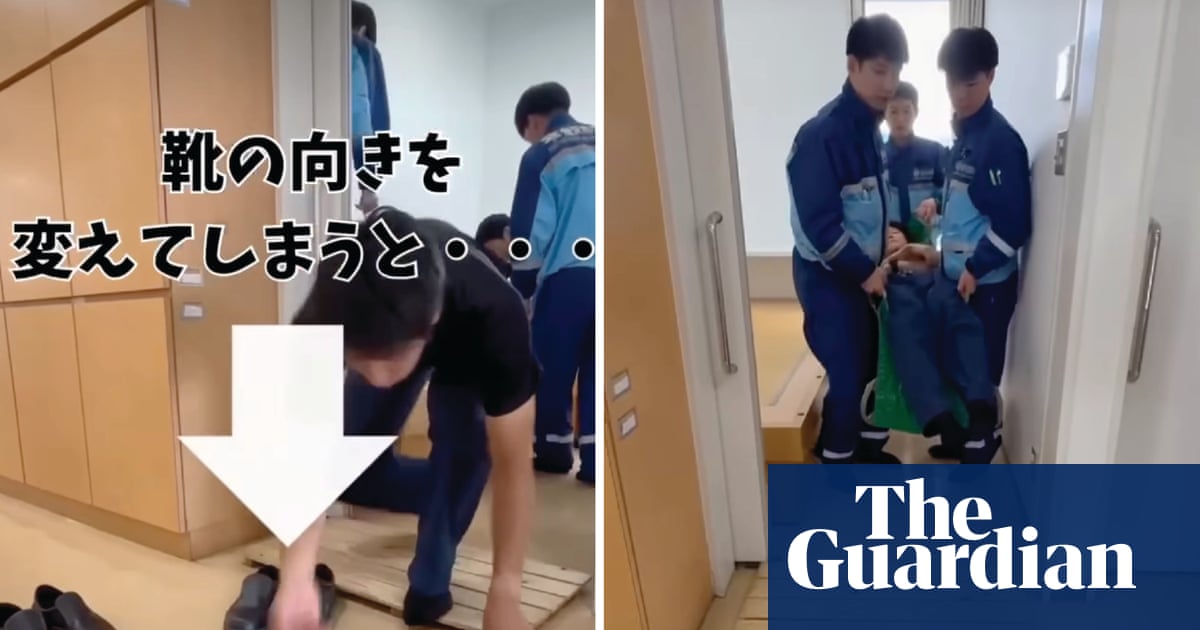
Please don’t rearrange our shoes when we turn up, paramedics in Japan urge
It is polite to reposition a guest’s shoes when they arrive, but the emergency services in one city advise just skipping that part
the Guardian
145 points · by high_na_euv · 2mo ago · 183 comments
Personally I got so tired of it we got those "one-use blue shoe covers" that we tell them to wear before going in, but of course I don't think either of us would think about that if we called for emergency services.
I was not brought up in a religious household and have never been a follower of any known religion. And I do not have any belief tied to this behavior. It is an oddity of my being that I accept.
Isn’t it interesting how one can be conditioned so? I sometimes wonder if alcoholics or drug addicts feel this way.
Perhaps the Japanese feel this way about their cultural quirk in the way I feel about mine.
This is something I've noticed is uniquely culturally Indian, and transcends all religions. Which is beautiful.
I was once whacked in the head by a teacher for throwing a book onto the shelf, and rightly so.
And I highly doubt that, in general, 'whacking' children will make them grow up kinder more compassionate adults.
Considering the rationale offered by Hindus, I’d be inclined to believe it is a Hindu custom adopted by everyone else by virtue of relative numbers. Sort of like how Christmas is secular in the US, Diwali in India, and perhaps weaker something like Eid in Jordan.
So I agree, very little to do with religion today, but perhaps not so always. Something like Halloween perhaps.
There's photos in the article, those aren't dress shoes with laces to be done and undone, they're fit for the purpose.
Also in cases where it's really dire they'll just step in with shoes on, it's just extremely rare and it might actually be another team altogether, operating under a different protocol.
What about when you're three people while carrying a person? According to the article, it can delay them by ~30 seconds and risk dislodging the oxygen mask, the linked video also demonstrates the difference: https://www.instagram.com/p/DbqGfGfox3f/
Might seem like a small difference, but add in a stressful situation with a person almost dying, maybe being in pain, and the emergency workers trying to keep calm while also suddenly not finding their shoes in the position they purposefully left them, and suddenly the difference might be much large and also impactful.
I bet you don't have children. 2s might be too late in an emergency.
So people are already doing this multiple times a day at their own homes and form a habit that often doesn't require much thought to follow.
(Where I live, this is the norm at home, but not at office or public places.)
Isn't it reasonable/normal to take shoes off at work and put on indoor does like sandals or similar ("work shoes")? Obviously it depends on the job, but it seems reasonable to me at a radio station. And if the regular employees are wearing indoor shoes, then it might become normal for outdoor shoes to not be typically worn inside.
For instance for an elderly couple living together but both being pretty weak, if one's oxygen level was falling they probably couldn't get to the hospital for a full checkup by themselves. They'll call for help, these people will come, fit the patient with anything needed to safely make the trip, and move them out of the appartment to the nearest hospital.
There will be no need to trash the floor in precipitation, and they might spend some time in the appartement to properly access the situation and make it safe. They'll still want to be able to evacuate the person quickly if/when needed, but there will be a lot more to consider as well.
I'm not surprised the person last mentioned in the article, who suggests exactly that, got 800 likes on their comment. I am surprised that it even needed to be said.
Now I'm suddenly wondering (probably stupidly) whether firefighters also take their shoes off when entering a burning building.
But ambulances in with full sirens begging over their speaker-system to have pedestrians at Shibuya crossing let the vehicle through, is probably the worst thing about Japan.
As for your second question, I’m reminded of Bob Mortimer in Would I lie To You: “… then the fire brigade came and ruined the whole house” - “Bob, surely the fire was ruining the house” - “No, water damage”. Maybe if those darn firefighters had taken their boots off, there had been a bit more left of Bobs childhood home.
That's what we learned in fire fighting training. Everything that doesn't get destroyed by the fire and smoke will get destroyed by the water you use to put the fire out. A house on fire is lost. You just save people and animals and then you do whatever you need to protect the neighbouring structures.
Relatives in an emergency often act irrationally. I heard of an old case where a man suffered a heart stroke, and his child was ordered to phone rescuers. The boy ran to the nearest phone booth, said "my father is very ill, we need an ambulance" and hang the phone. He never said where. The ambulance roamed around trying to guess the address of the emergency, but when they found the family in the street it was an hour later and the man was dead.
Unfortunately ambulances in Japan blare their sirens any time they are transporting a patient, and because they are free some people use them like taxis. So you may see an ambulance at 2AM driving down a residential street blaring their siren at full volume, going 5 mph while the medics call around to various hospitals to see who will take their patient with an upset stomach.
Once I passed a moving ambulance with the siren on...while slowly riding my bike down an otherwise empty road.
The result is that Japanese people seem to tune out the siren. If the driver isn't also on the loudspeaker telling them insistently to move aside, they assume it's not a "real" emergency.
Bob should have used some of his Fuji 9, that fixes everything!
> In Dutch culture it is far more common to keep shoes on literally everywhere
It is in many cultures, including my own family's, but having gotten used to taking them off from living in Japan, I find it extremely strange taking them off is not more common.
It feel similar to doctors refusing to wash their hands during surgery, though I get I'm not doing surgery.
https://en.wikipedia.org/wiki/Ignaz_Semmelweis
I never thought about it growing up but once I got used to it I can believe I used to walk across my house carpet in shoes that had dog shit, grease, and other grim in them, and then later lie on my floor and watch TV or whatever. I don't get why people don't see that and get grossed out more.
Sure, if they were covered in mud or feces then I'd take then off but for small amounts I wouldn't notice. Why that doesn't matter to more people seems more strange to me than the status quo.
That said, I don’t think it’s really rational. Our houses are full of bacteria and dirt one way or another anyway. It’s impossible to avoid that without having some kind of airlock equipped with a shower in your porch.
Old farmer style houses in Japan have an entrance area behind the main sliding doors in bare soil[1], and a wooden platform at waist height between it to hallways. The platform can be sat on to take off shoes or to drop off bags of produces, and then hallways and tatami matted areas are further raised an inch or two - the walking floor level of houses are therefore give or take a whole feet off the ground. These together create multiple mental boundaries for dirtiness.
Modern houses have it miniaturized into just a cinder-block high gap or sometimes just industrial colored tiles before a bump. But IMO it's still nice being able to leave wet shoes and umbrellas there.
1: 土間 or doma, meaning soil-space. Oddly this transliteration coincides with "home" in Russian(and of course rhymes with Latin domus).
One part is purely practical, making it easier to keep the living space clean when you are coming in from the farm etc. Places with messy winters have similar concepts for muddy boots, snow boots, etc.
Some regions also have (or historically had) real risk of parasite transmission from soil and short grass. Taking off shoes reduces the chance of bringing their eggs or tiny larva into your living space.
I can imagine some cultural practices here being early memetic/evolutionary in nature, much like some religions codifying what are essentially food-safety rules from a time before microbiology was scientifically understood. We think about the parts we can see, but also have some instincts and practices that seem aligned with threats we can't actually sense.
True, but I don't know about you, but we don't have literal rocks, sediment, dirt pee, or literal poop on our floors in our home, anywhere. But shoes do occasionally step on stuff like that no matter how small, and neither of those things I want inside of my house on the floor.
But you're right that there still is bacteria or dirt all over the place, no doubt. But still, I don't step on something slightly soft with my socks in the living room and then inspect my foot to find poop stuck to it, and I think I'm gonna continue to prefer this way.
Throughout my fire and EMS training I was taught to anticipate possible violence from the residents. I personally know folks who have entered buildings and been shot at or found booby traps. One guy I know responded to an arson house fire where the resident had cut out holes in the floor under every window and door and covered the holes with rugs, Home Alone style.
The US has a serious drug and mental health crisis. First responders often have to deal with people who probably would be in state care if we didn't spend all our tax money on bombs and tax cuts for the wealthy. Or at least they would have caretakers who visit and help them take medications and escalate when they start setting up booby traps to defend against the voices.
Depending on the boots, you might not want to wear them while "idle"¹ in any case, though that's mostly a non-concern with modern safety shoes.
¹ mandatory note: most emergency responders have tons of work while "idle", I just mean "not actively responding"
This seems like the best policy in an emergency where 30 seconds actually matters. And I actually like the East Asian custom of taking one's shoes off before entering a house and adopt it myself.
Similarly in the military. We got un-booted at bedtime, and put them back on when we got up the next morning. Even in the barracks, including the nice ones that were reasonably nice apartment buildings, I never took off my shoes to walk around my room or when visiting someone else's (and vice versa; no one took off their shoes to visit me).
The first time I bumped into that rule was when I met my wife, who'd moved to the area from New York. I was quite confused when she asked me to take my shoes off at the door, and more than a little anxious. Sure hope I'm wearing decent socks and my feet don't stink, lest I be traipsing dirty feet around her apartment. To this day, I'm not convinced that hardsole shoes that haven't walked through wet messes are substantially dirtier than a damp sock that's been inside a shoe all day long.
I can't imagine feet in socks would be dirtier than the bottom of a shoe, but I guess it depends on where you walk, and how nasty you let your feet get. Like if you use a public restroom and then walk on carpets in your home, that's just gross. Maybe you walked in a park where dogs play. Good chance of tracking some dog shit into the house.
Absolutely no way. Like, it's not even comparable, sweaty smelly feet are infinitely cleaner than a shoe that stepped outside just once.
Even if we only talk about visible dirtiness (which is probably the least of the uncleanliness), I've hosted dinner parties in my flat where people kept shoes one and others where they didn't, and the difference is very very obvious: disgusting floors after the former and normally-clean-looking floors after the latter
After thousands of interventions in this places, you are basically guaranteed to step while in your sockets on blood, syringes, broken bottles and glass pieces. Awful idea. Your toes smashing the leg of a table if you have luck. Hepatitis or HIV if not.
Also removing shoes that were designed to assure maximum stability before to enter in an unknown scenery can be a big mistake. You will regret it later, trying desperately not slip while you navigate a stretcher on a narrow spiral staircase, carrying a heavy guy with a fractured leg.
And it's so much more comfortable to be in your house barefoot, with socks or with slippers.
So much cleaner. I'm disgusted when people try to walk in my house with their shoes on.
First, in the rare cases you describe (when was the last time you stepped on feces?) one would indeed leave their shoes outside. But in the day-to-day your shoes have some dust on them and that's it - you won't even notice it's there when compared to the dust that already accumulates daily. If you live in a climate where this assumption doesn't hold (snowy areas come to mind) then the equation changes.
Second, the floor is usually stone and therefore designed for being walked on with shoes. I would feel awkward walking on some polished wood, but if the difference between inside and outside is "this one is less coarse but just as hard" then I wouldn't see a good reason for taking my shoes off. I would probably avoid the rug, but that's me.
As for comfort, keeping your shoes on also means one less thing to do when going in and out. Do not underestimate the path with less friction.
So shoes on is not universal in the West.
Try this , when was the last time you stepped somewhere that had previously been stepped on by someone who had walked on a spot which had been stepped on by someone who may have stepped on a spot trod on by ... go far enough back and it's all had feces on it to some small degree.
An easy way to keep this concept clear and understand the reasoning behind a 'leave the outside shoes out of the house' is something learned as a child.
Just like there is a Law of Conservation of Mass, and a Law of Conservation of Energy, and these two are the same law as defined by Einstein, there is also a Law of Conservation of Filth. The law may be stated as: "A spoonful of wine in a barrel of pigshit is a barrel of pigshit. A spoonful of pigshit in a barrel of wine is... a barrel of pigshit."
Taking off the outdoor shoes to come indoors changes the "is there trace amount of feces on my dining room tatami floor?" risk from "I cannot be reasonable sure," to "I can be reasonably sure that there is none." If guests find that too much friction to understand and accommodate, one might argue for a different set of guests who are less accepting of an allowable amount of pigshit in their wine.
I'm not going to say that every type of floor is to be walked on, with rugs and tatami mats being perfect counter-examples. But if a five-star restaurant doesn't ask me to take my shoes off (not evening Japan, AFAIK) then keeping them on is, from a sanitary point of view, probably okay.
However, later this changed, in good part because much of the population moved from bigger rural houses to smaller apartments in the cities. In a small apartment, there was not enough space to have at the entrance a big enough wardrobe with dedicated places for the visitors to store their shoes, and to provide slippers for them. Moreover, a small apartment was easier to clean after the visitors left.
Thus the customs changed, and it became normal when visitors came and attempted to remove their shoes, according to tradition, to assure them that there is no need to do that. Nowadays I think that few remember that in the past it was really mandatory to never enter a house with your shoes on.
I suspect it depends a lot on the climate, predominant style of housing etc. If you live in a nice climate and everyone has houses with backyards, you expect to be going in and out a lot all day. Very annoying to be constantly putting shoes on/off.
Personally, I just really don't care if the floor of my house is dirty. A thin smear of dog shit? If I can't smell it, I don't care. I'm not licking that floor. I'm not eating food off it. It's floor, it's basically in the same category as the ground outside: dirty.
I think of feet as dirty, so feet that go on the floor make the floor dirty.
I have to imagine the person who leaves their shoes on either never goes outside, or just has filthy floors.
Unlike the commenter above you, I don’t really agree that it’s completely sanitary, though. I’m just saying that keeping you clean is actually pretty far down the list.
Another thing about whether the floor is sanitary: that changes a lot based on how you use your floor. If you eat, sleep, or sit on the floor often like in a traditional Japanese home, keeping the floor clean is a lot more important.
Nah, the main function of shoes is (to support your feet and) prevent injury. Cleanliness is second on the list.
[ed.: added braces]
Removing one's shoes before entering a house isn't a thing in South Africa.
Filth can sometimes be a good thing.
Take a second, get a tissue, and go wipe the bottom of your shoe.
Then sanitation itself is a but of a moot. Bacteria can spread million different ways, it’s mostly futile fight. If you wear flip-flops all day and don’t wash your feet, don’t shower after using public bathrooms, etc - whats the point?
The Japanese shoe taboo is about purity. It's not about protecting the floor but about the idea of cleanliness. Walking in with outdoor shoes is the equivalent of deliberately walking into a western home with dogshit all over your shoes, or (since most Japanese homes have small family altars inside) spiritual desecration.
Having been to houses/flats across all of eurasia, uk to hong kong, vietnam to lithuania, the majority prefers taking shoes when entering a house, but can be as practical as necessary when the need arises.
Even when it looks like a laced up tennis shoe, closer examination of an 'outdoor' shoe will show that it has been stomped into and slipped out of many times.
If it is a sports use, i.e. basketball or other gymnasium, or indoors in a professional setting like at a busy office there will be a changing area and people etiher change into provided slippers (town hall and community centers, schools, and other public spaces have many cubicles and slippers) or will change into 'indoor shoes' brought for the purpose.
There is a strong cultural 'habit' that can be interpreted as 'manners' such that when visiting someone's house and switching from outdoor shoes the host will then either turn the shoes toward the outdoors such that they are easier to step into on the way out, or will arrange them facing out but no longer in the main path of the entry way.
It is this 'manners' which the EMT is requesting to stop. The indoor slippers are used for hard floor and rug covered areas, but not tatami mats. A quality tatami mat can be damaged and require actual replacement if stepped on with a hard soled shoe even once.
So the 'taking off of shoes on the way in my EMT is quite appropriate, and the time to 'unshoe' and reshoe on the way in and out is cumulatively not more than 5 to 7 seconds total - if the emergency case is that close to failure, the low speed ambulance ride through narrow streets is going to be the failure, not the shoes. But rearranged and relocated shoes becomes much more complex when the crew have a person in a stretcher (which is faster AND safer than a rolling gurney) - they can step into their own shoes without really even looking if the shoes are left exactly as they were placed on the way in - and this is what the original article is requesting.
The intent of the article in original Japanese is: "Don't slow down the exit process by moving our shoes in an effort to be 'mindful of good manners'. We really wont think poorly of your manners if you neglect this small gesture"
We're just going to pretend that Japanese web design is identical to the rest of the world's, and that Japanese homes aren't half the size of elsewhere such that every horizontal and vertical service is commonly used for storage.
People who think this have actually never been to Japan, most Japanese homes and offices are incredibly messy.
What is characteristic of "the American South" here?
The society is based so strongly on group cohesion and de-emphasis of the individual, the experience of living there is very, very different than the West.
I think that this "deep cultural difference" is what the original comment was trying to get at. Sadly the reference point of "American South" ended up triggering a different (less useful) trajectory for the responses.
The biggest historical commonality between the American South and Japan - or, at least, the Tokugawa shogunate that was ruling around the same time as the South - was that both of them were at one point ruled by a cabal of essentially feudal lords. There is a lot of convergent social evolution that happens when your country's economic elite all make their money by owning land - lots of strange social titles, honorifics start floating around, people start talking around problems, and the like. However, this comparison is only skin deep, and there's plenty of things the Tokugawas did that have no parallel, or even worked backwards, to what happened in the historically contemporaneous American south:
- Sakoku (the policy of keeping Japan completely closed to trade and immigration).
- While America generally has had a long streak of veneration of the police, they never reinvented anything close to the samurai in terms of being a hereditary warrior class with a tax stipend.
- Likewise, the American South did not have a caste system; Japan did (and so did France?!?)
This makes more sense when you remember that the Tokugawa shogunate itself is the time reversal of the American South: the Tokugawas were born out of a long civil war and ended with a foreign invasion (from America) while the American South was born from foreign invasion (of Americans) and ended with a civil war.
The American South is also, interestingly enough, a mirror of Japan in other dimensions as well. The reason why the Tokugawas shut the country's borders for hundreds of years was because they understood that Christian missionaries were a front for a larger invasion force that would pillage the country's resources and abduct people to become slaves in other countries. Of course, the South was buying slaves abducted in other countries in massive quantities.
Going back to the convergent social evolution I mentioned before, you can see some of this in Japan today. Kyoto is notorious for doing exactly the same kind of backhanded compliment bullshit the South loves doing. But even then, that's one part of Japan, that was formerly the capital city. One stop on the Shinkansen takes you to Osaka where people are about as open and outgoing as Americans are.
They simply didn't want another religion. Buddhism was already troublesome enough with a long history of popular uprisings and many monasteries having become as powerful as daimyos. Oda Nobunaga had been mostly tolerant of religions and also of Christians, but he is infamous for bloody curbing their power. The Tokugawa didn't want any of that from happening again, regardless which religion.
There was also a strong motivation to deflate the power of the port cities. They were often in the hands of untrusted daimyos because the Tokugawa prioritized controlling inland regions with farmland and important road connections to keep the economy running and to ensure that troops could be deployed everywhere and kept supplied in case of rebellions.