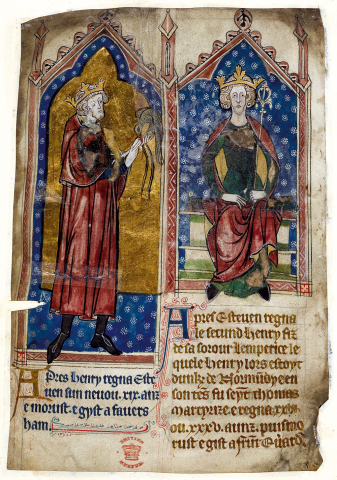
The Succession Crisis That Tore England Apart
Following the death of Henry I, medieval England was plunged into a civil war that reduced the country to a charred ruin. With the barons split between rival claimants, the people suffered.
History Today
47 points · by pepys · 2mo ago · 44 comments
G.R.R.M.: it's free real estate
Is always true, unless they somehow all comply with precisely equal reluctance.
> However, even such a decisive military victory was not enough to overturn a genuinely deep-seated prejudice against a female monarch.
Clearly prejudice, and lack of precedent, materially hampered Matilda's attempt at the throne, but speculative and reductive statements like these carry a whiff of dubious history. It gives the impression that Matilda's failed succession hinged uniquely on her gender, when her own father Henry I only gained power after a long and violent succession struggle involving both of his siblings. I assume the author's book goes into much greater detail on the many reasons Matilda's succession never achieved critical mass in England, but I think this short an article is probably worse for giving so much emphasis to this particular detail.
  > The bark that held a prince went down,
  > The sweeping waves roll’d on;
  > And what was England’s glorious crown
  > To him that wept a son?
  > He lived-for life may long be borne
  > Ere sorrow break its chain;-
  > Why comes not death to those who mourn?
  > —He never smiled again!
Yes 1066 was a peaceful transition and certainly not a scramble
I don't know about that, the quoted criticisms sound a lot like those that would be levelled at a king too. The issue is more that nobody expects a man to care, even a little bit, if someone accuses him of being crude and arbitrary in his search for power. Obviously it is gendered, but the actual complaints are generic. Anyone with serious power has to bat through things like that.
I can give an example by swapping in Trump. The criticism holds up with a gender swap, adjusted for the fact that by default we expect a man to be in the office so it isn't explicitly gendered. This sounds like stock criticism of him that might turn up in any political conversation.
[Donald Trump] at once put on an extremely arrogant demeanour instead of the modest gait and bearing proper to --the gentle sex-- [his office], began to walk and speak and do all things more stiffly and haughtily than [he] had been wont … [he] arranged everything as [he himself] thought fit and according to [his] own arbitrary will.
In particular, the belief that a married woman had no agency separate from her husband, who would then be de facto king, continued all the way up to Elisabeth II. Much reduced and not ultimately a problem, but it was still discussed at the time of her coronation.
What is more interesting in all this is the reminder of the succession crisis. Monarchy is "supposed to" reduce chaotic power struggles like this by making it unambiguous, but quite often the English succession was disputed or passed down through a second degree relationship.
I'm sure being a woman counted against her, bit if the article is going to put up a quote as evidence of sexism then it shouldn't be a passage that can be realistically adapted to any politician ever. If the article had a passage that says "we can't let this woman be king, she can't even own property!" that would be different. But the quote in the article doesn't sound ludicrous when applied to a man. It sounds like something that is routinely said of men in positions of power.
It could even keep the superficial gendering if you wanted it to, there is a lot of argument that men in positions of power should be exhibiting positive masculine bearing (stoicism, accountability, honour, etc, etc) that politicians routinely fail at to great public outcry.
Perhaps what you consider generic criticism was considered gendered criticism at the time?
This predates married women losing the right to control their own property https://lawandhistoryreview.org/article/married-womens-prope...