Friday Facts #447 - Factorio that you can touch | Factorio
Hello, we have very unusual Friday facts for you.
Factorio
362 points · by ibobev · 2mo ago · 129 comments
I'm surprised they didn't find a way to further improve the belt system. I thought they had it solved pretty well but e.g. Shapez is leagues better (talking about belt placement only here).
Have not played Shapez.
Think of how subnautica moved. The second game was very literally denser to the point that they slowed down movement to preserve any sense of space. And each step inthe tech tree required specific tools from a specific place. No more free explorations. No more alternatives. The player lost control over the story. Subnautica 3 is now so dense and linear I gave up after a week. It is more a decorated fishtank than open world.
I still play factorio (1000x) but I do not play the new planets. That whole rocket process is so locked down that there is little for me to enjoy. I get bored whenever there is only one way to do a thing and no room for a player to invent alternatives.
> there is only one way to do a thing and no room for a player to invent alternatives.
Sounds to me like you are caught up in trying to chase optimization and bemoaning the fact that there's only one optimal strategy. Do a no trains run! Or a no bots run. Or a 1000x science modifier run, or Lazy Bastard, or Death World, or... there are plenty of constraints, both programmed-in or self-imposed, that can push you out of the "standard" optimal strategy.
Space Age doesn't respect the people who played Factorio as a light a-la-carte design sandbox experience. But it isn't obvious that is worse as opposed to just different. Wube doesn't have to build games for those people, they have many players who clearly wanted different things.
One can't really point the finger at an hugely successful game - on the other hand I think it's another example of how bad architectural decisions in the underlying systems creep up and cripple future development.
The following is from the point of view of the "end-game" stage, of when you're doing things because you're trying the limits of the system - not your first runs, those were fun and I guess it's reasonable to expect a game to have a finite life.
With blue-prints you can't really customise them beyond parameters - which in turn are limited in the number of them that you can use, don't have any way of ordering, don't have any way of copying/applying them, don't have any way of relating them to other aspects of the blueprint itself (besides very basic stuff, that sometimes was broken too).
You can't apply "sub" blueprints inside a blue-print, making the whole idea of "blueprinting" quite limited. Like if you want to make a city block with train stations that can either take liquids or solids, you end up having to create 2 (almost identical blueprints), or 3 (a general layout city block and 2 "internal" for the stations).
To work around the parameters limitations you need to create monstrous circuitry abominations, that can be fun the first time you're implementing them, but are just horrendous in interface afterwards - doing a simple circuit change can take an hour and endless clicking, keeping memory of it all, double checking it and so on... The same to updating them if you have plastered N city blocks on your way to factorio greatness and realised later it needs a "slight" change in the circuitry control/flow.
The train system was also severely hampered by (although better in v2) their underlying choices - even the "wildcard" improvements of v2 still show those design issues popping up all over their interfaces and makes you reach for awful designs due to the way wildcards work with the stations naming, connections and many other details. Part of it is due to - from what I read - the way they implemented IDing the train/wagons - and other is just the inexistent connection between the seemingly connected aspects of trains, stops, and stations, resources, and units.
The network/automation (bots) was also pretty limited in functionality, yeah, it felt like a great advancement once you get to it, and then you have a learning curve until you master it but it just ends on a cliff - you can't really program the network in ways that seems obvious you should.
Some of this might be to keep the game "flow" mostly manual, but to me, that I don't like doing click & run endlessly and like games that progress further, it all got old at some point and reaching those hours of game-play others consistently talk about looked like subjecting yourself to endless punishment rather than enjoyment. I tried and in part succeeded to create city blocks that you just had to paste and pick your inputs, choose your outputs, place some trains and choose the type of input and output, and it all worked - no stuck trains, not the highest throughput by space area, but just endlessly expandable without bottlenecks - at that point I considered the game solved and moved on but would have spent (probably quite many) more hours on it optimising and testing designs if it didn't end on that functionality/UI/flow cliff once you reach a certain stage (and blueprint bugs too, like them disappearing after being saved and so on). And I had to use the map editor mods to be able to design the blueprints and iterate on them otherwise impossible...
In the end, I feel like the game provided me enjoyment worth its cost (and that's what matters) but at the same time, paradoxically, was a bit of a let down because the more "engineering", "architecture" like aspects of the game were not really fleshed out or deep at all. Like all the ingredients are there, but... It's mostly aimed at spreadsheet min-maxing and I prefer other sorts of puzzles.
The whole game really drills in what it means to "think like a computer scientist". Abstraction, encapsulation, modularity, etc
The game doesn't consume that much VRAM. It plays on 4 GB GPUs just fine. The GPU only needs to keep resident what's currently on the screen. Even including every animation frame, that's 1 GB tops.
Hell, the minimum requirements are a GeForce 750 Ti, or Radeon r7 360. Those are 2 GB GPUs.
I'm not certain but my guess is Factorio doesn't have the elaborate systems for streaming and unloading textures 3d games has.
Not everyone bought a GPU to run LLMs on. That is quite a bit of VRAM, especially for non-desktops
Gaming hardware reviewers have been complaining about 4GB of VRAM not being enough since probably 2018 onward.
I have a weird setup with two very old 5:4 1280x1024 monitors I like to use for fun, and even playing Subnautica (2018 Release date) I can use up 3.4GB of VRAM at that low of a resolution on High settings. (playing on a single monitor)
Hell if I had know that a 5090 would be worth 6000 USD I would have brought as many of them as I could for 2000 USD!
4 GB is nothing. Mid-grade GPUs from 2013 had 4 GB. Budget GPUs from 2016 (10 years ago!) had 4 GB.
I don't have it installed now (lest I get tempted into a quick 2-hour session and end up being late for work 12 hours later), but IIRC it performed the same for me on iGPU and 4090, even on the big saves running below 60 FPS/UPS.
Surely from first principles one'd expect 3D models to be heavier than the 2D renders, due to the extra axis?
A similar 2d image of a triangle would likely be thousands of bits of data.
The 2d probably uses a little less per pixel. Whereas the triangle has slightly more expensive compute per pixel cost. But modern gpu have dedicated hardware for that.
3d is probably more expensive compute but cheaper vram usage. At least to a point and a certain set of conditions. Barring things like textures and others.
> Barring things like textures and others.
Other than some really expensive stuff, it's not expensive. Who could have guessed?
The high quality sprites are 64 pixels across per tile. With each tile being 1 meter, 1 pixel is 1.56 cm (About 0.63 inches) across. By today's standards, that's a very low texture resolution, though they can get away with it when your camera is so far away.
But if the game was 3D, you could expect players to put the camera closer to your objects. You'd need significantly higher texture resolutions. And you'd need a texture for each part of the object.
Meanwhile, consider a 3x3 object. That's 192x192 = 36,864 pixels. Assume it has a 60 fps, 2-second animation loop. That's 4,423,680 pixels. With 8 bytes per channel and 4 channels (RGBA), that's about 17.7 MB, which allows you to store 56 objects per GB.
Which doesn't sound like a lot, but we're making some huge assumptions. Not all objects are 3x3 tiles. Most don't have 120 frames of animation.
And as I mentioned in another comment, you don't need to store ALL the game's art in VRAM at once. Only what's on the screen. And you can certainly fit an entire screen's worth of animations in a 2 GB GPU.
I am assuming that they are laveraging multiple compression technics like using texture specific compression on the gpu, or sub sampling the resolution directly. 8 bytes per channel seems rather large here as well.
I was hoping for an iteration of a factorio belt that could actually move!
https://wiki.factorio.com/Blueprint_string_format
(Also unrelated, I think by clearance they mean tolerance?)
i typically interpret it as having a hint of embarrassment to it (e.g. "not me eating instant ramen for dinner for the 3rd time"), but not always.
I'm looking forward to making a Factorio themed war game table. Star Wars Legion on the factory planet...
Not as sexy as the satisfactory one tho : https://www.reddit.com/r/SatisfactoryGame/comments/1vw7hb0/i...
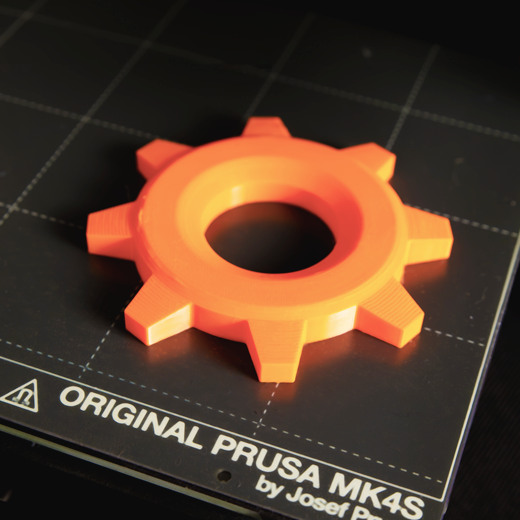
The original assets were never meant to be physical, so they had to completely re-engineer isometric tricks and floating geometry for 3D printing. Releasing the files instead of an expensive collector's edition is a classic Factorio move, and I personally love it. Now the community can remix these and build some awesome stuff that the original devs could never imagine. Awesome stuff!