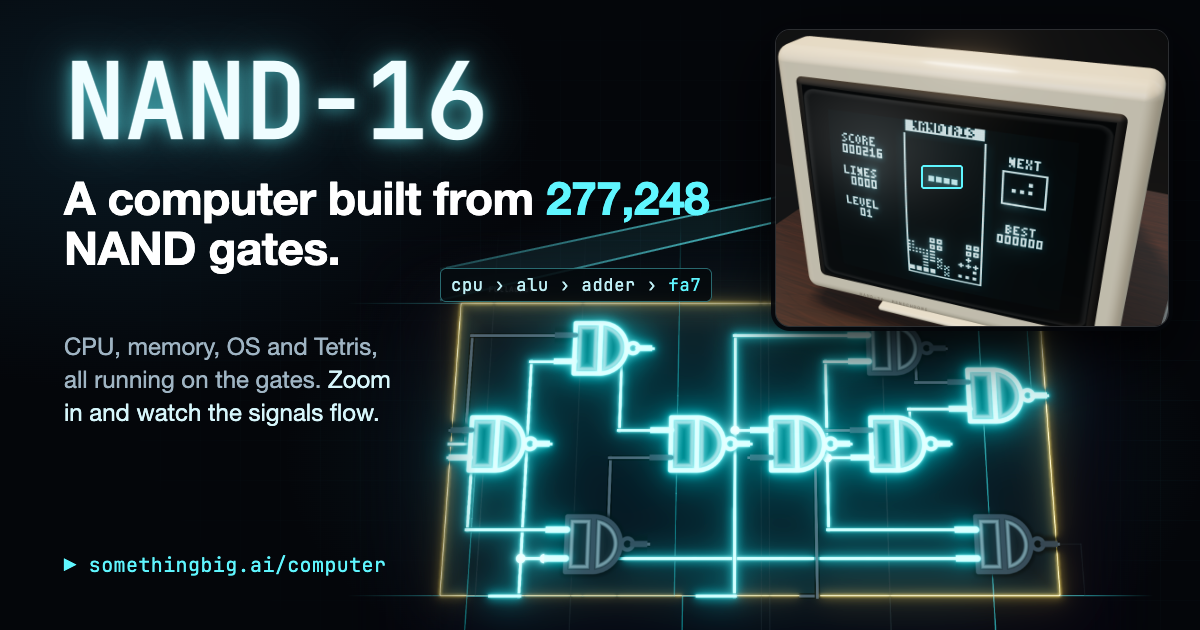
NAND-16: a computer built from 277,248 NAND gates
CPU, memory, OS and Tetris, all running on the gates. Zoom in and watch the signals flow.
somethingbig.ai
187 points · by rossant · 2mo ago · 101 comments
Bravo to the author. This is inspiring work.
Bravo indeed!
(Also, based on the CSS, the author appears to be GPT.)
I'll give an example of what I'm working on. There's a model for segmenting organs from CT scans. There's another model for calculating radial diameters of blood vessels from CT scans. You can combine the two and approximate how much blood flow each organ gets based on its segmented volume and the sum total radial diameter of vessels feeding it. You can then render all of that in an app that shows perfusion to that organ.
The idea is to combine these models to extract every ounce of usable information from a CT scan that might be useful for procedural planning (I'm an interventional radiologist). While each algorithm would take weeks/months to implement, Opus 5.5 can do them in minutes to hours and then stitch them together. The results thus far have been better than anything I've seen.
Just earlier today, I had Opus 5.5 try and read an X-ray. It struggled to give any real information.
Stitching algorithms together is also not hard.
When the model is shown to be within tolerance of what you can measure in the accepted standard methods right now, you can move over with confidence.
I no longer have to beg and plead the SW team to implement driver fixes or feature ads; I can freakin' do it myself.
Likewise, being able to explore e.g, a new vision algo piped directly into the software stack allows for setting up a demo in an afternoon.
I try to stay very cautious, and thoughtful prompting / checkpointing / getting it to first search for similar PRs as a guide have helped make sure it stays 'boring' and doesn't break architecture.
So far, I haven't been bitten... :)
Waiting for
   As a SWE by trade, AI hardware design has been life-changing...

   As a former engineer (now Uber driver) by trade, AI hardware and software design have been life-changing...
By way of comparison, the Intel i386 had 275,000 transistors.
The problem is the rendering is wrong. Gates which are connected to two distinct inputs according to the text description which pops up when you click on it are rendered as having both inputs connected to the same wire. It's a bit of a shame.
Today? Meh.
You don't need to prove it, that was never a requirement. You can simply say it. The only complication is that there's a fair number of people who, for some reason, really want to pass LLM output as their own. They are present on HN too. But here's another ancient trick to overcome that: reputation. Either the reputation you already have, or reputation you build over time. If you have a reputation as an honest person with genuine interest in software, you really don't have to worry, and you will have audience for your work.
Of course there is -- ask you about it.
The coolest interview process i ever participated in (at MIT Lincoln Lab) was structured this way, and seems 100% LLM-proof. The interview was: give a talk about a cool/impressive technical thing you did for an hour and then answer questions from the interviewers about it for an hour. No way to succeed there without actually understanding.
But you could have if you had have chosen to. Did you ask the AI what the slow parts were, and why?
Why did you want to emulate a 6502 in the first place? If you just wanted to run some 6502 code then that's ok, you didn't really need to know much about the 6502. If you wanted to know how much better it could be if it had an single register that was the high byte of zero page address accesses then you probably would have to be engaged enough to find out, and the AI would help you answer questions. You could try rearranging the lookup table at the bottom of the die to see if you could make your own instruction set that would perform better overall. AI would help with that too, but to direct it to do so you would have to be learning something.
My actual goal was to understand if it was possible to build the equivalent of a rudimentary CPU inside of a living cell. At a high level, the 6502 shows me that most of the circuitry of the chip is not concerned with arithmetic, but rather orchestration and moving data.
Same problem actually exists when trying to map this concept to a cell... the lack of wiring makes this more difficult.
I'm starting to think people impressed by LLMs are for the first time in their life not using a hammer on fastening screws and deeply impressed by tools that font fight them every step of the way.
I mean, it’s cool they got their AI agents to follow the footsteps of humans before it, but that’s it.
Of course, managing those people is a great skill too. But it's a managerial skill, not a technical skill.
And, frankly, it's more impressive than managing agents: people are more difficult than agents.
"I made a computer out of n logic gates" doesn't sound as cool I guess?
Granted I am criticizing the concept and post title, not the execution.
I don’t have any familiarity with what’s considered the state of the art here, but I was wondering if the number of nand gates used is significant? So maybe this is neat because it uses less than was though possible?
Edit: looks like from reading some additional comments here that this isn’t particularly novel in that regard though…
edit: press tab first.
claude "create a NAND gate-based computer, giving it a crappy web page"Feels like this https://www.youtube.com/watch?v=gId2HsHvSgs
I make my own pizza because I like doing it. And if I can't be bothered to make one, I'll just pick a ready made one off a menu from a pizza restaurant.
You ask it to try putting the mushroom in the pizza dough. What about cauliflower? What if the tomato sauce / cheese / mushroom order is changed? What if I add the vegetables in a second cooking step?
You're not a cook, but I'd say that at a certain point you might be considered a head chef in this example.
Doing something for fun is all well and good if that's the goal. Finding the best pizza dough recipe doesn't actually need you to get your hands in the dough if you can get the AI to do it for you. That's no different to delegating it to a subordinate cook.
You don't write in assembly. Or, probably, C. You don't write your own graphics driver, or GUI toolkit, or OS kernel, or typeface...We're all just climbing the abstraction tower. It's just that AI is a larger jump than most.
I was happy to have a good product owner.
But these posts are trying to gain plaudits for their technical skills and hard work.
When in fact they owned the product, rather than demonstrated the hard work and dedication of years past.
I mean I’m happy to congratulate the agents they used. Phwoar, look at those weights. Impressive!
Playing devil's advocate, AI is now standard tooling for any CS adjacent engineering discipline. The question then (IMO) is how this compares to what someone else would accomplish with the same or similar tools.
I'm making one of these myself. I'm not using AI to design the CPU, but I am using it to make the simulator and editor. I liked some of the design choices in Sebastian Lague's simulator for simplicity, so I'm making something like that, but web based and that I can use on a tablet to doodle designs while sitting on the sofa.
I did get rather nerd sniped after deciding I didn't want to lay all of the tracks myself and got it to autoroute as it went. That was a rabbit hole in itself. It seems even when using AI you can be sucked into trying to figure out a tricky problem that you don't strictly have to solve.
I kinda get it as a tech demo, but projects like this leave a bad taste in my mouth because I'm not sure what they're really supposed to accomplish for the author or the community. It's probably not something the person was genuinely interested in, it has no commercial or educational value, so it just... sucks the air out of a hobby? There are quite a few people who designed and built their own computers from discrete gates, and we're sharing this page instead.
So you can take an existing model of a computer, turn everything that isn't a NAND into a collection of NAND gates, then run software for the original computer.