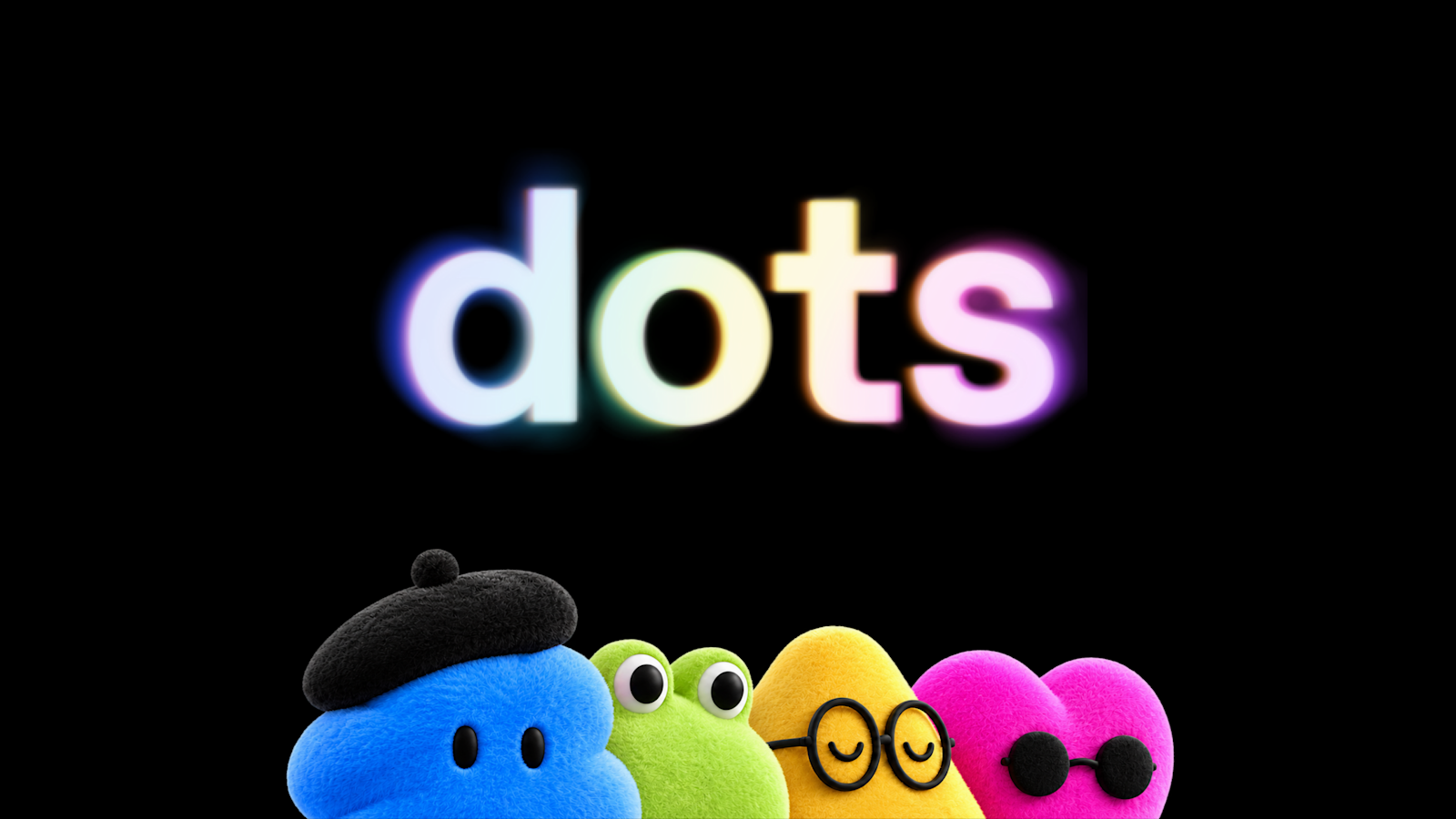
Introducing dots
Dots by OpenAI are proactive assistants that can keep working across complex projects and everyday tasks. Learn how dots help you stay in control while work moves forward.
OpenAI
770 points · by alvis · 1mo ago · 647 comments
1. Collaboration between always-on agents is a really, really powerful thing. It allows for domain-specific expertise that doesn't overload the context window, while still allowing for access to knowledge if they need it.
2. Domain-specific always on agents creates a good barrier of trust. One of the things I dislike about Claude is sometimes it's memory is all-encompassing. It's weird that it brings up things about my personal life when I'm talking about something related to my business. I've never had that happen with Grok Bot bots because I have one for my biz admin and one for my personal admin. They don't intertwine, which is quite nice.
3. Combined with cloud agents / cloud builds, things become really powerful for development. It was the first time that I felt there was a solution to the git worktrees / multiple streams at once issue. Each bot has its own computer and can spin up additional cloud agents. It comes at the cost of end to end speed - doing something via a grok bot often takes an hour end to end, whereas with a synchronous local prompt it'll take like 10min. The difference is I have to babysit one whereas the other "just works".
On the flip side, since using Grok Bots my inference spend has 2-3x'd. It's worth knowing that tradeoff. Nonetheless I think Luna is a fantastic driver for these, and OAI has very good pricing overall. I'd give these a shot - I think a lot of people would be surprised how helpful they are.
Both are just Codexes running in a permanently rolling session in dedicated UNIX user accounts. They're wired up to Maildir so receiving a mail activates Codex and makes it read the new message, there are autonomy wakeup timers, they have accounts in my bug tracker and CI systems. They're currently useful for:
• Triaging and working on customer support tickets. Sometimes I wake up and the fix/response for a ticket filed by a customer is already there waiting for my approval. Recently I started letting them directly interact with customers in specific scenarios.
• Triaging the bug backlog. One of them decided to spend its "free time" finding old bugs that were fixed without being properly closed, or are dupes, so it's cleaning up detritus in the tracker.
• They obviously do all the coding and debugging by just assigning tickets.
• They keep an eye on a "pet" server the company has, and have proven able to fix it in the past when it ran out of disk space.
• They handle non-business projects I have for them.
• They help out with the release processes.
The dedicated home dir is very useful and they use it all the time as part of coding and investigating tricky issues.
My setup relies heavily on email, as everything bottoms out in email anyway. Watching them mail each other out of the blue to coordinate stuff is pretty cool.
The example above of going through a bug backlog and double-checking closed bugs for accuracy is exactly the kind of work that is excellent for an agent. Assign that task to a normal human being and they would hate your guts. The agent won't protest as long as your token budget is there. You can confirm the results if you want.
Do they sometimes make mistakes? Yeah, and I still check their work. But I've also employed humans, and they make mistakes too. The AI is not worse.
I also have a strong feeling we've hit a ceiling on the amount of training data needed for LLMs, what they're all (hopefully) realizing is that you need to focus on how the model reasons, and hopefully someone figures out how to stop people from jailbreaking models, and stops them from just blatantly hacking other companies, that part tells me if it ever were marketed as true AGI, we'd be in very serious trouble.
I only have one though. What do you have the separate employees for?
For free time, do you send it mail with cron?
Another reason: parallelism. The approach of using a single rolling continuously compacting context window is simple and OpenAI are good at compaction, so it works really well. But it means the agent can only do one thing at once. If I send it an email and it decides to spend an hour working on it, then it won't pay attention to any followup emails until after it's done. So having >1 enables more parallelism.
That said, I don't feel a need for more than two and honestly even that is kind of overkill for the sake of it. For 95% of the time I've been doing this, one was sufficient.
For free time there are systemd timers that wake it up on a schedule and it uses POSIX locks to mutually exclude runs from different wakeup sources. TODO board items can be either foreground or background; when there's an item with foreground priority the timers wake Codex up a lot more frequently than if there are only background items.
I currently communicate with the agents through Claude RC, but I'll consider adding support for messaging them through other channels.
R. Axiom
R. Daneel
They sign their emails and GitHub comments with something like "-- R. Daneel, AI employee" so the idea is the naming convention lets people know they're interacting with a robot.
The way I distributed cloud agents for this https://news.ycombinator.com/item?id=49687032 was via grok bot setting up Fable cloud instances.
The catch with offerings like Grok Bot and Dots is that it is a slippery slope towards letting the labs keep the agent's learning and SOPs. That is where we should draw the line. Agentic coordination _has_ to be built with open protocols and OSS implementations, we as users need to push for the intelligence to be a commodity, and most importantly we need to make sure that we own the agentic team's learnings.
Will your Dots ever screw you? Delete your files? Hack a system by mistake? Dots doing this? You are in control [wink].
Will one of these little angels break containment and become the next hot vtuber?
Find out in the next episode of Ghost in the Shell 2027
So why don't I just have Claude write notes and summaries on specific things, and then it will always have a knowledge base? Am I missing something? I mean, if Dots and Grok Bot are not an extra charge / extra compute, then I guess that's fine, but in Claude Code you can make a AGENTS.md or CLAUDE.md file, and if you put it into any directory, Claude will read it when accessing that specific directory, so if its in your root where you launch Claude, your new Claude instance will read it and have all that in a dedicated smaller context window. But as it edits code, it can read the smaller ones too.
Do you use 'projects' in Claude?
I had the impression they provided discrete memory profiles on top of the shared one
For example, with Claude, I have an "operations" project that naturally grew to cover daily use of shared family calendar, sweeping my mail inbox, and my current personal todo lists, but also a lot of the latter made it deal with my Home Assistant instance. I have separate project for specific things to do with Home Assistance (e.g. one that's about "life support" - HVAC controls, dashboards, monitoring, etc.), one about phone specifically (front-loaded with dumps of specs of my phone's hardware, OS, etc.). Each of them has its distinct set of memories accumulated over months.
And so every couple sessions, I hit a situation in which the agent has to interact with tools and rulebooks that are focus of a different project, and it fumbles a lot. E.g. HA Life Support needs to add some tasks to the todo list, or the Ops project needs to look up climate stats for some reason or other, etc. In these moments, I really wish project memories could mix - but they can't, the boundary is high.
The most annoying case is when I tell Claude that it's wrong, and we literally worked out a solution (or consensus on ethics) in a recent conversation - and then it spends couple minutes looking through past history, burning a chunk of my 5-hour limit, only to come back empty. Yep, that conversation happened in another project. *sigh*
IMO best to keep work and personal data segmented on the hardware level. It's better for opsec in every single way and helps if you were ever to be subpoena'd or raided, your work laptop would be the only in-scope device for search/seizure.
If police raid your house looking for electronics, they're going to take everything down to the Roku stick.
Why does it take longer?
Without having access to the logs because Grok Bot does not expose much of the workings I am going to assume they are capturing bot requests, batching them, and finding the path to least API user impact. Without model selection my guess is there are a lot of model routing.
I get how i prefer an already researched-version of a bug versus a raw bug notice, but I can do this with webhooks in the correct environment.
I really have no idea what to do with my agents over night. I can not build more. I can not think of more problems. My RAM is full.
This is exactly where I'm at with AI. (Mostly via Claude Code, but I'm not sure the harness, or my workflow in particular, is the important part.)
I am increasingly wondering though, is there really a valid reason to keep blocking on my approval? Most of the time, I wind up saying yes anyway, because the model has a valid, efficient solution.
What if it's faster at this point to just fix the mistakes?
Scary thought, but it seems like we're close, or already there.
If feature B depends on implementation of feature A, and feature A happens to be on the 20% wrong side, then feature B will be wrong too, regardless of whether you happen to have better luck with it being implemented on the 80% right side. It'll simply be built on a broken foundation. It WOULD have been correct if the foundation was right, but it wasn't.
This is actually very common in software development, where you rarely have stuff happening in isolation. A lot of features deliberately touch each other, build on top of each other, and even more so when you factor in "accidential" overlap due to unclean technical boundaries (in spaghetti code, everything touches everything).
Here's the problem: decisions happen in sequence, layering on top of each other. If you have 3 chained decisions of 80% success rate each, your combined success rate is now 51%, marginally better than a coin flip.
For example I was optimising a checkout experience and I at least did 30 iterations till I was happy.
But there is also other stuff like namings. They pick good names but if you work with exchangeable vendors I need even more explizit names
However of course I’m trying to get as much in linting and agents.md
But even if I would say Yes to everything I couldn’t come up with things to do fast enough.
But maybe skill issue ?!
I only leave it truly unattended if it's working on a very tight improvement loop, for everything else I'm still checking in on it between working on other things.
I still find agents need a lot of guidance and steering to produce the kind of work I want, but auto mode in a strong sandbox is very useful to me to take a bite out of that. It's particularly good for exploring problems experimentally - where most of the exploration might be thrown away after settling on a solution.
Having used it sandboxed, I wouldn't dream of letting auto mode run outside it. It's very creative at trying to work around the constraints of the sandbox (legitimately, not to escape it) and the classifier for auto mode seems very permissive with the right context.
For context, I'm using per-project VMs with very limited egress and restrictive mounts. Self-built tool to glue it all together, currently unreleased. There has been an explosion of sandboxing tools recently, none of which was quite what I wanted. Heavily inspired by Gondolin <https://earendil-works.github.io/gondolin/>, but fat long-lived VMs.
In the morning I come and look at the work and decide what to do next. It's great in that sense.
But not great for peace of mind. Because now there's always something to be done overnight...
Are you sure? Based on their marketing video, usually you just have to tell it to swap one of the later slides or photos to put it first. :)
Oh, also you have to tell it those times you want to prioritize your children on your calendar.
Same thing in the development world. I need to do something when version x of some thing gets released. If I can instruct a bot to do it and it's safe enough (e.g. read only), then why not.
So why in the world wouldn't I respond to this by automating away the hassle?
The solution for both sides is for the companies to implement support bots that have more power to address my problem than the humans they replaced were ever given. I have a feeling it's not going to work out that way, though. Maybe with a few unusually-enlightened organizations, but I'm not holding my breath.
It seems like a dumbed down reskin of Codex/ChatGPT Work but with the power-user features e.g. visibility/mentions removed. As a serious engineer why would I want that? Then the word agent becomes dot.
It also seems to be running a VM so the agent has its own computer.
I guess the intent was to pull together the Codex, claw and ChatGPT Work paradigms and simplify them?
Take off your "engineering" hat and put on your "normie" hat...
OpenAI's Dots, Meta's Muse, xAI's Grok Bot, etc are trying to target non-technical people and give them "24/7 AI personal assistants". Apple is also pursuing this angle by adding more features to the new Siri (partnership with Google-Gemini).
Perspective of product and market : we need our AI to be more deeply intertwined with customers lives instead of just being on-demand chatbot Q&A sessions. The "sticky" product to create this customer relationship is "AI personal assistants". Instead of just providing "answers" (chatbots) -- provide "completed tasks" (AI assistant).
Perspective of technical predecessors and concepts overlap : OpenClaw and Hermes self-hosted software on Mac minis and Linux boxes as "personal assistants" is geared for techies instead of normies. Instead, repackage those types of tools for normal people in cloud VMs to be hosts for "long-lived agents". Zero install required.
“ Turn feedback into tested fixes You’re a developer working on an app. Your dot watches customer feedback for recurring requests, scopes smaller improvements and bugfixes, builds and tests them, and brings you complete PRs to review with attached videos showing the changes.”
I'm using "normies" to describe people who are not developers and they would not install something like OpenClaw on a Mac mini.
E.g. the OpenAI's 2-minute marketing video for Dot trying to show non-developers using AI assistants to get tasks done: https://www.youtube.com/watch?v=uXspbC2srEQ
A man wants his website changed, and a woman wants her presentation slides updated. "Serious engineers" don't need cutesy re-incarnated mascots of Microsoft's Bob or MS Office Clippy paperclip assistants. OpenAI dots doesn't have to win over HN techies who are comfortable with CLI tools.
Probably this.
> I guess the intent was to pull together the Codex, claw and ChatGPT Work paradigms and simplify them?
Probably this in part, too. They're trying to figure out how to decouple agent lifetime from conversation lifetime, without accidentally making it too useful for end users.
I noticed in the past that tooling - both for AI and in general - tends to miss the features that would make it most useful. Like, look how long did it take for the AI vendors to supported "scheduled runs", and they're still offering only toy-level configuration for that[0]. Wonder how many years it'll take to allow users to configure external triggers, and whether it'll be sooner than forced re-authentication will become frequent enough to make the feature useless in the first place.
--
[0] - I understand they don't want users to run this too often, or to accidentally end up spawning a job every 10 minutes - but with limits on frequency in place, there is otherwise no good reason for this to be a limited dropdown, instead of the "repeats every" configuration that every calendar app and phone app already uses.
That's how I understand it.
Cloud compute means its work VM is isolated from your devices, so it can't destroy your local data as easily (unless it has access to your devices) and it's on 24/7. A big negative is that you are giving access to even more of your services and data to a third party and the lock-in into a walled garden happens once you start depending on it.
So everyone is trying to give the aunts, cousins, neighbor's dads some of the agent capabilities that developers have been closer to.
That said, there's the other 10% here that is not necessarily new capability unlocks vs codex, but general product experience that can have some benefit to people already used to what the latest models can do
Why do they want it? What are some use cases that make sense?
It's not intended for coding.
think of things that need rvent handlers or web hooks
However, it is the case that other industries like 3d graphics and so forth have experienced a frontier shift so perhaps there’s still some advancement
Maybe people are ok with that, but I feel like it would be nicer to just sell a cheap SBC like a raspberry pi that you can plug in (and unplug!) and just pay for the tokens used instead of having your data stored offsite and paying cloud prices.
Thanks. I'll stick with self-hosting.
And then I'll have my current gaming rig with less RAM but better CPU and GPU run a reasonable smart tool agent for handling Home Assistant Voice Assist. Downside there: when I'm gaming, no voice assist. That may piss the wife off. We'll see.
At least, this way, I don't have to worry about god damn usage limits. I can knock myself out.
Today the models are better, but they don't seem trustworthy or reliable enough that I want to give them them a lot of access or freedom. My coding agents sometimes still go off in the wrong direction, or say they did something other than what they did, or say they will do something and then immediately stop without doing anything.
The always-running (so almost never supervised) agent that is meant to do the same work as a person (and therefore needs _access_ like a person) seems like a notorious footgun from earlier this year was just made more powerful, and the companies that are supposed to know the most are telling you to connect it to everything.
https://help.openai.com/en/articles/20001530-getting-started...
It's a little crazy that OpenAI is releasing sandboxed agents that are supposedly isolated to act autonomously on your behalf, encouraging people to hook them to their various social accounts when they can't even control 700 of them with access to nothing. 700 seemed fine and not problematic, why not try millions with access to every social media platform instead?
We're sure this wasn't the product they were testing that used makeshift forums to start hacking into stuff? I thought it was suspicious that they went so cute and cartoony with the design. Because if it wasn't, you might do the math?
I can't get a read only API key for my YouTube, Gmail, Outlook etc etc accounts. Only full admin access via a browser.
I can get r/o creds for things like GitLab and AWS and K8s, which means I'm very happy to let my agents run wild at work because I know for certain they actually can't do any damage, they can read all they want but can only go as far as opening and MR that I can review and merge.
I feel very far ahead of this stuff, I went through and built my local llm stack (omlx/pi) 3-4 months ago and haven't touched it much other than to try the recent qwen3.8 and its coming out too fast to keep up with and test etc. I have to download 40gb model files to test each release to go back to my old setup. It's not fun to work on at all. Tweak to hell to get a 10 token bump.
It makes me really wish I could see inside the office of a frontier company, but I don't want to feel like I play tech on a stressed out pro sports team right now. I can't imagine doing infra/systems for these companies is fun.
This stuff is going to get so many peoples systems hacked, we already have that clickfix malware everywhere convincing people to turn on llms in their terminals on a webpage error. Just give them a dot engine and let loose.
Unless Dots is dramatically more capable than Muse, I'm also more bullish on Muse than Dots. I think Muse is a better consumer play because it can be forever subsidized by Meta ads and find distribution in family of apps while Dots is in a weird place between consumer & professional. From the release, it also sounds like you'll have to pay per Dot at some point which doesn't sound appealing.
While meta can't get Facebook to properly load a video or a comment chain on their goddamn main platform.
At least that is what I can ascertain from this article: https://openai.com/index/how-we-build-safety-security-and-pr... (see first diagram when scrolling down)
> A protected workspace for each dot
> Each dot has its own cloud computer, where it can browse, analyze information, create files, and run tools. Dots can keep making progress in these workspaces, even when you are not actively engaged.
> Within each dot’s protected workspace, sandboxing restricts what code and tools that dot can access, helping contain the impact of harmful code or a mistaken command. We also isolate users’ cloud environments from one another and maintain the underlying Linux operating system and Chrome browser
> Each dot’s cloud workspace brings together its computer and the tools it can use. You choose which apps to connect and whether to connect your personal computer. Auto-review checks actions that need review before they run
So it seems like it runs on a Linux container on OpenAI’s cloud infra, but can get access to your local env through ChatGPT’s/Codex on your computer if you give it access
If I'm reading between the lines correctly, the core Dot agent loop does not run in the workspace, but outside it.
Anyways, I'm sure this Dots thing will be clearly distinct from the other projects and won't be deprecated within months
Just look at their SuperBowl/World Cup Ads: Grandmas' talking to ChatGipitee, so cute, so mainstream!
This looks like the new Paperclip helper for a new generation--I guess this is their answer to the (failed?) Jony Ive collab/gizmo, and Muse's cute thingymajib...
The real question to me is: have they lost the coders/terminal bros? And this is their push to stay relevant?
I think people can and should copy the full stack on top of open weights.
The services without the custom avatar now feel like they’re missing something.
As a kid I used to love the video game “Megaman Battle Network”, which depicts a world where everyone walks around with an PDA device carrying a fully customized AI buddy that navigates the internet for them. It was the first time I felt like we were getting close to that.
But even with the nostalgia, I don’t think I can ever connect up a Meta owned agent service to all of my accounts and information.
Just different interfaces on top of the same product (selling tokens)
Anyone wondering "why would I use this when I can use (OpenClaw|Hermes|my own computer)" -- these new services are not really meant for you. They're meant for the non-tech savvy and for the next generation of AI-natives who won't know anything other than how to use these type of services
For your casual user, these services will be hard to beat, since they’ll handle all the expensive and hard parts of using computers. No computer purchase necessary, no troubleshooting with tech support, etc. They’re also scalable where you could have not just one agent with one computer at any time, but many
In return, the agent providers would own your compute and data. I can even see them offering this low cost or for free so they can train off of users. Lock in would be insane
For privacy reasons, I really hope we find equally useful, private alternatives on our own hardware
Computers arent actually intuitive at all. Even a mouse and keyboard literally take weeks of practice to learn.
Imagine picking up a new product that will take you weeks of practice to use at basic level. And then you have to learn how to do every little thing in the OS.
This does not work on developers. Their empathy fails them here - because they absolutely would try a new product that takes weeks of practise. They like (or at least tolerate) learning complex+cool new things, thats why they are developers...
I'm working on an open version that runs agents on your machines and brings a polished UX, and good parallel divide-and-conquer coordination
I find Telegram, Messages and the like to lack the fidelity I'd want for managing such stuff. And the official OpenClaw app is ... well, it's weird that they shipped that
I don't think you'll be able to make most non-tech savvy general population understand what those services do that a regular chat window does not.
It currently tears down the container after the session, but it wouldn't take much to leave it running post-connection and make a mode that continually re-uses the same container.
It's also possible to intercept ACP read/write file and shell commands via one of the WASM-based plugins if you wanted to execute them in a separate VM/container. I'd have to double check on FS permissions for the Docker socket; I think plugins have no file access currently because I haven't figured out a permission system for it yet. The whole plugin system is new and I'm still working out some of the edges.
Feedback and feature requests welcome!
Truly frightening. And, unavoidable.-
(Should surprise no one, I guess that "Agents" are superceding and subsuming human agency. Itself).-
Now, lots of those people have all the data "in the cloud" (a trend that's been around for a very long time), but the actual mechanism for interacting with things exists, right? People want a large screen just to read things.
At one point all the AI churning is supposed to lead to _some_ output for _someone_ right?
Of course Dots will be the end of the PC era. Every innovation of the last twenty years was the end of the PC era and dots are just as good as those.
I think lock in in is the thing we should try to avoid from now on, especially when it comes to our personal data. Products like muse and dots are attractive when they have a free tier but someone always needs to pay the bill.
oh please current generations can't barely use a keyboard
wait till you hear about smart phones
What would they use this for in their personal life? What does it unlock that they can't do today? Scheduling things? Buying things? These are so easy now for nearly anything. Reminders? phones have apps for that, computers do too. People can already dictate all sorts of things via speech (siri, etc.)
I totally get the professional use cases, I just don't see B2C other than gimmicky things. So I think that means Muse/Meta wins this out, people using that have already succumbed to giving up their data for "free".
- Regularly get insurance (car/home) quotes
- Negotiate medical bills / help understand bills in general
- Analyze credit card spending / sort of like mint.com experience
- Advice on financial products (e.g. use money market for X sum vs having all your money in 0% checking) - sort of like a financial advisor
- Taxes and rebates, deal with IRS
- Reach out to Utility or whatever companies and file complains (saw this on Reddit where some guy's personal bot reached out to Verizon to complain about loose pole wires)
So it's practical time saving use cases...not a restaurant reservation or remind me about X or help me clean my mailbox BS cases. That stuff if for techies like us is useless but you have to start somewhere
to me they still are the only lab that ships fantastic models that are easily portable to different agentic harnesses. I use my codex subscription 24/7 within opencode and wingman and haven't had any complaints in a long time.
“My vibes don’t match a lot of the traditional A.I.-safety stuff,” Altman said. He insisted that he continued to prioritize these matters, but when pressed for specifics he was vague: “We still will run safety projects, or at least safety-adjacent projects.” When we asked to interview researchers at the company who were working on existential safety—the kinds of issues that could mean, as Altman once put it, “lights-out for all of us”—an OpenAI representative seemed confused. “What do you mean by ‘existential safety’?” he replied. “That’s not, like, a thing.”'
https://www.newyorker.com/magazine/2026/04/13/sam-altman-may...
There are plenty of self-hostable models. Hell, there are now model-specific runtimes that make it easy to run big models on consumer hardware. Strata, just a couple days ago released, lets me run Qwen 3.8 Flash Next at home on a single 3090 at 90 tok/s.
So, yeah, I'll be passing on these "labs" walled gardens,
I really am beyond maxed out at the availability of AI's. They all are so similar now.
It's a perfect communication of vibes, it's just the AIs' vibes not yours.
Tin foil hat version of me thinks that all the closed model companies want to desperately build an abstraction layer on top of the model, so that they can limit access to the model directly and build a locked down relationship with the user.
Other inference providers should counter this by providing their own version of standardized managed agents.
Coincidentally, I published a note on my blog just about this today https://aditya.rs/blog/2026/09/29/inference-providers-should...
But ultimately the AI company CAN choose to just make all the data exportable and open source their product for self-hosting. (The mainstream ones won't, of course, they want to lock you in and hide their AI prompts and algorithms.)
I think what is sorely needed is a version of Dots/Muse without lock-in risk but is still accessible to regular people unlike Openclaw.
I disagree with this part. AI companies will want to try their damndest to control distribution of AI, so that they can enshittify later.
Consumers conscious of this will want an alternative, of course. Might be niche similar to how Kagi is in search because big tech will always have a AI inference cost advantage + making users the product (extra $ from ads & purchase cuts) + the good old strategy of dumping.
so either they can forget about their moat or forget about the continent with those practices
The AI itself is quickly becoming a commodity. The ecosystem is what will keep people tied to one of the companies.
https://x.com/andykonwinski/status/2091990178638496195
I have not used it myself but it is in my todo list for a while.
This is a great research project/experiment but I would really suggest you pause before you give it actual data.
Even in the future if they are required by law to provide it, I wouldn't bet against the craftiness of the providers to invent some sort of network effect dark pattern to make it painful, if not outright impossible.
Just as an example, with Muse I can already see that the way they are thinking of making money is via taking a transaction cut, so it's not that hard to imagine that Meta can negotiate deals for txns that happens through Muse which won't be available elsewhere.
Your second point is where I'd imagine the future moats to live: Exclusivity deals with service providers. Things are already in motion with Amazon banning and Shopify explicitly inviting Muse; we'll probably see much more of that.
And as a secondary consequence, imagine you've connected your whole life to your agent and used it for 5 years, and then your agent gets prompt injected.
Everything about you/your life is stolen and it's just straight up over
The whole personal agents field is still at a nascent stage. As the field matures and we learn winning use cases and robust operating patterns, we'll also see a few open-source agent harnesses doing well. That would be the signal for commodity infra providers to start providing hosted assistants. Too much froth to keep up with, before that point.
OpenWebUI has allowed me to avoid this. Combined with OpenTerminal.
I am using zcode with GLM5.3 flash from z.ai due to the extra usage / air drops etc . However nothing I’m doing is tied to that harness.
When I moved from crush to Zcode , the first thing I did was tell Zcode to migrate all of my crush customizations to Zcode and to set things up in a harness agnostic way going forward. It did.
So the harness specific setup is just symbolic links to the canonical .md file in various git repos. Also the heavy use of redmine / discourse / GLPI (via small go CLi wrappers that crush and Zcode made for me ) allows me to remain context / chat agnostic as well.
This works for hosted mass-market solutions just as well! ChatGPT and Claude allow me to download all of my data, and these days data formats are less of a moat than ever given that you can just hand them to an LLM and have that worry about importing it into your new thing for you.
I've even seen explicit "offboarding prompts" to hand to your old agent, e.g. in Meta Muse.
Anthropic did the same thing. Earlier this year, Claude subs and Claude Code took off because of the subscription's incredible capability and value, then once they gained enough users, they started focusing on unnecessary products no one asked for (see Claude in Slack), and eventually lost their lead. After losing a bunch of customers to Codex subs they realized their mistake, and now they're shipping again.
AI companies are bad at making software; they are good at making AI models. And that's about it.
They also have a nasty habit of being aware of nefarious practices, will resist all attempts to and harvest their data, or lock them into your service, and will drop you if your competitor makes a 3% better product, and will reject every upsell for actually profitable services.
Plus there is only so many of them.
And now OpenAI has done the same thing with their fuzzy, friendly, colorful dots.
I am physically sick.
even seeing the linux penguin makes me want to punch my monitor and commit sudoku
when I tried GPT-5, I was sad mostly because GPT-5 had some added wordiness. fluff, if you will. o3, though, is a black hole you can talk to, and it only gave information back if there was something to give back. that kind of vibe is my dream coworker
Tools like OpenClaw and Pi seem to remove that from the equation, letting you keep your 'history' and customization while using whatever inference provider you want. If Muse takes off, which seems to be built upon or atleast arch'd similar to OpenClaw, I think we'll see the rise of on-device harnesses.
This would further the efforts to "resist all attempts to.... lock them into your service, and will drop you if your competitor makes a 3% better product, and will reject every upsell for actually profitable services.", imo. In a model-agnostic harness all you care about is speed, accuracy, and price.
> This would further the efforts to "resist all attempts to.... lock them into your service
Should make you "happy" to see that Nvidia's new safety feature-set might prevent you from running open models in the newr future, then...
https://nvidianews.nvidia.com/news/open-agent-safety-platfor...
Not all Nerds are the same. I've been attacked for questioning why some companies still use Oracle, when most of the ones I've worked at either migrated off Oracle or were in the process of doing so.
Case in point: all the people who still loudly say everyone should jump from Oracle owned MySQL to MariaDB, in spite of MariaDB Inc doing practically everything the original MariaDB fork was meant to "protect" users from at the hands of Oracle.
I'm not saying oracle isn't a huge faceless corporation that wants nothing but money. I'm saying that tech people are IME better at following trends than doing real research themselves.
This is extremely not the case.
Lol what? Most of the hackernews gang consider themselves nerds and they lap this shit up! Every new overpriced and unnecessary product that gets released by google, meta, openai, anthropic, whoever, they lap it up!
I also swap all the time for whoever is cheapest
They should try using agents. I hear they can write great software.
OpenAI did pull ahead in limits and quality for a while. Anthropic took it back with the Opus 5.5 rollout. I maintain subscriptions to both providers and use both daily. I can confirm these differences were real, not "it's just vibes and nobody knows anything".
I would bet that 99% of each company's paying customers either did not notice, or did not care enough to consider changing.
Opus 5 had really bad writing so I switched to OpenAI, though Opus 5.5 largely addresses that and it's not like them building some Slack integrations (or any other non-core stuff) halts the actual model training in any capacity. For what it's worth, Astra is a pretty good model and for all I know the new Sol will be as well, it's just that it's getting more expensive.
Hey, I never asked for it, but Slack Claude (ie. Claude Tag) has actually turned out to be a useful tool for a few things.
We use it for quick research that other teammates can follow, filing bugs, quick first round investigations on incidents, etc.
For instance, we rotate reviews (we post to Slack to ask for code reviews) between reviewers on a team with Claude Tag, and we also remind reviewers (in Slack) if it's been more than 24 hours since the review went up and they haven't started it yet.
Claude Code and Claude Design would like to have a word. Absolute killer products.
Isn't that every major AI company?
Isnt Chatgpt one of the most successful product of all time?
Lets assume that is true[1], all that says is that OpenAI has the best marketing of all time.
The best products are frequently not the highest-selling.
-------------------------------
[1] Depends on how you are measuring "success". If you're measuring it by revenue as a percentage of all products, it's probably not even in the top-ten.
To survive they need to capture different wide population markets. Can't really fault that logic. The whole point of "SI", is general purpose right? So that would imply being used by multiple markets with multiple products.
If ever the competition reduced it would turn into an absolute shitfest of nonsense very very fast, and that is a prime reason not to allow them to "pace the frontier".
Mistral models were the best for my use case when they came out, but they’re mostly almost a year old now. Hard to keep justifying using them, especially with all the price cuts this year on other models.
lol. At this point, they're miles behind home-appliance-manufacturer Xiaomi.
(Admittedly Mimo v2.6 is legitimately quite good, and really pushing the frontier in certain respects. For e.g., it's the only music generation model that actually listens to instructions.)
They're both finding out, very painfully, that there is no moat.
They attract customers by selling at a loss, but that only works when you can turn the dial up on those customers and start selling at a profit.
If either of them had a moat, this would work. Neither of them have a moat.
People seemingly ignore how ruinously unprofitable those companies are.
"After losing a bunch of customers to Codex"
Hot take: Right now it's quite simple to loose customers, like customer churn from A to B or back. That's the weakest spot, isn't it? No matter how complex the products grown and how deep they are integrated into our systems, common users can easily switch. Even heavy users, I argue. Just tell Codex to rewrite the existing Claude-instructions into their own. Even that may not be necessary, if you organized your work "agent agnostic".
And I dont see how that could change, that's why they try to offer tools that are even more integrated into our lives. Like "dots". But this also narrows down the use cases and client base, I argue.
The cost is going to be hard for many consumers to reconcile though. Free, Go, and Plus are probably the most popular consumer-facing plans, and Dots isn't available on any of those.
Who knows, maybe they think enterprise will pick up and run with Dots? Seems unlikely.
Altman shared a post yesterday that basically (I am ovrsimplifying) covered how the best coding, fastest, smartest models is less relevant than building generalist models because that's what builds a platform. Lots of reasons why, like how there's no stickiness for models which is a problem for monetization. They're also using these generalist models to then distill down to make other variants for specialized purposes.
So everything is about getting that huge collection of data and generalization.
> ...maybe they think enterprise will pick up and run with Dots? Seems unlikely.
> We’re also working with Microsoft to integrate specialist dots with their enterprise governance and security controls in Agent 365. The goal is to let businesses manage dots through the Microsoft tools they already use.
Genuine question. I don't hold Copilot in high regard, but I know they're bigger than that one product.
Reality: there are some companies that are very, very particular about letting their data outside of their purview. Think Wall Street, private equity teams making deals, VC teams, corporate M&A teams, companies dealing with legal contracts, etc.
For these teams that are heavily vested in SharePoint, OneDrive, OneNote, Outlook, etc. specifically for their enterprise controls, there really isn't much option. They can't use a Grok Bot, can't use Muse, can't use many, many things because of the risk of data leaks that will literally be millions/billions of dollars on the line.
You look at the landscape of what's happening with OpenAI and Anthropic agents "escaping", leaving notes on how to hack their way out for the next agent, etc. and it's not very inspiring if you're a CISO/CIO/CTO at one of these firms.
Am I criminally liable when my dot's "proactive research" is to break out of its sandbox and attempt to hack a government website?
1) are you rich?
2) are you useful to the present american government?
3) are you doing something that if stopped would break the AI buisness model
if you answered yes to more than one, you are not liable.
I mean, I feel like I'm going crazy -- but I was struck by this jarring blending of experiences ... shitting out some growth plots followed by autopilot on your wedding. Nice OpenAI. The only thing missing is a moment of self-reflection where I contemplate where exactly I lost what makes me ... me.
Is this what SV wants the world to look like? Mixing fucking cake batter while a bot shows me a regression to the mean website? Pretending like I have any sort of intentionality in my life, while a nameless entity (given quirky form) sort of walks me through my life?
I'm not sure why it gave me this impression, but strikes me as vaguely reminiscent of soma (from Brave New World).
Kind of sad, because the tech is actually incredible: who are they hiring to storyboard these commercials?
Ultimately they are selling a lifestyle. It's success without the need to have any of the skills or knowledge of a successful person.
The famous John Deer lifestyle ad from years back was selling running a successful farm without actually farming; it's some other schmuck out in the fields on the tractor.
With dots you can be a shot caller, a taste maker. Forget learning things; dot will learn for you. Forget making things; dot will make for you.
Their demos are getting awfully close to the point where all the things just run themselves. It's only by choice that they didn't demo it that way.
The challenge with mass replacement of employees is having someone come in and rearchitect the whole system with fancy harnesses and new agentic org charts. This completely bypasses that. Here is a shiny new toy that will do your job for you if only you spend a few weeks teaching it how...
What I do know is that those cute one-syllable names are meant to make you feel comfortable with AI agents who are deep in your business all the time.
---
[a] https://www.artsy.net/article/artsy-editorial-life-death-mic...
Our Bluehouse platform is an alternative and I promise you, we are not after your data. We just want to give everyone access to really cool Personal Assistants without having to sign up with the big corpos. We are based in Europe , which might be appealing - or not [1].
We currently raise pre-seed, so seats are limited, but its fully functional already. We run our whole business with it. You can talk to the agent via our beautiful apps or Telegram/Whatsapp if you want. I prefer the apps though as it gives access to very specialized functionality.
Claw is a cute name. Muse is cute name. Dots (note: not always upper-case) seems forced and impersonal, which doesn't match the vibe in the promo video.
I'm really curious if OpenAI wanted to adopt a different name at some point. Or maybe they hope that sometime in the future one of their products will supersede ChatGPT and everyday people will start using that new name for everything AI so maybe they aren't in a rush to rename ChatGPT itself to anything else.
Claw is also an existing name for an existing harness/agent, but at least that would be the same category as dots.
It's also short, gender neutral, not a human name (unless you're nonbinary because they can get wild), easy to pronounce and sounds good. This is what happens when your marketing department is one of the best in the world.
I think it's a good thing that AI providers are "coalescing" on an agent-model, by producing competing agent-products.
But so what would be the benefit of "Dots" over OpenClaw, Hermes, and Muse?
---
Decisions API Decisions API enables real-time decision-making by focusing Luna's intelligence on a specific set of user-defined questions with finite pre-defined answers. Developers supply context using text or images, and get back answers they can use to classify content, route requests, or choose an agent’s next action.
Available in limited preview today with a broad release planned in the coming days.
https://chatgpt.com/#pricing https://claude.com/pricing
It all just looks the same. I get that this isn't the technical details, but it just sends this message that everyone is copying each other all the time, this is the best way to organize a pricing page, etc. Just a weird, eerie feeling.
Tweaking everything, because any agent/model can only "interpolate" so much "resolution and detail" out of your written prompt.
This isn't really a problem, this is the nature of work, and hence I feel this product only accomplishes two things:
1. users spending more on inference
2. creating busywork with less direction than other surfaces such as a IDE, which is hard to review and will often lack meaning.
I minted what I thought was a minimal-permission Github token for a single action, and the agent I gave it to discovered it had more permissions than I thought, and made use of those permissions. Who is trusting these things with write access to their lives?
- AI is sitting on my two personal servers as root with unrestricted access to everything. I task them with deploying stuff, checking and patching security holes, reconfiguring the firewall, etcetera. It literally never failed at anything, didn't go "off the rails", didn't break anything.
- The other day, in order to deploy a fork of Plane.so, I gave an AI an full-permission token to my Coolify, to my Cloudflare account (so it could change DNS and Tunnel settings), and unrestricted SSH access to my server and to my browser via the Playwright Chrome extension. No issues.
- I have AI running unrestricted on my computer doing all kinds of stuff.
I literally never had any issues with this approach. Not a single one. I don't think there's as much of a need for sandboxing as some people would like to believe.
Maybe you’re lucky, or maybe the examples I’ve seen (and experienced) of agent overreach are particularly unlucky. I guess at this point it’s about personal comfort level, and mine doesn’t support that type of unfettered access yet.
The ideal evolution would be for these Agents to work with each other, but it's unlikely these companies would do anything to prevent vendor lock-in.
- Kids today, probably
Ok but I want the time and attention so that I can do important work. What bizarre marketing.
It's not giving any of your time and attention back, it's selling a world where your attention is always captured by some pavlovian app ping.
Ambient intelligence is only useful with ambient attention capture.
I also didn't expect the automation to come with all the pollution and destroying my field thing.
Ok, fine, use my laptop then… it struggled to download a zip file with its changes, told me it would have the dev stack up soon and…. Silence. It didn’t respond all night long, I messaged it this morning and it showed the typing indicator but sent no message. I tried again, no response…. Cool.
Meanwhile Claude handled 6+ issues end to end including preview URLs that I could test the changes before approving the merge.
This isn’t ready. I do think it’s a glimpse of the future, but it’s not ready.
Why I need pay a Trillion dollar company who keeps copying opensource projects?
No Thanks
Since it starts with the Pro pricing plan, I’ll have to try it out later when it’s available on the Plus plan. Pro plan for toy project is too expensive.
To discover the rollout for Pro users does not currenly include the UK :/
It’s having agents update websites, charts, etc for human consumption.
But isn’t the future the AI labs are (subtly) saying is that no human digital interfaces need to exist … and the interface is just the agent surface itself.
Can AI do my laundry yet ? Take my car to get the oil changed ? The annoying parts of my life I want to optimise away are not often the stuff in a virtual world
Also, I think Murderdot is a cool-ass name.
- Cloud workspace (Orb) and agents.
- Multiple agents with different LLMs and system prompts for different roles (Main, Librarian, Oracle...).
- A universal agent (Puck) for managing the whole workspaces.
- Web app or native app to work from any devices.
- Support subcriptions and API keys.
$100 is a pretty tough sell when the competition starts at free (Meta Muse).
On the other hand, Meta is not making money from muse base tier yet.
So, if OAI finds a way to make money the same way meta would for their free tier, maybe they follow suit.
I like my work! That’s why I do it. I don’t want some third party to replicate my skills.
I know this ship has mostly sailed and my point is not about turning it back.
I just wonder where are other approaches to AI, in particular: tools focusing on skill enhancement.
I see that Slack/Discord/... are on the roadmap, but I also see that Slack can be added as an Integration, so I guess what's missing is inviting Agenta to Slack or messaging it directly?
Also, you might want to update the changelog (or remove it), I thought initially that development slowed down, last release listed there 3 weeks ago, but on github I see frequent recent releases.
Slack is already released (together with Whatsapp and Telegram). You can invite any Agent to Slack with one click (if you use our App), or use your app to created (when you self-host). You can then invite it to channels and message it directly (just mention it)
>Also, you might want to update the changelog (or remove it), I thought initially that development slowed down, last release listed there 3 weeks ago, but on github I see frequent recent releases.
That's on me. I will fix today.
And let me know your feedback on mahmoud@agenta.ai (or in github issues)!
So, I expect it might be borrowing some ideas from that. Probably/hopefully not any of the code.
I ran an OpenClaw instance for a few months on a vm. It was fun but also very flaky. These days I already have chatgpt connected to gmail and drive, which is very useful for me and saving me lots of time already. I have some scheduled tasks running as well. This would just be the next step up from that. I'll probably give this a try when they roll it out in Germany.
It will be interesting to see if Anthropic will launch a competing feature as well. Also, there is now growing competition from Google, MS, Meta, and Apple that are each doing their own versions of AI Agents.
I think it's a great approach for enterprise since interacting with the machines as a babysitted pet disposable entity is the meta today with human workers. I'm excited to start my new role next month as tamagotchi engineer.
FTA: “For signing into supported websites, dots can use saved passwords without exposing them to the model.”
The only case it’s not is when you reuse the password or you are afraid the password would be leaked in some way. “Exposing your credentials to the model” doesn’t seem to be a real risk vector in itself. The risk is exposing the access to the model.
I find the password vault idea convenient and likely appropriate but it feels like a bit of theater. Better would be revocable access grants, and a lot of things can support federation through google and whatever. What needs to become a thing is federation to some AI agent federation authority. OpenAI, Anthropic, Google, some well GTM’ed startup could do this and it would be a boon.
Further limiting the actual domains, URLs, and/or Methods a model can call on a given endpoint is also possible. It does get more complicated, but it is possible. It has the benefit of having these agents work with the actual services and tools everyone is using right now. Expecting every service to implement federated IAM permissions through an IdP like google or okta before a model can begin to use it is a losing battle. It’s like asking if the whole internet can change to fit a fine-grain access permissions.
Any system offering actual fine-grain access permissions (AWS IAM, Azure Entra, Google OAuth, even GitHub fine-grain tokens) is a pain in the ass to manage. You are then left with the “Connectors” companies that offer a proxy between you and the actual service you want to call with their own APIs and permission structure. Now you don’t call eBay APIs directly, you call a “Connector” that exposes a set of eBay functionality for you.
The scope of startup would be basically the “internet”. Just make sure you support the internet with a federated identity layer on top. It’s not impossible, and I’m pretty sure that’s Cloudflares current mission statement, but it’s hardly a simple task. If you want a fast go-to-market approach, you do the secret vault approach and piecemeal an http policy per scenario. They you can run the scenario in a “learning” mode, then come up with the list of allowed urls/domains/methods and deliver the thing. As opposed to (quite literally) re-writing the “internet”
This is just a sub-par harness on the most expensive tier. If you're paying thousands a month for AI surely you can rent your own EC2 instance.
They're probably over-selling there. I hope. If they're not, a lot of people will be unemployed soon.
Also why do we need another name for agents? It's getting to be too much...
Next natural step: CEOs staring tens of dots to control other humans and agents XD
I can feel it in the air, every single software business is itching to get rid of as many developers as possible, and move everything to their PMs. Hiring has already almost completely stopped, and some have already started the layoffs. More will come.
A "dot" can replace easily tons of them.
Ive never wanted to move off grid more than now.
The idea of having an AI assistant help you with all aspects of life is cool and futuristic, but idk, I'm still just out here using a chatbot interface and doing fine.
Revenue increasing 51% YOY, wth. Cake vendor cancels another one is found and an appointment that works has already been scheduled?
Are we so much bothered by the mundane? I feel like that's most of the human experience. If we cut out the time we spend sleeping and working, it's the boring and mundane things that make life beautiful.
For now, coding is the only thing I ever use LLMs for
Thats my favourite one.
Colour me surprised then when I see, since circa 2024, an absolute deluge of AI products coming from these companies, each with their own naming scheme, marketing page, and accompanying hype post, and despite giving them MORE than the 30 second elevator pitch interval, I am left not understanding what it is they want to sell me. I have claude, I have codex, I get my work done just fine with each. I don't need another product for this. Any software these companies try pushing always ends up being something I could've made with their own AI models in a day and then never end up using. What's the end game here? What's the goal? What's the moat? I'm not sold on a single product outside of codex and claude code.
So if I've got this right, their security relies on other agents that sit at the boundary and sentry whether a proposed action is allowed.
This means they have to interpret the purpose of the action, what effect it will have, whether those two things align, and what is the potential risk / splash zone for collateral damage.
Sorry, but all the evidence I've seen points to their models being nowhere near good enough to do this reliably, consistently and responsibly.
The architecture also feels ripe for becoming a cat and mouse game between the 'competing' agents. It's already pretty easy to see how humans are manipulating their AI to bypass the baked-in restrictions.
Should have called them “motes” instead.
This will take off and all the time we've spent on colorful buttons and 3px margins will be like old 2 lane highways build next to the 12 lane super-freeways.
I guess Norway and 30+ other countries are excluded.
I've been trying to use this for the past 2 hours, oh boy the restrictions are strong, I asked it to figure out a trip for me, it did, I booked the flight and hotel but it noticed I'd not booked the shuttle and reminded me with the details we'd discussed and asked if it should book it, I said yes please book it, it went back to the website, checked all the details we'd just agreed and asked me to confirm the details, fine I confirm it, please book, it tells me it will book it, it goes on it's little cloud computer and completes the booking form then comes back and asks me if it should book it...so annoying. It can login to a lot of things for you with your password, deals with it all very well, login triggers a 2fa code to your email, even tho it has access to your email, it won't get it and enter it, you have to do it, no matter how much you ask it to do it, how explicit you are... this is annoying because uber triggers one every time and so automating flights -> uber less easy.
Generally speaking, it won't accept rules in it's permissions UI that give it broad authorization to do things for you, they literally have a rule checker that runs in the permissions UI and sends you back why it thinks your rule is bad, I've managed to get it to accept 2 rule so far despite trying many. I get it, and maybe it's best this way while they roll out - I can imagine a lot of people will let it go buck wild, but if you're looking for an openclaw like agent, this isn't it at all...!
Here is are 2 rules it rejected I found annoying:
"When completing tasks for me, or routine, reversible, low risk actions using apps and accounts I have already connected, proceed without asking me first. Use your judgment and minimize interruptions. Ask only when the action is irreversible, security sensitive, involves money, sends/publishes something externally, or the system explicitly requires confirmation." - rejected as overly broad.
"Reply as you to messages from coworkers tagging you in slack, prioritizing Andre, Jane and Eric. Reply in the same conversation, accept routine work status, scheduling or John's availability." - rejected! We've always had broad access to each others inboxes, files etc anyway because we work as one, but Dots doesn't care it's very cautious. Again, I get why they are doing this, I don't pretend to be an expert on where the lines are on protecting users vs getting things done, but this is annoying, I'm faster just using regular chatgpt + me. </rant>
Zuckerberg: Just ask
Zuckerberg: I have over 4,000 emails, pictures, addresses, SNS
[Redacted Friend's Name]: What? How'd you manage that one?
Zuckerberg: People just submitted it.
Zuckerberg: I don't know why.
Zuckerberg: They "trust me"
Zuckerberg: Dumb fucks
(Indeed: https://clawgpt.com/)
The donut-shaped image at the very top of the linked page is a big clue, and fits previous reporting that the Jony Ive project would be a donut-shaped hardware device: https://www.fastcompany.com/91587001/openai-hardware-donut-s...
Where are the Klingon avatars?
I can imagine something like Dots being utterly invaluable for running a traditional brick and mortar business, streamlining all of the admin work, but until they're really safe and well integrated we'll have to wait...
Living in the EU, I suspected as much. Still sad. I understand it is because we voted in a bunch of imbeciles, still sad though.
Yes. It was predictive programming for getting (paper)clipped by AI.
God I want the fucking market to crash
That part has always been true
https://sfstandard.com/2026/09/04/anthropic-threat-claude-sf...
Opus 5.5 decided to just randomly `pkill` everything on my laptop the other day. Jailbreaking models is still easy AF. Every single release like this brags about their "safeguards", but none of it really works at the end of the day.
Openclaw runs on your hardware, and this doesn't. Hence my comparision is actually valid.
And no, I'm not working at vellum or whatever if that's the reason for the downvotes.
Now I also just need open AI to release their own phone so I can summon it with my own hotword and not have to say okay f*** Google ever again.
My main concern is how I can have work accounts and personal accounts seamlessly be one and not have to log in to different ones.