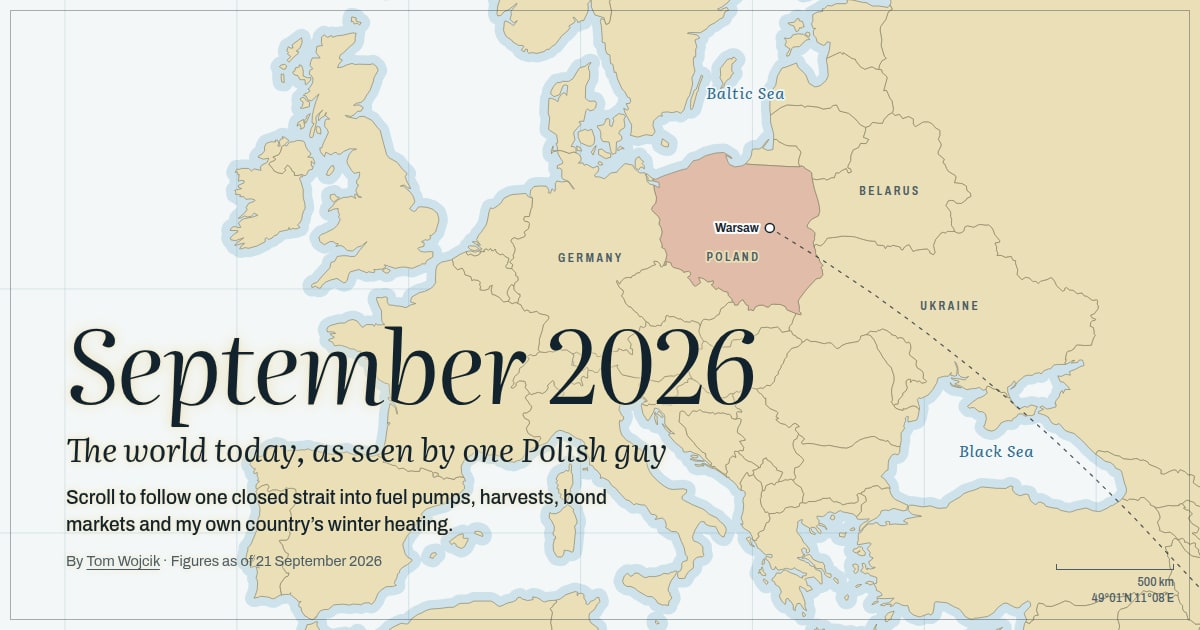
September 2026: the world today, as seen by one Polish guy
How a Pole sees the world in September 2026: a scrolling essay that follows one closed strait into fuel, food, bonds, defence and demography.
Tom Wojcik
525 points · by marjancek · 1mo ago · 391 comments
The war in Ukraine is a tragedy, but it has proved that Russia is weak. The price shock will speed up the transition to renewables, and Iran is losing its grip on Hormuz. So many of the other issues are solvable.
It's easy to be a pessimist, but there's a bright future ahead of us.
Remember this is a war that Iran has spent 40 years planning for.
Netanyahu has been doing the same "two weeks away" stand-up comedy since 1992.
Netanyahu asked every single US president. They all took advice and then went back with a polite "thanks, but no thanks".
You don't need to have access to super-secret intel to know going into this frivolous war was a very stupid idea. You just need to look at a standard map and use your brain.
Finally Mr Netanyahu found a stupid enough US president.
And the problem with the current US president is he won't accept a loss.
He is not the sort of person willing to accept he has bitten off more than he can chew.
Nor is he the sort of person who is willing to sit down and have a proper negotiated discussion. Infact he's the very person who just tore up the JPCOA seemingly just because he doesn't like Obama.
Nor is he the sort of person willing to learn from Iraq or Afghanistan.
So we have a stalemate. And a US president who doesn't believe in diplomacy, old-school politics or anything else.
And this stalemate is not one that is going to be resolved with more military firepower. Again, just look at the map....
It's at everyone else's expense, but so is everything else they do.
Its not my area of expertise by any means, but I would perhaps point out the US Strategic Petroleum Reserve chart[1] which is at its lowest level since 1982.
Also do not forget the oil and LNG needs to be transported and that is becoming increasingly difficult and expensive.
It may well be that the artificial party cannot go on forever.
[1] https://en.macromicro.me/charts/41674/us-strategic-petroleum...
It might check the phantom "short term profits" box, but anyone with any modicum of business sense (and the oil boys are no amateurs) see this event as probably the largest nail ever driven into the oil coffin.
Trump could not have given a bigger gift to the anti-oil crowd, making every human on Earth think "Damn, this shit is getting expensive and unreliable, what alternatives are available?"
It's not a stalemate. Best current estimates are that oil traffic through Hormuz is back to 80% of pre-war levels. This is not going well for the Iranian regime.
Its funny how the goal posts shifted from traffic to specifically oil traffic.
> 80% of pre-war levels.
and what happens when the US NAVY stops escorting?
At least he hasn't yet gone nuclear (metaphorically but also literally)
Maybe the only possible bit of credit we can give the guy is he said no when the Israelis wanted to use theirs.
Isn't it after all supposedly the world's worst kept secret that they have some too ?
But I'm also kind of concerned what happens in the unlikely event he does well in the mid-terms, and the same after the Israeli elections ....
Or blackmailed enough? People seem to be forgetting about that aspect of the Epstein ordeal.
I have Google maps open on another tab. Could you clarify what should I be looking at?
So has the US. But as the saying goes: Everyone has a plan until they get punched in the face.
True, but also worthless - the USA fired or retired people who knew the plan (1), and didn't listen to the warnings. It's more "Everyone knows the plan until they punch themselves in the face"
1) https://fortune.com/2026/04/05/doge-fired-state-department-e...
My understanding is that the US's longstanding evaluation is that their strategic goals in the region can't be accomplished by brawling with Iran over the strait, and their best move is to avoid it. The actions of every previous administration align with this view.
Where Iran's strategic position can be improved by drawing the US into an open conflict. Disrupting global petroleum markets, forcing the US to spend disproportionate resources defending its regional allies or withdraw and admit it can't, weakening the US's influence as a diplomatic power, all are achievable (or, frankly, achieved) with this conflict.
The US has no comparable strategic wins to even aim for here. At this point their only reasonable goal is restoring open trade through the strait, the status quo before the conflict. Fighting a war to successfully reclaim the status quo that was disrupted by entering the war is, strategically, losing a war.
NATO Secretary General Mark Rutte disagrees with your assessment: https://x.com/clashreport/status/2102671513337856357
Would that be the same Mark Rutte who referred to Trump as "daddy" during an alliance summit and sent him a flattering text message which Trump published[1] ?
Yeah. Erm. I think we know what side of the bread Mr Rutte butters his toast on.
[1] https://apnews.com/article/trump-rutte-text-message-nato-sig...
I'm not discounting the value of the good things you mention, but is there anything else to add to the 'golden age' description?
does anybody else wonders how this isn't a good old wishful thinking, when with 350+ billions of dollars in foreign aid to Ukraine, all sorts of intelligence and tech help, total and forced mobilization in Ukraine (while only one partial in Russia in 2022), all sanctions on Russia you can think of - even with all of that "weak Russia" after 4+ years of war still controls almost 20% of the Ukraine counting Crimea and it's not really changing?
or maybe there is a difference between "not as strong as was thought" and "weak" after all?
Also, Russia cannot keep this going indefinitely. The West can. There is some question about whether Ukraine can or can't, but from an endurance perspective, there is absolutely no question who has the upper hand. Nobody west of Ukraine is on a war footing, we're all working our day jobs, taking vacations, and growing our economies.
$350 billion of foreign aid sounds like a lot until you realize the GDP of NATO is more than $55 trillion. We could keep this going forever.
Russia is spending 7-10% of its GDP, and fully half of its federal spending, on the war. And that probably understates because Russia forces war spending onto localities and companies. This will come to an end eventually; time is not on Russia's side.
So advanced military - they use civil vehicles for assault operations.
So strong they lost the control of the Black sea to the country with no navy.
Been living a lot in SE Asia in the last 12 years but ever yeah in poland for few months. There has been really big inflation in the last 2-3 years and everybody notice it.
Been twice this year in Italy, one time in alps and last week in puglia and there is a reason so many Poles go there for holiday - its cheaper or similar price but better than taking a holiday in poland.
No one in the West has had the Eastern European experience of queuing for bread for hours and discovering there isn't any.
In the West we have exceptionally strong normalcy bias and can't imagine a world with severe scarcity.
In countries like Poland that's still lived memory.
They are not, and this is a good thing long term.
That is just hope-believe, i.e. it ain't happening.
> It's easy to be a pessimist, but there's a bright future ahead of us.
I lived through the 1990s here in Romania, the future does not look bright in the slightest. Yes, materially speaking we do have more stuff compared to the 1990s, a lot more stuff, but the opportunities in front of us are as slim as ever (which wasn't the case back in the 1990s). But maybe things look different for the Polish.
Why? Inflation was much higher then. There were almost no highways. Very little foreign tourism. Towns were ugly. Industry was barely functioning. Etc. Things are way better now. Just because Romania has high debt is no reason to be pessimistic. Everybody has high debt.
Worth noting mid east is all looking for other routes now 3-5 years from now Iran will be in a weaker economic situation on reduced flow. Hopefully Theocracy has been ended.
I think this applies to both sides, and the issue is that the people in power are not affected by the crises that cause hardship to ordinary people. " Iran is..." does not distinguish between the two, they are different. Fanatical leadership can live by "Some of you may die, but it's a sacrifice I am willing to make" .
The problem though is that people in the USA do have one lever to pull on their government, in the form of approaching midterm elections, that the people of Iran do not. And the leadership of Iran knows it. They may be fanatical and awful but they're not stupid - causing fuel shortages causes economic pain to ordinary people causes political pain to the USA. They have this weapon and are using it heavily.
Notwithstanding that, this assessment of blame is correct ( https://news.ycombinator.com/item?id=49907371 ), the missteps that put us in this mess with no clear way out all come from stupid leadership in the USA.
> That is just hope-believe, i.e. it ain't happening.
Best estimates are that 80% of the pre-war levels of oil are flowing through Hormuz right now. It's happening.
What are you hoping for?
>Iran is losing its grip on Hormuz
citation needed
not really, I think.
To stop the advance and drag it into positional warfare whole europe had to scrape for surplus arms, US provides a ton of munitions and guidance, the financial burden carried by the EU is absolutely insane - Ukarine's military budget is 40% of its GDP excluding direct military aid, etc.
Of course the war didn't go as to RF's regime boasting, but of all things it actually proved that the regime is not to be underestimated - they are very flexible, can adapt well and are very fast at adopting technology into the field.
I mean, we know now that they are not as powerful as they marketed - but the only other country who has engaged in a direct war with a peer adversary is Ukraine, and we don't know how prepared every other country is in practice.
I wish all the best for Poland and Polish people, but I don't think we should hedge our bets on nation-states and the situation around that going forth in 21st century
[0] https://www.oilandgasmiddleeast.com/news/strait-of-hormuz-oi...
Tragedy in Nepal was everywhere for a week. Advances in vaccination? Diseases cure? Green energy? Not much because it's very slow news.
/s but kinda not
How? Russia is successfully fighting the entirety of NATO on a front that it is continually pushing further west, with about 20% of Ukraine now lost. If anything NATO and the promise of US security is what has been shown to be weak. And I don't think the idea of US/Western superiority is ever going to come back to what it was given what has happened in the Ukraine and Iran theaters in recent past.
Ukraine us unlikely to get back most of the territory it lost in 2022, but Russia is also unlikely to even finish capturing the remaining parts of the Donetsk oblast, let alone the rest of Ukraine. It's taking Russia months/years to capture settlements with just thousands of prewar population. Donetsk oblast still has a heavily fortified urban area with a prewar population of 500k under Ukrainian control.
Last time I was paying close attention (maybe 8 months ago) the fighting was heavy in Pokrovsk, Myrnohrad, and not yet in Konstantynivka. Now all three of those are well within Russian control. And that seems to be the story all over the front. There may be some temporary regressions, and occasional slow downs, but overall the Russian side is continually pushing.
> It's taking Russia months/years to capture settlements with just thousands of prewar population
They're not moving quickly. That's the way they're choosing to fight the war, and also due to the strength and resilience of the Ukrainian side, along with roughly 300 billion Euros pumped into the war by NATO so far. I don't think the slow methodical approach is evidence of weakness. Taking the average territory capture rate since 2022, the entire Donbas would be under Russian control mid next year. Using only the relatively slow 2026 rates, the entire Donbas would still be under Russian control in less than 5 more years.
Russia is about 28 times larger than Ukraine and 10x GDP.
Russia is claiming to fight NATO, but NATO hasn't even shown up yet, but Russia is struggling. If NATO were to go to war with Russia, there would be very little that Russia could do. The one thing they might be able to do is the reason NATO has been holding back.
As far as NATO showing up, they have. To the tune of over 300 billion Euros. I'm not sure how you can claim Russia is not fighting NATO. Zelenskyy is constantly requesting more and more funds and weaponry from the west, because without it, the Ukrainian side would not be able to put up the resistance that they have been.
Russia is also not pushing, they actually lost occupied territory in 2026.
Has anybody told NATO yet that they’re fighting the Russians?
If only we had known, right?
Russia is reflexively anti-NATO as NATO is reflexively anti-Russia.
NATO is an alliance that was created in opposition to the Soviet Union. NATO has absorbed parts of the former Soviet Union.
Western companies pillaged Russia after the fall of the Soviet Union. Rightly or wrongly, Putin owes a lot of his original popularity to dealing with the aftermath.
Russia, rightly or wrongly, sees colour revolutions as intelligence operations, and territorial conquest.
Russia cannot accept NATO forces on its borders.
NATO is providing decisive material, political, logistical, financial and intelligence support to Ukraine, precisely to bog it down and drain it.
These are all pretty normal perspectives for most Russians. They're arguably pretty based, and not necessarily a product of internal propaganda campaigns.
The thing that westerners don't get about Russia, and the reason we're stuck in this Godforsaken conflict, is that we personalise things around Putin. We think that if Putin dies, everything will magically improve.
The decision to invade was Putin's, but the rationale goes much deeper and will outlast him.
Ukraine is taking back terrain currently:
https://www.reuters.com/world/ukraine-has-retaken-745-sq-km-...
https://www.kyivpost.com/post/85252
Russia is successfully fighting the entirety of NATO
It is not. The primary reason that Russia can even keep up is that it has many more citizens that can be thrown in the meat grinder and can work in arms factories and it has a larger industrial base than Ukraine. If you would tell most experts before the invasion, that it would've ended up as it did, they would have laughed their heads off. They would have told you that the Ukraine army would not be a match for the Russian army and they would have told you that the response of the West would have been divided.
Russia has ~146M citizens, Ukraine has ~29M citizens within land that it currently controls. Russia's estimated GDP is $2.66 trillion, Ukraine's GDP is $225 billion. That's 5x as many citizens and a 10x larger economy.
A real conventional war against NATO would be a completely different story. Sure, NATO countries would have to catch up with drone production and defense, but a lot of knowledge transfer and co-development is already happening. But NATO's economy and population is several times larger than Russia's. If NATO countries switched to a war economy, it would not be a fair game.
Of course, Putin knows this and he also knows the real weaknesses: there is a change that not all countries will uphold Article 5 and coordination might end up in a mess if the US would bow out, because command & control has always largely been handled by the US. This is why he is constantly testing how strong Article 4 and 5 are on an escalating ladder. The other weakness are disinformation campaigns through social media, which are working really wel for them, both in the US and in various European countries.
(I don't think it's useful to talk about nuclear war, it will end up badly for everyone in a population center. There will be no winners, only losers.)
Tell me how you would solve all the other issues, I am interested.
What makes you think no-fault divorce is desirable? Stable marriages are integral not only to the individual well-being of those who are married, but to a healthy society in general. No-fault divorce is one of the worst developments in the West, because it feeds mediocrity, selfishness, convenience, and self-indulgence. Requiring a grave reason seems utterly sensible. Do vows mean nothing? Are they just nice little lies to tell each other?
So, making civil divorce more difficult to obtain is beneficial, because individuals are weak, and indeed one of the purposes of the law in general is to teach and to help guide people toward a good life. So, here, by making divorce more difficult, it assists in getting couples to work their issues out. Speaking from experience, I know marriage forces a kind of ultimatum: either ship up as a human being—either keep chiseling away at becoming a better person by becoming a better spouse—or prepare for a miserable marriage. And let's not flatter ourselves: many people choose the latter and reach for the easy way out with divorce.
Appealing to Western hyper-individualism falls on deaf ears, because we've seen the effects of hyper-individualism. Collectivism is bad, but the extreme of hyper-individualism isn't good, either. Why would you want to replicate the tangible failures of the West in your country?
For instance: it's mentioned that EU gas storage is at 67% and Germany's at 56%.
What is not mentioned though is that Poland's storage is at 97% because the previous administration, for better or worse, was paranoid enough to invest in a sizeable marine gas terminal and the current one stocked up early.
Regarding real estate: adjusted for inflation prices peaked 2.5 years ago, interest rates are also much lower than back then. Nobody is buying because all the Ukrainian refugees who were moving to Poland are here already and that's the last bump in population this country will see for the foreseeable future.
Also there's the threat of war on Polish soil, which affects investor sentiment.
Is this an effect of social media and the 24 news cycle that has negative headlines on repeat?
https://energiedashboard.admin.ch/gas/eu-gasspeicher
For instance, Italy has more storage capacity per capita despite very similar consumption (~10TWh/1mln population) and they're already at 86%+.
Meanwhile indeed Poland has much less storage (about a third of Germany per capita), but it also uses it less (half the consumption of Germany per capita).
I must ask: what the hell are the Germans waiting for?
Plus, our chancellor has zero experience in governing anything (he's not even been mayor before) and is firmly stuck in thinking like a Blackrock executive.
So, to answer your question: We are waiting for a government that is not entirely in the pocket of those that want to stick to the status quo and profit from crises as long as possible.
Bureaucracy, most likely. That and in-fighting (I count NIMBY as an example of that, but not the only thing).
Here's a train station in Berlin, whose upgrade is currently 20 years behind schedule: https://en.wikipedia.org/wiki/Berlin-Köpenick_station
Just because the numbers might be small if germany doesn't has enough gas and some old fragile human being might die of this or because they cant afford the gas, its still no way to die in a country like germany.
What does your comment add to this discussion?
We should stop caring? You decide how others can live because you are well off?
I don't know if Putin is crazy enough to chance it, but I wouldn't put it past him to do so.
But even then, Russia would need to mobilize hundreds of thousands of troops and that is not something you can pull off in a week, or even a month.
A country that is rained on by 500 drones daily delivering 125KG explosives (so like a proper standard bomb dropped from airplanes) can overwhelm local military defense capacities quickly, leave infrastructure in crumbles (as in no water, electricity, gas, heating, gas stations working and so on) and at least in dictator's mind local population may crumble in weeks. You don't need to put a single foot in the country to reduce critical infra to rubble.
I can't imagine Polish folks would ever bow to russians after horrible things they repeatedly done to them, but ie in Slovakia it would be a very quick victory even if country wouldn't be ruled by ultra corrupt folks who would just give whole country to russians for some more corruption promises for later.
If puttin' will try anything in eastern Europe now is the best time. But I would expect more something along Moldova or baltics, Poland is far from russia and any extra force concentration in Kaliningrad would be easy to see.
Unless you mean nazi invasions ofc in which case you’re just a troll.
Many generations are. Last century saw the collapse of the British and Soviet empires - titans by any measure - through mismanagement. Europe as an international power was also broken (compared to how they used to be). I can easily imagine 1900s me fleeing to America in fear of the end times and feeling quite justified in his choices with hindsight. Less obvious where to run to these days as the US not-an-empire looks like it may crumble.
Most of the people who died didn't get an opportunity to complain, so we live with some serious survivorship bias on how bad things got.
OTOH, mobility is a privilege, and it's usually the least privileged who are the most affected by war. So I'm not exactly sure how I feel about my own advice, since it's most useful to those that need it least.
We made it a priviledge, but for a biological being, it's the most natural thing to do when you find yourself in a place that is shitty. There is a reason so many risk truly awful things to get a chance (chance!) at a better life: going to where food and safety is, is just what living beings do.
It also depends who you are. A very large fraction of American trans people (not a large absolute number, only a few hundred thousand) have moved from R states to D states recently due to repression, such as Kentucky revoking their driving licenses.
I do think the best political-economic era of my life was 1997-2001: election of Tony Blair until 9/11, covering the first internet boom. That was the closest to "world peace". That includes the Israel-Palestine peace process and the reconciliation of the post-Soviet states into Europe. If that had worked better, with a democratic Russia, the world would be a very different place today.
Americans just end up paying for a lot of things that are either undesirable for many Poles (e.g., a huge McMansion in desolate suburbs and the car to drive there) or paid for via other means (e.g., healthcare.)
Oh, best of luck convincing Americans that paying twice as much for shitty health insurance than you pay in 'high' general tax levels is somehow a bad deal for them. Until they actually live the experience they just cannot comprehend the second and third order benefits of a real social system.
US folks have more money on average, but are forced to spend them in ways ie europeans don't have to - top notch education and healthcare costs are huge in US for large part of population and compose big part of expected savings of parents and older folks, while an afterthought in Europe. How do you compare that.
Plus places in Europe like Switzerland have long term way higher living standards by any measure than even good places in US. Europe is big and diverse in ways US simply never was, it would do you good to travel the world a bit and see and experience it with your own eyes.
How do you define "average living standard", so that it would take a colossal disaster to have US reduced to that of Poland?
Depending on what you're running for China is in some senses kinda what the US was back in the day, except there's no land so no easy way for them to accept migrants. These day and age migrants also aren't very accepted anywhere.
The difference from the past is that the US has always been a melting pot, while China is pretty much a closed society. If you’d emigrated to the US, you always had a good chance of blending into that diverse society no matter where you came from. Assimilating into the homogeneous Chinese society will take generations.
For me it’ll be either the westernmost end of Europe or one of the better parts of South America, in the hope that they will prosper modestly in the shadows of the upcoming conflicts.
China's migration policies have been extremely strict, so to what extent they will be able to loosen that up without political upheaval is still an open question. So far they've only loosened up the restrictions on internal migration.
I think mismanagement is not accurate. The Soviet system was flawed and inefficient and could not compete. The European empires were made untenable by the world moving on: economic, technological and political changes.
I think Europe and America had a golden age when they were at peace and dominated the world economically from the 80s to this century, and forgot neither of these is a given.
Too late to edit now.
How are you supposing that it looks like the US may crumble? I don’t understand where these kinds of comments come from, aside from perhaps verbalizing something one might want to see instead of what is factually true.
That limited government is looking shaky right now. It's mostly Trump, but it's not just Trump - Congress has been increasingly worthless over the last couple of decades, and so the President has to rule more and more by executive decree. But Trump is pushing the boundaries of what the Constitution allows the government to do far harder than any President that I remember, even Nixon.
And if we lose the limited government, then within a generation or two, we're going to lose the rest. It won't be immediate (unless you fall afoul of the government), but it will come.
Well it's part of it. The other part is China does not want the value of its currency to rise and as an export-oriented economy they have a desire to manipulate their currency to keep it lower to ensure exports are highly competitive. That's not an allegation or a conspiracy or anything, but a policy choice and a fact. Being the dominant reserve currency as the USD is (remember it's not the only reserve currency) has a lot of benefits but some drawbacks too.
I don't think that American limited government is looking shaky right now. I agree Congress is becoming increasingly worthless but it's something that can be fixed if we want to. I also would suggest not being confused about Trump does big headline thing as a representation that America's government is shaky or something. He has pushed boundaries, but some of those boundaries are quite literally up for interpretation and while he may push those boundaries he also doesn't go around and advertise all the court or legislative set backs that have occurred.
The Iran war is actually a decent example - he does not have an authorization to use force beyond the limit authorized by Congress. While we're conducting limited retaliatory strikes (Congress wouldn't disagree with doing so except maybe the pro-ayatollah/anti-liberal faction (Congresswoman Ilhan Omar for example) and engaging in a naval blockade, Trump has had to follow the rule of law here and step back more grand ambitions and plans. Now of course he may do something and we'll have to see how the system responds, but everyday law and order and such is proceeding as it has for quite some time. To be frank, it's actually a little bit worse but that's not really due to Trump so much as it is to policing failures and anti-social behavior we're tolerating when we shouldn't.
The US is the most oil-dependent country (although all western countries are quite dependent on it) and it cut off its own supply of oil.
The US has canceled all military guarantees and aligned with two different fascist states, so military cooperation is unwinding.
It's been unable to manufacture anything effectively for a while now as all the money gets siphoned off corruptly (identical to Russia in the Ukraine war), not even the weapons used in Israel.
What else is there to being an empire? Its nuclear aircraft carriers - with no aircraft since they run on oil?
That's not what a decoupling looks like. Investors are probably just not buying because they know rates are going to go up. The Federal Reserve already strongly signaled another rate hike by end of year. Why would you buy something today that you can wait and buy for a better price later?
Second, if you want to make an argument about interest rates or the debt, you first have to make that argument and resolve it for the UK, Italy, France, and others.
Third, the USD is just the dominant reserve currency. It's not the only one. A reserve currency is just one that banks hold in reserve. The reason the US is involved in the Middle East is to protect the Petro-dollar which generally "requires" oil purchases to be settled in dollars. The trade off is we keep Iran in check from destroying the gulf countries.
> The US is the most oil-dependent country (although all western countries are quite dependent on it) and it cut off its own supply of oil.
This doesn't make any sense. The US is also the largest oil and gas producing country in the world. Even for the Strait of Hormuz and Red Sea you can read for yourself that the US has been able to break through and Saudi Arabia has quickly repaired the east-west pipeline and 3.5+ million barrels are flowing through there now (IIRC 60% or so of pre-attack volume). Either way, most of those flows go to Europe and Asia, not the US. So while the US is oil dependent (all countries are) I don't think your assertion is entirely accurate.
> It's been unable to manufacture anything effectively for a while now as all the money gets siphoned off corruptly (identical to Russia in the Ukraine war), not even the weapons used in Israel.
That doesn't make any sense either. We manufacture all kinds of things, including incredibly advanced equipment. We make airplanes, we make semiconductors, pharmaceutical goods.
> What else is there to being an empire? Its nuclear aircraft carriers - with no aircraft since they run on oil?
If we don't have oil neither does anyone else. Except that we do have oil so our nuclear powered aircraft carriers would just use our own oil for the jets.
It leads nicely into a conclusion that, even without the preface, seems reasonable: build personal buffers of water, electricity, and cash.
Tribal populations lived isolated lives. Most of human life on Earth involved only small-sized settlements with occasional visitors from the far away places.
Connectedness opens the flood gates . You get inundated with news from every corner as if it is happening in you neighborhood and as if those are your people.
You are not designed for this.
What a bizarre statement. Of course you are not designed for anything. You have adapted, genetically and socially. And you keep doing that. Modern society would collapse if change to a state of the world that you describe would quickly come. If it comes slowly, no matter what change, humans will adapt. Not all of that will be pleasant, but it eventually works out.
That means the modern society is not sustainable and cannot adapt to long-term changes. It's like those cities, where all traffic and power supply would be affected for every rain. That's not adaptation. That's just living precariously on greed and assumptions.
The drastic changes, if any, themselves would be purely man-made, not like asteroids that killed dinosaurs. A proper evolution or adaptation would not have drastic changes. Changes would be gradual in synch with the pace of biological evolution.
Why? I, as the poster you replied to, do not see it this way at all. Any society, modern or not, can adapt to slow changes. And rapid changes would be at least as damaging several centuries ago, when for example 2-3 consecutive years of bad harvests meant a major upheaval.
Things can look a lot smoother after a few centuries. My 2c.
Adption is not just genetical. A person can move from northern Europe to southern italy without problem. Its genetics don't need to change for that.
> That means the modern society is not sustainable and cannot adapt to long-term changes.
I don't see that connection. As long as change comes sufficiently slowly, adaptation is no problem. It's mainly that the quicker change comes, the more painful adaptation is. This it unrelated to how sustainable society is.
The author writes: "This time I do not need the research, because I have spent the past year looking for a house. (...) And the Polish loan is the worse product."
I wrote a piece comparing what Poles and Americans say about the housing crisis in social media, you might find it interesting, especially that I tried to compare affordability as well [0].
In short, it seems that:
- Warsaw is even slightly less affordable for its residents than Manhattan - but the Americans seem to be more pissed off by the situation.
That was very surprising to me.
[0] https://rudolf.observer/en/posts/who-complains-more-on-housi...
It's almost s if economic theories actually describe reality! Given that it's economy 101 predicting that this would happen.
Still, people do it again and again. Rent control proponents for housing should take notice.
Without introducing an unpopular tax regime, the French govt has found a way to progressively increase prices for higher mileage motorists. Supplying most motorists at a reasonable price, while having high-mileage motorists pay the unsubsidised price for most of their petrol.
Rent control working depends on multiple other policies and on the characteristics of the place. For Paris for example it did seem to have a positive effect: https://hal.inrae.fr/hal-05315123v1/file/Morin%20et%20al.%20...
Why does this might not apply to other cases? Paris is very dense already, not a lot of places to build anyhow. What other policies are required? Ensure people do not buy only for investment and leave things empty - they raised the uninhabited tax to discourage that, will see if enough to make a dent.
Almost all measures since have been detrimental to new housing, great for real estate owners, extremely poor for renters and allowed house prices to skyrocket. None of these things are on their own and it's a more-or-less global thing but they've done a great job making it worse.
And as a bonus: this was projected to happen by the governmental planning agency and rejected as fearmongering.
People bring in Tokyo as an example, but there’s even a rent control-esque thing here - right to refuse. Technically landlord can increase the rent, but you can challenge and refuse it, to keep paying the original amount. Like rent is going up heavily over here (my neighbourhood is about 10% YoY). You can’t really even build up fast enough to accommodate demand.
- To maintain fellowship, the empire spreads money to buy influence
- eventually this starts to cost too much, so the empire reduces spending
- wars ensue and independent voices emerge
- unable to establish order, the empire loses its influence and collapses
You can see this patterns as the US is overspending (high debt / trade deficit) while reducing its diplomatic influence on international programs. Not sure how they can save the USD value over time.
We're always looking for catastrophes or victories that happen in a matter of days, something that can be summarized in a Chyron. But in general the systems that really count work more slowly and with more complexity than that.
Things don't have to be apocalyptic to be bad. We have been on a rollercoaster of sea freight costs (SCFI) since COVID and the knock on impact on prices only seems to go in one direction. It adds to demographic and housing crises and government debt crises. Add in an energy crisis following on from the same crisis barely weathered at the start of the full invasion of Ukraine, add in a fertilizer crisis, add in a once-in-a-thousand year El Nino and things fall apart.
Humanity has always faced crises, many thought the world would end in nuclear fallout roughly half a century ago, but things don't have to have the salience of a nuclear bomb going off in the neighborhood to make everything worse. And it is a slow and gradual disaster.
The current strain of populism works the same way. Screwworm eradication efforts aren't sexy, they don't have high salience and they play into people's view that the government spends money and time doing nothing. And you remove the system and it doesn't fall apart immediately, and the effects are muddied with climate change impacts and so on. The doomsday predictions don't come to pass and people don't stick around to see the slow, creeping disaster they unleashed.
Is there any country that has good prospects? asking for a friend...
Poland has become a rich country within one generation after the fall of Soviet Union and one of the safest countries in Europe at the moment. There's always gonna be crisis in the world but at the same time you have to admit that we're living in one of the most comfortable times for humanity in general compared to past generations.
If it wasn't for the AI we wouldn't even be having this discussion because the linked vibe coded site wouldn't even be built
Also learn to choose your battle. If you focus on everything that's going wrong in the world and spend all your energy on that, you're gonna have mental problems.
Which would be good - we don't need AI propaganda slop like this page.
I'm not sure my generation thought that (I was born in 1955). Not in the South of England at least. Growing up there in the late fifties, sixties, seventies, I feel that most of us were looking forward most of the time and anticipating good times. At least most people I knew at the time. It was a time of accelerating change and a great deal of it was undeniably positive.
Maybe it was just something about the South of England though eh?
I do think though it's a little dishonest to be this alarmed now just because the crisis is at your doorstep. There is continuous misery all around the globe which everyone should acknowledge. The wars in the middle east brought destruction for generation and for entire regions. I am not sure those people are worried about the interest rates in Japan as much as they are about surviving. Including the current war. Think about Iran and its government what you will, but when a school gets bombed, innocent children die. I am not sure I find this less concerning than the state of natural gas capacity in Germany. And I live in Germany.
As for the energy crisis, the solution is in front of us. If you don't want to depend on foreign fossil fuels start electrifying and switching to renewables and batteries. You can do it cheap and fast. In fact, this is already happening in parts of the world and they are much more shielded from the current issues than elsewhere.
Claude chose a weird turn of phrase here. Does this mean "the smallest of the three was the sixth largest"? If the Ukrainians hit a tiny plant, will it now be "three of its hundred biggest diesel plants"?
It was a pleasant, concise and informative read. I actually read it from beginning to end. Unlike many of the artisanal articles starting with how the author experienced the crema of the morning's espresso.
The visual design is beautiful and the maps are illuminating for some of the points. But a good number of the map elements feel pretty superfluous, in a 'data for data's sake' kind of way.
Overall I think this would be more impactful if it were ~50% shorter or if there were more navigation - this is a ton of content to scroll through one panel at a time.
It would be nice if we had more competent politicians trying to solve problems and make things more efficient though but that's a problem no democracy in EU solved. We are paying for years of kicking the can in the energy department now but on the other hand maybe that will speed-up transition to EVs which will be both great for standards of living and significantly more efficient.
Geopolitics is hard to predict but I am also in optimist camp when it comes to war in Iran. The oil is flowing again and Iran can't do much about it. Workarounds will be found. Ukrainians now have a way to really hurt Russia which may result in peace at some point as well. If anything it's clear Russia is not dangerous in conventional war. They have sabotage but that imo is going to be less and less efficient as infrastructure and intelligence improve to handle it.
Overall - a lot of things went wrong and we are still standing. Once the environment improve we are in great position to be one of the best places to live and work in EU.
Capture rain water.
Have a buffer of food and medicine.
Build a fireplace an store some wood.
Calm the fuck down. We outnumber them three to one. Militarily even without the Americans, their active military is 1.2 millions according to the IISS the collective European one, not taking into account British, Turkish, Canadian or American is about 1.5.
We have a significant numerical advantage in kit as well a lot more tanks, apcs, etc, more and better airplanes, double or triple their navy, their only advantage is a larger ammunition production which makes sense because they are at war.
Their only advantage is our disunity and our lack of cohesion, that's the main thing the Americans provided to European defense on a conventional level, a singular command infrastructure through NATO's headquarters, on a secondary level they brought along significant logistical capabilities. But lets not forget that Russia does not have these logistical capabilities either.
I am sure someone is going to say but these are all obsolete cold war platforms that won't survive a second in the modern drone dominated battlefield. Sure, but the main advantage of drones is that they are cheap and easy to manufacture fast. European militaries do not stockpile significant amounts of these because they become obsolete in a matter of months. There are experiments going on across all of Europe on using small drones for all purposes and yeah if shit hits the fan the EU industry has to step up on production.
It would be incredibly foolish for the Russians to engage any European country, the balance of conventional power is incredibly tilted against them the only thing they can bet on is our fragmentation, and while the war in Ukraine is going on I don't see this as possible either since the bulk of their combat ready forces are bogged down there.
The real threat would emerge only if that conflict ended in their favor.
To the content:
Don't count on IEA's reports, they are just as subject to propaganda as any other media.
"When the world pays more, our grain can simply leave, so the price at home has to match" Not a fact.
At the moment as I see it some warmongers want really to escalate the situation to outright war between NATO and Russia so don't pay attention to Tusks words or any of the hawks from USA.
It is extremely urgent to push for a new Allied Nations organization not headquartered in the US and for them all to drop the dollar and put USA and Israel in check. For Europe to grow a spine, and for China and Russia to step up and stop being complacent with all the bullying going on
The whole world should say enough is enough
* Clearly AI written text on vibe-coded website.
* Heavily focused on doom and gloom.
* Lots of its points are subtly (or not that subtly) blaming the issues on support ting Ukraine in defending itself against Russian genocidal invasion.
Literally how did you come to the conclusion this was written by ChatGPT? The text is clearly written by a polish person that speaks fluent english as a second language - I know cause I am one. Telltale signs are sentences like "Meanwhile, shares are at records" which is an overly direct translation of the polish equivalent, where the word "rekord" by itself implies a record high whereas in english you'd make it explicit.
You tell me:
> Scroll to follow one closed strait into fuel pumps, harvests, bond markets and my own country’s winter heating
Or:
> France: a run on the pumps. [...] drivers fleeing record prices elsewhere emptied its tanks faster than trucks could refill them. [...] A price cap meant as a cushion, in a system with no slack, turned a price shock into empty pumps.
A cursory check on Pangram returns 100% AI written just from the first 4 paragraphs.
There may have been some human involvement with this website but they certainly didn’t edit it for style. Unfortunately if you don’t edit for style then people will default to the assumption that it’s entirely vibecoded.
- "But the same closure that empties a granary fills somebody’s brokerage account." Claude is obsessed with comparisons linked by "the same". There are several instances, like "Poland made the same swap, with oil" (but that one is odd because "the same" isn't referring to anything).
- "Europe’s potato belt tells the story in a single season": Claude also loves this "noun verbs the noun in a single noun" phrasing.
- "A country that loses its regular supplier does not only pay more. It ends up dealing with people it does not know." Claude's classic "it's not X, it's Y" constructions.
- "Strategists do not describe a stampede home. They describe Japan quietly ceasing to be the buyer everyone could count on, and long-term borrowing costs rising everywhere as a result." A variant following the pattern "it's not X, it's Y, and Z as a result." This is an interesting pattern, one that I don't think I've ever seen a human write. A human would likely write "...leading to rising long-term borrowing costs" or similar.
- The use of a verb (rising) there in the third part is typical Claude, as it really likes to verb when a noun would read better. Other examples: "markets price another rise"; "volume freezes, prices stay put and sellers wait"; "after five years the rate floats".
- "The test Tusk describes is a test of belief, and it arrives just as the Pentagon decides how many Americans stay." The juxtaposition here (a test that arrives) is very odd and typical of Claude.
- What's also generally striking is the proliferation of "X becomes Y" phrasings, which is something Claude loves to do. Price shock turned into empty pumps. A story is told in a single season.
I'll stop there.
What's fascinating to me is that I personally find this kind of text exhausting to read, but apparently other people don't notice it at all.
If we ignore the AI stuff, I will still say this is not good writing. What's so grating and noticeable for me is the monotonous style. The short, clipped sentences like little stabs of information. It never varies; the tempo is just fact, fact, fact. It's absolutely exhausting to read pages and pages of this.
Good non-fiction writing is enjoyable to read for a myriad reasons; authors use metaphor, juxtaposition, tempo, humor, irony, allusion, and all sorts of techniques to make an article enjoyable to read. Just throwing down facts one after another with this kind of breathless, staccato noir voice is not that, in my personal opinion.
I don't know how much AI is to blame, maybe the Polish version is different or if this is a deliberate style.
This technical analysis is really futile and counterproductive, there exists only vicious greed which will be followed by a catastrophe.
And before the NATO zealots, warmongers and NATO wannabes come here crying that you cannot trust Russia and that war is the only way (provided, of course, that you are not the one fighting), let’s address that right away.
You cannot trust Russia
Russia has maintained good relationships with a lot of countries, but none of them are NATO members or NATO wannabes. And, as a reminder, it was NATO that broke promises about not expanding eastwards.
You cannot deal with a country waging a war.
Yes, you can. Just take a look at Israel or the USA. One is committing a genocide in real time, while the other has been waging wars of aggression for ages. European leaders have no problems dealing
Let Russia leave Ukraine and have your peace.
> warmongers
Tell me which country currently wages war?