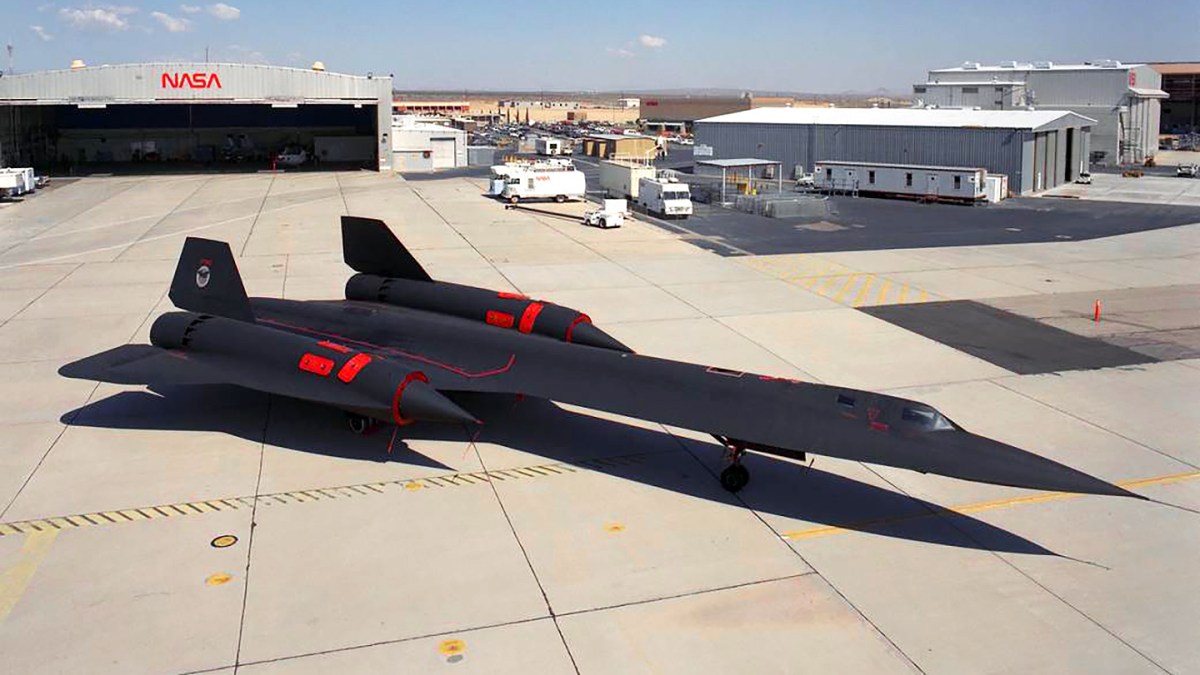
Former SR-71 Engineer Talks NASA's Blackbird Revival Program
Insights into the current status of NASA's SR-71 #844, what it will take to fly it again, and what the agency may be looking to do with it.
TWZ
137 points · by rkagerer · 1mo ago · 98 comments
- 800°F (and above) was the temperature of their cooling air
- the engine ran too hot for electronics, so they designed a hydraulic mechanical computer responsible for regulating various inputs
- the roar from the two external 400 cubic inch Buick V8 engines originally used to start the aircraft was so irresistible to the hotrod enthusiasts running them that they sometimes neglected to disconnect in time before the starter engines overran RPM limits and "puked their guts out under the airplane" - they had to buy up so much replacement stock as to deplete every single junkyard across the USA of that particular model (so the story goes - probably hyperbole but a fun tale!)
[0] https://www.thesr71blackbird.com/Aircraft/Engines/starting-t...
There was a proposal at one point for NASA to deploy a 21st-century automaton to Venus because the atmosphere is too corrosive for an electronic computer. Supposedly it would have delivered its data to an orbiter using a balloon and then the orbiter transmits the information over radio. I really wish they'd do that, I would love to see what could be done with mechanical computing using modern technologies.
Unfortunately there aren't a whole lot of situations where clockwork logic makes more sense than semiconductors.
A clever design to be sure, but still a long way from electronics that can survive anything near your typical oven temperature, much less the surface of Venus.
It was not a benchtop unit, it was a forklift model :\
This is nothing to celebrate.
I second the fact that the M21 is awesome though.
Also a Porsche 917. Incredible collection.
The SLS started in 2011. 15 years later, it finally managed a manned flyby. The entire program has generally been an endless series of errors and mishaps, and the Moon flyby probably should never have happened, but was greenlit for political/managerial reasons - highly reminiscent of Columbia and Challenger, but with a better outcome owing purely to good fortune.
Not only has it been an endless series of mishaps over an increasingly absurd timeframe, but the program has already been obsoleted by the Falcon Heavy, to say nothing of the ongoing development of Starship. It has a lift capacity of about 50% more than the Falcon Heavy, but one SLS launch costs as much as 40 Falcon Heavy launches, so it's existence just doesn't make any sense, at least not as a space launch system.
---
It seems likely that NASA would have been much better advised to have simply revived the Space Shuttle or perhaps even further back rather than trying to do something from scratch, simply because when you do it from scratch you end up trying to iterate on top of something that you no longer necessarily have the expertise or human knowledge of how to create.
I think where intuition fails a lot of us (myself included) is that in the software world if you have the code/documentation for something then building it is trivial. But in the hardware world, even if you have all the instructions and knowledge, actually applying that know how to create a working project is still very far away, through certainly nowhere near as far away as if you have started from scratch.
It's certainly true that you can build software if you have the code (well, mostly true. Modern frameworks suffer from quite severe bitrot). But I'm not sure that you can extend it.
Large software projects rely on people understanding them. If everyone who worked on the project is gone, it's very hard for someone to regain the architectural understanding required to extend or refactor things. Without any overlap, there's nobody to answer questions. As long as there's been a continuously overlapping stream of developers, that knowledge is more or less retained - but if all the developers leave, and someone picks up the project again later it's almost impossible for them to make meaningful improvements.
AI probably changes this completely.
I don't think they can make do with reduced capacity by splitting a lunar lander between 2 Falcon Heavy launches and assembling it in space.
The Lunar Module had a fueled mass of 16 tons. So the Falcon Heavy would be perfectly suitable. And that's without anything fancy like in-orbit refueling, modular designs, etc.
a) Some clearly preposterous order that originated with the demented commander in chief, and they're just going through the motions. Same concept as ordering steam catapults put back on aircraft carriers.
or
b) Intentional misdirect/bait to send various groups of people off in a wrong direction as cover for something else entirely.
This differs from 'a' in that the decision is not humoring the momentary whim of a mad dictator, but an a deliberate decision by a group of professionals (at least in theory), who have destroyed any possible means of connecting themselves with real information.
See: Special Military Operation. It was always surprising to me that the Russians essentially repeated the same mistakes from the first Chechen war after seemingly learning from them by the early 2000s
The administrator just wants to fly it around? Seriously?
What a joke.
So this led to the obvious question: why didn't we just recreate the F1 engine and the Saturn V? It turns out there were lots of reasons:
1. Materials science has changed. You can't necessarily make the same materials you made back then. And substituting them might have consequences on certification and testing that would make it much more expensive than a simple recreation;
2. We didn't necessarily know how to. Surprising as it sounds, the Saturn V program was pretty rushed. The engines and rockets were essentially handcrafted. Lots of things were documented but not necessarily everything. Even if it was, has that documentation been lost?
3. Loss of expertise. There's probably hardly anybody left who made those engines. Any complicated production line relies on reinforcing and building expertise through training and repetition. You'd have to build that from scratch. This is a common problem with any major weapons program. As soon as you stop making a particular weapon, it's almost impossible to restart it very quickly;
4. We don't necessarily have all the machining and secondary processes that existed then;
5. Advances in technology mean we can do better things now. For example, we can 3D print parts that we had no way of making them previously. It simply wasn't possible. This has come up in commercial aviation where modern aircraft (eg 787/A350) and their respective engines make heavy use of 3D printed parts, something the 747 could never have possibly have done;
6. Even if you can make all a complete system, what's your production capacity? The capacity for Saturn V rockets was quite low and because it was essentially bespoke, it couldn't be scaled. One of the impressive things about the Falcon 9 system is just how many of those rockets SpaceX could produce, even before extensive reuse of first-stage boosters. Capacity is something that almost has to be built in from scratch and it impacts everything. For example, a bunch of weapon systems have been depleted by the Iran War (eg Patriot interceptors, Tomahawks). You can't just turn a knob to ramp up production meaningfully. And where you can, it's incredibly expensive.
This is also a big part of China's current manufacturing advantage. There's an awful lot of standardization and regional specialization. You need a part? The factory that makes it is probably down the road. So certain things get made in Shenzhen because everything you need is also made in Shenzhen. This also means you can react very quickly, something a factory in the US could never do because it lacks that ecosystem.
They discovered all sorts of weird things when they made the original Blackbird. For example, titanium is so hard that they had to use special tools to machine parts like the panels. Well, in doing so they discovered that using cadmium in some tools to make them operate at higher temperatures and against harder materials would "poison" the titanium fatally.
So if you built a new hypersonic airframe now, would you use titanium? Do we have better alloys? We've had a lot of advances in single-crystal manufacturing for metals that have, for example, made jet engines incredibly reliable. And this btw is something China has had massive difficulties reproducing, at least for now. And they've spent decades trying.
As a simple example of this, there was a guy who went out of his way to make an electric toaster from scratch [1]. This is a relatively simple device but it shows how many inputs there are, which each have production lines (eg steel, aluminum and/or plastic). Now imagine what goes into a military plane that needs to fly at Mach 3-4.
[1]: https://www.ted.com/talks/thomas_thwaites_how_i_built_a_toas...
NASA asked several former SR-71A staffers to help secret restart - https://news.ycombinator.com/item?id=49890733 - Sept 2026 (401 comments)
https://news.stanford.edu/stories/2016/06/cooperation-u-s-ru...
The SR-71 won't because there's no JP-7 supplier, no flyable KC-135T, and no parts.
The balloon issue cannot be addressed by any modern US aircraft, and spending expensive missiles on low cost balloons seems like wasting money and resources.
We'll know soon.
High-altitude balloons are hardly a new threat. They have been used for decades, although some recent Chinese models are more capable than before. Regular tactical aircraft already in the US inventory are perfectly capable of shooting them down.
https://www.af.mil/News/Article-Display/Article/3288579/f-22...
SR-71 or not, there are already contracts for filling this niche:
https://www.war.gov/News/Contracts/Contract/Article/4613098/... (search for "swamp gas").
If money is flowing to counter/develop high-altitude balloons and declared as urgent, it's likely it's flowing in more than one vein.
The frame modifications you mentioned are already specified and tested, part of the YF-12 programme. It can easily carry air-to-air missiles instead of reconnaissance equipment, and the frame has flown with that configuration.
Is a missile a form of aircraft? Because there's variants of the Standard Missile which can hit a low earth orbit satellite, with the right timing, fired from effectively zero velocity and at sea level from a frigate.
The YF-12 prototypes looked superficially similar to the SR-71 but had substantially different airframes. There is simply no place in an SR-71 to mount the necessary weapons, sensors, and avionics without completely rebuilding the entire aircraft. That would be a stupid waste of resources when existing platforms can already accomplish the mission well enough.
If we're spitballing solutions, balloons are slow, fragile and move in relatively predictable paths. An F-15 could reach the same altitude, and launch it's own balloon with a small solid-fuel booster that also corrects the trajectory. If the interceptor balloon could get within 1-2km of the target balloon, then a cheap kinetic weapon firing HEI projectiles might be enough to destroy it.
https://en.wikipedia.org/wiki/McDonnell_Douglas_F-15_Eagle
That is the lower bound of what modern high-altitude balloons can reach. Back in 2023 multiple balloons were observed much higher than that up to 50,000 feet.
https://en.wikipedia.org/wiki/List_of_high-altitude_object_e...
This is still in the lower spectrum for such balloons. BS 13-08 reached 176,000 feet back in 2013 (there is reason to believe spy balloons would not go that high though).
https://en.wikipedia.org/wiki/High-altitude_balloon
So, you're wrong. There is no US aircraft that can reach them (unless they drop low as they did in 2023). The US likely wants to hit them before they go low.
The SR-71 is uniquely suited for this task, having reached up to 90,000 feet during testing. It was specially made for some kind of hybrid space war possibility (not balloons, but something high up there).
https://theaviationgeekclub.com/how-the-f-15-streak-eagle-br...
By "same altitude" I was referring to the SR-71. I do not know what the payload capacity was for either aircraft in the 90,000ft testing conditions, but for interception missions there are more important metrics.
Service ceiling: 65,000 ft (20,000 m)
That's high enough to go 15k feet above the highest ballon mentioned in the second link you provided, which was 50,000 feet.
Also, the SR-71 carried no weapons, only cameras, and re-tooling to support them would be far more expensive than merely shooting a balloon with a missile from the ground (or building an air-to-air missile that can be fired from existing platforms at altitudes like 65k feet).
Unit mix up?
The f-16 however, does have a surprisingly low ceiling, there are fighter pilot memes about it. https://www.youtube.com/watch?v=koEQp8ImlnI?t=643 something about having small wings, get above 30,000 feet and it's not happy.