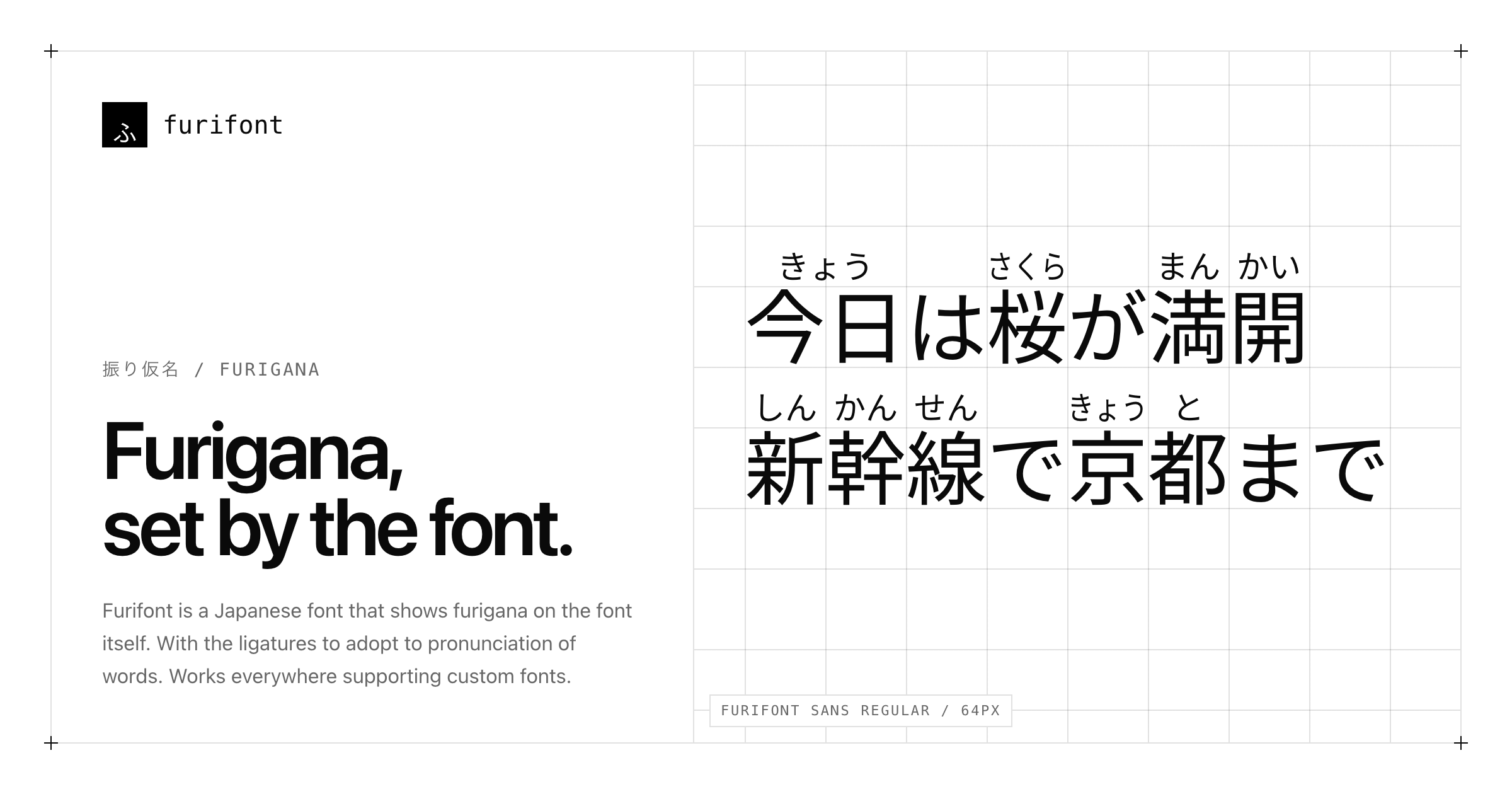
Furifont: furigana built into the font
A Japanese font that shows furigana by itself.
furifont.antfu.me
409 points · by plaguna · 1mo ago · 83 comments
For context, it's a hard enough problem that Google Translate's own romanised pronunciation guides are frequently wrong, or disagree with their text-to-speech.
Well, it wouldn't be the first time ;)
https://en.wiktionary.org/wiki/%E7%94%9F
And while you can usually figure out which reading applies based on what follows, there are still many cases where you can't. A standalone 今日 can be any of "konnichi", "kyou" or "konjitsu" depending on context and intent.
Someone further downthread said it appears to have about 80% accuracy on a short sentence, which means if you're not already at a level of skill where you can verify, then it's going to teach you the wrong pronunciations constantly. When studying languages myself, I find that learning the wrong pronunciation for something is annoyingly sticky, and unlearning takes more effort than learning something correctly the first time.
I’d say you can do a pretty good job with conditional random fields.
Still, very cool demo!
    Correct .. 80 chars
    Missing .. 12 chars
    Wrong ....  8 chars
Seems a bit drastic. Don't use it as the main font in a japanese textbook, sure, but use it with the disclaimer that it's not perfect and will get some readings wrong? Why not, still pretty useful. Should people also not use Google Translate? (also, you can stuff an entire llm in a font, it's been done).
If I asked you 'are you a sewer (pronounced "soo-er")?', would that make sense? Maybe if you looked at it hard enough and thought about it, but in the meantime, I would probably get some very strange looks for asking.
Stumbling on names is fine, name litteraly have no logic, there is no system that will get them 100% correct by definition.
Screwing meaning is on a whole different level and Google Translate or even the built in screen reader of your OS will do an extremely good job given enough context (a whole phrase).
In real world use there is little space for sloppy hacks IMHO.
Google translate does not - I see it get readings wrong on very basic sentences with plenty of context on a daily basis. It doesn't make it useless. The website mentioned the font wouldn't show furigana if the reading was ambiguous so I was basing my judgement on that, obviously if it's just always wrong, that's not useful.
One small thing on the Japanese version of the page: in the "Ligatures do the work" section, 合字 itself only gets じ over 字, and 合 has no reading. It should be ごうじ. I guess 合字 isn't in the dictionary, so it falls back to single kanji, and 合 is skipped because it has several readings.
(or maybe it could be theoretically done, just the mechanism to automatically classify wildly different pronunciations mapped to the same literal expressions don't yet exist)
https://dic.pixiv.net/a/%E3%81%93%E3%81%AE%E5%85%88%E7%94%9F...
Should probably use MeCab, which parses this correctly.
But you could set this as the default system font for Japanese and enjoy furigana everywhere, even in places that don't support ruby tags at all.
That way choosing a powerful and more accurate engine, or more adapted display of the characters also becomes an option.
From practicality standpoint, this would not work on unprepared texts, as pronunciation of Japanese words are a bit arbitrary and so correct pronunciations would need to be manually selected for each words.
i.e. "maize" could be read "corn". I believe LLMs don't necessarily have good intuition for that, being trained on plain texts.
As to how could such a situation could ever manifest: I would blame the fact that the official language of historical Japanese governments having been a really creative interpretation of medieval Chinese[1] sprinkled with labels and jumps and supplements[2][3], resulting in people just accepting wild divergence between literal and spoken Japanese. I'm not a linguist or a language major so I'd happy if anyone could further elaborate...
1: https://en.wikipedia.org/wiki/Kanbun
2: https://youtu.be/_k0I6bi2pYs?t=248
3: https://d1ysbfo9sxjda0.cloudfront.net/wp-content/uploads/201...
[0] https://litherum.blogspot.com/2019/03/addition-font.html
[1] https://en.wikipedia.org/wiki/Turing_completeness#Unintentio...
In the present context, an example is that the common reading of a Kanji word isn’t always well-defined, and neither is the decomposition of a sequence of Kanji characters into words.
https://pingtype.github.io/japanese.html
It also supports line breaking, so that words don't get cut in half when wrapping text.
Assuming you could hint the furigana from the application, the phonetic transcript would make it more accurate.
Maybe it is:
With the ligatures to adApt to pronunciation of words.
https://www.japantimes.co.jp/life/2025/06/06/language/furiga...
frequency wise it should be dai-ninki for sure
never even gets to 10!
confusing when you don't explain which limktations this is
A few people here rightly pointing out inaccuracies and other methods of display (ie Ruby tags) but IMO they are somewhat missing the usefulness here - there are many applications (ie e-readers, random web contexts, custom apps etc) where the traditional methods of display are hard or fail. I recently ran into it trying to get custom Japanese ebooks to display furigana with ruby tags on my kindle. It’s a giant nightmare. Excited to try this out.