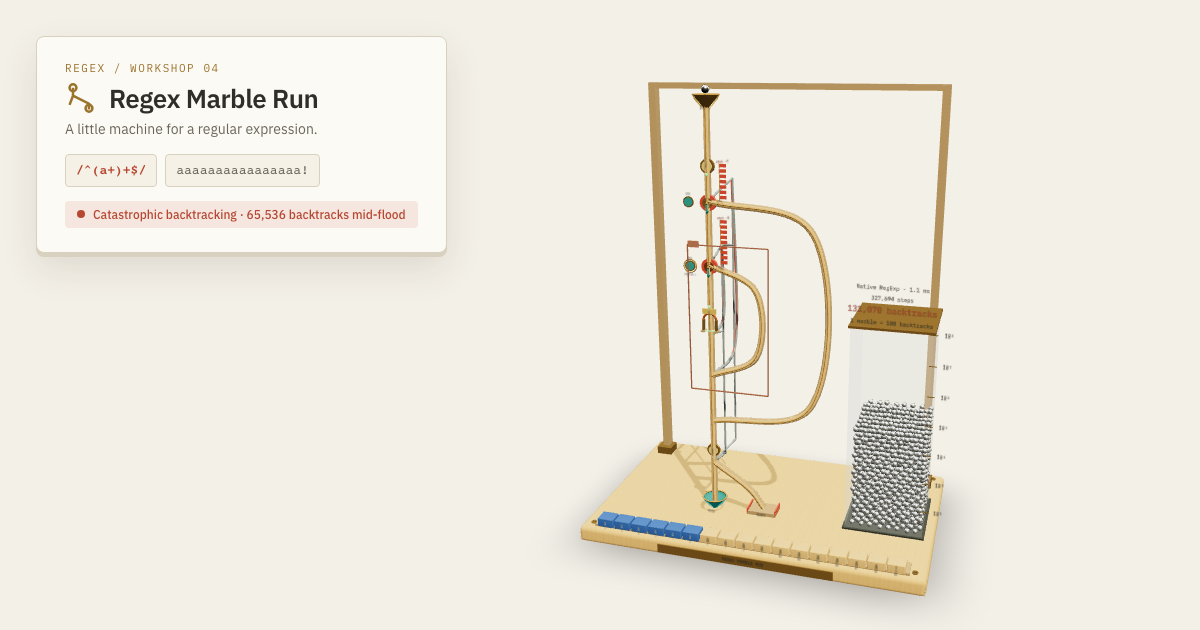
Regex Marble Run
Your regex as a 3D marble run. Watch catastrophic backtracking happen.
regexmarblerun.com
97 points · by seizethecheese · 1mo ago · 38 comments
Let's be honest, regex can be hard to understand even for technical people. (At least it's hard for me.)
So coworker built this to help anyone understand arbitrary regex commands.
AI disclosure: this was built using Agent Duel, a local coding agent arena system (https://github.com/bottomless/agent-duel). Promotion disclosure: our company is building agent duel. To test it and find bugs we are building passion projects through the system. I nonetheless thought HN would find this interesting.
But regex is also syntactically designed by Satan himself.
Most programming languages use commands that are semantically understandable, like "for" and "let" and "return" and mostly symbols we already know like "+" and "=". They use newlines and indentation for organization. And they put multiple commands on multiple lines and you can add comments and everything.
Regex is exclusively punctuation, with its own idiosyncratic meanings, all compressed into a single line, zero organization, zero comments, and impossible to remember what each symbol does if you don't use it daily. Not to mention the nightmare of escaping regexes when expressed as strings, on top of escaping regex symbols within the regex itself.
I swear it's high time we come up with a regex replacement that looks like normal Python code or HTML or something. So instead of:
^(\+\d{1,3}-?)?\d{3}-\d{3}-\d{4}$
  <start>
    <optional>  # Optional country code
      "+"
      <digit>[1-3]
      "-"
    </optional>
    <digit>[3]  # Area code
    "-"
    <digit>[3]
    "-"
    <digit>[4]
  <end>
    grammar IniFile {
        token key   { \w+ }
        token value { <-[\n;]>+ }
        token pair  { <key> \h* '=' \h* <value> \n+ }
        token TOP   { <pair>+ }
    }

    my $text = "user = alice\nrole = admin\n";
    my $match = IniFile.parse($text);

    if $match {
        say "Parsed successfully!";
    }
If you're not looking for that, and more specifically what you have shown above, there are often ways to accomplish that in certain languages. In Perl it's easy because you can use regex cars in a regex, so you can just assign `my $digit = qr/(? :0-9)/;` and then use it in the regex as you did (and Perl already supports non matching whitespace with a flag). For that matter, Perl regexes allow you to define chunks purely within the regex to be reused in a DEFINE block, so possibly that is a feature other regex engines have as well.
^(?P<country_code>\+[0-9]{1,3}-?)?[0-9]{3}-[0-9]{3}-[0-9]{4}$
  ^
  (
      \+
      [0-9]{1,3}
      -?
  )?   # optional country code
  [0-9]{3}
  -
  [0-9]{3}
  -
  [0-9]{4}
  $
It may feel silly to have a whole unit test for a one-line regex, but that one line can be really dense. If you wrote a function to parse the string without regex, that function would be complex enough to warrant a unit test, after all.
Introducing regressions when tweaking a regex in your application is also a big risk which unit tests can help mitigate.
Ultimately it is a dsl. Should equations in math also use full words and comments?
No, they should not. Maybe a nice syntax for grammars like raku is a better approach.
I just care that things have readable text names rather than inscrutable punctuation and single letters.
Yes, it is a DSL. Just like, you know, Python or C or HTML or CSS. Just because it's a DSL doesn't mean it can't actually use keywords instead of punctuation.
  patt <- country area "-" phone fin
  country <- ("+" %digit^-3 "-")?
  area <- %digit^3
  phone <- %digit^3 "-" %digit^4
  fin <- ! .
For example:
  <start>;

  option of "v";

  capture major {
    some of <digit>;
  }

  ".";

  capture minor {
    some of <digit>;
  }

  ".";

  capture patch {
    some of <digit>;
  }

  <end>;
Personally, I like regexes, in the same way that I like shell string manipulation: it looks utterly inscrutable, and performs magic. If I write one in code meant for others, I usually use extended mode with each line commented.
The problem IMO is that a lot of the traditional teaching material starts with the complexity (and impressive possibilities) of regex, when the best way to start learning it is probably just thinking about it as an extension to simple text matching.
Getting to know regex fully is in fact complicated, getting know enough regex to filter/search/replace 90% of everything you will always need is not too complicated.
  .
  |
  ?
  *
  +
()
  ??
  *?
  +?
So while I think it's a worthwhile suggestion not to show people the whole thing the first time round, I doubt that the whole thing is really that complicated.
Note that I teach tech topics at the university level, in an art school. That means a mixed audience of people who have a hard time with programming and complete nerds, but didn't come here for semantic definitions, but to get shit done. To get everybody on board with such a topic requires you to start small and on a literal "explain this to a 5-year old"-level.
Of course when teaching this to our sysadmin or someone more knowledgeable I could take your approach since I can assume they know the priors and even have seen a regex or two.
However most people don't care about any topic except when it solves their problems in ways other solutions couldn't. And this needs to be the first thing you show them. Why are regexes really awesome for certain problems that commonly exist. Bonus points if it is a problem they already encountered or are currently having.
If you really want to get technical: ., ?, and + are also shorthands. The formal definition of a regular expression is very minimal on purpose.
`.` is just `(a|b|c|...)` - List of all literal characters
`x?` is just `(x|)` - "x or empty string"
`x+` is just `xx*` - "x followed by zero or more x characters"
Whether this is exactly how they are implemented in any particular regex engine is an implementation detail, but formally there are very few operations which aren't just syntactic sugar.
  "|", which means "or"
  ".", which means "any symbol"
  "?", which means "at most once",
  "*", which means "however many times"
  "+", which means "at least once"
- using groups "(" .. ")" in replacement "\"i
- character ranges "[" .. "]"
- character classes "[:" .. ":]"
- multiline match
- ignore case
- beginning / end of line / word
If billions of dollars of IPO value were at stake, competing to use animation to convey an understanding to test subjects, this design would be toast. The model is cripplingly realistic, wasting most of its cognitive bandwidth on provoking a "Gee willikers, it really looks like someone built that out of wood!" reaction, leaving us to squint to see the balls or the parts of the machine implementing the logic. There's a particular genius to logo design, that needs to be applied here. If this were instead a cartoon animation, Walt Disney dosed the coffee one day at the studio to see what his animators could do, we'd get a visualization that better used its cognitive bandwidth to establish an icon language with the viewer.
The abacus is the T-shirt for this idea. Like a musical instrument, one can imagine operating an abacus without holding one, and some shopkeepers were able to leave theirs in a drawer after enough practice. Beads, like balls, leverage our brains' ability to manipulate physical reality, but the idea of counting became more vivid as the abacus design grew more streamlined. It not only became easier to build and operate, but it became a more effective "thought worm" implant into our minds.
We make contact with aliens, and in their museums they have an abacus for regular expressions. What does it look like?
This is important to get right, because soon AI will communicate with us using Pixar-quality 3D animation, generated in real time for each conversational turn. Many people still think of AI communication as exchanging "text message" prompts, but for my math research I'm already getting illustrated PDF slide decks as AI's responses to me in single conversational turns. One just has to ask; the form AI communication takes is only limited by our imagination.
Feynman diagrams and the like as rare exceptions, scientific communication is still mired in "telegraph" form, math symbols one reads along lines of text that once lived on physical paper. As future generations adapt to visual symbolic reasoning, the animations AI will use to communicate with us will evolve from representational to abstract art, for a "fatter pipe" pouring symbolic information into our minds. They'll find the "thought worms" that best hack our minds, make us smarter.
I'd love to see what your regex viewer would look like, if you were imagining this future.