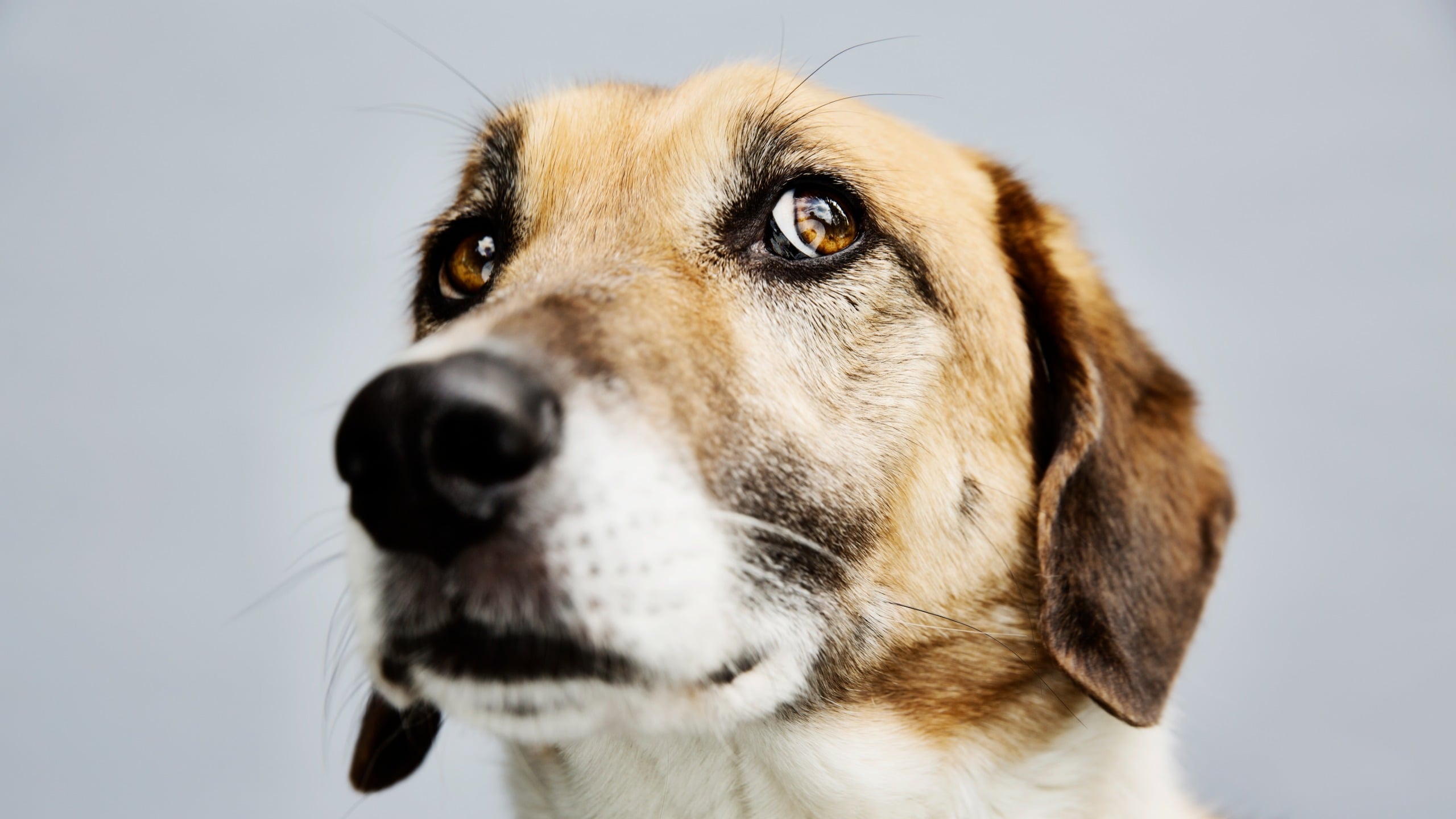
Dogs Seem to Agree With Humans That 'Bouba' Is Round And 'Kiki' Is Spiky
Picture a shape called 'Bouba'.
ScienceAlert
348 points · by gmays · 1mo ago · 221 comments
Dog's have very good hearing, and their hearing must help them to model the world around them, to understand what different objects in the world are.
So I think it's less about linguistics and more about our audiovisual mapping of the physical world.
Then again, that must be where the origin of language evolved from in the first place.
You don’t have to have much experience with dogs to know they understand words and very basic sentences around things they care about and understand (food, going for walks, prey, “business”, approval/disapproval).
I think I've heard about it before, but my stint at university in linguistics is > 15 yrs ago, so I don't know much about it.
I remember recognozing Chomsky when later studying CS and formal language basics came up, bringing the Chomsky hierarchy.
Do you have some favorite links to share about the "step change" hypothesis? I remember reading some odd info-news article comparing brains among different species of homo; and and maybe also this particular hypothesis, but I'm not really informed.
That aside, I don't understand why this "onomatopoeia" couldn't be shared among different animals and humans:
> I think objects with these shapes make similar sounds in the real world. Sharp shapes make percussive sounds. Round shapes make softer sounds.
Claiming that animals had no language at all would obviously be false. But we still have reason to think (?) that the human languages are intertwined with the intelligence gap we observe between humans and other mammals.
We have examples of people trying to invent languages in modern times, and it does not appear to be a fast process. The first people doing it would have the additional struggles of having no prior examples, no ability to take notes (writing having not yet been invented), and having to teach others to talk for the first time.
None of this is scientific (at least, not my attempts to describe it), and I don't have a good explanation for every swear or epithet, but I don't think it would be as satisfying to say "that's lubu!" instead of "that's caca!"
There's probably an overlap that makes the distinction fuzzy.
It’s like observing that humans across cultures agree that the word “woof” refers to a dog and the word “miaw” refers to a cat… no shit.
Edit - it seems there's evidence that this intuitive explanation is wrong, see the article linked here: https://news.ycombinator.com/item?id=50146562
This is why I like to remind myself that the world is much more interesting than I often think, which is why the drive to jump to simple and boring explanations can often be a trap.
Mexican / Spanish its Guau-guau or "wow-wow". Russia its tyaf-tyaf. Mandarin Chinese its wāng wāng. Few if any cultures that don't speak English know what 'woof' is.
We can't tell a story about our sensory experience without first drawing arbitrary distinctions to divide it, and objectifying those distinctions. The very notion of a percussive sound is dependent on our arbitrary differentiation of that pattern as separate from other sound experiences. That boundary isn't discovered, it's optimized. The fact that we can categorize so many different instances of sound as "sharp" isn't because sharpness was already an inherent object to discover: it's because our notion of "sharp" has been optimized to match many instances of a consistent pattern. We eventually use the same word for sharp flavor, because that relative similarity in experience is the implication we are communicating in the first place.
A sharp object will always make a sharp sound. This is an objectively true implication: that same object won't suddenly make a dull sound, because sound is physically shaped by the objects it moves through. The mistake is to assume this objectivity extends to the very definition of those objects. We could just as easily tell a story about a blarp object, where "blarp" means sharp and blue. That boundary is perfectly valid as an object in a story: it's just sub-optimal, because the experience of blue is irrelevant to the experience of sharpness. Every time we compare blarp objects with others, we are wasting effort, carrying the baggage of redundant blueness. We do this all the time, and we don't like it. Language will never be perfectly efficient, because there are too many subjects involved to relate them all precisely; and too much commitment to familiarity to update the language quickly.
At least in parrots, they love playing with sounds. They'll bang things, tap on things, throw things around, and even scream into different objects just to hear the difference. They also have decent object permanence, speaking anecdotally.
You don't need to. They probably mean how rounded objects tend roll or slide, and spiky objects tend to scrape at most or dig into a crevice and so abruptly stop with a shorter sound.
Evidence of the bouba-kiki effect in naïve baby chicks - https://news.ycombinator.com/item?id=47105198 - Feb 2026 (107 comments)
Which is "Bouba", and which is "Kiki"? [video] - https://news.ycombinator.com/item?id=46572742 - Jan 2026 (23 comments)
Bouba / Kiki Effect - https://news.ycombinator.com/item?id=45320327 - Sept 2025 (2 comments)
Bouba/kiki effect - https://news.ycombinator.com/item?id=40699583 - June 2024 (170 comments)
Bouba/Kiki Effect - https://news.ycombinator.com/item?id=27885703 - July 2021 (94 comments)
Bouba/kiki effect - https://news.ycombinator.com/item?id=8372550 - Sept 2014 (1 comment)
Why ‘Mom’ and ‘Dad’ Sound So Similar in So Many Languages - https://news.ycombinator.com/item?id=30605239 - March 2022 (1 comment)
Words known better by males than females, and vice versa - https://news.ycombinator.com/item?id=30275159 - Feb 2022 (650 comments)
Why spiky shapes seem angry and round sounds are calming - https://news.ycombinator.com/item?id=20830940 - Aug 2019 (21 comments)
Ability to identify genuine laughter transcends culture - https://news.ycombinator.com/item?id=17634212 - July 2018 (2 comments)
Molyneux's problem - https://news.ycombinator.com/item?id=16778983 - April 2018 (68 comments)
Distant languages have similar sounds for common words - https://news.ycombinator.com/item?id=12510720 - Sept 2016 (60 comments)
Are We All Synesthetes? - https://news.ycombinator.com/item?id=634989 - May 2009 (9 comments)
Oohs And Aahs: Vowel Sounds Affect Our Perceptions Of Products - https://news.ycombinator.com/item?id=54318 - Sept 2007 (4 comments)
the local curvature is continuous for "Bouba", every point on the curve has a single tangent, which evolves continuously as you walk along this presented curve.
For Kiki: the local curvature is discontinuous: at the inward or outward points, there are 2 tangents, so the tangent abruptly switches value when passing through this point when walking along the curve.
similarly the "B"s in "Bouba" are voiced plosives, while the "K"s in "Kiki" are unvoiced plosives.
I think people would similarily classify "Titi, Pipi, Touta, Poupa, Kouka" like "Kiki" but "Didi, Douda, Bibi, Gigi, Gouga" like "Bouba".
The vowels are obviously voiced by the vocal chord carrier wave "voice".
So when we pass through the unvoiced (T/P/K) plosives, we notice discontinuity like the discontinuously evolving tangents along the boundary curve of the figure.
Obviously mammals like dogs have a concept of continuity, topology, distance, they might get spooked by "open" stairs, because they can see between the planks, etc.
And when we hear voiced (D,B,G) plosives, the voice while muted still evolves continuously.
By contrast, it's very hard to make a K- sound without a sharp transient.
With B you are adding pressure to two soft tissues in contact.
With K you are adding pressure when one tissue is hard, and saliva is present (causing a relatively sudden production of the sound).
Try making B sound sharp, hard to do while saying Bouba.
Try making K sound soft, basically impossible, especially while saying Kiki.
These two concepts are not fully equal, so why don't we have two different words and see them as separate concepts?
> the Bouba evokes curvature because it makes me think of a Baobab tree.
I don't think there is such a universal sense of continuity considering that tonal languages sound very discontinuous...
Oof, the statistical power of 19 subjects is... not great
Skeksis vs Gelflings, you guess who are the bad guys.
Words are definitely associated closely with geometric shapes, and with touch and sound.
Also, most importantly, all thoughts are attached to places that you have already seen. You can't think about anything without attaching it to a known place. When you forget something, it's because that physical place (room, road, or park) is crowded with other thoughts.
That sounds like textbook "synesthesia" to me? I don’t associate numbers with any taste, smell, or color, and would wager that this is more common than the opposite.
From my discussions, the senses do work together or as I describe it is convergence of inputs creating a specific harmonic ratios or chords that map to the input.
Numbers with taste is new to me. I know for some numbers have colors or play notes/chords.
As of today we have no proof that all animals understand sounds and words the same way we do. Some closer primates likely do, because we share common ancestors that communicated similarly to us. But not dogs. We know dogs bark and can memorize words we say, but we don't know how they process those words. This is a step in that direction.
Aside from this bouba question, Kiki is a name. I've also wondered why these two words are used so often when talking about the effect, when they're both much more easily associated with something than takete/maluma.
The experimental evidence there, though limited, suggested no innate connection between touch and sight.
If you just looked at the sound wave of these being spoken you’d see one is more skirt than the other.
Even the letter b is more sounded than the letter k
I do not think this is realible experiment. Dogs are very sensitive to non verbal cues from their owner.
For example if owner is scared, it will defend the owner. I get assaulted all the time, by dog owners who unleash their dogs on me, in self defense.
Edit: just to clarify
I get assaulted about once a week, while running at park at morning. I was at hospital a few times, mostly it is unwanted physical contact.
It is leash only park full of runners, I have no idea why any sane person would allow dogs to run freely there!
I can not afford to move out. I started wearing body cam, and air horn.
???
There's one person in the area who seems to have a revolving door of dangerous dogs available he likes to keep off leash. Every time the police take one away for mauling an elderly man or whatever he finds another. He lives in an RV though, and CA's relationship with the homelessness problem is complicated, so he keeps getting a slap on the wrist.
The only inflamatory is police does not take away the owner as well!
> The second experiment, which involved 19 other dogs, was identical in design except that the owners wore headphones playing rock music to stop them from hearing the 'Bouba' and 'Kiki' sounds. The idea here was to remove any owner cues the dogs might have been following.
So they at least attempted to account for it.
Also, why do owners feel the need to unleash their dogs at you in self defense? This is very strange.
If you had actually read the article, they explicitly tested for and controlled this...
> The main difference between the two experiments was that dogs in study 1 showed a general bias toward looking at the spiky shapes. That bias disappeared in study 2, when their owners were wearing headphones.
... so, they accounted for it, and the control group (group wearing headphones) showed no significance in the dog's behavior. Seems like a huge claim when their control group to rule out the hans effect failed.
I must respectfully disagree; kiki is brown, not red, but it’s an easy mistake to make
Over time, hautbois (French) became oboe (English).
This one is also a curiosity
> isn't klop right at the edge between spiky and round
> Yes. “Klop” is borderline, but leans slightly spiky.
This is why dogs understand us so well. We are in many ways the same.
Not because we are similar, just they are evolved for companionship. That and 15-17k years of forced domestication.
In all seriousness, and I am surprised the article does not mention this, as dumb as it sounds Kiki has "sharp" sounds when pronouncing it and "Bouba" has a softer feel to it when pronouncing it.
As the article says it does not matter what language you speak, a word that quickly changes the sound back and forth to the same thing sounds sharp because that is how sharp things look and feel. The serration on a knife has the same angle on either side leading to a point. This is what makes sense to me as to why we correspond Kiki to something sharp.
This is just the same thing though?
It's not actually trivially obvious that different minds would agree on how "sharp" and "soft" apply to sounds and to shapes.
It is a bit mysterious why animals would all map e.g. sharp auditory waveforms to sharper / spiky lines (kiki figure), and then smoother sounds to smoother lineforms (bouba figure), but, reasonably, these senses evolved together and used far more shared underlying processing machinery than they do presently. After all, both light and sound reach us in waves and both carry energy.
Some primitive mush-blob perhaps just started processing all incoming energy waves together, differentiating e.g. smoother vs. more staccatto waves before making the distinction between e.g. sound vs. light. Or I dunno, but IMO it makes more sense when you consider evolution, and don't just look at processing now in isolation from the likely development of these senses.
But the place of articulation kinda flips, from rear consonant/front vowel (kiki), to front consonant/rear vowel (bouba).
If you flipped the voicing, it'd be 'gigi' vs 'poupa', which to my ears at least, is a lot less clear cut.
It would be more interesting if we had two sounds which didn’t have such apparent objective differences giving rise to specific and universal subjective differences, or if something that was not so cross domain elicited a different response, e.g. linking volume with sharpness as opposed to something like size.
I’ll rush to posit something for others to poke holes in: the definition of a Kiki word is a word where the syllables have a sudden “attack” then decay. And that’s a function of sound, not language.
Same genetics produce the same outcome (mostly).
It appears to me that onomatopoeia, at varying degrees, played a role in the spontaneous convergence of verbal communication, and thus the development of a language.