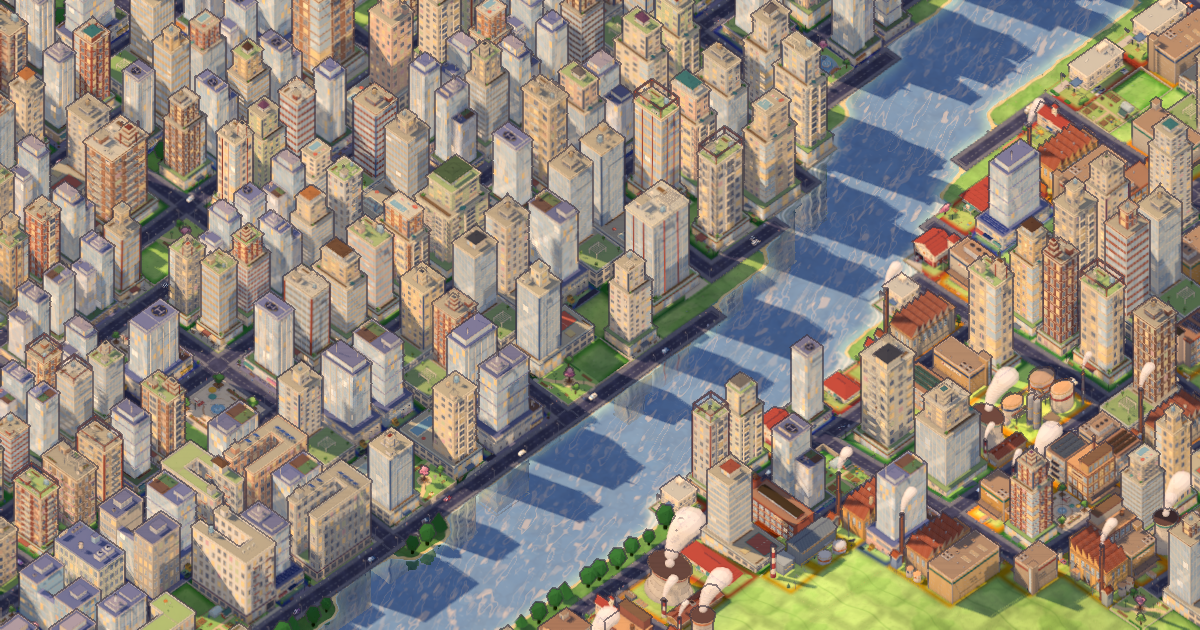
Permit Pending
Build the city of your dreams. Subject to approval. A free city builder about zoning, hearings, lawsuits and reelection.
Permit Pending
941 points · by pcai · 1mo ago · 428 comments
And yes, I did sketch a version that is even more procedurally generated, but it’s taking longer to get right than I thought
To the parent post: I have actually seen public interest groups bring petitions to a small city council with more signatures than there are residents of the city... but hopefully there's some countervailing force in this game too where local residents reject petitions that are driven by outside parties. In other words, not every signatory to a petition is a resident, and there's local resistance to regional causes. I guess this happens quite a bit more in the exurbs of major metropolitan areas.
That said, after playing it for a while something just felt "off". I like the idea of being involved in individual proposals, but there are too many immersion-breaking dialogs that come up (some of which just seem too irrelevant). And the text in them is sometimes "off" in a fashion that feels like it was written by AI (though I'm not sure if it was). The news articles and such in SimCity felt more hand-curated, concise and clever - thus more entertaining.
This is how real life works when when your proposed development doesn't fit the vision some random unaccountable bureaucrats and/or institutions you have to go through have for the vibe of the community.
I've often wondered about this kind of thing. When I go to an airport, it seems strange to me that each one is different with some of them having elaborate train systems, or multiple runways.
The engineer in me says "surely there is an optimal solution, so why are they all so different?". Is there a simulator?
Sim City was a fantastic simulation from the stand point of a game, but I'm curious; if you build a city simulator and let it grow organically (game of life style) can you put in sufficient regulation/parameters that get you to where we are today?
And if so, is there a simulation that shows us a way to get us to a better tomorrow?
Seattle has generally ether north or south winds depending on season, and the airport is located on the only buildable flat plateau for miles around, so has 3 runways all going the same direction, N/S.
https://wrcc-archive.dri.edu/cgi-bin/wea_windroseclim.pl?laK...
Denver built an all-new airport way outside of town where there was unlimited buildable land. Their winds are highly variable even within one season, so they have 6 runways in a crossing configuration.
https://wrcc-archive.dri.edu/cgi-bin/wea_windroseclim.pl?laK...
Optimistically, because each one has a different optimal solution given all the unique constraints for each airport project.
Also, airports aren't just built and then done. Often the cities around them will grow and the airports will need to expand and adapt to new constraints, sometimes many decades after they were first built.
Most airports were built during or before WWII, so few are designed to most efficiently accommodate modern usage. Maybe in the future we can better handle closer runways in low visibility, but first we'll have to figure out how to have two computers communicate directly with each other, instead of having one computer generate routes that get read out load by a human, transmitted over an analog radio, listened to by another human, then typed into another computer.
Tada! https://en.wikipedia.org/wiki/Controller%E2%80%93pilot_data_...
We need something where a control center computer that issues clearances can radio them directly into an aircraft's flight management computer. This wouldn't disallow ATC from reviewing the routes before transmitting them, or the flight crew from reviewing them before accepting them, but without people manually copying over the information, there's a lot less potential to insert errors in the first place.
https://en.wikipedia.org/wiki/Traffic_collision_avoidance_sy...
But it didn't happen. Namely, because of how much central control would be given to one man and/or his company to pull it off. The plan in its early iterations essentially meant that if you lived in EPCOT, you forfeited certain freedoms, such as what goes in your home, where you worked, and so on.
This game gave me a good chuckle as a Sim City fan. I'm guilty of complaining about politicians of all levels. But I don't envy their position of having to cut through the vines of competing motives and regulations. And at the same time, as a citizen, I'm not sure I would opt for the Utopian alternative.
Walt's brother, Roy (who remained after Walt's passing), was not the same visionary that Walt was. Simple as that. Most people would never have taken the risks Walt did with the company. Even the idea of a theme park that has tens of thousands of employees and requires millions of people to fly in from all over the world to be profitable sustainably, was quite a bold idea in the 1950s.
I regret that Walt passed too young. Florida would probably be covered in a large monorail network had he lived a couple more decades. And Epcot as a city would have been a tourist destination in its own right, and might have influenced urban development elsewhere.
I've been in several and they actually feel okay to live in, to run errands, to shop.
It only sounds funny if it's cranked up to the extreme -- like abusive housing associations, a cancer growing on the corpse of the old communities which just wanted some quiet evenings and the bins to not be overflowing, but it can be done well.
https://en.wikipedia.org/wiki/Poundbury is the King's pet village which is more dirigiste.
I'm pretty sure the point of the game was to make a statement and make people think/talk and boy-howdy op you did a great job.
With a proper SimCity interface and the full complement of fun natural disasters of course!
I've heard the soviet one is closer to what you're looking for - https://www.sovietrepublic.net
Not to say it isn't a great game, it has managed to steal a great deal of my time. With the caveat that its very unpolished and clearly straining under a load bearing amount of duct tape
Songs of Syx is closer but still too micro
Municipal rules, zoning, community feedback and so on all operate in the space of keeping people happy. No-one wants noise, so we have noise restrictions. Oops, construction is constrained. We all want no traffic, and lots of parking, so low density please, but that creates housing shortages and limits the usefulness of public transport.
So a rule is added here, a process there, and everyone is fighting everything all the time. Can't build this because traffic. Can't build that because impact on the neighborhood.
But yay, democracy? We can do anything as long as no one is subjectivly harmed.
And when nothing at all gets done, we blame politicians for being lazy, incompetent, or corrupt.
I cannot tell you how insanely inefficient and impossible it is to get 40 different families who all live on the same street to unanimously agree on something like a communal security system or a communal garbage can where all participants all fairly contribute and consume those services. And this is all done on a WhatsApp group over txt messages where nuance gets lost.
People complain about governments being slow, but until you experience the alternative (I have) you will simply never understand why its the lesser of two evils.
There's your problem. You are requiring unanimous agreement? Republics (et al.) were invented for a reason.
"Nuance gets lost" well with centralized politics, the whole damn point gets lost.
You actually have a slow government and are complaining about it. You have not experienced any alternative to slow government.
As they pointed out it's hard to get anyone to do their fair share, and unlike a government which can just MAKE you, they have no such option.
A point that comes up over and over again when discussing HOA's. See the recent submission:
There are two different problems here.
One of them is, you want to have some kind of non-excludable service. But if only 10% of people are contributing then they start to feel resentful and stop contributing, so then only 5% of people are contributing, until no one is contributing at all. So instead you want to have a majority vote and if the majority decides they want it, then everybody pays e.g. $10/month to provide it and you avoid the tragedy of the commons.
This one often has problems, especially if you allow centralization -- then special interests finagle their way into the budget being an onnibus take it or leave it bill where the large majority of what's in wouldn't pass if you put it up for a vote by itself, but nobody wants another government shutdown so now the deficit is two trillion dollars. But this one works pretty okay at the local level.
The other one is, we don't want jack the ripper or for the river to catch on fire. The way this one fails is that instead of prohibiting murder and leaded gasoline, a bunch of busybodies start trying to micromanage everything and pass rules where the marginal cost of administering the rule is larger than the marginal benefit of people following it. Which in turn allows special interests to insert rules that aren't even trying to be net positive and are just a thinly-veiled pretext over suppressing competition or creating demand for a particular industry's services by mandating it, which get easier to hide in the thicket the more unnecessary rules there already are. Which the local governments are even worse at because they're often prohibiting something (like housing construction) where people who can't currently afford to live in (and therefore can't vote in) that locality are the ones who need it.
So those are the two categories: a) spending tax money, b) prohibiting something. But the thing you're describing as being needed there is the first one and the thing people are objecting to with regard to permits and things is the second one.
And the second one has a fairly decent solution, if we would actually implement it: It should be harder to enact a prohibition than repeal it. Things that >80% of people agree should be prohibited stay prohibited, things some busybody or crony managed to have pushed through that one time become easier to get rid of.
You're literally describing a government
People move to a place and then expect it to never change again. After all, they bought a house there because they liked it as it is now.
All that does is create places that are encased in amber and unable to adapt. Homeowners have a disproportionate say. aspiring homeowners don't show up to local city council meetings
The top-down approach surely has problems too, I'm not denying that. I just think we need people in charge who can look at the problem holistically and say "hey maybe that inner suburb next to transit shouldn't force you to have a 1/2 acre lot".
This is a complicated issue. What if those people in charge decide your town would be better as a highway? I don't know... it's complicated.
Major projects like power plants or dams should be made at a state or even national level, but rules for which house goes where, less so. And if your town's rules are overly burdensome and stupid, that's an issue for your town's government to solve.
> In Germany they have a system where the government will bulldoze a completed skyscraper if you did the paperwork wrong.
I think if you follow actual development stories, you'll see a lot of this continuing to hold true. Seeing NPUs as being actually effective at curbing development is very naive. NPUs rarely push back against development, and it takes a lot of organizing to even get something up for a vote at City Council. And even then, most councilmembers are taking campaign funds from private-equity backed developers.
A lot has been written about this. In my city, we call it the Atlanta Way (derogatroy). There's a recent book covering this that's a great read: https://www.ucpress.edu/books/red-hot-city/paper
When the NIMBYs of today work to protect and even double down on the bad decisions of that era it makes you wonder whether we've really moved on from it.
Believing that neighborhood units are the largest impediment to effective and efficient planning is to believe the corporate landowners at their word. There's so much astroturfing that happens in these spaces, largely rejecting density and public transportation.
I can name off the top of my head a half-dozen community-oriented projects blown up by the very same groups, and even one instance where a former state ACLU director came in, pretended to be a movement-aligned mediator, and then proceeded to torpedo the drafted neighborhood deal. This same director later went on to be hired by the same private firm for a six-figure job.
The rot is real and rarely gets reported. David Simon was a rare one in his coverage of Baltimore, not all cities have skeptics like him who dig deep.
Community process results in bad outcomes for the community, it is inherently undemocratic, yet it's been put on a pedestal as the goal of all planning.
Take for example this ridiculous article from a transit planner bemoaning how Amsterdam may have wonderful transit outcomes, far more fair and equitable than anything in the US, but dangit where's all the process??
https://mass.streetsblog.org/2022/08/10/guest-column-europes...
It's self-parody.
https://bendyimby.com/2024/04/16/the-hearing-and-the-housing...
But it's been ten years since I've been involved with local community organizing and I know a dogwhistle when I see one. Whether or not the original poster intended it to be a dogwhistle or just formed that opinion memetically after uncritically absorbing astroturfed 'drain the swamp' rhetoric, it all leads to the same place where private equity and other investors get to run rampant with little regulatory oversight.
I grew up in Nashville and it also had a vibrant black neighborhood split in half by a highway. It was explicitly how Moses told planners across the country to get highways built it happened everywhere.
> Right, it was so much better during the Robert Moses era where urban planners bulldozed over predominantly Black communities and built interstate highways
you: "hey have you considered that actually you're a piece of shit?"
yes, these rules exist for a reason. some places (like Atlanta) are still guilty. i'm not saying we should plow down Chesterson's fence, but your hostile tone also sucks
HungryHobbit's response is just making that clear... he's actively defending what was objectively a shitty and unnecessarily snarky and confrontational post, because it adhere's to the HN norms of being smug, superior, dismissive, and dickish... but in a way that is just indirect enough that these maladjusted fucking nerds can pretend that they're polite and professional.
You'll enjoy the site more if you walk in expecting that everyone you're talking to is a smug little asshole who needs to get punched in the fucking face.
Now it's true that it could have been prosecuted anyway as murder or a civil rights violation, but it wasn't because of that convenient interpretation.
1. https://naacp.org/find-resources/history-explained/history-l...
2. https://www.congress.gov/bill/117th-congress/house-bill/55
https://www.berkeleyside.org/2024/07/23/berkeley-zoning-has-...
When there are rules on the books, and they are bulldozed over, you can generally sue.
And in terms of the black communities that were disrupted, there were many more black communities that were helped by the improved logistics.
Like Japan, being a democracy, seems to have a completely different zoning system than the US. We have the zoning system we have because we created it.
It doesn't help that buildings are likely to be the most expensive thing a person will create or own, and they have a very high impact and demand. You need electricity, water, sewage, access to make it usable, then you need to make sure all of that was done right to make it safe, and then you want to make sure it's not put in a spot that'll just piss people off... and so on.
Obviously we do tend to come up with similar solutions for these systems because I don't think there's some clear and obvious "well just do that" living out there. Yes it's better in communities that are small with lots of space, lots of funds, and like minded members, but the moment everyone wants to live on the beach in the 70-80F weather you're going to start running into lots of issues.
It's unfortunate because people like to imagine it's just "Them" doing it. "Them" being the perfect mental image of an adversary who we all have 100% dealt with. The petty neighbor breaking out technicalities to stop you from getting something you'd like for no better reason than "fuck you". Unfortunately it's hard to design systems with that kind of person in mind, because when you're dealing with 100/1,000/10,000 people, it's a lot harder to just say "you're just being an asshole, no one cares if you're correct, you lose"
Knowing human nature, the best plan for a state that wants to survive is to set a 20 year expiration on laws. Broadly accepted laws would easily be renewed, but obsolete ones would be allowed to die.
For more than a decade the US has been stuck operating by renewing the same budget more or less with minor modifications at random intervals of time depending on the political mood. It always gets approved eventually after occasional pointless, wasteful shutdowns. But nothing actually changes from those veto points, just more routine dysfunction and grandstanding.
Same with debt ceiling. Another veto point that gives leverage but has zero effect on actual spending. It probably sounded like a brilliant idea to control spending in the 70s or whenever it originated. But is entirely ineffective at the purpose of addressing the deficit.
Self expiring legislation would very likely end up the same way. Just another pro forma procedural roadblock that wastes time and makes the legislature even less effective at real problem solving instead of posturing.
Wait, do we need to pass a law for this?
Every new generation is convinced that all the cruft of the existing system is useless or obsolete so they create a new system without the cruft based on "first principles" or somesuch bullshit. And then through pain and loss they rediscover why all that cruft was there in the original system in the first place. What seems "obsolete" is many times a bedrock principle of the old system that only seems obsolete now because it is/was so effective that the problem it is intended to address/prevent no longer occurs.
Also, legislators review the existing laws all the time. Most "new" laws are just amendments to existing laws.
In other words, both the old way and the new way have value. The perfect ideal system is probably a synthesis of both, but in lieu of that, we can have both separately.
Morocco's high speed rail line opened in 2018.
And if one city, county or state says no to your commercial or industrial venture, it's nice that you can shop other states that might love to have you.
“Many forms of Government have been tried, and will be tried in this world of sin and woe. No one pretends that democracy is perfect or all-wise. Indeed it has been said that democracy is the worst form of Government except for all those other forms that have been tried from time to time…” – Winston Churchill
It's very easy to throw stones through windows. But before discounting one of our greatest creations, one which is so annoying and yet has brought us so much prosperity, what alternative do you propose?
Dictatorships, especially the communist style often use it as an argument for why their system is better than what we have in the western world. It is obviously propaganda, but why would they choose that propaganda? There is probably some truth in it. Commie blocks in particular managed to solve a serious housing problem very effectively. It wasn't great, didn't age well, but it gave people a decent place to live.
This is, arguably, the big problem. Things akin to Commie blocks have been tried in non communist countries, but in general government run housing has this major issue of almost always winding up poorly budgeted and supported, so it quickly becomes a nightmare as tax payers don't want to foot the bills on some other persons housing, and it's extra ripe for corruption and corner cutting, and so on.
Not that it shouldn't be investigated (any option should be considered), but it does seem to be one of the big weaknesses. In theory if a private landlord/building owner breaks the law, you have recourse though the legal system (yes in theory), while if the government isn't living up to what it said it would do....well you tend to lack any option for recourse.
To be clear this is a disgustingly simplified summary of a subject I have at best a casual hobbyists knowledge of, but there seems to be an advantage to leaving housing in the realm of private so that you have the option of kicking them in the teeth with the government if they completely fuck up. As messy as that might be, the alternative seems to be messier.
I happen to have lived through both of those theoretical systems. I watched my uncle pass bricks in a giant line, man-to-man, to build their commie block. A year later, my mom and I escaped to the USA.
Now, I am partially back in Poland, as the Soviet occupation is long gone. There are many problems, but generally, Poland is now a country one wants to come to, not escape. Well, Moscow is still being imperialist and murderous, so not that long gone I suppose.
I would like to point out that whatever the USA might be today, it is no longer a democracy. It is certainly not the country we came to. I would argue that after Citizens United, the USA is now finally a "Capitalism" - both economic and governmental system. In more recent times, the USA is now authoritarian - it's kinda getting modern Russified in the USA. Call it "unitary executive" or whatever, it's the same damn thing.
We are certainly living in interesting times.
Prospective residents and transit riders are harmed.
Rules and hearings overwhelmingly favor existing residents. If an existing resident opposes construction nearby due to noise, traffic, etc., the city will probably grant his wish. Because that piece of land is off limits for denser housing, now prospective residents face a smaller housing supply, higher prices, and longer commutes.
> [1] Human societies historically act as problem-solving organisations that tend to develop ever-greater organisational and technical complexity in order to solve the social, economic and political problems they are confronted with. As their complexity increases, the problems they have to deal with become more difficult to solve, requiring growing investment in further economic and societal complexity. According to Tainter, however, investment in socio-political complexity eventually tends to reach a point of diminishing returns, where the marginal beneficial returns (i.e. problems solved) of additional complexity begin to decline, leading to a lowered capacity to solve the new problems that arise and to deal with their consequences. These returns may even turn negative, at which point societies struggle to uphold the level of complexity they have reached and may have to move down to a lower complexity level. This, says Tainter, is the pattern behind the rise and fall of most civilizations in human history.
[0]https://ota.skadi.cloud/en/episodes/040O0P0C0P2C180H2B3z1W1N...
[1]https://paularbair.wordpress.com/2017/03/06/the-crisis-of-co...
[2]https://www.goodreads.com/en/book/show/477.The_Collapse_of_C...
I spent the last couple years trying to get contractors out to pave our private road. They'd either no-show, or ghost. It didn't make any sense since these were all 5-figure jobs. I'm trying to give you money, what gives? I learned from the contractor who did end up taking the job that our city is absolutely brutal with contractors... which can be a good thing for quality of work, but too much in this case means many contractors just refuse all work in the city. They're big enough that it's no great loss.
Why bother heeding requirements not to run heavy machinery outside people's houses at 4am?
Why bother getting proper utility surveys done, just yolo it and if a few thousand people end up without water/power it's fine because the people profiting from the work live elsewhere and can just blame the workers?
USA harms a lot under the orange clown. So first that term you use must be defined - what IS a democracy?
Russia and North Korea also claim to have some kind of democracy some sorts.
There are just too many differences in the term here.
> And when nothing at all gets done, we blame politicians for being lazy, incompetent, or corrupt.
Many are corrupt. Many are incompetent. Many are lazy.
By the way, at best you describe indirect democracy. This one has more limits than democracy, which - conversely - requires more effort.
It's the reason we subsidize farmers. It's the reason our tax code remains so complicated. It's also why it's hard to get anything built: Existing owners are highly motivated to block development, and the potential beneficiaries (people who might someday live there, etc.) are too diffuse to mount a defense against them.
Particularly if we define or replace "corrupt" by "extracting funds in every practicable way," which is observable behavior (regardless of reason or motivation) and which is _not_ covered in your explanation?
Sounds like you don't really understand what a "democracy" is.
Sure, our system is not working currently. Doesn't mean that the principle of "democracy" fundamentally doesn't work, does it?
Seems more like a flaw of high density than democracy if you look at democracy in low density areas and citizen happiness in other types of government in high density areas.
Yeah how awful that a government system works for its people....
We don't live in a democratic country. We live in a plutocracy. We explicitly allow money to influence our democratic process.
I’ll take either genuinely rural, or high-density urban over low-density urban/suburban any day of the week. (And have lived in each of the above for at least 5 years each.) I intellectually understand that it ticks a lot of people’s boxes for convenient, low-friction lifestyle, but viscerally, even nice suburbs with a little character just feel like a superficial, tepid, soulless simulacrum of an actual community to me. I’m clearly missing some connection or meaning in those places that other people are more attuned to.
Seems pretty earned in a lot of ways
"With particular reference to apartment houses, it is pointed out that the development of detached house sections is greatly retarded by the coming of apartment houses, which has sometimes resulted in destroying the entire section for private house purposes; that, in such sections, very often the apartment house is a mere parasite . . ." Village of Euclid v. Ambler Realty Co., 272 U.S. 365 (1926)
You're talking like this is the same group of people that want no traffic, less density, low noise, etc and then are complaining about housing shortages and public transport.
These are two distinct people. The former group is going to be mostly homeowners. People who bought property in a place are mostly happy with how it was when they bought it so if the public transport is bad they don't mind by selection bias. Obviously they don't really care about housing supply.
Non-homeowners, on the other hand, are usually looking for their golidilocks neighborhood (no blame on them, that's why looking for a home is so difficult and why people who find them are protective of them). They are the ones who found a place they can afford but the commute is too long and public transport is bad or they can't afford a place near their work because it's all low density and in high demand, etc.
Importantly, I think the groups of people with gripes about the housing market are pretty distinct sets of people who really don't agree with each other. There are people who are price out of home ownership (always with the caveat of "in the place they want to live") and there are people who are priced out of living where they want to live, even renting. One group wants density and one group wants those SFH and low density, just cheaper.
The SFH crowd can't be satisfied. It's just reality that highly desirable places are more expensive. The high density folks could be satisfied but at the expense of all the people who chose to live in the neighborhood they do. I find it hard to sympathize with people who don't live in a place and want to change it to suit their needs, at the expense of people who do.
> But yay, democracy?
Yes, working as intended.
As a mildly related aside, It's funny to me how "NIMBY" has gone from someone who wants something, in general, but not near them (homeless shelters, for instance) to someone who just doesn't want a thing at all while still carrying the same stigma. Certainly the people who live in a place should have more of a say as to what goes on there than the people who don't.
> And when nothing at all gets done, we blame politicians for being lazy, incompetent, or corrupt.
I only blame the politicians who make promises they know they can't keep. They're typically not lazy, incompetent or corrupt, they just lied to get elected.
Sigh. Democracy is going to hang itself with the bike lanes and public transit, isn't it?
Density increases and ubiquitous transit result in HIGHER levels of housing shortages. Just ask France.
Anyway, nobody who has ever been to a major French city believes that they've tried to increase core density. They famously have building height restrictions all over the place. Pretty much the entire city of Paris caps out at 7 stories.
And despite that, Paris is one of the densest cities in the world, and an incredibly pleasant place to live. This should be a good lesson to everyone that "high density" does not have to be synonymous with reams of skyscrapers.
Think about this: EVERY large European city now has a "housing crisis". And nice cities just a couple of hours from them have housing that is essentially free. In Japan it's often _literally_ free.
Want an example of a city that doesn't have a housing crisis and is comparable in population to Paris or Berlin? Houston, TX.
Density doesn’t cause housing shortage. A housing shortage creates motivation to increase density.
Wow, that's a new one
Hell, there are even consulting companies that provide guidance on how to upzone the city to squeeze most taxes out of new density.
increased density and transit increases demand for that area. high demand != shortage.
What are you suggesting exactly? low density and car-dependency is the solution to our housing problems?
Yes, it just means higher costs.
The only people who don't like low density are the poor, and this is why most of America is car culture, and owns their own houses. "Housing shortages" is another way of saying that existing home owners are earning strong equity.
Yeah, I do want no traffic and lots of parking, so low density please!
Personally I want no traffic but also little parking. Car infrastructure is a general blight on public spaces.
The contrast from simple and slow to complex and rapid and the buildup between is what produces the emotion, a cluttered and busy UI is just a cluttered and busy UI.
Also : a city planners' job is still fairly serialized and procedural even if it is busy and back-and-fourth; a cluttered UI does little to convey 'busy-ness and conflict'.
The subject area is great (teach actual civics) but this fails in execution. It could really use a strong pass on UX and learning curve, because right now its a product that everyone is just going to bounce off of.
Whether or not the topic is complex is beside the point. The point of this project, as far as I can see it, is get to teach this subject through experience to as many people as possible. Walls of text and tons of controls fundamentally undermine that purpose. Teaching complexity comes by removing everything that isn't absolutely necessary and arranging the complexity in a form that introduces it in compelling bite-sized chunks, so the player is always engaged.
To the creator - this is cool, you're certainly barking up the right tree subject-wise. The best thing you can do now is identify the specific learning goals and sequence, and the magic moments you think are possible along the way, and radically simplify the approach. Fork the project and take a different angle on it. I bet there's solid foundations here but if you want to influence you gotta refine.
Thanks for taking the time to take a look and give thoughtful feedback!
I took some perverse pleasure from the wall of complexity-- as you said, "that's the point". That really came through in my play experience, and I think that adds to it.
I wouldn’t necessarily fault the maximalist starting point, we’re in a new era of software where subtractive building (rather than additive) is starting to be a real approach to building. I’ve gone through the same process on a few projects - build to learn by laying all the ideas out and reacting to the ones that draw you in most, and then either chisel away the rest or start with a new project and swipe the gems from the last.
And TBH they were right! I watch a bunch of city meetings that Boulder posts online (https://www.youtube.com/@CityofBoulderGov/videos) and it's exhausting the amount of back and forth nitpicking and NIMBYism that goes on. It's surprising anything gets done at all. The cynic in me thinks the rich get their way because they can pay people to keep fighting for them - everybody else gets fed up with it and stops participating.
  .WebGL-0x15bc15784800] GL_INVALID_OPERATION: glRenderbufferStorageMultisample: Texture total allocation size is too large.
  play/:1 [.WebGL-0x15bc15784800] GL_INVALID_FRAMEBUFFER_OPERATION: glClear: Framebuffer is incomplete: Attachment has zero size.
  play/:1 [.WebGL-0x15bc15784800] GL_INVALID_FRAMEBUFFER_OPERATION: glDrawArraysInstanced: Framebuffer is incomplete: Attachment has zero size.
  228[.WebGL-0x15bc15784800] GL_INVALID_FRAMEBUFFER_OPERATION: glDrawElementsInstanced: Framebuffer is incomplete: Attachment has zero size.
  11[.WebGL-0x15bc15784800] GL_INVALID_FRAMEBUFFER_OPERATION: glDrawElements: Framebuffer is incomplete: Attachment has zero size.
  10[.WebGL-0x15bc15784800] GL_INVALID_FRAMEBUFFER_OPERATION: glDrawArrays: Framebuffer is incomplete: Attachment has zero size.
  play/:1 [.WebGL-0x15bc15784800] GL_INVALID_FRAMEBUFFER_OPERATION: glDrawArraysInstanced: Framebuffer is incomplete: Attachment has zero size.
  play/:1 [.WebGL-0x15bc15784800] GL_INVALID_FRAMEBUFFER_OPERATION: glBlitFramebuffer: Framebuffer is incomplete: Attachment has zero size.
  play/:1 [.WebGL-0x15bc15784800] GL_INVALID_FRAMEBUFFER_OPERATION: glClear: Framebuffer is incomplete: Attachment has zero size.
  play/:1 [.WebGL-0x15bc15784800] GL_INVALID_FRAMEBUFFER_OPERATION: glDrawArraysInstanced: Framebuffer is incomplete: Attachment has zero size.
play/:1 WebGL: too many errors, no more errors will be reported to the console for this context.So basically any road that isn't on the suggested unpaved tiles is useless, and the unpaved tiles can't be zoned.
[edit] It would also be nice to be able to find schools, police stations, etc. with an overlay view. There doesn't seem to be a data view for that.
I find the election timer & promises mechanic to be fun and unique. Although it's easy to trick out by dropping taxes six months before an election, it also creates a great secondary goal and tension in the game.
There's another weird thing... I assume it's not a bug, but at times, the budget will suddenly drop by $300k and I have no idea what caused it. The charts on the budget page can be hard to line up with mayoral choices or events, especially if the events are older than a year or off the list already. The first few times it happened, I thought maybe some consultant fees or rezoning had caused it, but it would be nice to know. Some sort of ledger you could go back and look at, maybe?
Once into the meat and potatoes of city management, the game is great and really playable. For a new game, it's got a surprisingly good balance of complicated decisions to maintain growth and equilibrium. I think Will Wright would give a thumbs up.
I'm really impressed by the quality given that it seems heavily vibe coded, I'd assumed I would encounter many issues, but I've found only minor bugs so far.
Further gripes: I don't understand what I'm seeing. The first "data view" shows a heat map of population, but which are the dense parts? Is beige denser than blue which is denser than icy grey? Where's the actual population figure for that tile, is it "district population"? That seems to be per-tile, so is a building a district? Why does the park have a population of 49, and why do the 49 people living in the park give me a mayoral approval rating of 56%?
I’m aiming for a specific mood so the others are going in the backlog until i can do them uhh tastefully
A city-building game in which the city would prefer you didn't - https://news.ycombinator.com/item?id=50036864 - Oct 2026 (201 comments)
Permit Pending error report Code: PP-SIM-F99D Step: running the simulation Error: Error: The simulation could not start. Build: 2e99342ba03e Time: 2026-10-20T21:37:28.780Z Page: https://permit.petercai.com/play/ Browser: Mozilla/5.0 (Windows NT 10.0; Win64; x64) AppleWebKit/537.36 (KHTML, like Gecko) Chrome/155.0.0.0 Safari/537.36
Machine: screen 1920x1080, window 1920x911, pixel ratio 2 memory 16 GB, cores 16 touch points 0 game screen menu, map quality setting AUTO, drawn at ?
Graphics: api WEBGL2 renderer ANGLE (NVIDIA, NVIDIA GeForce GTX 1660 (0x00002184) Direct3D11 vs_5_0 ps_5_0, D3D11) tier high MAX_TEXTURE_SIZE 16384 MAX_RENDERBUFFER_SIZE 16384 MAX_SAMPLES 8 EXT_color_buffer_float yes EXT_color_buffer_half_float yes OES_texture_float_linear yes
Stack: Error: The simulation could not start. at e.onerror (https://permit.petercai.com/assets/play-DYe3blxS.js:10:25790...)
Recent log: 21:37:28 failed to load script https://static.cloudflareinsights.com/beacon.min.js/vce70182... 21:37:28 error Error: The simulation could not start.
found the problem
For those wondering. I haven't played, nor am I planning to. I already suck at vanilla Factorio, tyvm.
Also it would be nice if popular menu options (like Street, etc) showed keyboard shortcuts.
And, is anyone else having trouble demolishing recently built streets?
    - Three.js for rendering
    - react 18+ UI built with Vite
    - charts are custom, no libs
    - main bundle size is a js file of 1MB (290KB gziped)
    - No router, no redux/zustand
- saves using indexedDB + service-workerThis is beautiful rage bait of a game.
The pendulum has swung so far we cannot build anymore. We can't solve the problems of today because our regulations that are responding to the problems of yesterday. I'm hopeful there's a better way but I haven't seen it yet.
[0] : https://www.americanprogress.org/article/unprotecting-americ...
When zoning regulations first started, it wasn't uncommon for people to drink unfiltered surface water and drain their sewage into an open pit. This heavily limits density, and was what zoning was targeting. There are areas in the US, especially in the south, where permitting and zoning are much weaker than in the rest of the country, but high-quality housing is just as prevalent.
[1] https://boardgamegeek.com/boardgame/347552/north-berkeley
The pain points for us are to do with attempting to increase the density of the city, which means building apartment buildings where there used to be just single story houses with backyards - something those residents don't like. Or the complexities of big projects like new train lines, that impact an awful lot of stuff around them.
But in general, a lot of stuff is getting built, it's just expensive.
After that it still did it on various different views but it was much faster.
My observation is, that whenever residents have little say in how their area develops they dissociate. Trash on the streets and decay and follow.
One of the soviets great problems was people not caring about property, as they did not own it.
And because LLMs are making love cheaper.
its all gucci
I can't tell if this is a real error or satire, lol
Both are similarly unplayable, but I guess it's the thought that counts.
Love it, I hope this becomes the most popular game on the internet so folks get to experience the Byzantine level of complexity we've made doing business in industries with physical stuff.
Unpopular opinion: cities should be private, for-profit corporations. Leasing land from the government and charging subscription fees. Like a very big hotel.
So all in all, small communities do not fail because online participation is impossible. They fail because obstruction is cheap and accountability is absent: one person can repeatedly delay a decision, while everyone who supported a controversial decision simply moves on. I think we are in that point in history where participation could be dramatically improved by LLM in pipeline (and there are real works behind it https://github.com/AIObjectives/tttc-light-js https://www.science.org/doi/10.1126/science.adq2852)
- Chat and voice messages becomes a source-linked with signed summaries (llm definitely can help most ppl structure their thoughts into words)
- disputes are classified as factual, distributive, value-based, procedural, or rights-related
- it becomes more real to agree on explicit success (or dealbreaking) criteria for every decision
- votes and objections also accounted as "prediction market" bets of their voting power.
- evidence is more reviewable with LLM
- and what's most important the outcome updates domain-specific reputation that weakens future vote weights of those who sabotaged, or joined to crowd for populist decisions proved to be failure.
If a blinded LLM assessment and the community votes agree, the decision proceeds. If they disagree, at least it is much rare occasion and interesting to consider the causes. The key innovation is an auditable path from messy discussion to decisions, evidence, outcomes, and consequences. Reputation becomes the non-monetary cost of being confidently wrong or strategically obstructive. I hope to see more of such platforms and survive experiments. Current situation feels like desperation
If this was an installable, moddable game, this would be cool. Further, I'm not sure why they could not add this as an existing module or feature within SimCity 3000 itself. It's a nice little wanna be clone. But playing a browser game just doesn't feel like a game.
Tangential: Elon was tweeting recently about how he blames bureaucracy for the NY-DC Hyperloop corridor's failure (https://x.com/elonmusk/status/2112102304782680107). Whether that is ignoring other major problems with the plan or not, there's been bi-partisan criticism of how the traditional western democracy has severely slowed down infrastructure investment (see, for example https://en.wikipedia.org/wiki/Abundance_(Klein_and_Thompson_...). I see a lot of people going to China after being oblivious to it for years mostly due to western propaganda and being in awe with how fast the country has advanced its industry and public infrastructure with superior high speed rail, power grid, and other investments. I wonder if the west will ever find a way to adapt the dynamism that an autocracy affords to its system of government (which sadly has been increasingly described as an aristocracy/plutocracy/corporatocracy/kleptocracy).
My impression so far is that hyperloop is simply a scam.