171 points · by theanonymousone · 3w ago · 459 comments
A race to the bottom, but I wouldn’t blame Amazon. Large multinational chains were hollowing out high streets and making them less pleasant before online shopping.
As another comment said, councils and government should treat high streets more like public commons, prioritising independent businesses and making places distinctive.
What frustrates me is that even prosperous areas with new developments rarely make space for small businesses. Instead, we get “private equity” chain.
Ugh, one I saw recently was Bristol University’s new campus by Temple Meads. The wall between the campus and station could have been lined with small, affordable units for independent and student-run businesses. Would love to browse a few interesting shops or grab a decent sandwich before catching a late train. 23m for a new entrance but where are the opportunities. (This is based off the media announcements, not walked through there yet)
You're advocating central planning.
The real problem is that it's very hard to build stuff in the UK. This is a choice that the people have made and the status quo still continue until they choose differently.
The UK can't make stuff because the rent is too high. Fix this and a lot of stuff downstream of it will change.
the uncomfortable truth is it would make property less interesting for foreign money flowing in the UK.
Which seems to be working pretty well in China.
When Britain was building new towns post WWII it involved a lot of central planning, and seemed to go pretty well.
You state this like it's inherently something to be avoided but you give no reason for believing so
See the Astley (Wigan) Warehouses and SIP car parks for two prime examples.
Central planning is the status quo. That's essentially what zoning rules are, and why everything is such a mess. You want to open a shop and live above it? No, sorry, not zoned for residential; banned. Operate the shop out of your house instead? Haha, banned. What if your shop really doesn't need very much space at all, so something the size of a closet would do as long as it's in the right location? Nope, minimum unit sizes or similar, prohibited by law. And so on.
If they want to stop doing this that would be great, but if they're not going to stop doing it then having the rules be things like "no chains" instead of "no small units" would certainly be an improvement.
Outside those very limited exceptions, planning in the UK is done on a discretionary basis, and both the discretionary system and the LDOs are overseen by Local Planning Authorities made up of elected local councillors.
There's no central planning authority, and the system is designed to be flexible at the cost of providing less certainty to developers. Mixed use developments are the norm here, and most new residential blocks will have some form of commercial or social space on the ground floor.
So? Nothing wrong with that.
Do some bunch of government clerks decide EVERY single _factory_ input and output in whole country is nothing wrong ? Starting with impossibility to do it right - is doing it by necessity wrong is not wrong ?
Do "central" setting prices for whole country, let say for next quarter - no matter reality - is possible ? I lived it and tell you: it's always wrong because it's impossible to do.
How you plan problems in production ? How you out-plan so someone stepped on something fragile ?
How you out-plan someone steal something ? Because "central planning" is sign that it's not good in your country so there is stealing and corruption on every step starting from "planners" to plans distributor to workers to packers to sellers.
How you like that reality now ?
Communism fall for a reason: stupidity of the imagined aka planned system. Because in all despotic systems on top of all of what needs to be done to live and work planned good life you have grafted parasitic structure of peoples which single occupation is just to spy on and terrorize their own peoples - and that costs a lot both in money and society quality.
Lack of freedom do this.
The only way to make a functional society that doesn't leave people behind, yes ?
A lot that I see have extremely cheap-looking fixtures and little to no decor, and unlike virtually any other store, they stock what they stock, which is generally the same as every other vape shop, and don't even bother to fill out the entire space if it would hold more merchandise.
I assume some are able to negotiate lower rents in exchange for short term leases while the store is technically still on the market for a long-term lease, similar to a pop up store. A lot that I've seen could be shut down, with all the merchandise and equipment loaded into a UHaul, within a few hours if necessary.
Nail salons are similar. They really should have custom ventilation systems since they're working with paints and solvents and glues and nail drills/lathes, but this seems to not be enforced since they're seen as girly little spas rather than industrial workshops and are often staffed by poor immigrants.
There are people go out of their way to buy...American candy in the UK?
Utterly perverted.
The US has something similar going on with medical and dental offices for the same reasons.
Who's to say how many clients a nail bar had? A box of fake nails is easily dumped in the bin.
The only way I can think to police it, would be for tax inspectors to stand outside and count the customers!
We all want little cutsey shops and such but how much money for that is actually sitting on the sidelines at any given time ready to pounce? Hardly any at all, if any. Nail shops and other bullshit on the other hand? There’s private equity specialized in selling shares of these schemes.
You can buy a vape online, but as a smoker, you don't want to wait a day when you've run out. Also as a smoker, I don't get why they're not regulated like tobacco. They shouldn't be sold alongside sweets, and should otherwise be treated like cigs (e.g. on packaging, licensing, advertising etc.). Seems very low-hanging legislative fruit.
I think you don't know why cigarettes are treated the way they are.
Hint: it's not because they are addictive. After all, caffeine is addictive and both tea and coffee is effectively unregulated.
I was just looking at the prices for city centre commercial rental in my nearest town. Huge spaces available, it's generally more per month, and I'd be worried about the rates threshold, but at a lower price point we'd be in business.
I think there's something to that. More people using a centre for work would create more opportunities in towns.
Again, I think the challenge the UK has is the gross differential between incomes and the cost of buying or renting property. Unsustainable, and very much part of these morbid symptoms.
The issue with that approach is that it results in numerous vacant spaces, which fail to attract enough foot traffic to be appealing to other businesses.
There was a struggling shopping mall near my home. Many retailers left the premises after one of the big stores shut down. Recently some other big brand occupied the space, in a couple of months besides it there is a Samsung store and an apple store. Now all spaces are busy and they stay busy all week long.
This makes me suspect that we highly optimised for the "2010s" online era without considering the side effects.
The UK economy has faltered and not had a chance to recover since 2008. The more recent improvements really because of a reproachment of Brexit and global concerns around the US are welcome but not necessarily structural improvements in the UK.
It's no coincidence that the businesses that can easily evade tax and usually also sell illegal goods are the ones that dominate the high street.
In many cases you can’t find out who the owner is. There’s too many shell companies involved.
These firms don’t care about occupancy, they care about the resale book value.
Business tax rates are based on those property valuations.
There’s no chance the property companies will reduce the value of their portfolio to reduce burden for tenants they don’t care about.
Then you have foreign online retailers like Amazon and Temu able to use complex multinational tax avoidance schemes and fake products to undercut the high street.
How can you compete if Amazon can deliver a knock off from China, that you can’t legally sell, faster than you can stock a real one into the shop, and at half the price?
isn’t that a great lever then?
Convince your neighbors that it's better to buy products they know from producers they trust from neighbors they live near.
It's small town and old school, but I don't see any other solution.
So unless your "convicing" is a serious eufimism for fairy drastic emforcement, the plan is doomed.
Social exclusion, like putting a kid in timeout.
Maybe they will get the hint, maybe not.
If good shops are available people will use them, if they provide what they're looking for.
I think we need the government to look at how retail works and what shoppers actually want.
There's not much local shops can do about the long tail, they can't stock everything. At the very least need to stop penalising them financially and allowing online retailers to compete on tax avoidance.
My father is old and naive. He was tricked into ordering fake "Yorkshire" tea bags from Temu. Fake tea bags for gods sake. It would be funny if it wasn't so tragic.
We have no control on the quality coming from these sites. We can't even guarantee items are not made using slavery. Both Temu and Chien executives refused to reveal that in parliamentary investigations.
Stuff like that has to stop, standards needs to be universally applied or the bad will drive out the good.
The problem with the British high street is that, in the long run, nobody is going to keep visiting the umpteenth independent café serving acidic coffee at £5 a cup, or the minimarket selling the same cheap tat I could buy on Temu for a third of the price.
You compete with Amazon on quality or selling an experience.
I'm a Frenchman but I hold no particular dumb grudge against the English, I actually like them, their style, their music, what I perceive as their refinement as much as their capacity to be hilarious, quick with the banter, overall good lads
so a few years ago, I booked a trip to London, then a train to Northampton cause I wanted to see the city where all the good shoe manufacturers are based (I own a pair of Crockett and Jones and enjoy other brands like Cheaney, Trickers, etc).
what a BRUTAL wake up call, what was on paper a thriving manufacturing town with rich history turned out to be a completely derelict place, with boarded windows in the main streets, beggars, dollar shops, litter absolutely everywhere and the signs that the golden age of the town is LONG gone. I don't know what happened there, recession, Brexit, I really don't know but I ended up taking the train back to London earlier than anticipated, completely shocked by what I saw
Good manufacturing jobs were gutted and sent overseas with no thought or care what the impact on communities would be. In some places families are now on the third generation on benefits because there simply aren't any jobs and the ones that are available require skills that people don't have because they aren't taught them in school due to the obsession with the Victorian education model and the shortage of skilled teachers and training opportunities for young people.
At this point nothing except for a total economic rebuild will save the UK high street and there is zero political will to do that because the current broken system makes certain people money.
And it’s true. Northampton is doing pretty great compared to a majority of the U.K.
That same bent of evil people came to my town to peddle some "looks good from my ivory tower" type municipal trash policy that incentivize all the wrong things. They cited an adjacent town that adopted their stuff and is renown locally for its filth as a "success story". The public's reaction was literally "hahahaha, oh wait you're serious, hahahahahahahahahah". City councilor literally had to bang the gavel a bunch and tell the crowd to be serious. It was glorious. The city council is not likely to adopt it at this point.
there's a chance that London money flows down there though, like Nice and the Riviera for France, I don't know
Unfortunately the British elites know how to colonise and extract, they’re just terrible at administering and building anything sustainable
The manufacturing employees, such as there are, drive everywhere, often live far from town, shop online or at out-of-town megastores.
It's an individualist, selfish culture since Thatcher or before, there's little of the pride in local businesses or local culture that France enjoys.
Dumb Brits became pure consumers since 1982, and blame black people and Muslims for why there's "no British culture anymore", instead of recognising their role in making it happen.
Also for Frenchman to say re les Anglais "what I perceived was their refinement"... there's a joke that the only people who think the English are refined are Americans (as we are a savage people).
it's the drunken brutes, the burping, clanic, air max 95-wearing savages, but it's also a culture where entire musical genres emerge, the country of Richard "Aphex Twin" James and Boards of Canada, the appreciation for gardens, the relentless success of great authors and directors
slightly different mix and I don't want to mistake one from another (total faux pas) but for me as an outsider, there's less of a difference
- it's extremely diverse, in a way that no other big metropolitan cities I've visited really are (and way more varied and diverse than Paris). You feel that variety crossing a street, where you go from "oh what a nice place with great heritage buildings and all" to "oh I should keep my eyes open, sketchiness has increased dramatically in the past second"
- London during the day and London at night are basically two different ecosystems, love it during the day, not for me at night (too rowdy / wild)
…we were the only customer there. There is no way in hell there isn’t something dodgy afoot. Would be surprised if they have 50 bucks of legitimate revenue a day
Progress will unavoidably kill more and more physical shops, but this has huge cons: cities are emptier and more dangerous.
In the average European mediterranean city shops provide lights, vibe, safety.
As people feel less secure, because it's getting dark at 5-6 pm half the year (the time people usually leave work) and shops are closed, they also go downtown less accelerating the death of other businesses.
And the only people on the streets are either those returning home, drunks, or immigrants doing god knows what. And this progressive decay accelerates. The only shops left are then bought en masse by foreign entrepeneurs, often working the place with their families 16 hours per day to squeeze pennies.
Any random downtown in Italy bar the most touristic places that have people all year suffers of this, even major centers (100k+ citizens).
If you go out after 7 pm most of the year half the people downtown are immigrants selling drugs, doing petty crime or whistling and annoying women.
I see and live that, and have female family members and friends being assaulted by these people, and they are immigrants.
It's not a matter of skin color, but demographics.
They are young, male, unemployed and from a different culture, they are more prone to decaying and aggressive behavior. But it's a fact, they make the cities less safe and they dominate the stats in petty and violent crimes.
Rents do get progressively lower in distressed areas because they are distressed, and higher in high demand ones, but that's not enough when less customers are entering your shops anyway.
Investment real estate has traditionally been a way for individuals and small landlords to build wealth over time. More recently, governments have decided that they want to add tons and tons of regulations to rentals, making it impossible for small landlords to continue to make a profit. Hence, they sell to big landlords who are impossible for tenants to deal with.
Italian cities are depopulating because of economic decline, not because people feel increasingly unsafe after 5.
It's incredible how much of what we consider safety ultimately boils down to totally arbitrary vibes. There are tons of cities in the mediterranean that are way more dangerous than the worst parts of the uk, but because Italy has better PR (and isn't the target of right-wing hysteria), nobody cares.
Are there parts of society where this is different? This whole going concern is vibe-based.
I live in a little community outside Boulder, and we have a nice little main street area, only a few blocks, which is a good size for our community. There's a few restaurants, a cafe, a community space, some boutiques, all of which encourage foot traffic and liveliness. But recently, a little book shop devoted to kids books was forced out due to increased rent demands, and an architecture firm moved in. What was previously drawing maybe 100+ people a day to the main street now attracts 5 employees who work in a closed office. Not the end of the world for the main street, but if a few more shops make a similar decision it will be completely dead.
Add coffee shops and restaurants nearby, help promote casual entertainment venues like mini golf, community theatre, and weekend markets.
Grow from there based on the type of demand that appears, keep business rates low for the area.
They say it can't be done, but when that last shop closes right now there will be no choice.
To combat the dereliction and anti social behaviour they would have to rebuild anyway, and it will cost them more later than gradual repurpose/ investment.
Look at European cities that have implemented this even in part, and tell me it isn't much nicer with fewer cars. Shopkeepers are usually opposed to it before, but see that the improvement in atmosphere attracts more customers than are lost through the lack of parking spaces.
Which European cities would those be? And I'm not interested by the tourist-infested ones.
La Panne / De Panne, Oostende, Knokke-Heist, etc, all have quite vibrant town centres, seasonal events, food markets, playgrounds, free-to-the-public pétanque/boules courts, you name it.
Then in France, Strasbourg has completely pedestrianised the town centre, which is similarly successful, although a little more touristy as you say - nice places attract tourists and shopping, it's unavoidable!
Much of the city area, not many at all. Superblocks in Spanish cities come to mind.
Good public transport, common from 100k people or so. Universal in megacities.
And one of the reasons is definitely that out of your list, city planners have very different ideas about the first point, free parking. They want the opposite: ideally, no cars in the city at all. So, parking fees have been raising to exorbitant ranges as they want to incentivize people to take public transport instead. Except that people instead turn to internet shopping.
Largely because no-one wants to go shopping then carry potentially heavy items on a bus or bike.
I grew up near Bluewater shopping center in England, which had plentiful free parking, lots of good shops that were open late and a security team which moved people doing undesirable things along.
Compare this to the nearest towns (Chatham, Gillingham, Strood, Rochester), where the (often Conservative!) council members seemed perplexed that people didn't want to pay £6/hour to park in a decrepit garage that constantly smelled of piss and walk past myriad instances of low-level quality of life crime to get to shops that closed before most office workers could reasonably leave work.
I haven't been back in ~10 years but I imagine the situation now is even worse and all of those towns are in the same category of vape shops, charity shops and empty shops.
We've build our urban centers as places that prioritize cars over people, and we're suddenly confused as to why people don't want to spend time in them.
In small towns maybe less because most people going shopping aren't from the town itsef but its surroundings so if they need to bring a car in the first place, they'd rather go where they can park it. And this is somehow a failure on how most european cities have tackled mobility itself. A lot of urban areas have been equipped with more or less secure bike paths, but they too often become impractical or plain dangerous outside in the larger area outside of the cities.
If you can’t put a picnic table on it, it’s a place where movement must be prioritized over recreation.
But we did remove traffic from half of Oxford Street last week.
https://www.youtube.com/watch?v=wn3p7by5F0I
A lot of what he said about the root causes of why UK high streets were dying seems to have been accurate, and this is before the double whammy of the Covid pandemic and the increase in interest rates to tackle inflation (as well as the mini-budget crisis of 2022), plus energy prices for shops and pubs in the UK are really high.
Retail parks are so popular in the UK because being able to visit a couple of stores in the park and do your shopping in one hit, plus the cheap/free parking, and that is ultimately what UK shoppers want - convenience.
If councils want to rescue their high streets, they may have to get more creative when it comes to getting new stores to open, beyond just offering a respite on business rates.
Highstreets have become hostile to the shopper, no doubt.
Basically supermarkets stole the highstreet's lunch, then moved out of town.
German high-street retail establishments are open a ton more hours every week despite not being allowed to open on most Sundays.
Only yesterday, I drove into London and walked nearly 20k steps to visit the various locations on my itinerary. Not every inch of a space need be a road, but banning cars and insisting everyone walk or use public transport also isn’t the answer. We need roads adjacent to large, pedestrianised areas.
The specific problem with the UK is how London-centric and unreliable our transport infrastructure has become. Not to mention driving can be incredibly fun! Much more so than cycling when it’s pouring with rain, you’re going to a fancy event, or have a large amount to move.
More than half of the shops are retail chains with stupidly bright colors that clash with the local architecture. The other half is cheap-looking stores and bad restaurants.
To illustrate my point, I picked a random town center on google maps:
https://www.google.com/maps/@52.5494903,0.0881482,5a,55.8y,2...
This has a costa coffee, a subway, a ladbroke, a betfred, a bright vape shop, a haart real estate agency, a bunch of hair salons, etc.
To be fair, this town has also a number of local shops that look decent. But overall the aesthetics of it is highly depressing to me.
Look at the triovet clinic, this is a local place that wants to look like a national chain.
The biggest cost is labor, but labor money isn't something you need up front, since presumably at that point you have money coming in.
I realize everyone who's watched Breaking Bad thinks it's all about money laundering, but that's not as easy to do anymore, at least where I live, and the nail salons are proliferating.
Glasgow at one point had eight American Candy Stores that were always empty but been operational for years. Not even good American Candy.
I mean, Ghirardelli chocolate is nice, and I am fond of Junior Mints & Bit-O-Honey..but you can miss me with most Hershey and/or Mars products.
Rents are high, parking difficult, the products undifferentiated (carbon copy list of the same 15-20 chain franchises), not unique. After all of that, I'll assume prices are no better and may be worse than online retail.
I'm not sure what the answer is, as retail is not my area of expertise. However I think that if there is a solution it will have something to do with people, community, and offering a specifically local experience. Not one which is purely a chore, and I think it will involve much more than just "convenience".
In general, it seems as if Oxford City Center is just too big: it can't sustain all of it, and people gravitate towards the nicer part, which is the Westgate.
Parking is a massive blight on our cities (and suburbs and rural areas)
it never ceases to baffle me to see the progressive cosmopolitan types being utterly detached from the reality they live in.
The US might be terminally carbrained but if you design infrastructure for walkability it is fantastic, much more convenient (parking is awful, carparks are awful), and cheaper.
The rub is nyc can’t even do that anymore. How many subway lines came up before 1940 and how many after? What has population growth been like since 1940? All bad on all counts.
We can articulate the solution but we can’t deliver it. Unless you already have this lifestyle you won’t get it. You have to move to where it already is. You can’t expect it to be built for yourself.
Or just accept the world has moved on.
There's also the fact that property developers, commercial landlords, and institutional lenders frequently favor corporate tenants over independent operators. Rising property values and high commercial rents also price out local, independent owners.
However, there have been some exceptions under the New Urbanism banner where you see localized revivals. Some cities (like Jersey City) cap chain occupancy of retail space to 30%. Portland and Austin use zoning rules to make commercial real estate unattractive to chains. Commercial community land trusts can also be used to freeze rent and make space more affordable for local businesses. I doubt there's a one-size-fits-all approach.
What shops would you suggest could be added? Most people are buying larger items and clothes online or in chain retail park stores.
My small town has multiples of all of these but also many nice cafes/bars/restaurants and a butchers, bakers, a small market and fruit and veg, a couple of diy/hobby shops as well as 3 supermarkets, a library etc. There are even a couple of clothes stores and some pound shop type places.
I can't really see much of a change coming here or how it could be much better. Our 2 nearest city centres have a bit more variety but of course are mainly chain stores. People go out for an experience rather than shopping and this had already started well before covid hit.
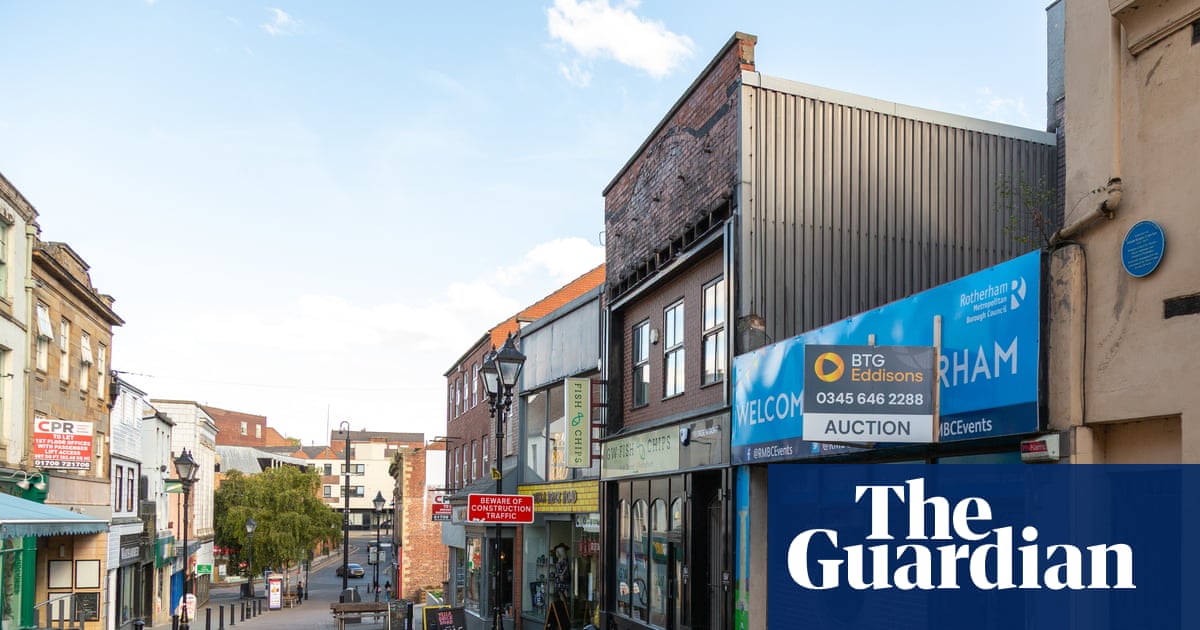
EDIT: Interesting they chose Rotherham as an example, of course if they'd chosen Harrogate, Oxford, Durham, Bath etc the story would have been quite a bit different...
Also, right behind where that header photo was taken, is a GOOD example of attempts to regenerate the high street.
But the causes are much longer reaching than anything this points to – it's been in decline in Rotherham since probably the 1970s.
The broad strokes are true in general, though.
- asset prices don’t support ROI on low volume / low margin shops - I’m not saying ok, but when you say would I buy this shop and rent it to myself - too often the answer is no
- virtuous cycles / density - and at much easier to open a business next to another successful/ complimentary business - i want the butcher, coffee shop, dry cleaner, wine shop, gourmet shop, pub, bakery etc all right near each other I don’t want to make a special trip for each.
- these shops need to be open past 5/6pm!
They also need some sort of tax forgiveness if they are to be at all competitive with the major online retailers who pay very little effective tax - which isn't really on them but on national governments to level the playing field.
But yeah, UK main streets have a problem.
People just don't want to walk around places when they can drive and buy everything in one place.
"They do it because they can", this is the best explanation in so many cases, this not the exception.
Police don't care enough (or are told to do just enough to keep some of the public happy) and the government likes the income taxes from the "employees" and the council likes the business rates...
It's corrupt as hell
Councils trying to extract as money as possible from shoppers via parking companies doesn't help either.
Zero info on who the government hundreds of millions is going towards to help the problem (let me guess: a bunch of nonprofits who won't solve the problem).
Not even close, unless you own a shop (in which case, in some areas, life can undeniably be exasperating and miserable). The vast majority of high street crimes are shoplifting or possession (or drinking in alcohol control areas) and an astonishingly large number are attributed to a tiny, tiny number of people.
There are high crime areas in most towns in the UK where you will feel pretty safe, because the crime is simply not directed at you.
When it does spill over into personal violence, it is the aforementioned handful of people with drug problems. It’s worth noting that one incident involving three people is likely to result in a dozen recorded crimes. And a British town of sixty thousand people will have so few of these prolific individuals that they themselves commute to neighbouring towns to steal.
Worth remembering also if you are an American that in the UK we have not decriminalised marijuana, so there are drug possession and small-scale dealing crimes in there too.
The crime is there, can be absolutely overwhelming and police does absolute f*k all about it (after the robbery they didn't even bothered to shop up, I was told over by phone to collect the evidence myself and bring it to the police because "we are solving these crimes from the office" by the investigating officer. They didn't solve that one).
That sounds like something that would be extremely easy to fix!
For one thing, it’s a revolving cast of a few dozen people at any one time (people do go to prison, get rehabilitated, move on or get moved on). For another, they are often vulnerable or exploited: a lot of shoplifting is done to order, to supply the black market.
The UK does need to take shoplifting more seriously, but it’s important to understand that it is a consequence of both the design of retail (self-checkout and fewer staff) and of the cost of living.
https://en.wikipedia.org/wiki/Rotherham_child_sexual_exploit...
It sounds like a very rough place, with very incompetent police.
I've seen shops in London that don't even bother having any products on display. Just many blokes and a till.
https://en.wikipedia.org/wiki/Rotherham_child_sexual_exploit...
People don't understand the scams but they smell it. They know how they remember things and they know that everything is getting worse not better.
I dare our governments to try and draft us into another war, literally dare them, even a war to defend our actual land - people have nothing to fight for and will turn their weapons on perceived perpetrators. It's brewing. This slow decline is painfully visible to people.
> People don't understand the scams but they smell it.
This is so so true and well put
In the uk virtually all thrift stores are run by a well known charity and thus the locals call them charity shops.
If it's supposed to be a display of a city's finest... we're not doing very well.
Modern döner-kebab meat is rarely the quality shawarma of a century ago. It is highly processed and basically a big hot dog.
> Kebab shops elsewhere in Europe are often associated with shady dealings.
No they are not, but there's a lot of racist propaganda that says they are!
As a Brit that’s moved to Australia let me say the kebab shops here are a revelation. The meat is nicely cooked, generally identifiable, and not swimming in grease. The bread is usually more like real Greek gyros bread, the salad fresh…
My memories of Kebabs in the UK is of very dubious slices of something coming off the elephant-leg at the back of the store, nothing you would ever consider when sober.
What, the elephant leg? In the UK it's mostly Doner - https://en.wikipedia.org/wiki/Doner_kebab
And doner kebabs on sale in kebab shops in the UK are of very dubious origin. There have been a variety of scandals over the years about the origins of the meat.
About 20 years ago I read an article in the metro newspaper about the origins of the meat, a study having been done, which found that most kebab meat in the UK was not what it said it was. A significant proportion contained a mix of lamb, beef, pork and unknown meats. And at that time most of the allegedly 'halal' doners on the market contained pork.
Recently one of the UK's biggest suppliers of kebab meat was fined for selling doner meat that advertised 87% lamb, but was found to be using large quantities of fat and skin, with meat making up between 10 and 50% depending on which source you read. The 'meat' itself, where it was even from sheep was largely neck trim and mutton trim, and they were using goat as well without labelling it - https://www.bbc.co.uk/news/articles/cy736xme2vvo
Maybe you found some good places in east London that were actually making their shawarma on-site. But the standard of a generic 'kebab' in the UK has always been known to be awful.
If you want quality Turkish kebabs which are nicely cooked, generally identifiable and not swimming in grease you go to a Turkish barbecue grill restaurant.
I don't know how long you've been away but they're everywhere here now with not an elephant leg in sight. They'll even serve you a nice salad with bulgur wheat.
It's disingenuous to pretend that you can't get decent food in the UK if that's what you are looking for or that you can't buy terrible food in other countries such as Australia too.
Yes, you can get good Turkish food in a lot of places, and good Turkish food is delicious.
But the post I was responding to called out kebab shops in particular as excellent and I wouldn’t want people thinking they can get ‘good’ food in the average high-street kebab place.
Don’t get me wrong, it hits the spot after a skinful… but high-quality it is not. See my sibling post about the various meat-scandals.
> It's disingenuous to pretend that you can't get decent food in the UK if that's what you are looking for.
Just as well I said nothing of the sort then eh?
If I go to my local high streets I either cannot park at all (all residents only permits or disabled or taxis only or bus stops etc) or I have to pay eye watering fees - e.g. £1 or 2 per 15 minutes. Council parking wardens will be out prowling looking for infractions and giving you a £80 fine without any grace period.
...Or I just go to a shopping center like Brent Cross and park for free with zero hassle.
Yes I can walk or take the bus to the high street, but that will turn a quick 20 minute errands I to a 100-120 minute roundtrip, with the discomfort of doing it with shopping bags on the return journey (and the buss will cost you more than parking and fuel, while being slower, less convenient, and less pleasant)
For what it is worth, I don't feel like crime or drugs are a concern, at least not in my part of London.
Or just go to a supermarket or shopping center where parking is free and easy and you are not being preyed on by parking companies trying dark patterns to fine you.
I can catch a bus but I have to walk to it, it comes at most twice an hour (usually hourly) and it a very circuitous route so it take ages.
Or I can drive 15 minutes from my door but it's expensive to park. So I generally head in the other direction to an out of soulless town shopping centre.
It would be luxury to have something like the Tube arriving every 2 minutes. I love it when I'm in London.
I will say, that sounds expensive for parking, but completely not out of line with what I would expect to pay for premium (location) parking, though I'm used to VHCOL parking rates and maybe you don't live in that big of a city.
Parking in premium areas can certainly be £5 an hour - but that really will be for premium areas with few spots and high demand, although that's a common situation in historic town centres. I wouldn't be mad enough to try and park in London but I'd expect parking there to be through the roof. The places I usually park for shopping etc (outside London but still SE) are more like £1 an hour in town centres, or free when the car park belongs to a shop or is in a less on-demand area.
£1.85 each ride. So £3.70 round-trip if you can do it in just two rides. There are discounts if you are quick (e.g. you might only pay once) but it is time dependent.
Or just drive directly and quickly with zero hassle for pennies of electricity and free parking in a shopping center.
No, it's that I don't like the council and central government turning a blind eye to obvious crime fronts because they're desperate for the tax. Don't call me a bigot or xenophobe.
I would prefer them to be knocked down for housing frankly, as many town centres are close to useful train stations. The council can then use the council tax
Councils are supporting the don't build any housing any where mandate. It is such an obvious use of the land it's crazy. We still have to delusionally play along with ideas about how to "regenerate the high street".
Case in point. Huddersfield is currently "regenerating" its town borrowing huge sums for a new library and new markets etc instead of just flattening the town and replacing it with housing. The railway line is also having a major upgrade. The timing is literally perfect. Another own goal. But hey a lot of employment was generated and I'm sure the mandate to employ local didn't mean a lot of backhanders....
People will move to a shithole if it has good transport links to jobs, which Huddersfield has. Look at Romford for example. The council has sold off loads of land for flats and is selling more. All because of the new Elizabeth Line
Guess what the result is when 10,000s people with good jobs move in to an area? Demand for shops and services!
Not sure about how to get out of this pickle. So many modern problems stem from the crash of our prehistory behavioral adaptions against new context brought on by civilization and technology, which now moves faster than we could actually adapt through natural selection.
Local business owners are taxed to death.
Meanwhile, multinationals with HQs in tax havens roll in and set up national branches. The local branches pay their HQs for imaginary "services" and "rights", allowing them to operate practically tax-free in the country.
Good luck staying open little guy. We're lucky we still have vape shops and nail parlours.
It's also a vicious circle : Because there is less and less physical shop selling specific goods, you have to turn to the internet, which mean local businesses get less traffic and die off. If you have any slightly niche hobby and do not live in a major metropolis, you are SoL. As an example, I would have to go 200km away to buy raw leather and leatherwork tools despite living in one of the biggest city in my country.
Possible solutions to this include 1. More stores introduce a paid membership. This is not a bad idea, a store pays for the cost of the physical location with the membership fee and has similar prices to online stores, and they have an incentive to maintain product quality, Costco is very successful with this model, but I'd be worried that that the model is begging for enshitiffication, you could really cash out on the store's reputation by lowering the product quality and increasing the costs and relying on the friction of the existing membership to keep customers for a fair while. 2. Stores focus on being an enjoyable experience, and hope that if you're spending enough time there, you're going to want to buy something. This is what Barnes and Nobles is doing, and most surviving malls. 3. Some sort of policy fix. I'd be in favor of an online shopping "tariff" designed to bring online prices in line with what it costs to run physical locations, collected by the feds and redistributed to localities. Has the minor downside that everyone but me would hate it, and it would be so monstrously unpopular that it could never happen. If we could figure out a way around that, though, it could be quite good.
You expect retail outlets for that? 30 years ago when I was making my own shoes in London and wanted to buy hide I had to trail around grimy industrial areas to visit a wholesale warehouse and persuade them to do retail for a moment. (I bought my tools from other hobbyists.)
Industrial businesses were less rigid about avoiding retail sales than today but it was still way more hassle and generally "the dark ages" comparatively.
To be specific, Amazon (its business model) killed small* goods shops in city centers.
The only businesses still open are services (food/restaurants, health, etc). Because those need you to actually bring your own body near the bodies of others.
___
*: and big, see the Galerie Lafayette/BHV struggles in Paris, they sell items that can largely be delivered in 2 days buying directly from the brand or from Amazon
And of course let's not forget COVID, which was a major factor in destroying small business of any kind.
Big players similar to Galeries Lafayette also fell victim but for different reasons. First (I think) they tend to be well-staffed, so their costs are much higher than e.g. Zara. And second, outsourcing of manufacturing has made a visit to Lafayette kind of pointless: If you are to choose between 50 shades of "made in China", you might as well do it from the comfort of your home.
Even if you control for the Amazon factor or the Walmart factor by looking at services, the bulk of these "successful" businesses are either chains or owned by a bigger corperate entity that can do kind of the same thing.
And the ones left aren’t paying taxes, or wages.
So a lot of high-earners would now have to pay UK taxes on worldwide income. So they left the country or only stay there mininal amount of days to not be considered resident.
Many high street businesses were working for these people with tons of disposable income.
Also criminal situation was little better when these high-profile people were roaming London streets. No one wanted something happen to them.
Poundland[1] is going under as high net worth customers switch their purchases of multipack Wagonwheels to Dubai. ;)
This is just nonsense. If out of town retail parks are still flourishing then it's not a lack of consumer demand; it's price and convenience that matters.
1. Poundland is actually going under because a US private equity fund, Gordon Brothers, spied an opportunity to asset strip them by pretending to offer investment.
They were gifted the business for a nominal £1 and have refused all offers of a buyout that would keep Poundland afloat.