329 points · by PaulHoule · 1w ago · 358 comments
I had the same reaction ... cruelty. They clearly looked miserable. Perhaps some liked counting cars. But there was empty pasture as far as the eye could see, without shade structures, so they all hung out by the highways signs inhaling diesel fumes.
Beef has the highest split for the farmer. For something like chicken, the farmer get around 15%.
And for vegetarian products the split is even worse, with less than 10% that goes to the farmer.
In spain for instance, there is traditionally a mix of gras and trees, so pigs and cattle do find shade (and the pigs more food from oak trees). And also the gras grows better for not getting full sun all the time.
I think that the facility near Coalinga is a Concentrated Animal Feeding Operation (CAFO), in which they aren't grazing on grass but instead eating from giant troughs of grain.
You know, I think there'll be grass.
Trees in pasture are a non-negligible cost factor because they take a long time to grow and a lone tree in the middle of a flat pasture doesn't have great chances of survival, and then you'd have to manoever around it when working the area with a tractor or similar farm machinery.
The sensible thing would be for the farmer to just make judgment calls from day to day based on the weather etc. but that sort of judgment is precisely what's being displaced if the incentives are pulling towards either chasing higher prices through eco-certification or lower cost.
There was considerable pushback from the 60+ crowd and NIMBY types just like there is for everything new and different, but we got three permitted and are waiting on them to begin construction.
The thing that got me was there was a lot of people that just made whatever argument they could to try and stop it. All kinds of arguments that people either didn't understand or didn't really believe in. They just knew they hated solar. I really couldn't wrap my head around it.
From my perspective. It's a net good for our ranchers. We're mostly small family ranches, 200 head or less and the lease paid by the solar company helps these folks meet the bottom line. Beef prices won't stay up forever so it's a good time to diversify.
[1]: https://www.renewableenergyworld.com/solar/utility-scale/tex...
I have a box of 18”x18” samples cut from large solar panels on my desk from some material tests. I’m careful when handling them due to small glass splinters, but overall there is not much glass that comes off.
The CO2 vendors are really helped by it being invisible, aren't they? Nobody's going to pay to clean that up.
> The CO2 vendors are really helped by it being invisible, aren't they?
At this scale CO2 is irrelevant. As an example, China alone burned more coal from 2020-2025 than the entire world did in the entire 19th century. None of the major emitting countries- especially the USA- have made any useful headway in reducing raw CO2 emissions, and sticking a small number of panels in rural Appalachia will do nothing to change that. It's wildly cost ineffective compared to the grid scale installs power companies are setting up of windmills and solar panels elsewhere.
People don't hate solar. They hate who solar is associated with by virtue of it's loudest promoters and first adopters.
This goes for a lot of things.
Or, for example, they strongly believe that replacing farmland with solar is bad for food prices / security / whatever. Or, we've got a bazillion square feet of ugly ass industrial space and you want to take my green fields and replace them with installations of glass?
There are probably other reasons I've never heard or not thought about! This isn't my wheelhouse.
Broad brushing everyone who takes a position counter to (your) common sense as being a thoughtless reactionary is just ensuring continued failure to understand.
in the field with the solar voltaics
photosynthesizing layers in the solar mosaic
chlorophyllin’ all these feelings in the form of a laser
Absorbing gases that trapped in the ozone layer
My siliconite inverted til i collect the light
In organelles then transferred out in the black of night
I bring you sight, green, red & blue thru my prism white
Racks upon my roots until I practically am out of sight
was fun writing the parallels between a solar panel & plant lmaoeg https://www.countryside-alliance.org/resources/politics/alli... or https://www.cpre.org.uk/stories/solar-farm-risks-our-livelih...
Their opening point was concern about solar power displacing agricultural use for land, while comments here talk about using it to provide shade to cattle. Doesn't seem like a particularly good argument.
Also, your articles are from the UK, a pretty poor place for solar. The farmers must be in dire straits if they feel they have a better chance with solar than what they already know how to do and have the equipment for.
There's a discussion to be had about land ownership and consolidation (especially in Scotland!), but not one to hang on renewables. I have sympathy for tenant farmers - historically not a well treated group - but these days you do have the option to not have that economic situation.
Bonus: trees are biodegradable so when they’re done, nobody has to go out and gather toxic minerals to keep them out of the environment we’re engineering them into for whatever reason.
There's plenty of buildings for that
Ideally, a safe, green, cheap, dense battery we can simply charge and discharge at will, but that’s as magical of a solution as fusion is.
Cdte and cigs panels both contain heavy metals and problematic materials like various selenium compounds. Maybe wherever you are is banning the use of those and only allowing for crystalline silicon plates? Certainly this isn’t the case everywhere.
Actually better for the environment to cut it down and make furniture from it :-)
Unlike the fuel source of the nuclear power plant that costs far more per MWh.
But also, we’re not advertising nuclear as the thing you can do out in the middle of nowhere, it’s highly centralized and easy to secure and regulate and oversee.
(also, lol at talking about nuclear in contrast to "toxic minerals"! What do you think uranium is, my dude?)
China has fish farms with solar, reflection from water increases efficiency by 5%: https://www.youtube.com/watch?v=MgQVV0_75j0
Livestock need shade, and grass doesn't need continuous shade grows better in shade in most tropical climates. If its too hot, grass dies off. Livestock also need ACs when temperatures reach 50+ centigrade, which can be powered by solar.
Cows are ruminants, they lie down and ruminate for hours in shade.
Except for goats, solar works with most animals.
Solar can always be used as a fence (zero land use, zero interruption to machinery) and get paid at a higher rate in the mornings and evenings, extending solar production window by ~4 hours.
Farming is tough and low status. All countries support farming with subsidies. The best use of farms is solar+ anything else. Photosynthesis is 6% efficiency (and it goes down to less than 1% when we use it for livestock feed or ethanol with conversion losses), solar is ~25%. Solar has zero opex and can run for 3 - 5 decades, output can be used directly.
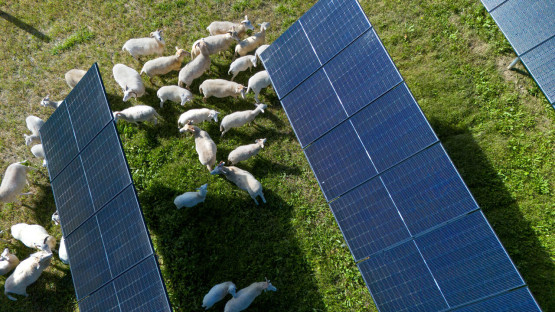
Why not goats?
So in theory my 4.6 litre V8 Range Rover is a net-zero-emission vehicle. I'm just burning the gas that would have gone up the flare stack somewhere else, in smaller quantities - a flare stack burns enough gas for me to do 250 miles every ten seconds.
In Oklahoma we have way less flair gas as chapter 10 of the Oklahoma Register prohibits wasting oil and gas. That and we are a gas state more then oil.
I grew up in oil and gas. And different times over my tech career worked in the field on tech. So much I view it as a computer.
>It's cheaper to flair it in Texas then use it so one doesn't have to pay out to mineral rights owners.
By selling just oil, do they not have to pay out to the mineral rights owners?Or is the full explanation more complex? Seems like it must be.
FYI flair vs flare, then vs than
You need a specific destination for the pipe, and then capex is proportional to the distance, but the revenue for the gas is proportional to volume of gas produce. So there's going to be a cut-off where you don't make enough gas to be worth building a pipeline and flares are more economical.
bitcoin causing less emissions than what was already occurring, in those areas
we will probably see a resurgence of this with the new Democrat railroad commissioner in texas, basically the flaring industry was getting indefinite waivers to keep polluting as the agency was captured, but the new administration may be very strict, which means flare gas fields will either need to shut down many operations or accelerate partnerships with miners that want to use that energy
Or do you mean less net emissions, assuming that bitcoin mining would have otherwise been powered by other means?
Jesus wept!
I think we have set a new standard for green washing.
And the question when anyone starts doing a thing is whether they will be able to keep doing it once investors want their money back.
The main blockers I've had are (1) I haven't come up with an affordable racking solution that will hold up to 1,000 lb steers rubbing their butts on it and (2) our local power company sucks with regards to solar and its useless trying to back feed the grid.
I'm guessing the poles would be quite sparse though. A pillar strong enough to resist a steer could likely hold up a fair span of panels. You'd need to do the math I guess.
I was wondering how vet bills are handled for animals that are employed as 'mowers'. Does the farmer provide daily care and the solar company just pays him for the use of the animals or does the solar company own the animals and hire a farmer to provide daily care?
We could do a 3 sided run-in shed with panels on the roof, in the summer here those can pretty warm unfortunately so the animals would have shade but a bit of an oven.
We're a little over 4 years in, we have 20 head now with 14 calves having been born here and we've yet to call out a vet, knock on wood. We're well under stocked for the size of our land so they stay very healthy all things considered.
(Maybe do make a few strong ones without electric fence, too, so the scratching can go somewhere?)
Right now the blocker is security - leaving $10M+ of equipment in an unguarded shed in farmland isn't the smartest move.
tho I guess the sheep may appreciate the shade...
Green-colored things reflect green light (which hits our eyes so we see it) and absorb the rest, that is, the "red" and "blue" parts of the spectrum.
Modern plants are green due to a backwards-compatibiity issue, IIRC. The first photoynthetic plants were purple, so as to absorb the most powerful part of the solar spectrum, the green light. But they were anaerobic, that is, did not produce oxygen. When oxygen-producing cells appeared they had to use the "junk" purple light, and ended up reflecting green which they did not see much of anyway. After the Oxygen Catastrophe the purple anaerobic life mostly died off, and green plants have been owning the planet ever since. They mostly did not learn to use the green light (and turn black) even though it's now all theirs.
Also the OP was thinking that the land under the solar panels could be put into better use, but such ultra high voltage transmission lines themselves come with restrictions on what can be built beneath them.
Long lines are AC, they must come from dams or coal generators, still with a huge loss. Solar is DC. It can be transformed at a loss.
Be careful with the term "government nonsense". It's a very slippery slope from there to losing environmental regulations and eventually representative democracy.
CATL Sodium Battery Hits LFP Cost Parity in 2026: 15,000 Cycles, 30-Year Life - https://news.ycombinator.com/item?id=50399657 - November 2026
Ember Energy: Solar electricity every hour of every day is here and it changes everything - https://ember-energy.org/latest-insights/solar-electricity-e... - June 21st, 2025
https://ember-energy.org/app/uploads/2025/06/Ember-24-Hour-S... [pdf]
- 1 kW of stable solar power across 24 hours of the day can be achieved on an average day in a sunny place like Las Vegas with 5 kW of fixed solar panels and a 17 kWh battery.
- The sunniest regions in the world can get as close as 97% of the way to 24/365 solar – stable supply every hour of every day of the year.
- Achieving 97% of the way to 24/365 solar in very sunny regions is now affordable at as low as $104/MWh, cheaper than coal and nuclear and 22% less than a year earlier.
It's not about "where can we put solar panels", it's about "how can farmers lose less money farming".
If you can put solar panels on a pasture and not significantly impact the agricultural value, it's another revenue stream which will help you survive the next agricultural crisis that bankrupts the next swath of small farmers (the next one being the one we're currently in, where diesel prices are up and ag prices are down).
>The world has plenty of barren, desert areas
Often (but not always) these areas are actually degraded by human influence.In these cases, we should regenerate the ecosystems we destroyed, not treat it as "free" surface area that doesn't matter just because we damaged it.
No sane Antique Shop has a "you break it, it's now yours to do whatever you like" policy. I wonder why? :)
I mean, you break it, then you pay for it/deal with the consequences, then the broken pieces are yours to do whatever you like with. That is generally how it works.
I don't think leaving the land as-is is going to be better than putting solar panels on it. In fact, is seems like solar panels might be better than leaving the land alone: https://www.ecoportal.net/en/sahara-solar-panels-double-sahe...
>I don't think leaving the land as-is is going to be better than putting solar panels on it
I agree, but who said "leave as-is?" I said we should regenerate the land.If some folks think it's hard to regenerate desert land, it just goes to show that perhaps we should be learning more about ecosystems and how they work.
Anyway there’s my ethos. This farm has solar panels only on top of grazing pastures, cause it keeps cows cool. They’re not like blotting out the sun or anything. It’s a productivity and health boost for the cattle, and renewable energy that runs other systems on the farm.
My first priority would be ensuring building products/regulations allow practicable solar onto every rooftop and many sunfacing vertical surfaces within a city itself.
That would go a long way to reducing energy transfer costs and helping with heat island issues. All without using scarce ground space.
Then build outside the city however the maths for transmission vs space works out.
https://patternenergy.com/sunzia-comes-online/
It took 3 years to build from start of construction but 20 years from start of planning:
https://en.wikipedia.org/wiki/SunZia_Wind_and_Transmission#H...
But do you think it's the lacking technology that prevents turning vast areas of Syria, Libya, Iraq, Israel, Yemen, Pakistan, or, say, Congo into colossal solar powerhouses? One can name various reasons, but I'd say that they all boil down to the current lack of wisdom in humanity as a species.
If it were the wise thing to do financially, the Sahara would already be covered in panels.
The inability to solve the contradictions that lead to the constant wars in some of the potentially most productive regions of the planet is what I attribute to the insufficient wisdom so far attained by our species.
All sorts of reasons make sense though:
* farmer wants supplemental income - if X fewer sheep means you can have > Xprice_of_sheep dollars from solar. Not to mention diversifying income streams.
Transmission losses are real.* not everywhere has access to a desert.
* A lot of places are barren "deserts" due to overgrazing, and the overgrazing causes a lack of shade that is a positive feedback on desert conditions. Solar panels can provide just enough shade to bring back plants and grazing area.
It’s not a bad idea but comes with a number of substantial challenges so hasn’t seen much traction this far
Why would Europe want to make itself energy-dependent on another continent? It's unnecessarily risky and prone to disruption by hostile nations.
The move from fossil fuels to renewable energy sources is an amazing opportunity to gain back our energy sovereignty, so let's not fumble it by putting our energy generation physically outside of our control.
We saw what happened when Europe was very dependent on Russia for natural gas. Getting (mostly) off of it was possible, but certainly not a fun time.
Most of these "grasslands" were formerly a rich ecosystem of different grasses, bushes, trees, etc. We've mowed it all down and converted most of them into monocultures, basically deserts with grass instead of sand. So putting in some shade isn't necessarily degrading these systems, they're already degraded. If the panels provide shade and places for birds and insects to live, it's improving the situation.
There's nothing really "barren" in a natural landscape. Maybe dry lakebeds?
Especially in southern/eastern California - https://en.wikipedia.org/wiki/Deserts_of_California
The big problem putting solar panels over grass is that it dries out in the summer. Inevitable grass fires will damage your panels. Grazing helps with that. Or you can mow.
https://www.scmp.com/news/china/science/article/3363108/grea...
Many efforts to reverse desertification, plant trees and grow stuff/crops in the semi-shade. Shade does a lot for keeping moisture in the ground, but it’s much less effective than tree cover, as the roots draw water up from deep below etc.
https://www.princeton.edu/news/2018/06/28/sheep-shear-mainte...
One approach is to convert the excess into energy, the agri-voltaics angle which has a few startups. The other approach is to convert that excess solar energy to wavelengths that could be used more effectively by the plants. This is done using spectral conversion materials or fluorescent materials. My startup, Solarfoil, is part of that latter space.
Happy to see this topic on HN, and would love to connect with others active in this space.
Evaluating land productivity with semi-transparent colored CdTe thin-film PV and broccoli cultivation in agrivoltaic systems - https://www.cell.com/cell-reports-physical-science/fulltext/...
The layer of CdTe is thinner than a hair, is hermetically sealed inside and CdTe is practically insoluble in water. It is also much less toxic than elemental cadmium.
Even if the panel cracks and a torrent of rain flushes through it, the runoff would not dissolve/transport any to the soil.
Sure, dust and shards shouldn’t be ingested, but I think that applies to all types of panels.
>The carbon impact of lawn mowing is significant; one hour of gas-powered lawn mower use produces 11 times the emissions of driving the average new car for an hour, resulting in approximately 563 pounds of CO2 annually for an average lawn.
If we are serious about "ecological gains", shouldn't we compare this with the overall negative impact of sheep grazing (e.g. https://ourworldindata.org/is-organic-farming-better-for-the... )? Why only consider biodiversity (which certainly is important)?
Please don't do this. Quote a reputable source, not some software known for ~~hallucinating~~ bullshiting.
Spot the vegan; or maybe you are American and not used to sheep?
In Blighty, we keep sheep on land (typically moorland and highlands) that is otherwise utterly unsuited for cultivation or cattle; sheep are hardy animals. They provide us with a healthy foodsource and warm, enviromentaly friendly, sustanable clothing.
There is significantly more biodiversity in permanent grassland - solar panels or not.
And solar produces way more than 10 times more energy than energy crops.
So if you worry about nature and land use, you should focus on energy crops (and efficient ways of getting tasty protein).
I live in the Netherlands, and we apparently fucking love grass over here, and most of those cow pastures are basically dead zones. Most farmers here us perennial ryegrass. It grows fast and outcompetes basically anything else that may want to grow there.
Only organic farmers try to have some sort of diversity.
And of course the meter wide strips of land at the end of huge grass fields so the farmer can get some EU money.
I guess it depends on the type of grassland.
This is false. Organic farmers avoid some specific scary chemicals, and that is all. (at least in the US where Organic farmer has a legal definition in law). In some cases their avoiding those scary chemicals results in even more harmful farming practices, in others it doesn't - but Organic is useless as a label and we need to dig into how a specific farm runs.
Any farmer with pasture isn't going to do anything to prevent diversity - will remove anything that harms the cattle, but otherwise if it grows the cows eat it so it isn't worth worrying about.
Any farmer with any other crop is going to carefully manage what is there because anything other than their plan is a weed that harms yields.
There is nothing about organic above. Just about what makes money. If it is organic and makes money conventional farmers do it as well.
Yeah, same in Ireland. Here we also spray pig feces from industrial feedlots onto the fields. The countryside is a toxic sewer.
New study compares growing corn for energy to solar production - https://news.ycombinator.com/item?id=47868063 - April 2026 (184 comments)
Technology Connections covered this a few months ago https://www.youtube.com/watch?v=KtQ9nt2ZeGM - from about 22m to 38m
That also makes the groundcover more accessible for either mowing or grazing, since the footprint of each rack is however big you have to make the footing so it doesn't lever itself out of the ground in a wind storm.
The issues with goats and cattle have been mentioned - they can be managed if you try, but it requires understanding and managing it. You need strong posts for cattle. For goats something they can't chew, and also if they can get on the panels they will so again strength where you might not want it.
You can grow corn under these if you want - you just need to be tall enough for the tractors to get under and other such concerns.
Sheep are easier on the surroundings in general.
Sheep are less chewy and are much more content in trying to find ways to kill them selves in new and difficult to clean up ways.
Cows raised in pasture that is properly managed and rotationally grazed - these can end up carbon negative.
* the pasture being well managed sinks CO2 long term.
* methane emissions from the manure decomposition is minimal
* the feed isn't trucked around
* if slaughtering and butchering are done on-site the only trucking needed is sending the beef product offsite.
I work in solar farm development, and as we already have a very renewable grid adding more solar does not greatly reduce our emissions due to avoiding fossil fuels, however the removal of cows from the land we use is arguably the some of the best environmental outcome of our work.
Direct burial PV cable https://www.wireandcableyourway.com/solar-photovoltaic-pv-wi...
Solar panels are joined together into "strings" which means that you have something like 12-18 panels in series. Those strings are joined into a combinerbox that takes 8-15 strings and join them into one big lump.
Each string is >500volts DC. So they need to be protected from both sun and animals.
The main animal oopsey is where the strings enter the string combiner box. the stings come straight out the back of the panels, run along the mounts and then into the combiner at the end of the row. When the strings emerge into the combiner box, they are protected by a metal cage.
The big fat combined cable then goes into a ground conduit to go to the inverter.
In my experience the cables will probably run straight into the combiner box, and then into the ground without additional protection, then over to the nearest inverter and transformer.
I have also seen a few projects with the cables run above ground on hangars, though this is less common.
There is a ground swell of farmers who find that the vet and ancillary costs Are not worth the effort of holding normal sheep - so there is a growing use of “non wool” sheep - who just have coats as sheep did before we kicked about with their DNA. (Of course they still kill the boys and slaughter the mums for food but hey …)