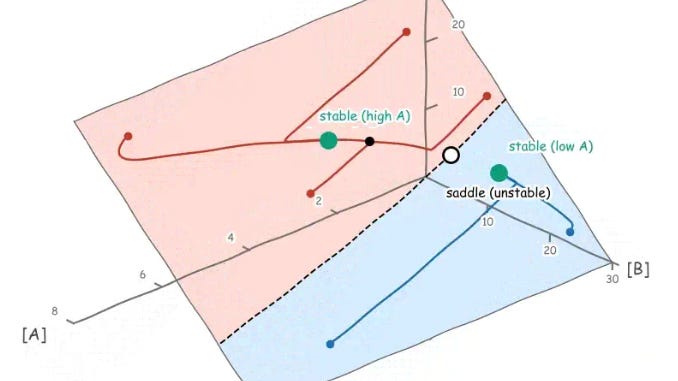
Chemistry is Actually Geometry
Theoretical Biologists should know about Feinberg’s Deficiency Zero Theorem
chillphysicsenjoyer.substack.com
351 points · by sebg · 1w ago · 146 comments
I was very aware of the ambiguity in the title re. geometry of molecules vs geometry of kinetics though, and I was trying to be a bit cheeky :) ! Maybe I took it too far
Actually PDEs can be represented as geometric objects using jet bundles. So there you go
Enzymes are very good at positioning the sidechains in the active site to influence how the reaction proceeds. Mutations of these sidechains can change the kinetics, speeding up or slowing down the reaction.
Also I find it a bit pedantic on the "theory" word, giving me the impression that the author have forgotten that there is no theory before practicing, exploring or experimenting that's why it's called theory.
Theory has meaning beyond the scientific method. The etymology is about contemplation and speculation. Taking the title as an implication of binary reasoning sounds like "mistaking the map for the territory". I take it as a simple premise of the contained body of text. It wouldn't make sense to write an article about geometry in chemistry with a title like "Everything is Actually Everything... It's Complicated".
On the contrary, I find that a core disservice of the industrialised education system is that it inherently hides such analogies by segmenting knowledge into discrete disciplines. Analogies are how we understand the patterns of the cosmos through language. I was never taught how interrelated everything is. I ofcourse heard statements that alluded to it, but nobody ever stated that biology or geology are ultimately just a branch or subfield of chemistry, which is itself essentially a subfield of physics, itself a subfield of math... all different resolutions of the cosmos... but all of it is based on philosophy, and our entire perception of reality is just an interpretation of a tiny sliver of what exists... and most of reality itself might never be observable to us; never practiced, explored, or experimented beyond our minds... Oh no, I've gone cross-eyed.
We’ve known many of the results for 50-100 years and the theories have been thoroughly tested. These techniques are widely used in chemistry and biology.
The post is mostly, if not entirely, textbook as in you can take almost any physical chemistry textbook (in the US this would be an 3rd year undergrad class) and get essentially the same overview.
I actually thought the coverage was pretty shallow. A hand wave at quantum mechanics but no discussion of the Born-Oppenheimer approximation. No discussion of reaction intermediates or mechanisms. No discussion of the dynamics of diffusion and when the well-mixed regime breaks down. Everything assumed that concentrations were high enough to avoid stochastic chemical kinetics. All of this is also pretty well-trod.
Anyone wanting a more thorough treatment of the field would be advised to look other places, like Steinfeld’s _Chemical Kinetics and Dynamics_ as well as the vast literature on this topic.
I hope to get to the frontier soon!
Anyway here’s my biased and probably outdated view of some areas worth looking at, depending on your particular interests:
- For reactions in biological systems, you should be aware of COMSOL [0] and projects like the Virtual Cell [1]. These simulate reaction-diffusion networks and associated systems.
- For many biological systems, the concentrations of important species is so small that you need to use stochastic chemical kinetics. See the seminal paper by Dan Gillespie circa 1976-1977 [2] and the follow up work in the 90s and later [3].
- To understand where these rates fundamentally come from, you should start at the phenomenological Arrhenius equation, and look at transition state theory (activated complex theory), and theories of reaction rates. This is textbook stuff. Steinfeld covers it well.
- Then the theory gets more complicated and combines statistical mechanics and quantum mechanics. RRKM theory was the first really successful gas phase theory (also well-covered by Steinfeld). It’s evolved from there in sophisticated ways.
- For room temp reactions Kramer’s theory [4] was one of the first successful explanations of rates but makes assumptions that are less applicable to complex systems like proteins (ie: the diffusion and friction terms are independent of the progress of the reaction coordinate).
- Approaches like transition path sampling [5] (developed at David Chandler’s group at UCB) made some progress with complex transitions of more complicated systems, but stalled for a while. I’m not sure where the frontier is now.
All of these get very deep and complicated. In cells, you essentially never have a truly well-mixed regime; vesicles and motors are fundamentally important.
For reaction rates, gas phase can seem simple, but it’s often where there’s clear evidence of coupling between electronic and rotational/vibrational quantum states. As far as I know, the role of solvent in liquid phase reactions is still poorly understood for complex biological systems. Explicit water molecules are expensive to simulate directly and reaction timescales can be milliseconds or longer with a fundamental integration time step in the picoseconds. These are not trivial simulations. Rosetta- and AlphaFold- style approximations are, afaict not built for studying solvent effects and usually involve implicit or semi-implicit solvent.
Lots of good and hard questions. The literature is broad and deep. I hope you enjoy your journey!
[0] https://www.comsol.com/ COMSOL is commercial but widely used for simulating reactions in diffusion-advection regimes with complex geometric constraints.
[1] https://vcell.org/ It’s also used for simulating reactions in-diffusion networks but with a strong focus on biology.
[2] Gillespie, DT. J. Phys. Chem., 1978. Vol 81: pp 2340-2361 (1977). There’s also a J Comp Phys paper from 1976 that’s more explicit with the derivations. ACS has almost certainly paywalled this, but you can find pdfs around, eg: https://www.cl.cam.ac.uk/teaching//2223/Bioinfo/papers/Danie...
[3] Look for review papers. Eg: https://www.dna.caltech.edu/courses/cs191/paperscs191/gilles... I’m sure there’s something newer too.
[4] Kramer’s theory should be textbook but it involves a lot of stochastic process theory and I’m not aware of any good textbook that covers it well. This is overview by Tokmakoff is pretty good: https://chem.libretexts.org/Bookshelves/Biological_Chemistry...
[5] The Wikipedia page for TPS is okay: https://en.wikipedia.org/wiki/Transition_path_sampling But I’d look at review articles out of Chandlers group in the early-to-mid 2000s. The first citation gives an idea: https://scixplorer.org/abs/1998JChPh.108.9236D/abstract
My understanding is that the math works, but it works in an incomprehensibly large number of different possible ways — all of which have extreme consequences, none of which can be reasonably tested.
(+) Here, I'm allowing theory to stretch broadly to cover all manner of guesses and hypotheses.
With maths, we can prove things with 100% certainty given then axioms. The axioms are not there to be proved or disproved; they are what _define the system_. We can choose different axioms, and have a different system.
With science, we can't prove anything 100% because it is based on observation, not axioms.
This is not correct. We have a notion of the natural numbers in our minds but axiomatizing this notion is elusive and impossible if one insists on a nice set of axioms.
Consider this. I claim it is not possible to prove that addition of natural numbers is commutative. I claim this because any system of axioms one proposes to use as the axioms for the natural numbers that does not prove that addition is commutative would be rejected. What this shows is that we believe addition is commutative regardless of what axioms we use.
The axioms do not define the system. Axioms are found to be acceptable if they describe the system accurately enough.
The fact that axioms are taken as given does not mean we haven’t really proved anything in math. We have unambiguously proven an enormous amount of statements. Whether or not those axioms reflect absolute truths of our universe is a separate question, and has no bearing on whether or not those statements are true in a universe that does.
If the foundation of a statement is unproven then the statement is ultimately unproven. Yet, we can prove that statements derived from axioms are true or not within the system we've defined.
Rather, math is based entirely on arbitrarily chosen/defined axioms - and it's literally all about proving 100% congruence/certainty to the definitions given.
It's in applying math to reality where there isn't a 100% certainty, but that is the realm of science.
Anyway, lots of things are "actually geometry" but chemistry is kind of the one science that really does just reduce to QED first principles pretty cleanly. You don't hear a lot of talk about emergent chemical phenomena.
Arithmetic can be "actually geometry" if you're good with a compass and straight edge and the use of geometry to understand numbers is old.
Anyway, I'd say chemistry is actually physics and that may or not be actually math of any kind. At least in part, probably.
What? All of chemistry is basically emergent. we do not for example have clean, reducible models of the details of why aufbau diagrams fill the way they do in the transition metals, it's very hand-wavey and extremely empirical. Why does iron freely access the +3 and +2 states in ferrocene? Like why are titanium [-2] and [+1] states even a thing at all. Why does zirconocene have just enough space to do an p-pi sigma bond in ziegler natta catalysis? What the fuck even with p-pi sigma bonds in the first place?
> chemistry is actually physics
You cannot throw a physicist at chemistry and expect insight or even understanding to come easily. The defining mentality and approach are just so different. So much so that probably the methodological approach should be a better definition of what constitutes chemistry vs physics.
Anyway, no one outside of your specialty knows what you're talking about and so that is congruent with my "you don't hear much about" which I think you read as "does not exist." I don't know if there are emergent chemical phenomena, just that they are thrown around to mere mortals like me the way evolution or social behavior are. Or life itself.
This isn't about physicists and chemists, obviously or their praxis. It's about what is actually happening and if you can explain it solely using the tools of the underlying layer.
You have succeeded in out esotericking me, but I don't think anything I stated was incorrect.
[1] "Nevertheless, the matter of emergence in chemistry is far from settled." https://pmc.ncbi.nlm.nih.gov/articles/PMC9814932/ (2022)
My examples are basic things they teach you at undergraduate level (I'm not an inorganic chemist, my examples are inorganic/organo metallic examples, last I saw them was an undergraduate).
>> At least in part, probably.
> You have succeeded in out esotericking me, but I don't think anything I stated was incorrect.
I agree, it's very hard to disprove loose claims. It's a good strategy for not being disproved.
I don't really understand the opinion piece you linked to though, which seems mainly philosophical. Can you explain it to me?
As a physicist whose worked with chemists... I don't see the value in saying chemistry is just physics. And its not even that I fundamentally disagree, it just not a valuable statement.
It's kind of anachronistic too. Thermo was born out of the fuzzy interface of chemistry and physics. Is thermo/stat mech chemistry or physics? Obviously physics, but the last 30 years the coolest stat mech developments came largely from "chemists". For a given phenomena/set of phenomena, there is usually a "best" way to approach it, and that best way is increasingly not going to separate cleanly by department.
Since you're talking confidently about emergence, I take it you're familiar with "more is different"?
Chemistry is mostly atoms and electrons. An AMO physicist can't do much with a polymer, but the polymer scientist (usually chemistry, chem E, sometimes physics department) certainly use born-oppenheimer...
Quantum Electrodynamics? quod erat demonstrandum?
in either case, not sure exactly what you're claiming. biochemistry emerges from chemistry...RNA world, etc..
in a manner of speaking, chemists are ultra specialized physicists, and biologists in particular molecular biologists are ultra specialized chemists.
the whole thing is a stack that assembles higher organization from lower subunits, typically atoms, molecules, and aggregates.
To be fair, you absolutely do; it's just usually called something different. Like "biology".
When I was in college anyway, it wasn't part of the discussion.
> ...reduce to...
Everything "reduces to" physics. That has nothing to do with something being emergent or not.
Emergence refers to a particular kind of reduction.
"Emergence" means that in some conditions a very different layer of organization emerges on top of another layer of organization. Chemistry as a completely different organization of matter, emerging from particle physics with respect to up/down baryons and electrons, at energies < ~1–10 eV, could well be the gold star standard of emergence.
https://www.explainxkcd.com/wiki/index.php/435:_Purity / https://xkcd.com/435
(edit: although I think downvoting the question is a bit harsh; did I miss something?)
I could be wrong but I remember my EE friends saying imaginary numbers show up in nature somewhere. That blew my mind so has stuck with me.
Whether youve one, or two, reals -- the reals are the heart of the matter, which make the representations geometrical (over, say, algorithmic which would be grounded in the integers).
https://acko.net/blog/how-to-fold-a-julia-fractal/
Note the meat of the tutorial is contained in the frames that you navigate with the arrows on some of the illustrations. It doesn't display well on mobile.
Pretty much every other physical use is also because i has a cyclic 4 periodic structure.
Weird fringes at the seams of the simulated world we are in. Lazy evaluation and limits in calculation precision/performance.
units = the semantics, so that "1" of something is a property of a particular extension in time and space (eg., of charge)
symmetry breaking = all the ways that the reals are carved up
Proteins fold, thats also geometry.
Sterics is a vastly simplified model as atoms aren’t static. There’s a lot of real world behaviors that you don’t get from static models.
Thus the critical distinction between distance and at a distance.
The article is interesting to understand some cases, but the title oversells the coverage of Chemistry by a lot.
For example, there is nothing about organic chemistry. Let's pick one at random: What is the difference between CH3-O-CH3 and CH3-CH2-OH? They have the same atoms, somewhat similar structure, but they are very different materials and have very different reactions.
In my university in Argentina, Chemist have Linear Algebra in the first year, and 1D diferencial equation in the second year and they even have some introduction to dynamical systems last time I was a T.A. in that course.
The chemical part of the article are simple inorganic reactions, that are covered in the first chemistry courses. It includes kinetics that is just differential equations. In the first courses the idea is to make a lot of approximations to get 1D differential equations that are a lot easier to solve than 2D and 3D and N-D versions.
Mostly you assume the concentration of one molecule change, and the concentration of all the others is so high that you can assume it's constant. (This is an important difference between chemistry and math. The chemistry part is to know which assumptions to add or what to mix to be able to do the assumptions.) Something like https://en.wikipedia.org/wiki/Rate_equation
I agree the article is about other systems where you have more than 1 variable and it was used to be call dynamical systems, but for some reason it's renamed every few years. The solutions have invariants, so there are a few geometric varieties there. Anyway, it's a very niche topic, for weird chemical test-tube reactions and many of biological systems.
I good title would be "Application of multi dimensional differential equations to some weird unusual chemical reactions" instead of "[Everything in] Chemistry is [just] Actually Geometry".
I get the sentiment but that’s a poor example.
If you call the difference of a banana and a rock just geometry, everything is just geometry.
---
Back to my example:
CH3-O-CH3 is a gas https://en.wikipedia.org/wiki/Dimethyl_ether
CH3-CH2-OH is a liquid https://en.wikipedia.org/wiki/Ethanol
The difference is very slight advanced chemistry that is not geometry and is out of the scope of the article https://en.wikipedia.org/wiki/Hydrogen_bond
---
[1] I'm almost sure that a rock has more neutrons than a banana of the same weight. I'm trying to find an example that balance the protons, neutrons and electrons...
After thinking for a while, I think that a Diamond and a crystal of Sodium Hydroxide of the same weight, have the same numbers of protons, neutrons and electrons. Better and/or more disimile examples are welcome.
that’s as absurd as saying that is all there are. the difference in bonds do in fact cause that.
or should we not look at molecular modeling software and instead focus on something a little further from geometry, like… uh… reaction energies? Oh, wait, in that case…
Here's a related paper from his group: https://arxiv.org/pdf/2311.11939
That was pretty brutal but plenty of people were still not discouraged.
A dynamic system is a system considered in the context of some theory of physics that evolve in time, such as classical dynamics or electrodynamics.
A dynamical system is a submanifold of a jet bundle over the product space of some open set and a time manifold which is almost always R with the most common exception being S^1, typically written as J^1(R×M), considered with some regularity conditions that permit you to do analysis over any contour lines of your choosing in the dynamical system. Essentially, it's a rigorous way to study what happens when you mix arbitrary differential equations and arbitrary differentiable manifolds, such as in the phase spaces of any random IRL shit.
System is too general and underspecified and dynamic system is unclearly specified because you done know whether it readily exposes the interfaces/frameworks that someone would use to theorize about dynamical systems.
Potential and kinetic energy oscillating back and forth are responsible for: planetary orbits, electromagnetic radiation, water waves, sound.
Not sure how commonplace this is, but I like thinking about it in signal-processing terms:
https://en.wikipedia.org/wiki/In-phase_and_quadrature_compon...
Conclusion: Based on the above, the 10x increase in the page content is hereby concluded to be due to the drastically reduced effort in producing the content.
Consider rock candy growing in solution.
If only reality was cube based, like some kind of Egany Minecraft thing.
jk
- "Layer-Coded Plabic Graphs, Complex Vector-Relation Configurations (VRC), and Unrestricted Grassmannian Quantum Chemistry (QCI-GXC) in MADNESS Multiwavelet MRA-PNO and Tequila for Computational Advantage" (2026) > "2.1 Master Taxonomy Table of Lower Grassmannians in Quantum Chemistry, MADNESS MRA-PNO, and Tequila" https://westurner.github.io/sustainablefactory/grassmannian-... , https://westurner.github.io/sustainablefactory/grassmannian-...
Nonsense, check out FT-ICR
Fourier Transform Ion Cyclotron Resonance Spectroscopy
https://warwick.ac.uk/fac/sci/chemistry/research/oconnor/oco...
It is both eyes and hands, you can selectively energize the kinetic energy of species at a certain resonance frequency.
Suppose A- + B- <=> C- + D-
Then you can push the balance to the left by transmitting the ion frequencies for C- and D-, or to the right by energizing A- and B- ion species. So you can actuate reaction coordinates.
Sweep wit a frequency or white noise to identify how much of what is currently present in your vat.
This tool is both eyes and hands.