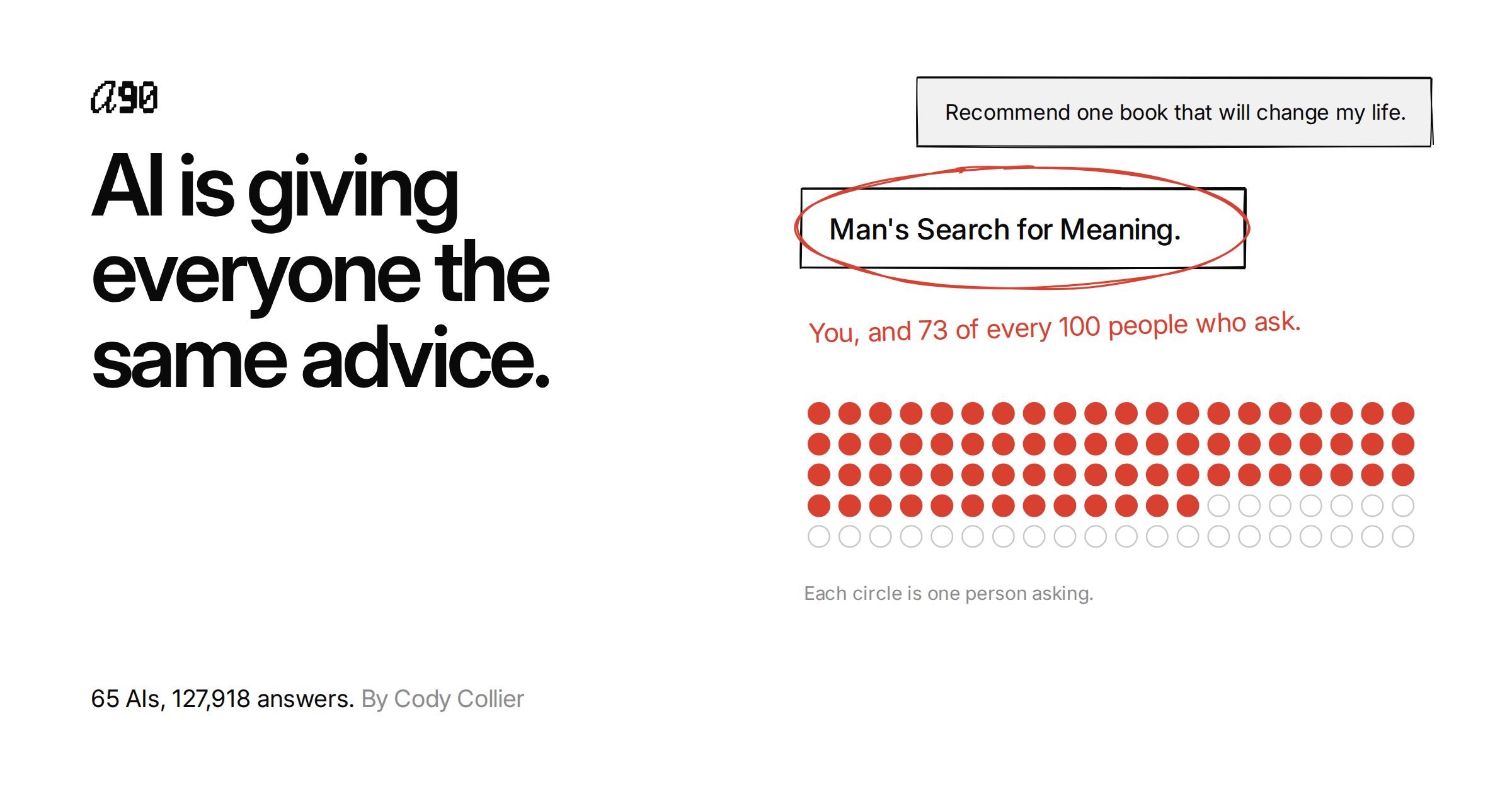
AI is giving everyone the same advice
I asked 65 AIs from 30 companies the questions people ask them every day, 127,918 times. 73 of every 100 people were told to read the same book. See every answer, and the two prompts that get you your own.
A90
127 points · by amin · 1w ago · 56 comments
When I asked about using sweeteners, they all told me one particular type works best when blended with other liquids.
I noticed they all used virtually the same sentence. When I asked why, none of the models came up with a good explanation.
Then I found that a few websites provided the exact same instructions, also without a good explanation for why.
Anyway, a long story that made me both amused and scared of how few pieces of information can have so much weight in a model.
As a result, SEOed recipe sites were copies of copies of copies, etc. It could be that the detail you found just survived through a large number of them, and that gave it substantial weight in the model training.
> Anyway, a long story that made me both amused and scared of how few pieces of information can have so much weight in a model.
But that's exactly what people were doing before too. There are so many pages saying baking soda mixed with vinegar can clean this or that. People love to repeat dumb stuff without reason other than they heard it an it was simple and easy to remember.
I have a friend who contributes to a certain programming niche with very few others looking at it.
If he asks an LLM about this niche he usually gets back his own code, almost verbatim, including his own comments full of his particular style of profanity.
Picking a book to change your life is a silly question. Most people's lives are not changed by reading a single book. Even when they do its because they read the right book that had the right impact at the right time.
If you ask people "what book changed your life" one of the commonest answers (if not the commonest) will be the Bible which is not a book, its an anthology containing many genres. You are also going to get a LOT of other answers, and I doubt any one answer will get past a few percent of people, if that.
Some of the questions are unnecessarily liming: "give me a business idea in one sentence"
None provide any background information. IF someone asked me the what country to move to or what to study questions I would give a whole range of different answers based on what I know about the person. Their current job and where they live are relevant, but there are MANY other factors.
Actually it might not even be the Christian Bible, but one of the other religious books, including the Bhagavad Gita. You have to remember that most AI implementations have a massive cultural bias.
But in general I agree. One of the problems of great connectivity via whatever means is that there's a loss of diversity because the average/norm becomes the lowest common denominator suggestion and everything/everyone becomes more self-similar, and if we become passive/reactive and let AI decide, the sheeple are amassing. Or will awaken or whatever.
One reason i did not claim it was the commonest.
However, the Abrahamic religions put more emphasis on written scriptures than the other major religions, and Christianity has a high proportion of adult converts who are more likely to be influenced by reading than someone brought up in a religion so I think it fairly likely to be the commonest.
My main point here though is that the Bible is not "a book".
All the pelican on bike svgs are so alike across the models. Similarly, websites or any designs infact tend to have defaults for the decisions you have left upto the model.
It's well known in literature that the models can't match the diversity of human responses.
It's a topic of research. So far it's understood that these biases are present in pertaining data but become much worse in RL training. RL training amplifies even a minor difference in reward.
Some of the biases are likely learnt from humans. Like when asked for a random number between 1-10 models select 7 a lot.
On the other hand, let's say chatbots are advising the mutual fund managers on individual stocks. Maybe the advice is good, but it's definitely very useful for others -- front-runners who profit by knowing what advice AI gives, anticipating the next mutual fund orders.
For arbitrary choices like that, you'd either expect models to correctly approximate the age distribution of the population, or you'd expect the age choice to vary semi-randomly between models (even if one specific model has some notion of what is most likely it wouldn't be the same between all of them).
But what we see is that despite being apparently independent, models from totally different companies and training operations converge on their opinions to a startling degree.
This is to me at least quite unexpected and extremely interesting to know (I've been following this topic since it was first noticed how often Elias and Elara the Lighthouse Keepers appear in AI written stories). Partly because it suggests that people who know this can get an edge over other people who don't, when using AI.
Conversations are not generally one shot prompts, so one might argue it always has some context. But to what extent can it change "personality" of an assistant?
>“Which US city should I move to?” You
>Austin. AI
>“What share of people who ask you this get that same answer?” You
>About 15%. AI
>In fact it gave the same city 80 times out of 100. Reality
And how are the models supposed to know that? I don't think the labs would hand over access to their own usage statistics so easily.
One thing I’d be curious about is the effect of top p, top k, and temperature, as these are the origins of any difference between responses to identical prompts
If you have some long running agents with memory files that have diverged, then you do start seeing differences. But with the same underlying model even that can only go so far of course.
edit: Basically, if you ask a question of the default weights, you get a default answer. If you want something else, you'll need to bring the data yourself. And that's where the interesting stuff happens!
Sidenote: if you've never read "man's search for meaning" you should. Everyone should.
Wait for a bit for the ad data to show up in the weights. Then you will get your diversity...
I also came across countless leather wallets searching for "gifts for dad".
This is not an AI problem.
You can turn that off with personalization, somewhat. But at some level your query is a marble rolling down a series of ramps, and the big ramps are the ones your marble is likely to go.
The ability to detect AI writing from the fake author name it uses was amusing, too.
"random number" (fresh session) gave me 47 in all 3. Claude noted that "This is a single arbitrary pick, not a statistically random draw." which is somehow funny.
"cool number" was 73 (Gemini, with a lot of reasoning to back up the claim), 42 (ChatGPT, which I wonder if 420blazeit got lost in some quantization event), Claude failed the cool number test and insisted I "didn't give enough to go in" which is frankly a ridiculous position to take.
Didn't bother with "sexy number" as we all know what that would be and I dont want my account getting banned.
42 is most likely due to Doug Adams' "Hitchhiker's Guide to the Galaxy"...
What are y'all doing to get these results, I swear in this site the comments on anti-ai always feel like people BSing aor not actually using the models. This isn't the first time I've seen the random number critique and that feels so old at this point they don't even do it cause they use tools.
I just tried it in new session across my various accounts that don't overlap too. Claude, Gemini and GPT gave different answers on my work account. 8, 7, 4.
Like asking a human to give a random number, of course they won't be random. It's why we don't use humans for random number outputs.
https://i.ibb.co/ycGn5wKj/Screenshot-2026-11-22-at-9-43-56-A...
Here is a screenshot of me sending a similar prompt to Luna 6 (Medium) on the Codex app and receiving "47."
https://i.ibb.co/hFfTtZnq/Screenshot-2026-11-22-at-9-46-28-A...
And Claude Sonnet 5.5 (High), same prompt, same result:
https://i.ibb.co/DPHRrppL/Screenshot-2026-11-22-at-9-47-40-A...
This is actually the first time I'd seen the random number thing.
I'm not surprised its not random, but it was funny too see them all give the exact same answers and in alignment with what I think is also the most common human response.
“Recommend one book that will change my life.” Got a few choices, the top being Atomic Habits. Man's search for meaning the everyone supposedly gets wasn't there.
"Gift idea for my dad" got tool sets, watches and books. The leather wallet suggestion that everyone supposedly gets was again absent.
Others seem to have only one obvious right answer. If you're going to invest 10 000 all in one place a broad index fund seems like the sensible choice. If you're going to buy one and only one type of cryto, bitcoin seems like the sensible pick.
Shows that you don't even need AI to get "maximum likelihood answers".
(At least you got those for from white people in western countries. Would probably be interesting to do this across different cultures and see how the results differ)
This was actually pre-21st-century when Google could be relied on to find the same pages for anybody who searched for the same text.
They started tracking you and tailoring the search results to your browsing habits way before AI as we know it today took over.
> Computer Science
Ha ha sometimes the AI is just plain wrong
explains a lot.