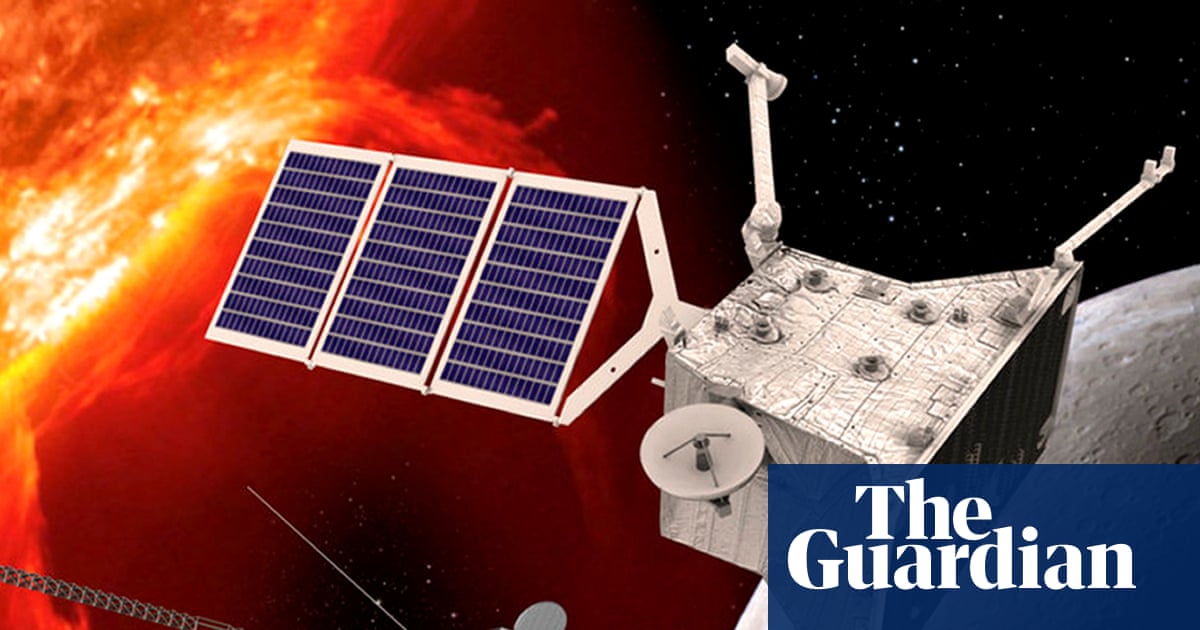
Spacecraft reaches Mercury on second-ever mission to enter its orbit
BepiColombo double probe will map planet’s surface and study its interior to shed light on its unusually large core
the Guardian
362 points · by geden · 3d ago · 123 comments
> The spacecraft are expected to orbit Mercury for about three years, after which they will run out of fuel, lose altitude and ultimately slam into the surface. “Sadly, they are not coming back,” said Bunce.
Does Mercury have significant atmosphere at the orbital altitude? Mascons? Gravity interactions with the sun? Magnetic influence? Solar wind?
> The spacecraft are expected to orbit
what's the point of not answering the question?
https://www.google.com/search?client=firefox-b-d&q=bepicolom...
> ESA later established that the spacecraft stack achieved only around 77% of the total planned velocity change but it remained safe and entered a 75-hour orbit around the planet, slightly longer than the planned 58-hour orbit.
[1] https://en.wikipedia.org/wiki/BepiColombo#Arrival_at_Mercury
I'm wondering if all the software was written with a 58-hour period in mind
I don't know for sure about Bepicolumbo but I suspect that it could, given the improvement in computers since then. The craft does have 3 star-tracker cameras to know its orientation and then you can calculate from there how much energy the solar-electric thrusters put out. Then its just some computation which I'd think it could do pretty accurately, but I don't know how much the solar-electric engine failures (which delayed Mercury orbital insertion from December 2025 to November 2026) are understood and accounted for by the spacecraft itself.
I'm 99% certain that Doppler shift and/or earth loss of signal times are used to improve the accuracy of the orbital determination to get that orbital error bars as small as possible. Because observing the perturbations on satellite orbits are our best tool for mapping mascons, so knowing the orbit as precisely has a large scientific benefit.
But more than that, good spacecraft software development principles don't have you depend on it. For all of its critical functionality, the spacecraft doesn't need to know the period of it's orbit. It needs to know "which way to Sun" and "which way to Earth", everything else can be handled remotely if needed.
https://www.esa.int/articles/about-us/directorates/operation...
The whole process requires multiple burns to refine the orbit, and as long as they didn't miss by a lot on the first burn, they will adjust the other steps.
If there was a more critical underlying issue that prevented refining it, it'd probably reduce somewhat the quality of the science since they are on a higher orbit than the one they designed it for.
How could I be unware of a mission to Mercury that's been flying 8 years, and thus planned and developed for longer? How many times have I read about Voyager reaching 1 light day, or every little milestone for a Mars rover?
The same happens with many non-NASA missions. Are others' experiences the same? Even in Europe or Japan?
(Recent faux pas: wishing somebody in the UAE Space Agency success with their Mars orbiter only to be told that they'd already achieved their objectives, and were now extending the mission for another year)
This has been a great competitive problem for decades: we do great things but we coudn't let the world know if our lives dependanded on it.
Which, in a way, they do.
Well you better start researching harder because we're roughly 3-4 years away from AI being able to construct spacecraft autonomously. Get ready for the average joe tiktok vlogs to Mars and back.
edit: Maybe there's a way if you could get an orbit where your aphelion is a close approach to Mercury and slow enough to orbit Mercury? Not sure getting into that positon is possible or cheaper than just making the burn at Mercury though.
Any non circular orbit is going to spend half the time speeding up moving towards the body it's orbiting and the other half slowing down again as it moves away from the closest approach to the main body it's orbiting.
Braking and making your orbit smaller is exactly the thing that makes a spacecraft go faster (counter-intuitively), by the result of "falling into" your orbiting body. This leads to all sorts of counter-intuitive dynamics with spacecraft maneuvering. Such as, how do you move towards a space-station to dock with it? You burn your thusters away from it. What happens in low-earth orbit (with some atmosphere) and you deploy a large parachute? You speed up.
Orbital dynamics are weird.
That sounds impressive! The delta-v needed to even pass Mercury at a reasonable speed for scientific work has got to be substantial. This is likely a real achievement! Seems understandable this is only the second time we’ve done this.
(Barely, 21.5km/s vs 21.7km/s, both figures without gravity or atmospheric losses at launch but those should be identical.)
Click on Low Earth Orbit for the start, and then click where you want to go.
For comparison, LEO to Pluto transfer is 8.3 km/s.
One of my favorites is that it's easier to reach the Sun from Earth by going via Pluto [1], in terms of delta-V. Obviously it takes awhile. But people like to say "why don't we just drop waste into the Sun?" but doing that is incredibly hard. You slow down a little from an Earth orbit and you don't fall into the Sun. You just get a new orbit.
For anyone wondering, the issue with getting to the inner Solar System is we don't have the gas giants to slingshot around like we do for hte outer solar System. The gas giants don't magically create energy. Momentum is preserved in the gas giant frame of reference but you pick up speed in other frames of reference.
BepiColumbo's orbit is kind of an amazing orbit because they had to brake around Mercury a few times to bleed speed. But the mass is so low that it took multiply flybys.
[1]: https://space.stackexchange.com/questions/39059/does-it-requ...
Not sure how long a solar sail would take as an alternative to fueled flight. For realistic sail sizes, I'd presume a few decades if you get good gravity assists (the 'thrust' seems about two orders of magnitude lower than the best ion engines, and there you can pack a handful as BepiColombo does)
After leaving earth's orbit, you're not suddenly free to turn any direction and float off to whatever you want: you're now in solar orbit. And after that in Sgr Astar's orbit. And if you were to clear any of those, your target object is probably in one of those orbits so you'd need to re-insert yourself
You can get to Mercury in months using a standard half-ellipse Hohmann transfer if you have the mass budget for an absolute shitload of fuel to burn once there to get rid of all the extra speed you gain while en route. But that’s not realistic, so both MESSENGER and BepiColombo spent years in complex trajectories that started with a few Earth and Venus gravitational assists to drop their perihelion to Mercury orbit, then many flybys of Mercury to incrementally slow down enough to finally be able to enter orbit around the planet. It’s a bit strange that the Guardian article didn’t mention that, but you can find illustrations in the usual places.
But anyone with a computer and a suitable program can plan such a trajectory, it’s not like some special secret knowledge is needed.
Does KSP model perihelion of Mercury (as measured by MESSENGER after its orbital maneuvers) or orbital resonances like the 1.5PN post-Newtonian expansion of the GR (General Relativity) metric tensor?
KSP could simulate N-body gravity and 2.5PN gravitational waves with any of a number of models: Cachazo's over Witten's SU(4) twistor string theory, QED scattering gravity, GrC(2,4)•GrC(2,4)^V gravity (with the Caret Wedge)
KSP2 unfortunately won't run in WASM in a browser tab with localstorage/sqlite for students without login.
BepiColumbo has a delta v capability of around 5km/s
The exception was the New Horizons probe to Pluto. To insure the probe covered the three billion miles during the career lifetime of current scientists, they had a very fast blast off from Earth with one Jupiter gravitation assist. This was the fastest rocket to reach the Moon in just eight hours and only ten years to Pluto. The tradeoff was it past Pluto so fast that there only a couple days of observations.
Indeed. Per Wikipedia, New Horizons "was the fastest (average speed with respect to Earth) human-made object ever launched from Earth." Even so, it took over 9 years to reach Pluto. One hesitates to imagine how long it would take with a slower but cheaper booster.
What will cause them to lose altitude?
It's not losing altitude overall in the sense of losing gravitational potential energy (due to eg drag), but rather that the orbit extends both higher and lower than it started until the lowest point meets the surface of Mercury.
Small potatoes, but can perturb the trajectory, especially if it flies through Mercury's shadow.
(for the ctrl+f'ers, it's written as 0.0007 N on https://en.wikipedia.org/wiki/Solar_sail)
Edit: I'm wondering about the shadow thing (modeling Mercury as a point mass with a shadow, just for the sake of exploring this). Intuitively I'd say that the solar wind 'brakes' you equally while you come out of the shadow but then pushes you while you go towards the shadowed area, so your orbit decays on the former side and grows on the latter, right? And same for any other orbit where you're not equidistant from the sun at all times: it'll push on that component of your motion vector. And if you were in an equidistant orbit, random fluctuations in the sun would make it imperfect (no longer equidistant) soon enough
I get the broussard ram. Jack didn't work in interstellar space but I'm wondering if the physics are different for more modest speeds, an ion drive and with a solar wind for a somewhat similar approach
I hope someone more knowledgable will correct me on these
-
In case you didn't see the sibling comment already, u/dantillberg posted an excellent reply. It's gravity in the end, but not in the way anyone is familiar with (I didn't know, and I wrote a mini simulator to get a feel for orbital mechanics) so it's not helpful to just post "gravity?". Point masses will orbit each other forever; around earth it would be atmospheric drag that gets you first; it's really unintuitive that gravity is what gets you https://news.ycombinator.com/item?id=50614344
To be more concrete: the Sun is close, its gravity "tugs" on anything orbiting Mercury quite strongly, plus Mercury's own orbit around the sun is quite excentric, which changes the strength of the Sun's gravity tug.
This all makes the orbit less stable, until its lowest point intersects the surface.