99 points · by giuliomagnifico · 3d ago · 43 comments
MRAM has been stuck in a tiny market niche for a very long time, simply because it's not competitive in anything except some space applications. Yet the small-cap stock of the titular company ($MRAM) was involved in what looked like a pump-and-dump cycle piggybacking on the RAM shortages. Their stock went from $10 to nearly $50 and then back to $10ish in a matter of weeks.
If I were to wildly speculate, articles like these may be appearing in an attempt to recreate that cycle.
As a result, for this generation we’re seeing a much-larger-than-normal step from 45 nm straight to 22 nm planar or even 18 nm FinFET, which is a huge step in available compute — but only TI is trying to do it with conventional flash, and they’re doing it at a new fab. Other vendors are using either MRAM (the subject of the article) or TSMC’s PCM — both of which are different enough from flash in behavior and performance to require significant software redesign (though mostly in exciting ways, enabling new capabilities).
This really is a big deal.
I designed in a Everspin MRAM. Had to take it back out when we learned that the small magnet, to activate a reed switch, near the MRAM would destroy it. It did not just lose a few bits, the device was forever dead. We are talking Refrigerator Magnet level field in close proximity. Everspin later went bankrupt.
Before they did I sent them one of the failed devices for analysis. They did explain the failure mechanism to me but non-disclosure that I had to sign prevents me from saying more about it.
Great technology as long as no magnetic fields are close to the device.
The Cypress, now Infineon, devices claim to be immune to this type of problem. I've not been willing to take a gamble on being burned again.
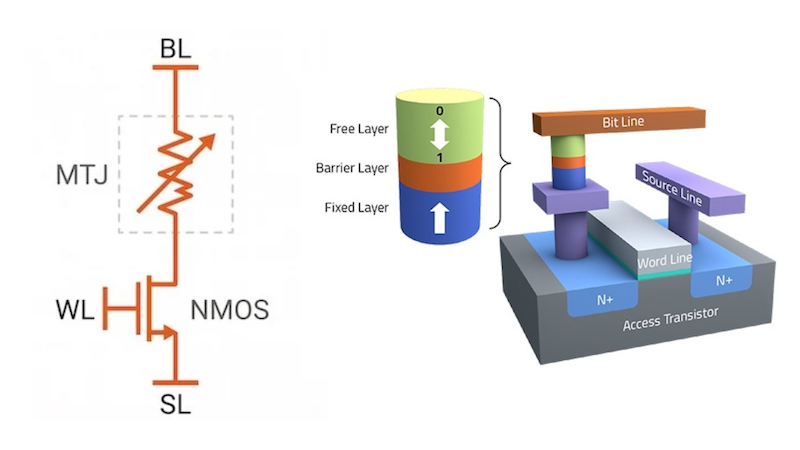
Second gen STT-MRAM used the electrons (with a spin direction) to transfer that spin to the domain to change state, so no field. My hunch is that these would be less susceptible, but hard to tell.
I've become tired of the blood loss from the Bleeding Edges of technology since then.
Weren't floppies and hard disks prone to the same issue?
There are too many lawyers in the world, I'm just being safe. It was a valid thing when I signed it.
Yes, placing embedded flash on the same die as logic is indeed becoming more and more of a problem. But replacing that with magnetic memory on the same die as logic doesn't really solve the problem either: you are still wasting a significant area of expensive die space on some weird foreign process!
Our storage demands aren't exactly slowing down. Giving MCUs several megabytes of flash is already fairly standard, and there's zero doubt in my mind that it will grow to several hundreds of megabytes in the not-too-distant future. Memory scales incredibly poorly, so the only sensible approach is to put it on a different die.
We are already seeing this hitting mainstream budget MCUs. See for example the RP235x: by default all you are getting is a logic die, but you can attach an external flash chip via QSPI. Alternatively you can go for the RP2354, which comes with a 2MB flash chip die integrated into the package itself, attached to the same pins you would use for an external one. And that's a $1.10 chip - if fancy packaging can be done at that price point, why even bother looking into MRAM?
The way this was solved with core memory on the PDP-11 was that there was a power loss warning signal (on the UNIBUS!) used to prevent any attempted reads (which were destructive) or writes during a impending power outage.
In modern servers there is a similar thing: I think you get 6 ms of warning from off the shelf power supplies. This could be enough time for nvDIMMs to work: flush the hopefully not too large cache and then put DIMMs into self-refresh (where it is then safe to bus switch them to an FPGA). Then supercaps provides enough energy to copy the RAM to flash after the power goes out.
Edit - wait after reading the article I don't get it. SSD flash works till 3nm nodes doesn't it? Then why mram for 16-22 nm mcu nodes?
This is important for cost-reducing embedded products. Even if the chips were free, bonding two chips together would break the budget. What you want is a single product that contains the MCU, the SRAM for memory, and something for storage that can hold the program, all built onto a single tiny piece of silicon, sold for prices starting at $0.025. (2.5 cents each)
I wonder if it would even work in a workstation / laptop? There are magnetic fields moving around for cooling fans and other components, unclear how stable / usable it would be for any "real world" application.
The external magnetic fields are weak and the internal magnetic fields from motors or other devices can be avoided by either choosing a distant position for the MRAM or by using a simple magnetic shield.
So MRAM is certainly preferable in any aircraft or spacecraft application, because of its much greater resistance to radiation than that of flash memory.
Also, in all other applications mentioned by you, a magnetic shield would not increase much the cost, weight and volume, as a thin sheet of high-permeability metal should be sufficient.
Most Flash memory is rated for only 10 years if temperature ranges remain favorable. The more erase-write cycles that retention leakage rate goes up.
MRAM has very limited use-cases due to energy demands, and limited speed. =3
They are a drop in replacement for battery backup SRAM, and some people retrofit old equipment with MRAM. It is a lot like a CMOS battery keeping lab calibrated settings, and the cost is negligible compared to lab service fees.
I also bought a few to test a toy processor project, and decided MRAM just isn't viable right now due to the power budget costs. =3
Strangely the article does not says anything about power consumption. Is that 0.7W/fewKB on reads or writes or both ?
https://mm.digikey.com/Volume0/opasdata/d220001/medias/docus...
Still at $0.051/kiB they can keep dreaming about consumer markets.
Note, early MRAM chips were still comparatively much better than FRAM technology. I can't believe people in these threads even brought that up... like it was ever a real option. =3