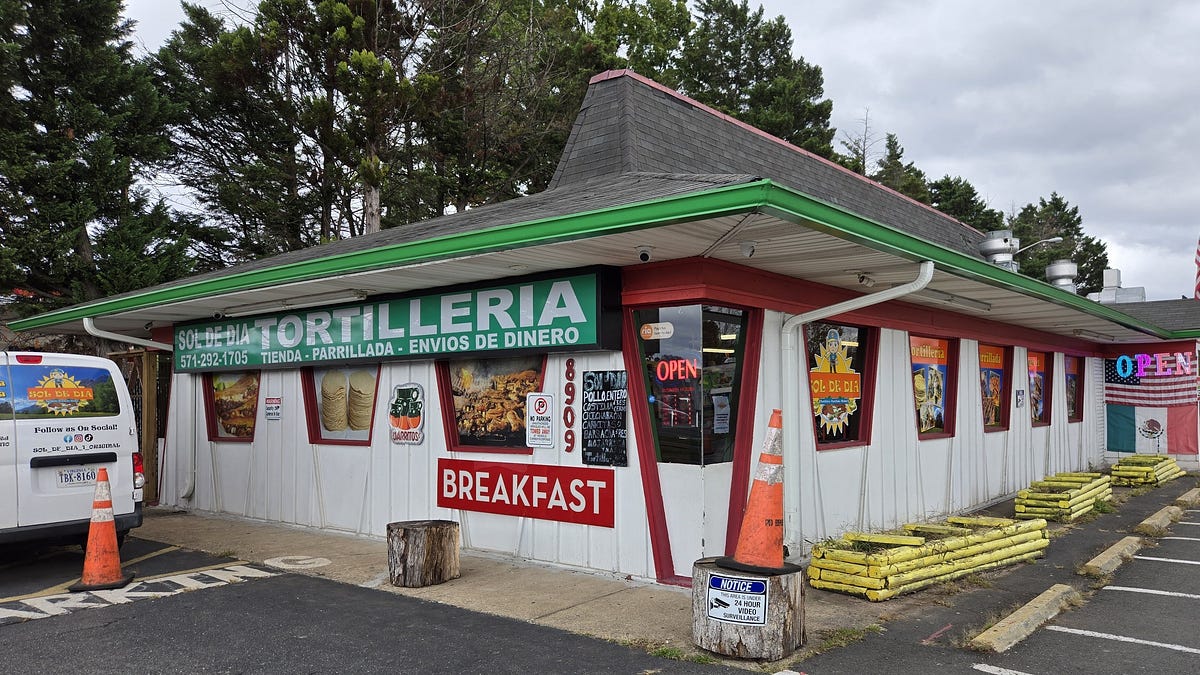
"Blight" And Entrepreneurship In Manassas, Virginia
On developing the perception to separate the form of a place from what it contains
thedeletedscenes.com
24 points · by NaOH · 3d ago · 14 comments
I think it's the last little patch of that town with cheap rent, so it's a hub for entrepreneurship.
Enatye is the best ethiopian food I've ever had, local chains Weird Brothers Coffee and Aslin both started back there, and there's a cute little French cafe with lovely sandwiches. Those massive new mixed use plazas by metro stations have sky high rent and a small local business can never afford it, so those are filled with Starbucks and Sweetgreen.
I think this is a lot of what the author of this post is getting at. Urbanism so often means gleaming expensive sterile mixed use developments, when what makes places so special are these areas where people really can start their own businesses.
I ended up moving to New Zealand, and live in a car dependent subdivision, but they put in a food truck park with a coffee food truck, a playground, and a (clean!) public toilet that's less than half a mile walk from the entire subdivision. I find NZ to be really interesting in terms of ideas for incremental urbanism that wouldn't require Americans to break up with our cars.
The built environment is superficially similar, and the roads are filled with Ford pickups, but there are sidewalks absolutely everywhere and networks of trails, and some kind of cafe and often a small grocer within walking distance in any subdivision. Maybe it's all a bit like Reston with less opinionated architecture, but it's the whole country.
I think people often look at Amsterdam and other dense cities that are on a complete opposite spectrum from American suburbia and don't realize the middle ground that exists, and that could be a much easier sell to the average American. Kiwis are also obsessed with owning single family homes, but those homes are knit more into communities.
The article makes a more interesting point. Those cheap old buildings help people start businesses. They haven't been fully rent-optimized to the point only large national chains can afford the rent.
The subtitle here seems to be going out of its way to sound like Baudrillard. That is a very bad choice, Baudrillard one of the worst writers I’ve encountered in philosophy. He’s also a terrible philosopher, and I think the bad writing is what helps him get away with it. He writes shit like “The territory no longer precedes the map, nor survives it,” and it's very hard to know what that even means because it's said in such a profoundly stupid way. This article isn't stupid, and it doesn't need to hide what it is saying like this.
It takes a lot of self confidence to say "I don't understand what this means" and brass balls to continue on "and I don't think anyone else does either". I think we are trained to try to find something that makes sense at some level when reading philosophy, if you are learning then a book shouldn't make sense the first or second time through, and it's easy to assume you just don't get it.
The insight that a place is different from what it contains dates back at least to Aristotle’s Physics, Book IV.
> The existence of place is held to be obvious from the fact of mutual replacement. Where water now is, there in turn, when the water has gone out as from a vessel, air is present. When therefore another body occupies this same place, the place is thought to be different from all the bodies which come to be in it and replace one another. What now contains air formerly contained water, so that clearly the place or space into which and out of which they passed was something different from both.
You are doing a good job of illustrating my complaint, though, because your Aristotle quote is not really on topic.
Aristotle’s question is what stays the same when the contents change? First there’s water in the vessel, then there’s air. Both occupy the same place at different times, so the place must be distinct from either substance. (The usual deep insight from Aristotle lol) Neither this article, nor the subtitle I'm complaining about, are wondering whether 'it is the same place' when 'the contents change.' It is more that 'appearances (form) can be deceptive' and 'what appears run down may actually be thriving (contain a thriving community).' The subtitle says it so obtusely that it's not surprising you misinterpreted it, and that lack of plain meaning is what I am addressing.
In the Aristotle setup, it would be comparing a bottle of water to a bottle of vodka, and the article would be saying "they look the same" but "here is how to tell the difference: open the bottle and taste what is inside".
Let's say the Aristotle quote was on topic: then you are agreeing with me even more strongly because Aristotle said what he said very clearly.
Not much more to say at this point. You’re interested in philosophy, modern or ancient, only insofar as you can mock it.