How a Mechanical Watch Keeps Time (Interactive 3D)
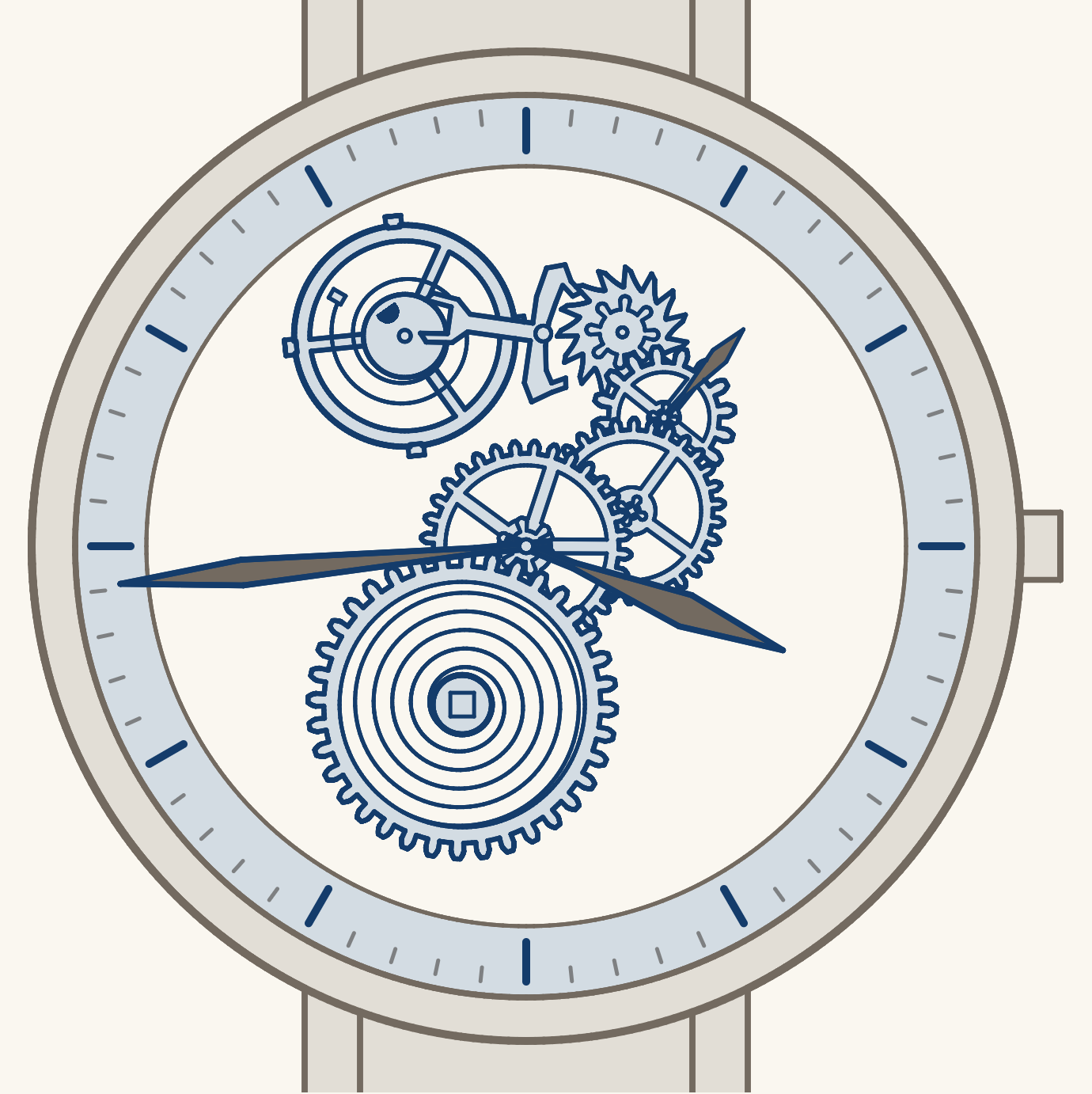
How a mechanical watch keeps time, piece by piece: the hairspring, the balance wheel, the escapement and the gears, in live figures you can step through.
martincmartin.github.io
198 points · by martincmartin · 2d ago · 51 comments
Now if you ask the AI a specific question about the energy flow in this system, the AI will immediately answer what it got wrong: the balance wheel needs to have the energy replenished every half cycle.
And for that to happen, the pallet fork must have a) jewels and b) a specific shape to give a tiny push to the wheel once a tooth is unlocked. [1]
[1] https://upload.wikimedia.org/wikipedia/commons/7/75/Palettea...
Also, the AI didn't make the decision not to include the proper shape of pallet stones, I did. It kept pushing me to explain how the energy flows to the hairspring, and I was adamant that was out of scope for a "101" style explanation.
You can clearly construct a sentence, yet instead of writing this yourself, you argue with an LLM to get it to output the text you want - which I am absolutely certain you would have done a much better job of.
The writing is just... horrible. All AI generated writing is. It's full of things that almost make sense, but just don't. "The wheel slows it to a pace that the gears can count."
Gears don't count. This makes no sense. Maybe it slows it to a pace that allows the mechanism to keep up? That would be a better way of putting it, don't you think?
"Before we go on, something that trips people up until they think it through. How long does the second hand take to go once around the dial?"
Excuse me. Nobody is tripped up by this question. It takes a minute. This section should just be removed, it adds nothing.
You mention jewels. But not why they are jewels. I presume it's for their longevity and resistance to damage, but you (I mean the AI, pardon me), don't bother to mention why.
You could, if you wanted, discard the AI entirely and write, yourself, a far better introduction and explanation to how all of this works. The AI is pure laziness, and always results in a much worse outcome. Always.
This sentence was entirely mine (most other sentences that people have picked out as Claudisms are actually from Claude and in retrospect I'm embarrassed that they made it into the published piece.)
I added this short section because, when showing the associated talk to my son, he said "wait, you said the second hand, but then you said it turns around once a minute?" Or maybe it was the minute hand revolving once an hour, but either way, I saw it confuse the first person I showed it to, and it seems like it could confuse others. You can argue whether I should have included it, perhaps I over fit to a single data point, but if I had written the entire thing myself, that section would be there. AI had nothing to do with thinking of it or deciding to insert it. Perhaps I should make it shorter, or just a paragraph rather than a separate section.
You mention jewels. But not why they are jewels. Yes I could have expanded on so many points and made this much longer, but was trying to focus on the basics for people who had never seen watch mechanisms before. Perhaps I was wrong to introduce the term jewel without a full explanation.
For the record, reducing friction is arguably the biggest one. There's whole fascinating story about energy, the amount of energy in the mainspring is tiny yet can power the whole mechanism for 40+ hours, and reducing friction, as well as energy lost when the roller jewel knocks the pallet and then the pallet knocks the roller jewel, is fascinating. But that's definitely beyond the scope of this work, maybe some day I'll create a "201" blog post, I promise to be better about making it my own voice!
You could ... write, yourself, a far better introduction and explanation"
Thank you for your confidence!
Edit:
you argue with an LLM to get it to output the text you want
No, Claude wrote the first draft, I edited from there, I'd ask it (and other AIs, and actual humans) what was good and what could be improved, I'd edit based on its suggestions and my own ideas. So I wasn't getting the LLM to output the text I want at all.
I also wanted something that would focus on the basics for an audience who had never seen this stuff before. The Bartosz page is great, but it goes into a lot of detail on all sort of stuff that can be kind of overwhelming on a first reading.
The post from Bartosz Ciechanowski is a master-class, the first time I interacted with it I was enthralled for almost an hour. I don't know that I would even TRY to create a similar post.
Feels important to mention that there's an elite version of this somewhere in the post...
It seems unfair to the author to criticize their work when the commenters didn't give the page a lot of their attention.
Still, I'm happy with how it turned out.
Or was there something else that made it seem artificial?
Full disclosure, I did use AI to help create this, but it's about as far from slop as possible. I created the outline for the talk and the topic of each slide before engaging AI, and would fix some code by hand, although I'm a systems programmer and not front end, so it mostly handled that.
Fun story: the second script it made, to generate the watch model (at the time it was an SVG, I later decided to convert it to WebGL), it kept the data in a dict, e.g.
  TEETH = {"center": 46,
           "third": 38,
           ...
           }
I asked it why it did that, and it said "Oh I followed the style of your other script" which was a throw away script for an experiment. I have no idea where it learned this style, maybe lots of throw away code in its training data, or code written more by scientists/mathematicians rather than software engineers? I'm genuinely at a loss. So I created my first coding agent skill, a Python code quality skill, that starts with "if you're using dict literals with string literal keys, consider a dataclass or class instead."
It did write the first draft of the text from my notes, but none of it was in my voice, and it emphasized all the wrong things so I rewrote it all. I'm sure an AI phrase or two slipped through, but it's about as far from slop as AI assisted code/writing could be.
After unlocking, the tooth of the escape wheel needs to press against the pallet, which will press against the impulse jewel, to add some energy to the balance, otherwise the balance will come to a stop.
It would be good to be able to slow down the animations to check this.
The escapement really has two jobs. One is to limit the rate at which the mainspring can unwind, and the other is to supply energy to the balance so that the balance keeps swinging.
(Source: I have spent a lot of time designing clock and watch mechanisms, I wanted to make my own wristwatch but eventually gave up, some notes in https://incoherency.co.uk/blog/stories/the-watch-project.htm... - here's the best model of my escapement that I made: https://www.youtube.com/watch?v=NW2_8KEqEEE )
I thought of talking about how the pallet stones slide along and are actually pushed by the escape wheel's teeth, and therefore accelerate and knock the impulse jewel. But that would have involved slow motion and zooming in, and felt like an extra level of depth beyond the basics, like a "watch mechanisms 201" where this was 101.
Also, while showing an early version of this to a friend, and pointing out the impulse to the jewel, they said "wait why do you need that, the hairspring oscillates on its own?" I pointed out that with friction it would stop before long. Bringing friction into all parts opens up a can of worms where you want to talk about lubrication and jewels where the arbors contact the main plate, and that was definitely beyond what I was aiming at here.
As it stands the article basically acts like the balance works by magic and is liable to confuse readers in my opinion.
I understand the negative reactions but if you're interested in watch mechanisms I found it useful.
There's a local group of friends that gets together every few months, and I wanted to explain my fascination with watches to them. I got a 3D printed plastic model, but it was hard to explain why e.g. the hairspring moves back and forth (we don't think of curved objects doing that, we're more likely to think of straight objects being back towards straight) and that the mainspring was pushing things (I would bend the escapement out of the plane so the mainspring could run to show them). I thought of projecting Bartosz's page, but I'd have to hunt around in it for the specific things I wanted to show, so I decided to make a "quick" presentation, and then it just got more and more elaborate lol.
Nowadays there's also the danger that time invested reading an article is wasted but I think that doesn't apply here.
Early clocks and watches weren't very accurate, didn't even have a minute hand because they gain/lose hours per day.
How a mechanical watch works (1949) [19 minutes]
One thing I am missing though - the part where the escapement wheel pushes the balance wheel to maintain its oscillations. Always seems a tricky part to me.
I enjoyed this web page, I've known that watches have a mainspring and gears for a long time but it's never been clear to me how they maintained their rhythm, surely when the mainspring is fully wound it holds more energy so the clock should spin faster!
I've read some of your responses in this thread and found it interesting how confusion about that mechanism was your inspiration! You also mentioned that you were a teaching assistant, that your writing style was short and sweet, that you wanted to introduce the basics to a new audience and that you used Claude to help write the article before feeling forced to rewrite it.
Unfortunately I found it a little difficult to read, focusing more on the graphics/animations. It's difficult to criticize because while you may have rewritten parts you felt were unclear it's hard to be sure what parts of the writing/structure are holdovers from the first draft. Claude likes to repeat itself and jumps to use analogies, when the article went from a ice skater to a child swinging on a swing to describe the balance wheel's motion it seemed to be unfocused. People normally stick to one analogy as to not confuse or overwhelm the reader, it's mostly small nitpicks like that which made me want to skim as opposed to read the article.
I did learn how a hairspring works though! But I did learn it only after reading the comments in this thread and referencing the ciechanow.ski article for holes in my understanding.
The critical piece of information that was missing for me was how the hairspring maintained it's momentum over long periods of time. Your article uses the example of a diving board swaying back and forth, but over time a diving board will return to it's resting position.
You even ask the user to manually coil the spring to observe it's motion, implying to the reader that the spring is manually wound. This is the hairspring though, not the mainspring, most watch designs I'm aware of don't have two separate winding wheels. You did mention the balance wheel provides balance and inertia, but this was done while talking about the periodicity of the motion, without implying that this helps feed energy into the system.
Bartosz Ciechanowski's article also almost doesn't mention it, however after the mechanism was explained and when going into detail about the hairspring assembly it's stated "When the watch is shaken, the motion of the shaft is absorbed by the spring, similarly to the suspension system in a car.", which explains to me why the hairspring isn't a perpetual motion machine.
Why the hairspring can be wound with motion while the mainspring has to be manually wound still requires me to understand it's a lot easier to stop several gears from turning than it is to provide enough energy to turn them, but that could reasonably be left as an exercise to the reader.
Ciechanowski did highlight something similar: "The barrel itself turns quite forcefully, but at the escape wheel, the torque is greatly reduced, which prevents the escape wheel from pushing the pallet fork and thus the balance wheel with too much vigor.", but this focuses more on why they don't interfere with each other rather than why one requires manual intervention. (Although that was also on my mind)
Either way I'm glad you prompted me to learn more about this topic I care about, and that you linked: https://ciechanow.ski/mechanical-watch/ as a reference early on in the article for people who wanted to learn more.
If I was to give you advice I'd suggest just leaving Claude out the writing room, short and to the point is a simpler writing style and is something most people enjoy reading. Without planning your writing and putting yourself in the shoes of your target audience, it can back fire on you. Ciechanowski was a far denser read but I enjoyed the parts I read more, the writing felt intentional, feeling more like they were talking to me rather than explaining several things in isolation, with little touches throughout the text like coloring the parts they're talking about to lower the cognitive load of the text on the reader.
(Rereading this ironically the first two sentences of my last paragraph coincidentally read very much like they were written by AI, the more of it we read the more it become normalized I suppose.)
it's hard to be sure what parts of the writing/structure are holdovers from the first draft.
To be clear, I read over the whole thing many times, and if I decided to keep something that Claude wrote, its because I thought it was appropriate. So, all blame should go squarely to me.
It's a good point that switching analogies is confusing, each one takes effort to wrap your head around, so finding one and sticking to it is better than introducing a new one for each point.
Leaving out the "how a hairspring keeps swinging", and friction in general, was a conscious choice to focus on the basics. More details in this comment [1].
Shaking the watch is actually not what restores energy to the hairspring. If you look at Bartosz's Balance section [2], the fifth illustration, he mentions "escape wheel unlocks and pushes the jewel of the pallet fork," that transfers energy from the gear train (going train, ultimately from the mainspring) to the pallet fork. Then slide it a little more, "pallet fork pushes the jewel roller and the balance wheel," that transfers the momentum of the pallet for to the balance wheel, keeping it rotating. It's complicated and hard to understand, because first the roller jewel knocks the pallet fork, so the jewel is in contact with it and pushing it. Then very quickly, the escape wheel pushes the pallet, accelerating it so the other side of the fork now knocks the roller jewel. It's complicated, happens in a tiny fraction of a second, and is not very intuitive. It also took several centuries for watch makers to settle on this design, but it's very energy efficient, minimizing energy lost to friction.
With the feedback from this entire comment section, I agree with not having Claude write anything at all. I've learned that I'm not as good at getting rid of Claudisms as I thought, and whether or not they're helpful in explaining things, they're distracting to people who notice them.
Thanks again for your thoughtful and detailed comment. Comments like this are why I engage in writing at all, and they help me become a better author.