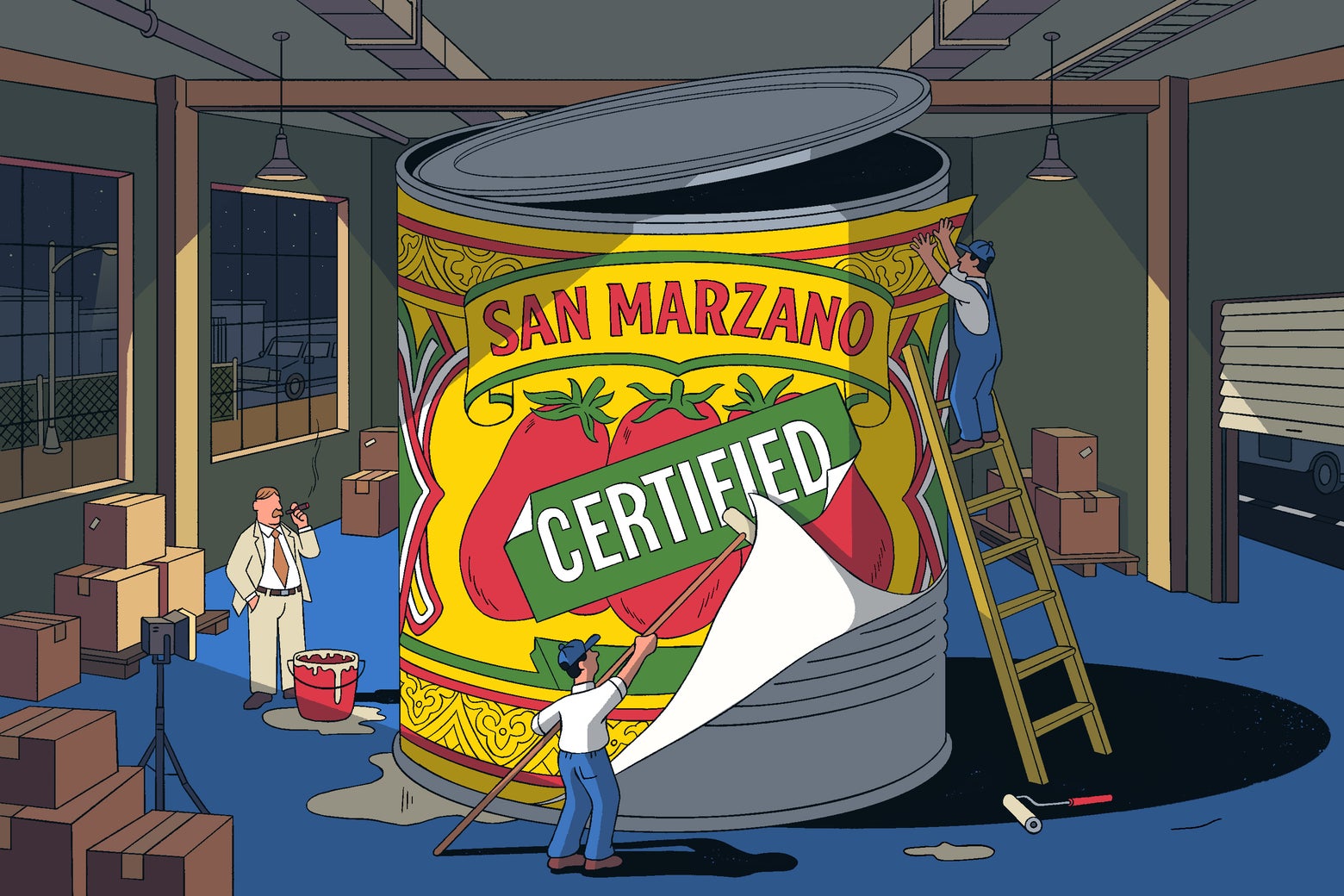
Two Californians Are Suing a Major Fine Foods Brand for “Tomato Fraud.” Their Claim Is Juicier Than You Might Think.
A simmering legal drama may be about to boil over.
Slate Magazine
80 points · by ncr100 · 2d ago · 124 comments
…but: The 3$-8$ range seems insane for me. Is this normal? Or are we talking “premium city prices”?
2€ (2,19$) is the good stuff, but you get decent canned tomatoes for 1€.
Usually I've had that conversation over parmigiano reggiano, which is mentioned in the article.
It gets even more dramatic when you cut out the deep rural areas of the US that Germany doesn't really have.
I also understand that imported premium groceries kissed by the sacred earth of an italian volcano are in the upper price range.
Though whenever we can, we use the fresh ones my farther in law grows.
Nobody wants “perfectly good” truffles or “perfectly good” ham, they just settle for it. If you’re looking for a globally premiere ingredient, then something at that tier would be incredibly disappointing.
In the US, you can definitely find extremely affordable, perfectly good tomato cans, but avoided. In the comments here you will see that large cans can be found for under a dollar.
Adding calcium chloride to tomatoes is done to keep them firm in the can and not deteriorate into a slushy red goo.
However, calcium chloride prevents the proper softening of the tomatoes under heat, making it take a longer time to cook a red sauce from scratch.
No offense meant but every once in a while I read something like that about the way things are in the US and I'm just stunned. How does that sort of thing just happen? Who even asks for tomatoes with citric acid?
People who don't want botulism?
> From a food safety standpoint, Blakeslee said tomatoes require acidification, which means adding acid to increase the acid content during canning.
> “The natural pH (acidity level) of tomatoes – no matter the variety or color – is at or above 4.6,” Blakeslee said. “Therefore, many tomato varieties are low acid foods. While they might taste acidic or have a sour taste, the actual pH measurement is the true indicator of acid content.”
> What that often means for canning tomatoes is that bottled lemon juice, citric acid or vinegar must be added.
[1] https://extension.k-state.edu/news-and-publications/news/sto...
Unfortunately canning requires heat treatment of the item (followed by cooling and vacuum pressure). Since we all know what happens to tomatoes in a hot environment, they can’t be canned to be washed :(
SMT are indeed watery and tasteless.
Cento were notable mostly for their inconsistency. Some cans were good, some were not, and reviews were similarly all over the place.
The best were from Wegmans and cost $4.
The real ones are quite good. Not at all watery or tasteless.
I wonder how much is age of the can, harvest time for the tomatoes and quality of the harvest/season, etc. The cheapest definitely seem to have an impact on quality, though.
My recipe (and care about SM tomatoes) is a linguini with sauce:
- Ready in 30m. INGREDIENTS: 1 can SM tomatoes chopped, with garlic, olive oil, 2 tsp capers, 6 black olives, 1/8 tsp red pepper flakes, and 1/2 tsp oregano. HOWTO: Cook linguini separately. Cook garlic / oil / pepper first for a minute or two, then add the rest and cook. Serve with cheese and crusty bread.
Usually I find domestic Hunts tomatoes to be good and consistent. I don’t have a Wegmans, but my local Italian stores carry Cora and other imported brands which are usually great.
SMT San Merican Tomato Whole Peeled Tomatoes
It's just marketing, use the ones that taste the best. I've definitely bought these fake ones.
Hey, a can of tomatoes from a class action would put it in a top-3 class-action payouts i've gotten.
Selling San Marzano, the cultivar, is illegal in the EU, as it is covered under their PDO/DOP laws due to being named after the location. Wild, right? You cannot label them as "San Marzano-style" in the EU either. You can sell them only as generic plum tomatoes, which they are not when grown correctly.
What makes San Marzanos what they are is they are neutral pH cultivar that can grow in the rich volcanic soil of Mount Vesuvius, and maintain the desired taste and texture when grown in minerally rich neutral pH soil anywhere in the world; however, if you grow them in acidic soil meant for tomatoes, they do indeed turn into just normal tomatoes and are indistinguishable from any paste tomato. Real San Marzanos grown correctly are less acidic tasting and sweeter, but also cook amazingly into a sauce, unlike any other paste tomato I've tried.
Italy has attempted multiple times to enforce their laws on American companies that largely sell to American customers, and have attempted to prosecute Cento more than once (which Slate does talk about in the article, but is unusually biased in favor of Italy).
In the US, it is legal to sell "San Marzano-style" in the US, and vary in quality: some brands are San Marzanos but are grown in tomato soil (thus taste like any paste tomato), some brands are not San Marzanos but a different cultivar that has partial San Marzano genetics and was grown in neutral pH soil (thus taste like a San Marzano). San Marzano-style does not need to be grown in Italy.
Cento does something clever: they source their San Marzanos (the cultivar, not the DOP) from farms on the other side of Vesuvius that is outside of the San Marzano DOP region, in Campania. This is important because you can buy DOP designated San Marzanos that are not grown on Vesuvius, and these tomatoes lack the intended San Marzano taste, but are fully legal!
The San Marzano Cartel (known as the Consortium in the Slate article) has been trying to sue anyone involved with Cento to close this loophole, including trying to fine and close down any farm that is doing perfectly legal business: the Italian farms outside of San Marzano can grow whatever they want and sell it to Americans without violating DOP laws. Also, since Cento left the Cartel, they quit selling DOP cans altogether to focus entirely on their San Marzano-style export product, since the Cartel complained it was confusing for consumers that Cento sold both DOP Marzano and Marzano-style (I think their DOP Marzano was worse than the Marzano-style).
The article mentions SMT sucks, and they are correct. They are a little more watery than other brands, and are harder to cook down into a sauce (probably because of the citric acid and calcium chloride). Also, Muir Glen is a lot of people's favorite, and used to sell a San Marzano style. I never liked it, and I do not understand the fascination.
Delallo's DOP Marzano is probably the only one on the shelf that is better than Cento's imo. Like, even having DOP labeling doesn't mean your product is good! Colavita and Muir sell DOP Marzanos and are no better than Cento's, while costing almost as much as Dellalo. Pastene's DOP Marzano is also good.
I have been told Kirkland's DOP Marzano is also as good as Delallo's, but I don't live near a Costco.
Is this not it? https://www.eataly.it/p/pomodoro-san-marzano-dellagro-sarnes...
Completely with you. Every can of Muir Glen whole tomatoes I've used in the last decade has been greenish, hard, and tasteless. And yet I see them on recommendation lists all the time.
For the instances where I need that "fresh" tomato taste, passata is becoming widely available at my local grocery stores.
Even when it comes to preserved foods, it pays to do a little taste test between brands to find the right mix of flavor and value.
In the USA, there is a far greater variety in the products you are legally allowed to apply the "Parmesan" title to - there isn't the same restrictions on ageing, milk treatments and additives etc.
The DOP label in the US at least ensures the cheese meets the European definition on the cheese. I have no doubt great Parmesan can/could/is being made in the USA, its just that most of the time the stuff you pick up in mainstream supermarkets that is not DOP labelled is rarely this.
This is almost entirely wrong for canned tomatoes, which are almost always superior to fresh for sauces. This isn't even secret knowledge, ask your AI about this. Fresh tomatoes are bred for totally different characteristics and qualities than sauce tomatoes, which need to be canned as quickly as possible after harvesting.
I don't know why people always say this.
Canned tomatoes are almost always superior to store bought fresh tomatoes for sauces. Because most tomatoes at the grocery store are terrible.
But grow your own tomatoes (or spend fortune at the farmer's market) and you can absolutely make a sauce that meets or exceeds that made from a can.
EDIT: As another has noted in this thread, things like managing your soil pH and likely all sorts of other factors also matter. Can you be sure you (or your farmer) are doing all this, and correctly? Real DOP handles this all.
It isn't like this is a controversial thing I am saying, plenty of professional chefs agree with me. In general, good canned tomatoes make far superior sauces to almost all fresh tomatoes, and are also available year round. If you are in the very rare case where you have access to fresh tomatoes of the right kind, well, then, great! This is not most people most of the year in most countries.
If you give me non-sauce tomatoes fresh from the vine, nope, still almost always worse than the proper sauce tomato canned (though I'll make an exception for certain cherry-tomato sauces).
It’s not only Italy taking this seriously. And these are not certifications of quality; they are certifications of origin and method. So in a sense they guarantee the quality floor, but indirectly by putting constraints on the ingredients used and on the methods of production. But it does not mean that basically the same product, made in conditions or locations different enough that they don’t get the certification cannot be better. Also, some certifications are stricter than other in terms of what they allow.
For example, I really like Roquefort, which is a PDO that is strongly enforced. I think that even the most basic ones are quite good. There are several other blue cheeses made in other villages of the region and that are just as good or better, but they are outside the PDO.
The parent mentioned champagne, which is a bit similar: there are several sparkling wines made the exact same way but outside the PDO, and those can be fantastic as well, much better than average champagne.
If adhering to certain standards does not count as enforcing quality, then what does?
This is not always true, the geographic conditions of the area the food is grown in can be a large part of the taste. This is especially true of tea leaves, which have no local fresh version. (Not that I would want my tea leaves fresh anyways).
>Even when it comes to preserved foods, it pays to do a little taste test between brands to find the right mix of flavor and value.
That I can absolutely agree with.
> Implausible indeed, but a New York judge dismissed the case, citing that your average person wouldn’t expect San Marzanos to be labeled with the Consortium’s DOP seal: “Here, while there may be ‘some few consumers’ who expect that a San Marzano tomato must be certified by the Consortium, the Court concludes, drawing upon common sense and common experience, that the vast majority of reasonable consumers expect no such thing. It is much more likely that consumers expect tomatoes grown in a region of Italy.”
Fraud or not, this cannot be a serious legal decision, right? Forget political activism from the bench, this judge must have a pantry full of tomato cans stuffed with cash.
Who even wants San Marzanos? You can buy fresh Jersey Devils for much less money, or canned.
Bianco DiNapoli for example
then why did they have to steal an established excellent specimens name, with recognition and history built in, and potentially tarnish an otherwise excellent product?
probably because the tomatoes are merely the same, and taste is entirely subjective, so just suggesting something may be better on the can is enough to trick your mind into making it so (placebo)
the producer optimizes for the larger market
But yes of course, plenty of people have fairly insensitive palates, or just don't care. If you do care though, the better quality is very much worth it.
You can solve all of things and make cheaper tomatoes taste the same. Too acidic? Add Sugar. Too thin? Reduce. Not flavorful enough? Add concentrate(tomato paste).
I now buy Great Value brand canned whole tomatoes and that tubed basil paste assuming I don't have fresh basil growing actively in my hydroponic garden
Execpt its not just food. Well, this is about Scam Marzanos versus San Marzanos. But most goods have striated pricing, and its basically "terrible dont waste your money", "mediocre but gets job done", and "laughably high but appears to be perfect... appears".
And if you dont do enough research, you find out that they took the same shortcuts and "cost reductions" that make the expensive thing also just as failure prone and cheap, but gilded.
I had to get a new can opener, since the previous plastic/metal one fell apart. Turns out the new apparent metal one was just a metal COATING and still shit plastic. It too fell apart in a month, conveniently after losing the receipt. I, instead went to the antique mall to a cooking booth and bought a 1960's can opener. Its been working for years with no failure end in sight.
And honestly, the whole country feels like this. Im sick and tired of it. Id like to help fix it, but those with money caused it.
Described here: https://www.reddit.com/r/BuyItForLife/comments/j2qvnq/someth...
I feel the same way much of the time. Ironically, it is exactly this perceptible but difficult to measure loss of quality that fuels much of the desire by older people to "go back to when things were better", even though it was largely their generation's decisions that lead to the current situation that emphasized short term (and long-term) monetary gain over product quality. For what it's worth, there used to be a great Reddit before it was somewhat ruined post-AI, called Buy It For Life, and was a fairly good source of information on what to buy. I've also found that antiques for hand-operated tools to often be superior. That's not always the case though, I'd prefer modern German-brand hand tools over antique US brand hand tools, because materials science has actually markedly improved since the 1960s, we just choose to also push the margins in most products to save costs, but in tools its more about strength and this is reflected in premium brands. Not much beats old school scissors and can openers and the like, though. May need restoration and sharpening, and will require maintenance, but will work forever.
I don’t understand: ultimately it doesn’t matter what’s on the label when you can LITERALLY taste it yourself.
Unless people trust labels more than their own senses. But who would do such an idiotic thing?
Not at the grocery store I can't.
Is this not how every engineer approaches buying any product? I feel like I'm talking to my teenage son.
You'll achieve better results by cooking according to taste rather than labels. There are no magic foods or ingredients.
Luckily you have tremendously sensitive tastebuds and sense of smell. And you can develop better sensitivity to your body's nutritional response.
Stop worrying about magic foods and labels. They are impossible to enforce. Even the guidelines allow for a margin of error in recording macro and micro nutrients.
To be clear, I'm Greek and our EVOO beats the pants off both Italian and Spanish, which may have a better name but in my experience is not worth the label. The olive oils that Italians buy from us cheaply are cheap because nobody in Greece deigns to put them in their salad, although of course they are used by corner-cutting restaurants.
Anwyay if you want good quality EVOO, buy PDO Greek EVOOs like Kalamata, e.g.
https://www.iliada.co.uk/products/iliada-kalamata-pdo-extra-...
Or really anything that says in Greek that it's exclusively from olives and extracted solely by mechanical means. If it says "korneiki variety" even better.
The time to first paint. The lazy-loaded images that load too late. The numbered lists, the fonts. How on earth did a food company build such a Claude-y page??
Everything else is you trusting every single person in the supply chain that touched whatever product is in front of you.
Might be easier to trust a neighbor or local farm where you can see the process, but it’s trust nevertheless.
I wouldn’t trust any parm that isn’t in a hard block form at this point, as all other versions are adulterated with cellulose or other packaging modifiers and stabilizers
Eventually everyone is going to have a mass spectrometer at home to verify quality.
The kind of tomatoes you want for good sauce are totally different, and are picked fresh and put straight into the can. You cannot "learn how to pick these" beyond simply trying the different companies cans (or trying to get into arcana about specific lot / batch numbers implying harvest dates), because you cannot inspect the tomatoes inside.
So sauce tomatoes are an exception where you can't really "learn how to pick best ones" by look or feel, it really does come down to total solids and other quantities that aren't visible or feelable until cooked.
I rather no tomatoes than flavorful ones produced by slaves or tainted with bpa.