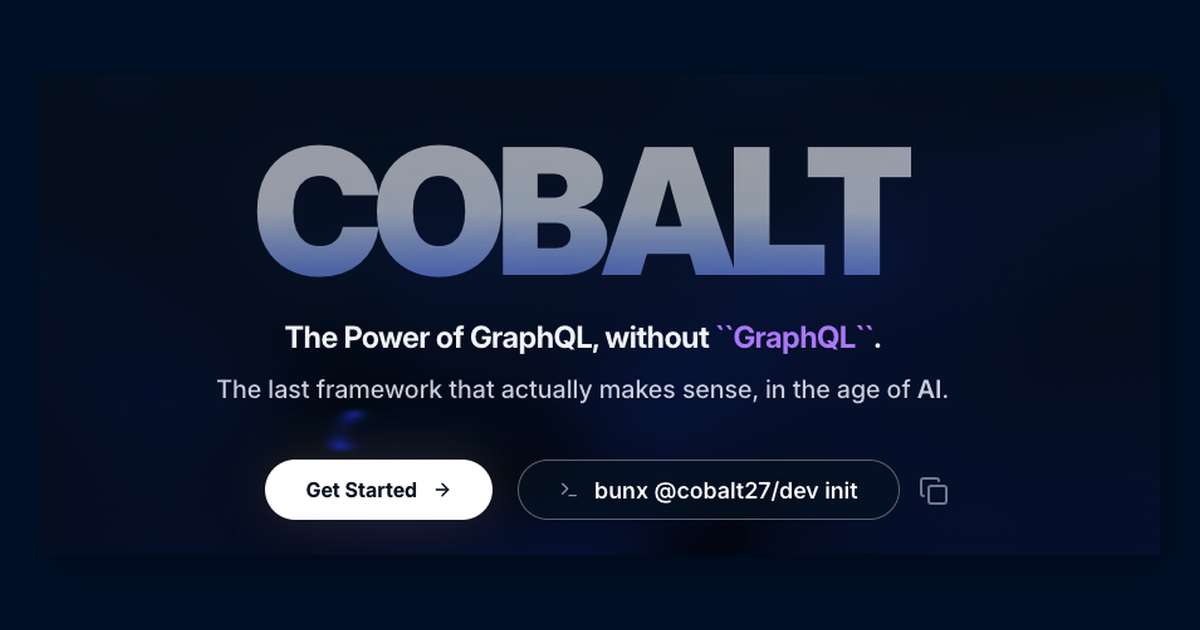
Cobalt — GraphQL from TypeScript, without writing GraphQL
Cobalt infers a GraphQL schema from your TypeScript resolvers and generates a typed SDK. No schema files, no glue code. Open source, powered by Samarium.
Cobalt
62 points · by Shoetp · 22h ago · 47 comments
But over time I've come to realize that those features aren't all that helpful. More fixed and static responses are much easier to manage. They force the caller to do things in a performance oriented way for the backend. And, importantly, all telemetry is based on CRUD/REST style endpoints. You lose a lot of that if you just have a GraphQL endpoint. It makes it supremely hard to see how you are being called or what you can drop.
It's flexible, but it adds too much undo complexity to a system that adopts it.
Well thought out REST endpoints organically grown as usage is required or observed trumps hyper flexible endpoints created because "Who knows what the user might need". And particularly in the age of LLMs and AI where adding and deploying new endpoints can take hours rather than days. Or making/updating a client for a service is extremely fast, there's just no reason not to go down that route.
> Well thought out REST endpoints organically grown as usage is required or observed trumps hyper flexible endpoints created because "Who knows what the user might need"
The issue with having all those endpoints is that you start waiting for one endpoint response before calling another, and that adds a lot of latency for end users.
I don't see telemetry as being a problem for internal use. Just log operation names instead of endpoints (and enforce unique operation names, which you can do with Apollo's operation manifests). It's also pretty easy to move off of it when all your callers are internal: just turn the operations into REST endpoints.
I do agree that AI fixes the "our backend team can't add project count to the companies endpoint for two weeks" problem, and that GraphQL was often chosen for no reason.
the whole argument of frontend changes is weak but when you got massive number of api clients (customers) then yeah since they can use a version of your api on their own cadence.
Of course, this is valid reasoning up until the point where you end up with a REST API with a comparable amount of complexity. If you end up with REST endpoints that accepts params for which fields and nested relationships to include in the response, then you've got most of the complexity of GraphQL.
I worked in an org that introduced a GraphQL gateway that was mandated to be the only point of contact to the backend. That was literally the only way to get backend developers to provide god damn types consistently.
Sure the same can be achieved with OpenAPI, but the GraphQL gateway _forces_ it, you can't work around it, you can't be "we are too busy now, we will do it later" or "it is just a POC (that ends up in prod)". It doesn't help that OpenAPI is terrible to use in some runtimes (like Go) and most people who actually do use OpenAPI don't validate _every_ request/response against the spec before processing it.
GraphQL in this regard got it right, you either conform to the spec you created or you GTFO.
Another big thing is consistency in implementing "long-running queries" (GraphQL subscriptions) since there is no standard for this kind of stuff in the non-GraphQL-world it ends up with an org having dozens of different ways of doing subscriptions each with its own bespoke authentication/authorization madness.
This comment illustrates quite clearly how naive GraphQL boosters are about prior art.
REST isn't a spec, it's a "philosophy" with no normative implementation. There are specs based on REST though, so use that if you want to. But I'm personally not going back to pointless debates about PUT usage or idempotent bullsit... which is why I use GraphQL.
Of course, GraphQL was, quite explicitly, intended to be a layer over the CRUD/REST-style endpoints. It is interesting how it tried to become something else once it left the hands of Facebook, but I guess that's par for the course when few have Facebook-type problems but like to latch onto trendy things.
> And particularly in the age of LLMs and AI where adding and deploying new endpoints can take hours rather than days.
GraphQL's main value proposition, when humans were still writing code, was providing a map of all the services in the organization to even know what was out there available to use. In a large organization it is easy to not realize that a service exists at all. LLMs can equally benefit from something like that.
You could enforce this in a REST JSON API, of course.
GraphQL was built for the needs of Facebook, not a one man band. A product of Conway’s law.
If you're not schema-first, I can see the issue. But then why aren't you? Code-first is a lot of extra weight to carry unless you're getting into icky meta-programming territory.
(I guess on reflection what it comes down to is that I don't really see the point of GraphQL if you're not going schema-first. If you are, and you have a modestly complex API, I do.)
The classic example is user passwords. For the database schema, it makes perfect sense to store the password hash alongside the user's other details. For the front end, it's positively dangerous to return the password hash when all the front end needs is the user name and avatar url.
I think part of the attraction of GraphQL was being able to specify that front-end schema properly, and let the front end create its own queries on that schema.
But then folks decided that the front-end schema should be generated from the back-end schema because maintaining two schemas was too hard.
And, of course, the majority of what I've seen GraphQL as actually used, there's one query, fired at page load, that returns a giant json blob with all the data in it, because the front-end devs don't want to deal with quering for what they actually need.
Object all you like, but it is not inherent to the idea of schema-first GraphQL, is it?
The “schema” in “schema-first” is not the database schema. It is the schema definition language document.
“Schema-first” does, broadly but not universally, suggest a mapping between the schema definition and some scheme of business model objects or structures that can be instantiated.
But it does not at all insist they are database ORM objects. It implies only that the resolving code follows from (and can be generated from) the schema definition document, rather than the schema definition presented by the GraphQL endpoint emerging from invocations in code.
They can be lightweight business logic models that do or don’t have an ORM mapping, plus invoking ordinary methods identified by attribute decorators in the schema definition.
See for example Golang’s gqlgen: https://gqlgen.com/
(Golang being a language that largely rejects the need for an ORM)
> This is ORM thinking, and ORMs are universally stupid.
Mind you, this is a rigid kind of thinking I reject. I know it’s the cool dissident voice here but I have no time for it.
> And, of course, the majority of what I've seen GraphQL as actually used, there's one query, fired at page load, that returns a giant json blob with all the data in it, because the front-end devs don't want to deal with quering for what they actually need.
Well, not if there is competence, but either way that can happen without it too, won’t it?
It’s not just that users are holding it wrong. It’s sold as that tool. Boosters’ main argument is how simple it is to gather all the data from many different backends without needing to understand the details.
But yes, declaring component data needs via fragments is great and then you build the query document by combining the fragments so you only fetch what your UI needs. You can really make your app perform well on high-latency mobile networks by reducing the amount of round trips. You don’t need GraphQL to do that per se but it helps.
Where's the fragments, directives, global object identification, subscriptions, updating local data from mutations, being able to apply filters to child entities? Standard spec that's language agnostic? what "power"? This doesn't seem to even come with the server adapters that make GraphQL so powerful (JS example drizzle [1], or pg_grahpql). This reads like a garden variety RPC library built off a poor understanding of GraphQL.
I didn't want to come out to bat for GraphQL because the server side is a viper nest of accidental complexity as you get in the weeds. But if you follow Relay style GraphQ L[2] there's a ton of power there and I wish Meta actually documented their library rather than letting Apollo and react-query style libraries dominate leading to everyone using it 'wrong'.
If I did capital N need this level of granularity, Why would I pick a non-standard JS library when there's a standard with an ecosystem and much more powerful?
[1] https://orm.drizzle.team/docs/graphql [2] https://alan.norbauer.com/articles/relay-style-graphql/
The era of "AI geocities"...
---
I did try to go back and read the content (a few times), but couldn't relate with the problems. Clients will ALWAYS have dependencies on the server, no framework can erase that.
I didn't experience the GraphQL train, so can't relate to all the problems I guess.
  > The Power of GraphQL, without ``GraphQL``.
  > The last framework that actually makes sense, in the age of AI.
Then
  > Why Cobalt?
  > It's simple and powerful.
  > Cobalt never gets in your way.
  > It extends GraphQL but doesn't force you to use it manually.
  > You get the iteration speed of tRPC and the flexibility of GraphQL.
> ENDPOINT FATIGUE & OVER-FETCHING
> Managing hundreds of endpoints creates a maintenance nightmare. You fetch huge JSON blobs just to display a username.
Talk about hyperbole.
Who says I'm managing hundreds of endpoints?
Who's fetching 'huge' JSON blobs just to display a username?
Surely that's easier to debug, maintain, test, audit, and guard. What could actually go wrong?
Just a little bit of tooling and it works well, we have like 300 models and it never felt a shore (something like https://github.com/teamstarter/graphql-sequelize-generator, there are a lot of similar initiatives).
Aaaand I’m out.
REST allows you to specify which fields you want so you can drop what's not needed over the wire.
How? GET doesn't formally allow you to specify what to fetch, QUERY isn't a thing yet, and building an end point for each unique use case doesn't scale well and results in a complicated API.