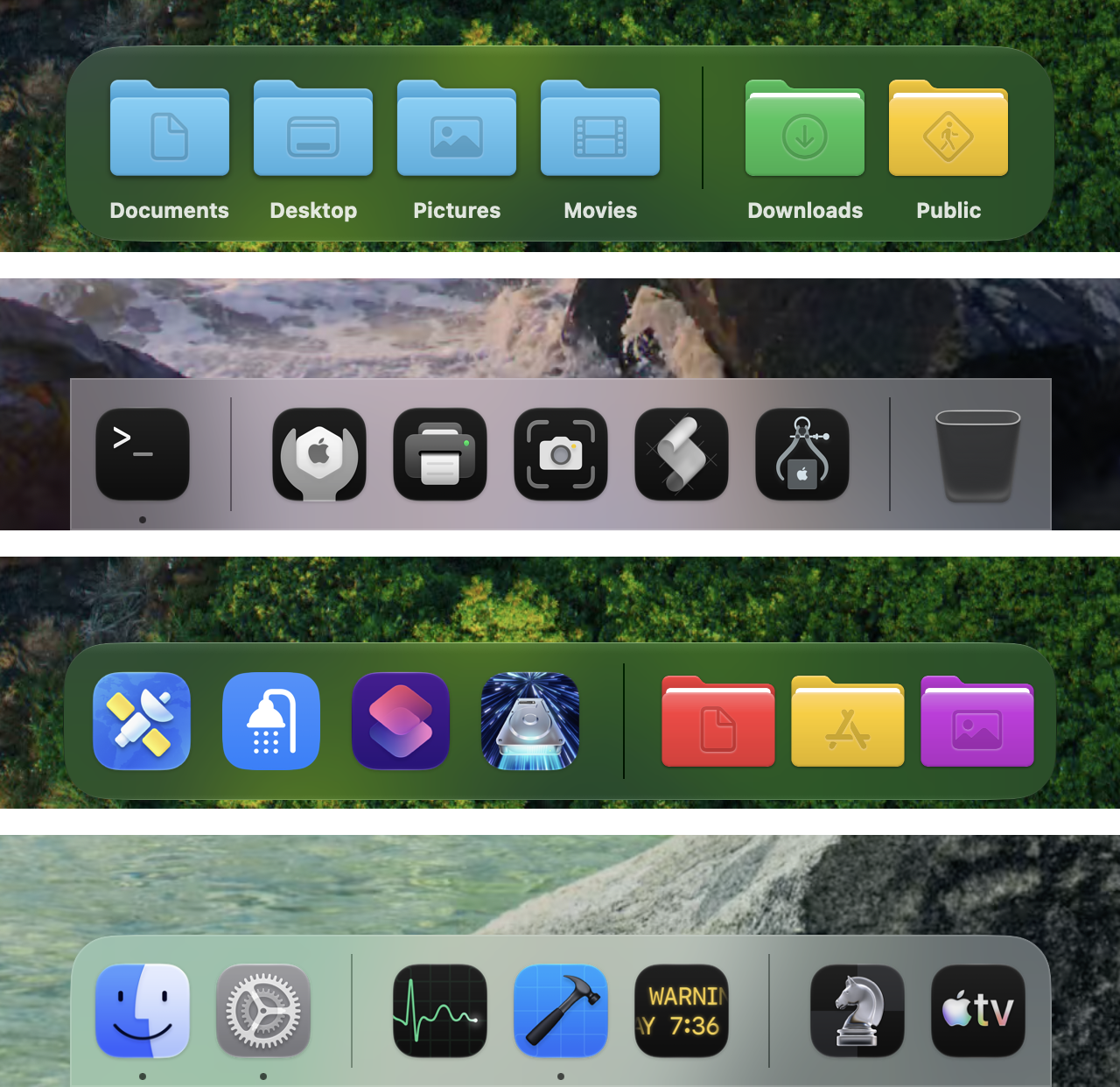
Jetty Pro
hypercritical.co
That way you only have to pay whenever a new Mac version introduced changes that require the developer to put in work to update the app. (I realize that monitoring private api changes is a kind of constant work even when an update isn’t required, but that’s imo a tradeoff with selling something like this).
Maybe this is niche enough that it won't matter or small enough that there isn't a lot of attack surface, but it's more "you only have to pay when a new Mac version introduces changes -OR- the developer fixes a security issue." Yes, maybe the dev could back port security patches, but that adds more unpaid work for them.
I think perpetual fallback licenses are a good concept, but I think in reality it's a lot harder for that to be viable.
Mostly I work on my own projects in them, and anyway if I’m working on code from someone else they could do malicious things directly in the project code itself that I compile and run instead of making some exploit specifically targeting the IDE I am using.
I've thought the same thing many times, but it seems to be the best compromise I've found to date.
I think it's the most fair balance of subscription and one time payments, although I still get complaints that I don't offer truly one-time payments. Truth be told, we'd be out of business if we did, so I'm happy with the compromise.
The one alternative I'm still considering is simply attaching major versions to major macOS versions (e.g. 1.0 will be "27", 2.0 will be "28", etc). Although since I'm going to be about six months out of phase, I'd have to offer some kind of grace period, which may ultimately be the same as a "one year of free updates" model.
Sketch let users keep their original license/app, but quickly started adding things that made those apps kind of obsolete
pen.dev added accounts/signin to the application, turning it into a freemium saas, the old app is not supported (probably doesn't work or will ask for account)
I think once the business transitions to subscription, it's very hard for them to keep/support a standalone app
2026 features. 2027 features. Probably couldn’t have people auto subscribe to new offerings though.
I believe this is the best compromise in the paid applications ecosystem.
If you have even the slightest idea about application development and the capabilities of GPT Codex or Claude code, this is the future for a lot of people.
At this point, skimming the thousands of lines of Claude-written Swift gives me a higher sense of trust than reading the marketing page of a random third-party app developer.
Most recently I've re-created iina (mac vid player), IINA used ~1.5GB playing 4k vid, my vibed player does the same with ~350mb.
I did the same with the Remote Buddy app (I paid for), my vibbed app now actually works with my siri remote every single time without fail (Remote Buddy was pretty buggy for me, constantly needing restarts or lose connection to the remote).
It is pretty nice to no longer need to beg/prey and wait years for a feature you'd like.
What was linked to today on HN is Siracusa’s blog post.
A subscription is an extra bit of cognitive load in my already-constrained mental resources. I need to constantly assess which subscription is running out, whether I want to keep it, which e-mail I used to sign up, and if I fail to miss the deadline I have to pay for another cycle. There's a good chance I'll keep paying for it long after its utility to me has gone to zero, which is obviously what most subscription services are counting on.
At some point just "no" is the best alternative.
(Don't even answer that, because if you say it's not okay I will think you're being unreasonable.)
Clearly there are prices where subscription pricing is not predatory. The problem is most subscriptions are not priced reasonably compared to their predecessors with fixed prices.
I'm sure it's still wildly used though.
Isn't the premise of the post kind of that it wasn't a one-shot input? The author explicitly states that they tried to do that and ended up spending quite a bit of time developing the result, and that's with their many years of experience in this area.
Give him the benefit of the doubt on this one, his other apps are one-off purchases.
And now we have an app that isn't being sold on the App Store adopting the crappy App Store subscription model of "keep paying forever even when there was no compatibility breakage this year and the developer hasn't added anything that you want, but blame the subscription on potential compatibility problems whether or not they exist."
Wish he'd just say "It's a niche product that won't sell a ton of copies and I want to have stable revenue regardless of release schedule, if you don't like it too bad."
It might be because I've been a Siracusa follower for a very long time through all the OS X reviews and now his podcast, but I think it's pretty clear he is saying that between the lines, and is just having a little tact and decorum about it. Saying it explicitly I think would just make people angrier.
EDIT: As a personal desktop app, the bar to implementing your own is much lower than I thought. I think my comment would stand only for a widely used open-source library.
I don't think that word means what you seem to think it means, considering there was zero complaining in that comment.
Bitching cause they don't want to pay for a piece of software (that no one is forcing them to pay for) cause their clanker can do it. I would unequivocally say this is complaining.
This one has an easy fix: create an alias and drag that into the dock.
...that's a good sign!
https://news.ycombinator.com/item?id=50631094
Perhaps I’ve worded it poorly, but I would think the idea comes across.
I don't know that I could sink time and money paying for, configuring, and adapting workflows to a tool which could be made inoperable by a third party to the transaction.
1) The risk of Apple breaking stuff wouldn't be mitigated by a one-time purchase. If they break something, they break something. Payment model changes nothing about that.
2) Doesn't risk of breaking change from Apple's side make a subscription model make more sense, not less? If a feature you want is no longer possible, you can just stop paying the subscription. If it was a one-time purchase, you'd either be out your money or have to receive a refund—and how exactly do we decide how much of the value of your original purchase was delivered between when you bought it and when that feature disappeared? Should the dev go hungry retroactively because a feature that you valued lasted some amount of time but not forever?
A recurring (and therefore cancel-able) Subscription is the lower-risk and more equitable model for such a scenario on both sides, IMHO.
2. No. Not everyone is on the latest macOS release ASAP.
How much active development are you doing day-to-day? It sounds like you're arguing the subscription is required for ongoing compatibility, but what if Apple doesn't change these APIs for 10 years? You sit back and collect it _just in case_ they do?
The "everything must be a subscription" trend is incredibly unpopular, and you're never going to have enough FAQ entries to justify it.
Case in point is AI inference services, whether because a model got deprecated/removed, price became unsustainable, or the company went bankrupt!
On Linux its expected that if the software you use somehow doesn't support it (it seems KDE Plasma has every possible configuration these days) you can open a PR or find an alternative that someone open sourced and released for free.
I also don't think the issue is with paying for things as you insinuate, but the pervasive post-2010s software mentality of turning one-time payments into indefinite, repeatable subscriptions.
Ideally but realistically no, because these pieces of software end up in a "too many cooks" situation. Good UX requires a heavy hand from the top and a singular vision. Which... is hard, very hard. There's very few exceptions like Blender for one where they embody this and they need laser focus to achieve this.
Add the fragmented UX paradigms and WM fuckery on top, you end up with a hodge-podge of software that looks and feels wildly different. (Like how some applications use a weirdly low resolution cursor or a different cursor on Linux because different windowing systems, UI Toolkits use different cursors like wtf? [1]).
Or for any UX bugs fingers get pointed at the WM instead: "Yeah no wonder you saw X. Your WM is shit, everyone uses Y these days". Bad UX and OSS go hand in hand on Linux primarily because of this. It's developers adding features that developers want without the Marie Kondo-esque "does this feature really bring joy/utility" or if it should be prioritized or not paired with a Linux design tooling failure that makes it an uphill task to get working and looking nice.
(And I don't even want to speak about Windows here.)
Techies have, for decades, been baffled by Apple’s prioritization of fuzzy things they didn’t understand
Sometimes, opening a PR is a mutual time burden on the PR opener and software maintainer, which results in nothing being merged. Sometimes the Alternative here is best described using the We have McDonald's at Home meme, where the alternative, presented on equal footing to what it's being compared to, is found lacking upon inspection.