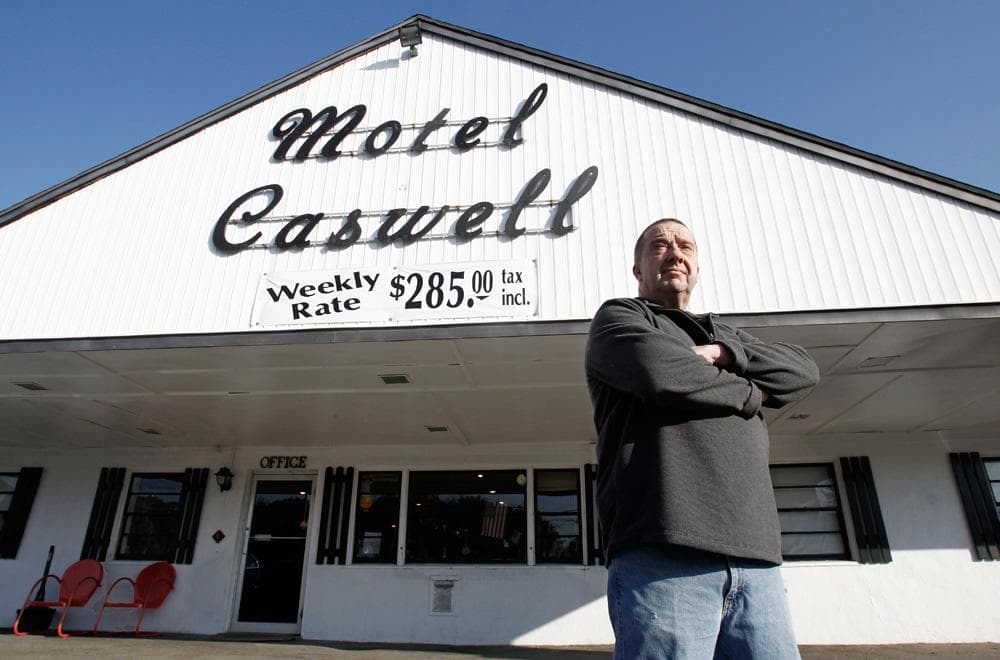
Tewksbury Motel Owner Fights Move By Government To Seize Property
Crimes committed by motel guests have given the government grounds for seeking to confiscate the family-owned property. It’s worth about $1.5 million.
wbur.org
208 points · by eric_bullington · 13y ago · 136 comments
Any time you read a story like "government attempts to liquidate real property to fund police department", your first thought should be "that's not the whole story", because (for the most part) that's not how the federal government operates. So, some issues with this story:
* This case is Sonya Rao, not Carmen Ortiz (though once again Ortiz oversees all the cases in her office).
* The hotel is, let's not sugarcoat it, a blighted flophouse. Don't take my word for it; here's TripAdvisor ("ROOMS BY THE HOUR: Hookers, drug addicts, drug dealers, need I say more") complete with picture: http://tinyurl.com/ta-caswell and here's Yelp ("Please don't bring your kids here.") http://tinyurl.com/y-caswell
* The owners of the hotel were warned repeatedly by local law enforcement and an intervention of local hotel owners; specific measures were suggested to minimize the problems at this place and weren't taken; the hotel had no security, and its drug countermeasures consisted of a list of persons not to rent to again.
* The hotel owners made no policy changes after a methamphetamine lab was discovered in one of their rooms.
* The hotel owners made no changes after the dead body of a heroin overdose victim was found in one of their rooms.
* Drug deals weren't simply occurring at the hotel; the Tewskbury PD repeatedly discovered drug dealers operating full-time out of rooms in the hotel.
* The owners of the hotel repeatedly admitted under oath that they had continuing knowledge of drug crimes occurring on their premises, and had no policies to investigate the use of their rooms.
There are places like this all over America and they're all neighborhood blights that need to be shut down (hey, by the way, still think there couldn't possibly be a difference between an apartment and a room up for temporary let on Airbnb?).
If all we're saying is that civil asset forfeiture is the wrong means to shut them down, I'm with you. But this case does not make my blood boil the way it does for some. Beyond that, I'm not sure HN is a great place to debate it.
As for your specific statements, I find it hard to reconcile your claim that owners "...were warned repeatedly by local law enforcement and an intervention of local hotel owners; specific measures were suggested to minimize the problems at this place and weren't taken..." with the article's claim that sworn testimony by local law enforcement that, "the Tewksbury Police testified they never communicated with Caswell about what he could do to reduce drug crimes."
But be that as it may, if you care about civil liberties it is a fact that you'll mostly wind up defending unpopular actions by unpopular people who are unpopular for a reason. Because that is mostly who prosecutors are going to throw the book at, and go out of their way to target with every tool, ethical or not, that they can.
For the fourth time today: it is not my position that civil asset forfeiture reform isn't direly needed. But if you look at the process that actually occurred in this case, you'll find that this is very much not the textbook case of CAF abuse. This property was a real, practical problem for the community. The US Attorney's office used, in effect, a civil suit to resolve the problem after multiple local law enforcement interventions failed. That suit is receiving a full and fair hearing in front of an impartial judge.
Let me ask you directly: why do you think it should be illegal for the US Attorney's office to file a civil suit against the owners of a property that appears to be instrumental in the narcotics and vice trade of a whole township? If I slip and fall on your walkway, I can sue you. Why can't the government, here? They aren't threatening to imprison the owners. They're saying, "hey, owners, your operation of this business is so negligent and creates so many costs to the neighborhood that after multiple interventions with local law enforcement we're finally forced to sue".
If what they're doing isn't illegal, the state and city governments have the power to pass a law against it that actually gives them fair warning as opposed to nonspecific threats.
If what they're doing isn't illegal and the state and city governments don't want to pass a law against it, there's no reason to substitute the US Attorney's judgement for that of the people whose job it is to enforce the law.
The US attorney's office shouldn't have standing to sue on behalf of the neighborhood. The neighbors might. If it's for some reason in the national interest to make sure that this particular flop-house changes its address, I suppose they could fund the case.
In other words, it is a textbook case of CAF abuse: avoiding criminal trials to get a plaintiff-friendly civil trial, stretching jurisdiction limits, bypassing separation of powers by enshrining prosecutors as policymakers, the whole deal.
You ask: "If I slip and fall on your walkway, I can sue you. Why can't the government, here?"
This would imply that there is a single act (slipping and falling on a specific property) and a single remedy for that act (a lawsuit)
But here, the government has a choice of causative acts (drug deals and arrests were prevalent throughout that neighborhood -- they had quite a bit of choice as to which property they wished to "sue") and a choice of remedies ... of which seizure is the most extreme of all possible remedies.
It would be as if the government was seeking a specific property to slip and fall on, and chose to only pursue the most extreme possible form of response for that action.
They chose not to pursue the other properties, which showed equal rates of crime (this is NOT in the docket report you read), and chose not to pursue other remedies (such as other sanctions and means of remedy). And in this case, their own interests and the interests of the police department are particularly served by the extreme remedy, and the choice of party to pursue chosen by the "ease" of achieving this remedy.
On the rest of it, if there is ANY truth to the claim in the article that prosecutors do not bother to bring these cases when the property has less than $50k in value after debts, then no matter how much of a problem this hotel may in fact be, there is a fundamental problem with how prosecution is being brought here.
    why do you think it should be illegal for the US
    Attorney's office to file a civil suit against the
    owners of a property that appears to be instrumental
    in the narcotics and vice trade of a whole township?
Out of morbid curiosity, does the government ever do anything wrong? Whenever you comment on a story involving government, I know, without fail, that you are going to somehow take the "pro-goverment" line.
You've done it here. You did it with Aaron Swartz. I've seen you do it on other threads where civil libertarians are outraged about one thing or another.
So: do you ever actually side with the people? Or is it just all government, all the time with you? I ask because I'm starting to tune you out, and you make such insightful comments on other topics.
Just because I don't use the exact same reasoning as you do to arrive at the same conclusion does not mean I am in a bucket with "people who think Swartz got what he deserved".
What I'm guessing happened is this: you think what happened to Aaron was terrible because the conduct outlawed under CFAA shouldn't be criminal. I think what happened to Aaron was terrible because the sentencing mechanisms under CFAA are insane and scale trivial offenses to multi-year sentences by having them track "damages". Both of us arrive at the same conclusion, that Aaron was maltreated by prosecutors, but by different means.
This way of thinking, where anyone who disagrees with a specific point about Aaron Swartz must somehow be on the side of the government, is a pox on the whole site.
Just that you took the most pro-government position I've seen anyone on HN take, both recently and in that (regrettable) thread six months ago.
Perhaps you don't see yourself as pro-government, and it's just been a string of articles where you think the people are in the wrong, not government. That's fine, I'm just trying to understand why you comment the way you do.
UPDATE: I think I see now what my issue is. Whenever the goverment does something wrong, you tend to do two things:
1. You write many, many lines where you point out how great the government is, what a good job they're doing, etc. It's all very "pro-government" and mostly, actually, off topic.
2. You then, at the end, or frequently in some later comment, claim you disagree (sometimes even in ALL CAPS) with the thing the government actually did that was wrong that everyone else is talking about.
So, when people are upset with the government for, say, civil forfeiture, you don't talk about that. Instead, you talk about everything else you can come up with to make the government (or in this case, Ortiz) look good.
I guess that's why I see you as "pro-government" with your comments. Perhaps others do too, and that might be good enough reason to consider toning back the gov-love?
I apologize in advance if this is completely off-base, but, my personal theory is that due to tptacek's work in security, he is afraid to take a harder stance against government wrongdoing. Perhaps this would risk his (or his company's) eligibility for future security clearance and/or government contracts.
To quote Upton Sinclair, "It is difficult to get a man to understand something, when his salary depends on his not understanding it!"
I shouldn't have to spell that out simply because I (a) disagree or (b) read news stories more carefully than you do, but every time a story like this comes up, I inevitably do have to defend myself from someone who thinks my opinions are bought and paid for. In reality, arguing against random HN people argues against my own interests.
HN is supposed to be a place that encourages intelligent conversation and freedom of thought. We as a community are supposed to be mature enough to understand that not everyone is going to see things the same way.
The problem is, a lot of left-leaning people are so completely certain that their views are correct, and their correctness seems so obvious to them that they can't imagine how any logical person doesn't perceive reality in the same way. Just as many Conservatives feel the exact same way.
What gets lost in all of the petty arguments is the fact that there is plenty of room in the middle for people who agree with Republicans on some issues, and Democrats on others.
One of the dumbest fucking things our nation has ever done, is allow the formation of distinct political parties. The governance of the United States, or any other country for that matter, should not be conducted like a fucking football game.
He's just really really wrong on this, is all. Let's not discourage people from using their real name or their real opinions.
I think we'd agree though that sans rundown hotel the drugs still would have been made, the people would have died, the cops would have had to arrest people.
Like it or not, the marginal people in the world need places to sleep, go to work, shout at aliens and watch law and order like everyone else. If the meth lab wasn't there then maybe the suburban rental down the street, or the dead junkie could have been in the room next to yours at the quality in that didn't have a huge warning on yelp that let you avoid it.
It's a decent part of the reason that a lot of cities have relatively well know open air drug markets in bad parts of town that don't get much static, or that the oakland pd mostly looked the other way at the large mostly illegal mega grows in the warehouse districts 10 years ago because they knew the alternative would just push them into residential neighborhoods and cause a lot more problems.
Minus the moral outrage and necessity of retribution, the guy was probably doing the rest of the hotels and the town a favor.
I mean that is unless you're arguing to generate enough new revenue so that we can spend drug war size money on top notch medical, pyschiatric, housing and supervision for a large chunk of marginalized people in this country.
> The hotel is, let's not sugarcoat it, a blighted flophouse. . . .
If the government wants to impose some standards on how a hotel should be run, it should publish laws to that effect and the penalties should something on the order of fines or loss of business license, not loss of the property.
> The owners of the hotel were warned repeatedly by local law enforcement and an intervention of local hotel owners; specific measures were suggested to minimize the problems at this place and weren't taken; the hotel had no security, and its drug countermeasures consisted of a list of persons not to rent to again.
It is not the duty of private citizens to act as an unpaid quasi-police force.
* The hotel owners made no policy changes after a methamphetamine lab was discovered in one of their rooms.
> The hotel owners made no changes after the dead body of a heroin overdose victim was found in one of their rooms.
Are they required by law to make changes?
> Drug deals weren't simply occurring at the hotel; the Tewskbury PD repeatedly discovered drug dealers operating full-time out of rooms in the hotel.
If and when police discover illegal activity, they are free to do their jobs and arrest people. It is not the hotel owners' job to act as a police force.
> The owners of the hotel repeatedly admitted under oath that they had continuing knowledge of drug crimes occurring on their premises, and had no policies to investigate the use of their rooms.
Knowledge that crimes have occurred in the past does not mean that the hotel owners had a duty to act as an unpaid police force.
So what were these guys doing, and how is it different?
Your entire comment essentially boils down to this. I reject the notion that there is something wrong with using drugs ... but even if you don't, do you really think the hotel owners should be Drug War warriors, enforcing the law, and turning their own customers in to the authorities?
I was enraged at first but when I had this same thought, it changed my mind.
Truth is, it would be bad for business if Caswell took an activist approach towards cleaning up his property. Or at the very least, he believes it would be bad or else you'd think he'd have done it by now. He does, after all, live on the premises.
All this "behind closed doors." Sure, wink wink, nod nod.
Perhaps the gov't needs to build more of a paper-trail (assuming the news article I read was correct that this guy has not had any formal issues renewing various licenses and such) but yeah, you don't get to profit off of criminal activity and not expect the public to do something about it.
Just because you believe there's nothing wrong with using drugs doesn't mean that current drug dealers are perfectly savory characters.
They could just as easily threaten owners of a motel, and tell them that if they don't get to do their thing there will be more trouble than the motel owner can handle.
Having a fixed place of business makes you vulnerable, and the neighbourhood this motel is in makes me sceptical about it being easily sold to new owners. I think there is an element of making an example out of this particular motel to scare the rest into compliance. "Look what happens if you don't clean up, you lose your business". But unfortunately if you do try to clean up you find yourself facing armed gangsters. Tough choice.
I wouldn't bring up the meth lab, except...they had a meth lab on their property.
More generally, a "service provider" (taken loosely) has no obligation to act as law enforcement of its service. An ISP knows illegal activity happens over its lines, and it profits from it. They have no obligation, nor the power, to police their lines in a manner that would make them immune from this sort of forfeiture.
I'm going to guess you don't share your neighborhood with crack houses, meth labs, drug dealers etc
- 15 crimes over 14 years in which he rented 200,000 rooms, and
- he runs the risk of discrimination accusations if he refuses to rent a room.
What specific policies would you implement if you were managing this hotel that would have avoided 15 crimes in 200,000 room rentals? You're so confident this guy is negligent, show us how easy it is to avoid these problems.
I don't want innkeepers to be direct reporting agents of law enforcement agencies, or subject to a 100% asset tax when they don't meet law enforcement's demands (plus appear to be an easy profitable high-equity target).
There's a whole weird history of civil asset forfeiture being abused, such as when the one black guy in a rural Ohio town is pulled over on his way to buy a new truck with cash, and the cops seize the cash under CAF rules on suspicion that the guy's a drug dealer. I AM NOT ARGUING THAT CIVIL ASSET FORFEITURE IS OK. But you'd want to be careful (not "agree with me", just, careful) being knee-jerk about this stuff.
The reason the Innocent Black Guy in rural Ohio ends up with an impossible battle and travesty of justice IS BECAUSE the system gets lazy and invents crap like "suing property" and "plea bargain poker" in search of expediency against numerous truly unsavory characters. You can't claim to be concerned about IBG's plight yet be unconcerned with the deterioration of the legal system that eventually causes IBG to end up at the complete mercy of one prosecutor.
If the Tewksbury PD had knowledge, did they not also have the ability to give the info to a local county or state prosecutor? And if they knew and did nothing, either the community by way of the police chief give tacit approval, or, there is corruption somewhere.
It went to federal trial because the feds have worked out a system where they'll take on all the legwork and trial expense for the local police, in exchange for 20% of the take ($200K in this case).
It's 100% about money, and 0% about reducing crime or prostitution (other properties nearby have identical crime rates, but aren't worth as much, so they're not targeted). Police departments use the money from civil forfeiture to pad their budgets. In some cities, the amount of money received each year from civil forfeiture is 3-5x that provided by taxpayers!
If you want to go wild with rage, spend some time reading up on the civil forfeiture laws and abuses. IMO there is no greater example of bad law and bad government today than civil forfeiture. I'm not alone in thinking so, either. It's that evil.
The US has enacted some truly bad laws in the last decade or so, but civil forfeiture is so far out in front as "worst law in widespread use" that is has no real competitors for the title.
1) Don't rent rooms by the hour: this reduced prostitution.
2) Only allow registered guests to enter the hotel further than the lobby: good bye "drug stores"
3) Work with other local businesses, the police, and community members to clean up the streets. Drugs and crime should be bad for business. Elect and work with politicians that will put more police on the streets. Maybe institute a curfew. Improve the schools. Create after school programs.
If I was being proactive at fighting the blight throughout my 30 years (and my fathers previous 29) then the government would not be taking away my Model... if anything I would be getting in trouble for what I would be doing to whoever attempted to run a meth lab out of my place of business and my home (Those things explode!)
From other articles [1] and [2]: "Dein asked Rao if it was the government's assertion that if a drug transaction takes place in the parking lot of McDonald's or Dunkin' Donuts, and the employees are aware of it and do nothing about it, the government could seize those businesses as part of the drug-forfeiture law.
Rao essentially said that was true. She responded, "The test is knowledge and reasonable steps to curb drug activity."
What makes it worse are the potentials for substantial and unstoppable abuse from the US government on forfeiture laws:
"Dein said she has "serious concerns" about the government's interpretation.
Institute for Justice attorneys argue the case is simply about money. The government stands to profit in the sale of the Caswell Motel, which is worth an estimated $1 million with no mortgage.
Under a process known as "equitable sharing," the federal government would keep 20 percent of what it nets from selling the land, and the Tewksbury Police Department would pocket 80 percent, while the Caswell family will lose its livelihood, the Institute for Justice alleges."
Bullock wrote that if the government wins, it would be a slippery slope.
"Accepting the government's theory of forfeiture would subject to forfeiture countless establishments that serve the general public simply because they are the site of occasional drug crime,'' Bullock wrote.
And to counter many of your claims above: "But during the trial, Caswell, 69, who lives on the property with his wife, Patricia, testified he was "surprised'' by the civil-forfeiture notice.
"I never had any warning," he said.
In nearly 30 years of operating the 57-year-old Motel Caswell, which was built by his father and supports his family, Caswell testified that he has never been fined, cited or arrested, never had his business permit pulled, and was never told he could be in trouble for any third-party drug activity at the motel."
Furthermore, to your contention that this one property is the source and cause of the issues:
"It belies this notion that the area's great and there's this one problem property, the Motel Caswell," said attorney Scott Bullock from the Institute for Justice, the Arlington, Va.-based libertarian law firm representing motel owner Russ Caswell. "That's not the case at all.
Bullock said that when the Institute for Justice first took on the Motel Caswell case in 2011, the team examined police logs and found the rate of arrests at the motel comparable to that of its neighbors. He said more recent statistics obtained by The Sun seem in line with those initial findings.
The numbers raise the question of why this one business was targeted under the seizure laws, Bullock said.
A spokesperson for the U.S. Attorney's Office did not respond to a request for comment Friday."
[1] http://www.lowellsun.com/todaysheadlines/ci_22253534/caswell... [2] http://www.lowellsun.com/todaysheadlines/ci_22365659/tewksbu...
It's possible to simultaneously believe that we should be concerned about the lack of restrictions on the use of civil asset forfeiture and and at the same time believe that the state should have some recourse in court for properties operated in the fashion of this motel.
I edited my response above to include this section:
Furthermore, to your contention that this one property is the source and cause of the issues:
"It belies this notion that the area's great and there's this one problem property, the Motel Caswell," said attorney Scott Bullock from the Institute for Justice, the Arlington, Va.-based libertarian law firm representing motel owner Russ Caswell. "That's not the case at all.
Bullock said that when the Institute for Justice first took on the Motel Caswell case in 2011, the team examined police logs and found the rate of arrests at the motel comparable to that of its neighbors. He said more recent statistics obtained by The Sun seem in line with those initial findings.
The numbers raise the question of why this one business was targeted under the seizure laws, Bullock said.
Also, how many upscale hotels that cater to people in the entertainment industry (for example) haven't had 15 drug-related crimes in 14 years (about one per year)?
It is beyond the power of U.S. attorneys to legalize either activity, but they are not beyond blame for enforcing unethical laws, and it is clearly baseless to blame private business for not helping them do so.
But I also think that meth labs, street-level hand-to-hand narcotics trading, and street-level prostitution are illegal for good reason.
That's the problem with your argument. This isn't a story of a negligent businessman allowing riff-raff to fester. It's a story of a social problem caused entirely by the government, being used to take property from a private business who didn't do enough to help them enforce their destructive laws.
The casinos have no on-site fraud/embezzlement monitoring programs for the crimes that occur in their hotel rooms, despite numerous cases every year arising from their properties. Someone call the Nevada equivalent of Carmen Ortiz and get these multi-billion dollar businesses confiscated! (I'm being sarcastic, of course - this type of thing is insane and deplorable in a country like the US).
> * The hotel owners made no policy changes after a methamphetamine lab was discovered in one of their rooms.
http://www.sfgate.com/news/article/Hotels-motels-hot-spots-f...
> * The hotel owners made no changes after the dead body of a heroin overdose victim was found in one of their rooms.
http://radaronline.com/exclusives/2012/06/murder-suicide-whi...
> * Drug deals weren't simply occurring at the hotel; the Tewskbury PD repeatedly discovered drug dealers operating full-time out of rooms in the hotel. / * The owners of the hotel repeatedly admitted under oath that they had continuing knowledge of drug crimes occurring on their premises, and had no policies to investigate the use of their rooms.
http://www.lasvegassun.com/news/2010/dec/30/hard-rock-hotel-...
> * The hotel is, let's not sugarcoat it, a blighted flophouse... There are places like this all over American and they're all neighborhood blights that need to be shut down.
Ah, now we are getting somewhere, because this seems to be the primary complaint. If Charlie Sheen does cocaine in a luxury hotel room, that's all good fun. And it would be absurd to shut down the hotel because of what Sheen did, right? But a motel that serves poor people who are not celebrities -- yet nevertheless do drugs sometimes -- is entirely different.
This connects to the point that Orin Kerr and others have been making regarding the uproar over Aaron's death. "If you want to end these tactics, don’t just complain about the Swartz case. Don’t just complain when the defendant happens to be a brilliant guy who went to Stanford and hangs out with Larry Lessig. Instead, complain that this is business as usual in federal criminal cases around the country — mostly with defendants who no one has ever heard of and who get locked up for years without anyone else much caring."
Then why did you write a long comment rather than just flagging the article and moving on?
If you believe grabbing property on that basis is justified, then, I am sorry to say sir that you are just a government shill who supports fascist forfeiture.
And apparently Caswell has had fewer crimes than other nearby addresses
http://forfeiturereform.com/2013/01/14/analysis-shows-fewer-...
In NYC, it's the Hotel Carter:
According to the agent’s sworn testimony, he then goes to the Registry of Deeds to determine the value of the targeted property. The DEA rejects anything with less than $50,000 equity."
Ouch. I knew about the US forfeiture laws but this still managed to surprise me. The agents seem to have left any connection with justice and are pretty open about their real goal: grabbing money.
Yeah, false slippery slope and all but is it really a false one?
It's not the hotel owners job to do the job of the police. I don't want to check into a hotel and have them check my police record, ask if I am planning to have visitors, scan my luggage in a metal detector to see if I am carrying anything suspicious or illegal. Not their job.
If they see a crime occurring or something suspicious, call it in. Fine. But to hold private business owners responsible for the conduct of their customers? Ridiculous.
The government can't just "seize" the property. They're suing the property in civil court. For what appears to be very good reason. The whole thing is receiving a full hearing in front of an impartial judge.
It was an unmitigated disaster, and public policy has now shifted 180 degrees (with the biggest change in policy coming from the passing of the Public Housing Reform Act in 1998).
Even DC, where I live, has been working to undo fifty years of bad housing policy, with the shuttering and redevelopment of projects.
While serving on a homicide grand jury, ~20 of the 100 or so homicides we heard occurred at Sursom Corda, one of the last projects in the city, which was finally closed down.
If your standards can include 9 years of traffic and a baker's dozen of issues it seems like a vast majority of lodging would be in danger of a zealous prosecutor.
Now I'm sure this guy has in some way separated himself out in the states attorney's mind as compared to the usual econolodge, but that's faint comfort. Working for a time with federal investigators it became clear that pretty much 100% of the population is guilty of something if you're looking, usually something that can be finessed into a no joke federal rap.
It's very unusual that it ever becomes an issue - but you get the right combination of attention, timing and bad luck or malice and then suddenly your world turns upside down. It seems like this happens really often when you're a target or related to an investigation, they put together what they think is a solid case only to find out whoops they got it wrong you're obviously not their guy. At that point god help you if you're stealing cable or borrowing your brother's wifi or were growing a tiny pot plant in the basement.
I wonder what even the theoretical justification for something like this would be. If we seize the hotel then those junkies will stop shooting heroin because they cant get a chill hotel room in town?
Where have we heard this story before? It seems as if the Judiciary Committee might have more than just the Aaron Swartz case to consider.
As this case shows, it's an injustice that almost entirely hits the lower classes.
It's not a conspiracy. There is even a certain logic to it: if drug dealers keep using a particular place as a meet up spot, you have to wonder if the owner isn't turning a blind eye to keep the business. But: this is a cheap motel. Of course it's going to be a hotbed for shady things. If you're up to something shady, where do you go, the Ritz?
But the forfeiture laws are completely insensitive to these facts. All they do is to work the taking of property from the poor just because by virtue of being poor (or serving the poor) crime happens in their midst.
The owners of the hotel aren't poor (the tenants obviously are, though).
Unlike many CAF cases, this one received a full hearing in front of a judge with evidence presented from both sides.
You're right--even though I think civil forfeiture is wrong, I can see how this would not be a sympathetic case in front of a judge.
http://www.plainsite.org/flashlight/case.html?id=1823970
You can help shine a light on what the DOJ and USAO are up to (and continue what Aaron Swartz started by downloading PACER) using this tool:
http://www.plainsite.org/asymptote/
If you follow the directions, it doesn't cost anything.
As a bit of silly trivia, in the movie "Invention of Lying" Ricky Gervais' character had a quicky fling set there where it was named "A Cheap Motel for Intercourse with a Near Stranger".
[1] http://www.ij.org/massachusetts-civil-forfeiture [2] http://my.execpc.com/~ajrc/ifj.html [3] http://www.futuregamez.net/movies/inventionoflying/invention...
Well, here's some other (obviously evil) organizations funded by the Kochs:
  - ACLU
  - MIT
  - NYC Ballet
  - American Museum of Natural History
  - PBS
- Lincoln CenterBut is there a wiki somewhere that is tracking these so that when people go and look at Ortiz in more detail, we've got a quick way of educating them?
Unfortunately they have been upheld by the Supreme Court. And oddly, the freedom touting Republicans have traditionally supported these laws as they are "tough in crime."
Thomas Jefferson - "A government afraid of its citizens is a democracy. Citizens afraid of government is tyranny."
The owner may be upstanding, but the people we expect to protect us (the gov't) see it as a nest of thieves, regardless of who owns it. But if that were illegal, it seems to me Vegas would have been plowed under a long time ago.
Transparency's a bitch.