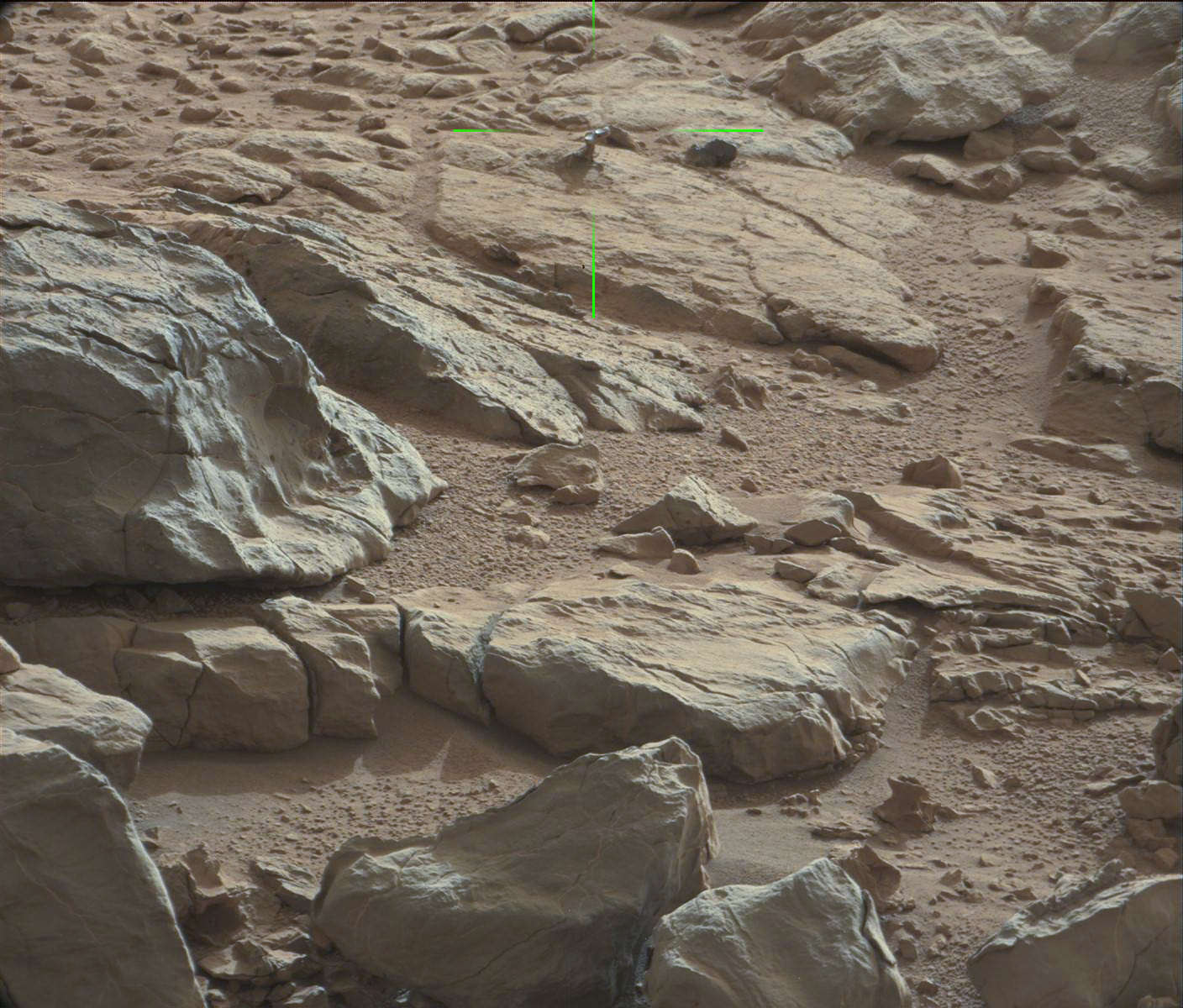
Another Weird Shiny Thing on Mars
Universe Today
203 points · by anigbrowl · 13y ago · 147 comments
[1] http://photojournal.jpl.nasa.gov/jpeg/PIA15696.jpg (debris from the last few minutes of flight),
http://www.lpi.usra.edu/meetings/lpsc2013/pdf/2800.pdf (debris from interplanetary cruise and atmospheric entry).
[2] http://www.spaceflight101.com/msl-descent-stage-impact-analy... (crash movie).
[3] http://www.nasa.gov/mission_pages/msl/multimedia/pia16230.ht...
[4] http://link.springer.com/article/10.1007%2Fs11214-012-9879-z (free full text)
Love the phrase "energetically disassembled".
BTW, you absolutely have to love the tack NASA has taken with making images virtually immediately available for the public to consume and research. Imagine if the Curiosity photo archives were only made available months after the fact - it'd be too late to do anything based off of community findings!
Way to go team!
"the little protuberance is probably about 0.5 cm tall, or even smaller."
Five mm is obviously tiny. Keep this in mind before making up hypotheses as to what the thing is. =) We have to wait until better data is available.
What's fascinating in itself though is that no person, however sceptical, can immediately rule out the possibility that stuff like this is some form of life or even evidence of non-human technology. Of course, such hypotheses have to work extremely hard before they should be accepted. Our standards of evidence for stuff like this must always remain as high as possible, given the emotions and mass misunderstandings involved. But the very fact that we've come this far and still cannot rule out the existence of life on Mars is quite remarkable.
This moment, if/when it happens, will be so mindblowing on so many levels and affect us deeply as a society/species/etc. that I just WANT to see it.
Also, the information we exchange with them would have a huge impact on everything. What if they have the secret to efficient solar power? Or AI?
Living as pet slaves for extra-terrestrial overlords would have little "long-term effect on most people's daily lives"?
Personally, I'd not be that mind-blown, more like vindicated for years of conjecture and lively debate.
* or what have you
The realization that those dots moving across the sky are not gods did little to eradicate religion. Nor did the realization that gods did not carve the canyons or raise mountains, or even create the species or the stars. Why should finding some living junk on Mars be the game changer that everything else failed to be?
You can never completely rule out that possibility, regardless of how much evidence you collect, but it's a matter of semantics at that point. Immediately and without collecting anymore data, we can dismiss the hypothesis that this is non-human technology as unworthy of our attention. It's not merely that the hypothesis has an immense burden of evidence to heft, but that it's a waste of time to even consider it.
Seeing possible evidence of extraterrestrial life in every unexpected observation is nothing more than a superstition.
I agree, and I hope I didn't give the impression that this is what we should be doing. This thing is still just an observation - it's not evidence of anything yet. My point was this: we know of things that would effectively rule out the 'life as we know it on Mars' hypothesis (e.g. absolutely no evidence of any water, liquid or otherwise), but we're not seeing them.
It's true that we keep trying to dream up new ways of allowing the possibility of life on Mars to counter existing hurdles (e.g. hypothetical microbial life buried underground to shield from radiation), but if there were some solid evidence that would allow us to say 'yeah, there was almost certainly never any life on Mars, and neither is there any life on it today,' we would accept that filter.
We could then put Mars in the same category as the Moon when it comes to the life hypothesis. This is not the case - so I'd say a search for evidence of life on Mars (past or even present) is justified.
Take a look at Russell's Teapot: http://en.wikipedia.org/wiki/Russells_teapot
Follow that with careful study of Occam's Razor: http://en.wikipedia.org/wiki/Occams_razor
Of course searching for evidence of current or past life on Mars is justified. But there is a huge difference between searching for evidence, and declaring every anomalous discovery to be potential evidence. In addition, the hypothesis "a technological civilization has lived on/visited/probed Mars" is a minuscule subset of the hypothesis "there is, or has been, some form of life on Mars".
Here's Random House:
a belief or notion, not based on reason or knowledge, in or of the ominous significance of a particular thing, circumstance, occurrence, proceeding, or the like.
You cannot rule out the possibility that when you drop a ball it won't fall to the ground. Empirical reasoning does not operate in absolutes. Only inductive reasoning operates that way.
Precisely, and so 'rule out' shouldn't be taken to imply an absolute ruling out of things. =)
Perhaps I should've said effectively ruled out. Life on the Moon has been 'effectively' ruled out (lack of liquid water, no atmosphere, full exposure to radiation and impactors, etc.) - but many years ago it wasn't extremely unreasonable to suppose that life might exist there. Now we know better - we'd have to reach for very convoluted scenarios to argue for the existence of life on the Moon. The same is not true for Mars (although it's not a picnic, obviously), which I would say is remarkable - there aren't many celestial bodies that have passed that test.
[1] http://en.wikipedia.org/wiki/Exploration_of_Mars#Past_missio...
They are separated by hundreds/thousands of miles.
Most of the impact sites of those objects are known except for a few. MCO's impact point is unknown and whether or not Beagle 2 hit the surface is unknown (it may have skipped out of the atmosphere into a heliocentric orbit, or into an elliptical orbit and reentered elsewhere, or burned up entirely).
Even so, the chances are astronomically low that Curiosity has managed to stumble upon the wreck of another spacecraft.
I don't think anybody is confusing the likelihood of finding a piece of a plane due to not looking at the picture well enough. It's a question of if there would be anything in that picture to begin with.
Yes, more probable, but still not probable enough to seriously consider.
>Especially with volunteers scouring every taken image for anything that doesn't look like a rock.
You'd still be preposterously unlikely to even encounter any debris.
My first thought is that it's a vein of metal that is exposed.
A. Aliens
B. Piece of one of our own spacecrafts
I choose C. None of the above.
Is it perhaps the more comfortable of the two possibilities?
Here's the link to the full-res photo from NASA: http://mars.jpl.nasa.gov/msl/multimedia/raw/?rawid=0173MR092... and http://mars.jpl.nasa.gov/msl-raw-images/msss/00173/mcam/0173...
If not that, I wonder if it's something produced volcanically like onyx.
Either that or a door handle! :P
The cool thing is that Curiosity is so crammed full of equipment for studying mineralogy and chemical composition that we'll likely be able to solve the riddle pretty quick.
This, of course, will turn out to be nothing more than an unremarkable optical illusion; an urban legend is born.
> Pareidolia ... is a psychological phenomenon involving a vague and random stimulus (often an image or sound) being perceived as significant.
I got caught in snow storms several times and what surprised me was how much physical effort it takes to do this for any length of time.
It looks almost like molten metal poured into a sand cavity, and then with the sand blown away. I guess you wouldn't get oxidation or similar activity on Mars (?), so it remains nice and shiny. I wonder how far the shape goes down, and what could have caused it?
Mars is principally deeply covered in iron III oxide. That's why it's red.
NASA has images like that. They also have images formed after extensive post-processing, or merges of several images, or from frequencies other than light, or computer rendered from map data, or etc etc.
Robots are a poor substitute for humans when it comes to planetary exploration.
(High resolution imagery + many many human eyes) > Human eyes
Never mind that Curiosity has now been operating for 6 months without food, water, or sleep, and is expected to continue doing so for years.
What Curiosity has done in 6 months could have been done in a couple of weeks by a human, sleep time included. Robots are vastly inferior to humans for this work, and will remain so for some time to come.
Nobody cares that Curiosity is not going back to earth. For an astronaut, that's different
Not to mention all the instruments in Curiosity (which not necessarily a manned mission to Mars with the intention of coming back would have)
I think we could all agree to send Paris Hilton to Mars.