57 points · by illdave · 13y ago · 51 comments
So, should we expect 37signals to ditch "bootstrapping" over VC-funded startups soon?
Let me be clear, I'm not out to troll 37signals. But here's the thing, if you claim a superior ideology, sell that ideology on paperback and then go against your own methodology, you're going to get some feedback. You can't claim that everyone is a troll, or a "cesspool" whenever people confront these ideas - especially when you're selling them for $.
So a more apt analogy than yours might be "we should expect 37signals to continue bootstrapping but also take a small loan from a bank to cover short term expenses".
And re-read your first post. You are suggesting that 37 Signals has done a 180 degree about-face, which is really unfair especially since you do actually understand the tech.
> So we stopped and thought about it for a bit. Do we want to have to hire an iOS developer and an Android developer? That’s a lot of specialization, and we’re usually anti-specialization when it comes to development.
I don't mind it when people change their minds about something, its a sign of intelligence, but if you're going to do it after having taken such a hard stance against the position you are now in favor of, at least do the intellectually honest thing and at least say "Yeah, we weren't in favor of this before, but we changed our minds. here's why" instead of acting like it never happened.
The biggest thing I took away from this blog post was this.
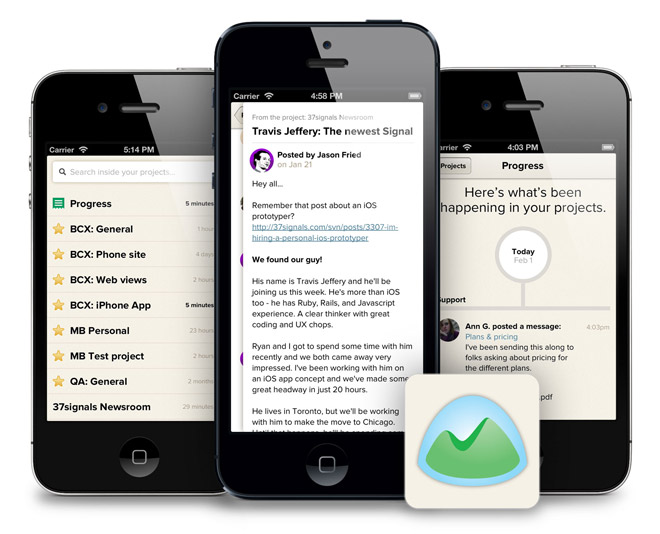
"NOTE: Basecamp for iPhone requires an account on the new Basecamp (released March 2012). Basecamp Classic is not supported."
I wonder what % of users haven't switched over even after a year. I think this is a good lesson for anyone thinking about effectively launching a new product to replace one they already have.
The company I work for did a similar thing about 15 months ago. We still have about 10% of clients on the old system. We offered free upgrades to get everyone over but some didn't want it. New platform has now diverged sufficiently away from the old one that there is no direct upgrade path any more. This has effectively left 10% of clients stranded.
Looking back I think any replacement product needs to be 100% compatible and after x months clients are forced over. It causes some short term hassle and support costs but in the medium term really simplifies development work if old products are completely retired.
We'll be addressing Android at another time.
I actually think this is a ploy to get their users to convert. 37signals has a strong "we let our users outgrow us" stance, so what I read between the lines is that 37signals sees no hassle continuing to support the old system (it's massively profitable). Dually it gives a better justification for an up-sell to get people on to the new system.
I think this strategy is brilliant.
https://basecamp.com/1679267/announcements/10
One of the reasons I recall this is that I saved this particular e-mail newsletter at the time. I thought it of particular interest they dedicated resources on making a mobile browser performant version and had eschewed a mobile application approach. So what has changed or did they feel a deficiency in that version?
I've been a big proponent of full native apps on mobile when possible. But this has got me thinking that the hybrid approach can be a smart move when done right.
(Source: the post)
[1] http://37signals.com/svn/posts/2761-launch-basecamp-mobile
Native is good for high fidelity interaction, animations, responding to gestures. However the native APIs are bad for designing "documents" -- that is, layouts where elements flow within a container and push each other around. That means that things that are extremely easy on the web can be painstaking in native UI without much upside.
Web views have limited interactivity, but they have other advantages:
* Faster iterations. You don't need to push a build when a webview changes.
* Document-style layout, as mentioned above.
* Higher density. We found it easier to show more information on the screen with HTML/CSS than the native controls. Looking at other apps out there makes me think it's an attribute of the medium, not just us.
* No need to sync data or duplicate logic. Sending HTML down the pipe is simple.
Finally yes, we get the multi-platform advantages because the web views are also served to people who hit the regular mobile web version of the app without any wrapper.