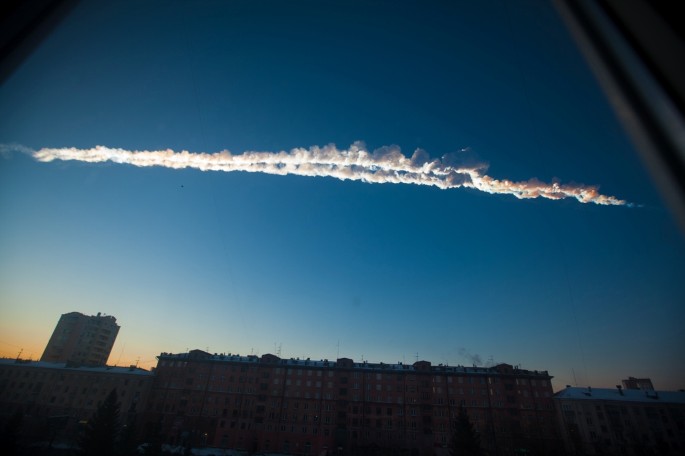
Russian meteor largest in a century - Nature
Explosion rivalled nuclear blast, but rock was still too small for advance-warning networks to spot.
Nature
242 points · by ananyob · 13y ago · 158 comments
One day, driving home I happened to look out at something I thought was a plane and nearly drove off the road as I saw a meteroid falling silently through the sky. There was absolutely no sound and it moved much slower than I expected. After I regained control of my car and pulled it over to get out and watch, I saw small pieces silently broke away and the light show continued until it went over the horizon. It was totally unlike anything I'd ever seen before or since. It's dreamlike and beautiful.
I waited a few minutes after it went below the horizon since the angle it went on made me think it might have made it to the ground, but I never heard anything. It was never in the news, and nobody talked about it afterwards, for all I know I'm the only one who ever saw it. It was both terrifying and amazing. I had no idea what I was looking at since it didn't look like any picture of this phenomenon I'd ever seen.
One thing I'm sure of, is that I've never seen a video that ever does such a spectacle justice. There's so many subtle details that get completely obliterated on video.
Here's some video that do a pretty good job of showing what they look like.
http://www.youtube.com/watch?v=GWhrW7lpqZM http://www.youtube.com/watch?v=dyW0g1SIyxI
The videos of the one in Russia are on an entirely different scale. The sonic boom was tremendous, the amount of light being thrown off of that thing was unbelievable. Extrapolating from what I saw and how I now know video changes things, this must have been an unbelievable beautiful and terrifying sight.
I wonder what must have gone through the minds of our ancestors when, hundreds or thousands of years ago, they'd witness such events (let alone ones similar to the Russian meteor). A lot of old creation myths etc. make a lot more sense now :)
I've watched three shuttle re-entries (benefit of being in California when they were landing in Florida) when the shuttle entered a dense enough atmosphere to create a contrail it looked very similar to this one (although it had a glowing purple leading edge which I never did get a satisfactory explanation for).
I've tried to imagine what this sort of event would look like to someone driving, now I know. Personally I would be expecting the shock wave so I would try to find some place to pull off an avoid being directly impacted by it. I did some experiments with hydrogen and oxygen in a misspent youth (its a pretty powerful explosive at the correct mixture) and the shock wave can take your breath away.
Blast effects trail off markedly with distance. For Hiroshima, most blast damage was confined to a radius of 1.6 km from ground zero, roughly correlating to an overpressure of 5 psi. Glass will fragment at much lower pressures, generally 0.14 - 1.4 psi. Blast damage falls as the inverse cube of distance.
The difference between mother nature and a human adversary is that Mom has zero fucks to give for where she does her work. Asteroid impacts are randomly distributed around the planet, for the most part (latitude may play some role). Most impacts should occur over oceans. Russia, being the largest country, and Siberia, being the largest region of Russia, will tend to see more impacts than other areas, though on an area-normalized basis the maths should work out. So while we may see larger energy releases from space impacts, they'll typically be targeted away from populated regions. Not that a large enough impact couldn't still make for a really bad day.
Unfortunately it hops from 21 kT to 400 kT, but still.
(http://www.carloslabs.com/projects/200712B/GroundZero.html)
This is an appropriate calculator for meteors [2-3], including the effects of the actual blast (overpressure), not just heat. The documentation says windows are shattered at about 6,900 Pa (1 psi).
[1] https://en.wikipedia.org/wiki/Effects_of_nuclear_explosions
[2] http://impact.ese.ic.ac.uk/ImpactEffects/
[3] http://www.purdue.edu/impactearth (Flash)
Nukes go pop all at once, closer to ground (but depends on the nuke, I guess).
http://en.wikipedia.org/wiki/Cretaceous%E2%80%93Paleogene_ex... http://en.wikipedia.org/wiki/Permian-Triassic_extinction_eve... http://en.wikipedia.org/wiki/Cretaceous%E2%80%93Paleogene_bo...
WP estimates roughly one million car accident deaths per year (worldwide est for 2007). Heart disease numbers are more like 30M/year, although lots of those people were very old, so it's hard to estimate what's preventable. Compare that with a hypothetical meteor that kills one hundred million people, in a confined geographic area (that's 1/7 of Europe, or 1/5 of N America, or just half a dozen large Asia cities). What're the odds of that meteor? Even the once-per-millenium Tunguska event wasn't large enough to do that much damage. But suppose once-per-millenium meteors WERE deadly enough to kill 100M people, that's still 1/10 the deaths per year. If it's more spending-efficient to prevent the deaths from heart disease, do that. If it's more spending-efficient to prevent the deaths from meteor impact, do that.
On the other hand, extinction events are worth treating with extra care. Which in fact is exactly what meteor watches do, which is why they only look for entry diameters over 100m. Seems reasonable! Extinction events have happened 5 times in the last 540 million years. They're pretty rare. Maybe we should just roll the dice.
Off-topic: That's not what "shrift" means. Maybe you'd like "short order" or just the clearly "in a short time".
Guns Save Lives http://www.realclearpolitics.com/articles/2008/02/guns_save_...
"If someone gets into your house, which would you rather have, a handgun or a telephone? You can call the police if you want, and they'll get there, and they'll take a picture of your dead body. But they can't get there in time to save your life. The first line of defense is you."
http://gunssavelives.net/ has a huge collection of articles like these:
Son Uses Dad’s AR-15 To Defend Home http://gunssavelives.net/self-defense/video/son-uses-dads-ar...
Armed Citizen in TX Stops Shooting Spree and Saves Cop http://gunssavelives.net/self-defense/armed-citizen-in-tx-st...
GA Woman Kills Would Be Rapist With .22 Pistol http://gunssavelives.net/self-defense/video/ga-woman-kills-w...
Sure it's distinguishable. It's scarier, so it's easier to get people upset about it. People seem to be orders of magnitude more afraid that they will be gunned down as opposed to, say, killed with a knife or a hammer.
If we're putting as much money and effort into automobile safety as society wants/will allow, there's no 'loss' in taking additional funds to tackle the next problem down the line. And so on.
http://visually.visually.netdna-cdn.com/NuclearWeapons_4fa46...
We can't work on anything until we eradicate bad! $foo is so much less important than bad!
/s
The secondary damage would be much worse then primary.
Something like this actually happened in Ft. Worth back in 2000. It was caused by a tornado. Walking along the sidewalks afterwards was terrifying, as you never knew if a shard of glass might come swooshing down towards your head. They did, however, create several wooden structures like painter's scaffolding that you could walk under for protection. http://en.wikipedia.org/wiki/2000_Fort_Worth_tornado
It caused half a billion dollars in damage.
But you really couldn't have prevented it. Minimized damage, debatable.
Though i would have to imagine a meteor over New York(same strength earlier today) would be much worse, probably even a worse case scenario?(again for same strength).
Meteors of this size your probably right, no easy way to prevent them. But i would not say that its impossible.
Meteor defense relies on early detection, but we are unable to spot these until after they already hit (and by then it's too late).
Is that the space logistical engineering equivalent of a mere matter of programming?
My understanding is that all existing plans for deflection are wild-and-crazy and completely untested.
We'd be okay if we had 30 years of warning, because that's long enough to try multiple insane strategies, each of which takes half a decade to get working.
That obviously doesn’t help (as much) with dinosaur killers, but certainly with anything below that.
We also need to come up with some treatment for space dementia. It almost ruined the mission last time.
http://jalopnik.com/why-russians-are-obsessed-with-dash-cams...
EDIT: Just realized this was posted as a HN news item, probably from the original source.
Like NASCAR stationary cameras around a track can be stitched to appear to track with the cars.
EDIT: well, lots of news agencies are using the word "exploded", so maybe it did. I see somebody else mentioned claims that Russians shot at it, but I'm skeptical that they'd be able to notice and react to this thing in time.
EDIT EDIT: OK so it looks like space rocks "airbursting" is not unheard of: [0]. Really curious what the physics of that involves.
[0] http://en.wikipedia.org/wiki/Tunguska_blast#Asteroid_airburs...
In this case, the most intense period involves peak pressure. The meteor falls down, encountering gradually thicker air, heating up and heating up, until finally, the pressure and differential internal stresses are sufficient to separate it into smaller pieces.
These smaller pieces are a lot less massive per surface area, so the pressure acting on them is going to be a lot more relative to their mass, and they are going to slow down much faster. The deceleration while this is going on, then, is going to induce sufficient turbulence to break them up even faster. So the breakup occurs in a sort of chain reaction, and the pressure waves from nearby fragments influence each other, adding turbulence and slowing the cloud of fragments further, until it all ends up as small particles spread over a large area. These particles are moving for the first fraction of a second of their life at supersonic velocities, generating a very large pocket of vacuum / shockwave as they dissipate their energies. The rapid expansion of the largest highly vulnerable layer of the asteroid into a cloud of dust thus constitutes an 'explosion', even if the energy is all kinetic instead of the slow chemical burning that happens afterwards as the white-hot particles oxidise & turn to ash.
Asteroids are not uniform, however. Wrap a chunk of granite in a chunk of sandstone, and you may end up chipping off bits of the sandstone for 10s, heating up until all the white-hot sandstone flies off in fragments at once for 2s, and then the granite flying further towards the ground until its yield strength is exceeded in a higher pressure regime, or it impacts the ground. With complex structures, multiple waves of fragmentation are possible, and rather than being a simple matter of the fragments immediately dissipating into small particles and a harder core, a meteor will tend to split into chunks which themselves become smaller examples of this phenomena.
http://www.usatoday.com/story/news/world/2013/02/15/russia-m...
http://www.ctbto.org/fileadmin/user_upload/pdf/ISS_Publicati...
Edit: Ah, its also in the news http://abcnews.go.com/blogs/technology/2013/02/asteroid-2012...
Anyway, here is the wiki link to that event http://en.wikipedia.org/wiki/Tunguska_event
When I was a kid who was fascinated by UFO stuffs, that one was always speculated to be an explosion of an Alien spaceship.
Most asteroids that we can detect we do not have the technology to deflect unless we discover them decades before impact. Even then, deflecting them is all theoretical and would be a monumental technological undertaking, as it has never been attempted before.
http://tvtropes.org/pmwiki/pmwiki.php/Main/RussianGuySuffers...
Universe agrees with it: Tunguska and "УФО" are both in Russia.
I suppose that all other world can relax: something bad or REALLY BAD will go on head of "russkie"
(It was a joke)
I mean recently Nasa found some anomaly on Mars too, and then they say "no its not interesting its just erosion; (mars has next to none atmospheric pressure btw) i mean if i where a geologist, then any curious shape even if it was made by erosion would attract my attention i would take samples; and most likely such samples would be more interesting then dust-hole digging. What has become from NASA i wonder. Once they where explorers curious.. now they only call their device curiosity
http://en.wikipedia.org/wiki/Sikhote-Alin_meteorite
http://en.wikipedia.org/wiki/Tunguska_event
http://en.wikipedia.org/wiki/Patomskiy_crater (Debatable meteorite origins)
No. An incoming meteor or asteroid is perfectly ecumenical with respect to location, therefore the vast majority of meteors fall into the oceans.
On a related note, the best time to see meteors is between midnight and dawn in whatever location you find yourself. The reason? At dawn, if you look straight up, you're looking in the direction Earth is moving in its orbit at thirty kilometers per second. By contrast, if you look straight up at sunset, you're looking at where Earth has just been and is receding from at thirty kilometers per second. Earth's velocity is added to that of the wandering space rocks near dawn, but is subtracted at sunset.
The Russian meteor even happened at dawn.
Or, alternatively, not.
USA Today has a decently balanced assessment of the incident. Apparently Russia Today was "informed" of that. However the deputy prime minister has countered that by stating that "Russia does not have the capability to shoot down meteors."
http://rt.com/news/meteorite-crash-urals-chelyabinsk-283/
Russia Today claims that it was printed in the local paper.
[1] http://s.telegraph.co.uk/graphics/html/Years/2013/February/i...
True random distributions just work that way. If something that's supposed to happen once in a hundred years is spaced out at roughly 100-year intervals, that's not random.
About '1' apparently.
Otherwise the northern emisphere is in trouble.
I find that coincidence very, very weird too.
And you gotta love all the people saying: "Nothing to see here, move along", as if they had themselves ran all the computation and knew for sure there was no relation between the two events.
http://s.telegraph.co.uk/graphics/html/Years/2013/February/i...
Coincidences do happen once in a while.