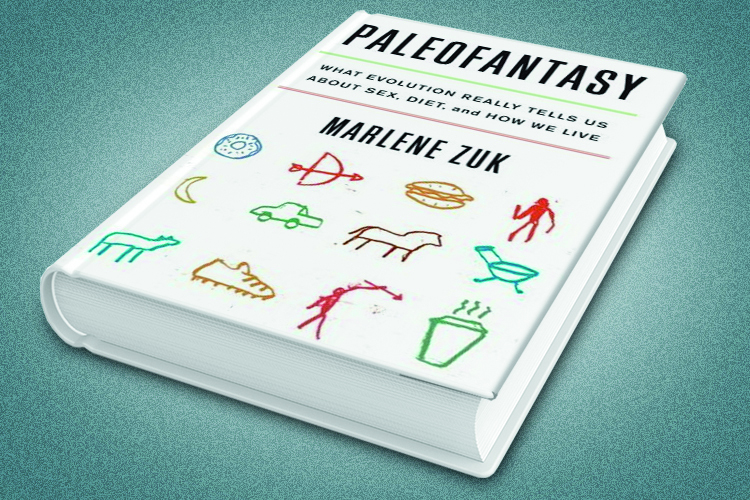
"Paleofantasy": Stone Age delusions - Salon.com
An evolutionary biologist explains why everything you think you know about cavemen (and their diet) is wrong
Salon.com
176 points · by tangue · 13y ago · 190 comments
To anyone uninformed about the paleo diet:
The Paleo diet is not a crusade against anything that isn't a meat or vegetable and its certainly not trying to perfectly emulate some fictitious caveman's food diary. The paleo diet is a recommendation to avoid things that have anti-nutritional properties, things that may tax our liver or our insulin response or halt our ability to digest vitamins and minerals as effectively.
The critical takeaway from the paleo diet is that there are many foods that the average person may have a "tolerance" for, but why eat foods we simply tolerate when we can eat foods that we thrive on?
The Paleo Diet is based upon eating wholesome, contemporary foods from the food groups our hunter-gatherer ancestors would have thrived on during the Paleolithic era, the time period from about 2.6 million years ago to the beginning of the agricultural revolution, about 10,000 years ago. These foods include fresh meats (preferably grass-produced or free-ranging beef, pork, lamb, poultry, and game meat, if you can get it), fish, seafood, fresh fruits, vegetables, seeds, nuts, and healthful oils (olive, coconut, avocado, macadamia, walnut and flaxseed). Dairy products, cereal grains, legumes, refined sugars and processed foods were not part of our ancestral menu. The site makes constant references to "the mainstays of Stone Age diets" and advocates a high potassium/sodium ratio because "Stone Age bodies were adapted to this".
Another site early in the results: "Cut out all cereal grains and legumes, cut out sugar, eliminate dairy products" which I think covers everything outside of meat, fruit and vegetables.
PaleoDiet.com: "Paleo is a simple dietary lifestyle that is based on foods being either in or out. In are the Paleolithic Era foods that we ate prior to agriculture and animal husbandry (meat, fish, shellfish, eggs, tree nuts, vegetables, roots, fruit, berries, mushrooms, etc.). Out are Neolithic Era foods that result from agriculture or animal husbandry (grains, dairy, beans/legumes, potatoes, sugar and fake foods) "
If you object to people rebutting this 'straw man', then perhaps you should try and stop people from proposing it. You can't call something a straw man simply because it's not what you personally mean by the word.
[1] http://en.wikipedia.org/wiki/Rice#Asia [2] http://en.wikipedia.org/wiki/Soy_bean#Asia [3] http://www.hsph.harvard.edu/obesity-prevention-source/obesit...
Don't try to tell me every american, especially fat ones, cracks open a can of creamed corn kernels every meal for a vegetable. In a modern fat american diet, grains = wonder bread (or equiv) made out of sugar, oil, and HFCS, doritos made out of oil aka junk food. Pizza with the wheat and soy flour crust baked on oil with a super sugary sauce covered in oily meat and dairy cheese. What, if anything, do americans eat made out of grain that isn't a junk food? Bread is junk food. Donuts are junk food. Pretty much everything from the bakery is junk food. Breakfast cereal is junk food. Granola bars are junk food. Oatmeal (my son needs special GF uncontaminated oatmeal..) is just a delivery vehicle for 25% by weight brown sugar, butter, and maple syrup, so thats junk food too. Anything fried, baked, and heavily seasoned and sealed into a shelf stable bag contains wheat and/or soy and is junk food. Is there any junk food out there made without dairy, soy protein extract, or wheat? I have extensively researched this and the answer is basically "no". My son can eat a couple kinds of corn chip and some unflavored potato chips, thats about it for his "typical american diet" junk food. Almost anything "heat and eat" from the freezer section of the store is off limits.
My son has a medically diagnosed allergy to a protein in wheat. So for about a decade, no wheat (ditto soy and dairy ... so we eat what boils down to medically required paleo diet at home since about 2004, although we don't (probably to our detriment) exclude potatoes, rice, and beans). Coincidentally, exclusion of wheat pretty much excludes all junk food. There's not much he can eat in the category of "junk food" other than some plain potato chips, and specialty expensive therefore rare exotic gluten free junk food. I only get to eat "junk food" while at work, its not like I'm gonna dig into a cake in front of a kid who can't eat it without exploding out both ends...
I see it as a happy coincidence. If the FDA mandated all junk food contain blue food coloring, and a diet was proposed that we shouldn't eat stuff made with blue food coloring, it doesn't "really" matter that its not the blue dye making us fat...
To me that means past data on obesity quite pointless - that large parts of our populations is able to afford enough food to easily get fat is a relatively recent thing.
However, what you are copying/pasting here is marketing copy. Diets tend to fail because people fail to adhere to them. People fail to adhere to them because they are complicated. These sites are trying to convert visitors by providing a simple, palatable message.
When you get past the sales pitch there is real science behind the paleo diet. The paleo diet started out as a hypothesis based on a paleolithic diet but the paleo diet is well supported by modern nutritional concepts and is advocated for those reasons, not simply because a caveman ate it.
edit: if the paleo diet were simply based on the premise "a caveman ate it" it would be nothing more than a fad diet that died out in the 70s.
My point is that you are wrong that nobody makes those claims, here are some examples of people using exactly that description. Feel free to argue that it misrepresents the makeup of and the reasoning behind paleo diet, but don't argue they didn't say it. And if you've literally never heard someone arguing that they eat just meat and vegetables because our bodies evolved for it in the Stone Age and haven't had time to learn anything else, I envy you.
Here is a fun article about some people who self describe as being 'paleo', for an example of how this 'just marketing copy' is the same as the actual justification for paleo used by many people: http://www.nytimes.com/2010/01/10/fashion/10caveman.html?pag...
====
You'll be following the diet that every single person on the planet ate only 333 generations ago. ... Here are the ground rules:
1. All the lean meats...you can eat
2. All the fruits and non starchy vegetables you can eat
3. No cereals
4. No legumes
5. No dairy products
6. No processed foods
====
It seems like much more than a straw man or marketing copy.
http://books.google.fi/books?hl=en&lr=&id=d_lVB6HZJ4...
Page 23.
google: "straw man fallacy", first result http://en.wikipedia.org/wiki/Straw_man:
>A straw man is a type of argument and is an informal fallacy based on misrepresentation of an opponent's position.
I'm not a "Paleo" person, but the hinting in this article that folks trying to infer better living patterns from the past are loons is faintly preposterous. We have just mounds of evidence (which doubters are free to research themselves) that many pre-Agricultural societies had (and have, actually) far lower rates of the so-called "diseases of civilizations". More abstractly, evolution isn't magic. There is some rate of lifestyle change due to technology that will outstrip evolution's ability to accommodate it.
Hunters and gatherers weren't obese. We are. By irrefutable inference, some lifestyle difference explains this. One valid way to approach the problem of our accelerating obesity is to study what has changed. The theory that I consider most likely at this point is the one argued by Stephan Guyenet, a PH.D. neurobiology researcher who studies the link between obesity and the brain. He posits that modern industrial food is hyperpalatable, so we eat too much of it.
http://wholehealthsource.blogspot.com/2011/10/case-for-food-...
It wouldn't be the favorite theory in the Paleo community, I imagine, but it springs from the same intuition.
Yeah and that difference is the sheer abundance of cheap calories. People can and did get fat when eating too many calories of Paleo (easily possible if you overemphasize the fatty meats and sweeter fruits), people can and did lean out on breads and junk-food by simply consuming fewer calories than they expended over a prolonged period.
I have no axe to grind here, I'd say I myself eat 99% Paleo 99% of the time, save for the occasional brownie. Otherwise it's meats, vegs, fruits for me. But that's just my personal taste, and for body-fat storage or lack of it, consuming in excess of your energy expenditure surely must account for most of the most of it.
Actually you shouldn't even want to as there's a certain problem with gathering data on populations that lived 10,000 years ago with a geographically dispersed sample size of ... oh, I don't know, single digits?
Here is what I consider a decent introduction into the subject
http://wholehealthsource.blogspot.com.au/2009/03/paleopathol...
Obesity is the result of a caloric surplus. Cavemen didn't have that luxury.
Obesity epidemic is a very recent phenomenon. Are you arguing that there were no societies that had caloric surplus up until late in the XX century?
Or would you say that American Samoa with obesity levels of 70% [1] somehow have the luxury of having calorie surplus, while people of Switzerland (8.2% obesity) are struggling to get enough food?
Speaking about Paleo diet in particular, why don't those guys gorge themselves into obesity [2]?
The Kitavan people have been under greater study for their remarkable health characteristics. The people show no indication of coronary heart disease, stroke, diabetes, dementia, congestive heart failure, acne, low or high blood pressure, or obesity. There is also almost no indication of cancer.
The Kitavans have abundant food supply and are not threatened by malnutrition or famine.
[1] https://www.cia.gov/library/publications/the-world-factbook/...
Do we know that? I thought there was some research indicating the hunter-gatherer societies actually had to devote rather little (comparative) time to gathering sustenance.[1]
Is there some research I should be aware of that refutes this, or at least asserts more information as to a likelihood one way or the other?
No obese cavemen? How about a cavewoman?
So the energy in/energy out thing might hold, but it is just part of the problem. The real problem is how to regulate food intake appropriately.
Actually Dimaond also describes traditional people overeating to the extreme when they have meat on rare occasions (some kind of meat festival). So of course abundance of food is part of the problem - if those people had meat all the time, perhaps they would overeat immediately. But so we could still learn about sane frequencies of food intake from traditional societies.
(I don't really have a point, but it's interesting how focused pop culture is on chipping rocks when polishing them is one of the foundational aspects of civilization)
The obesity epidemic is a modern phenomenon. It has nothing to do with the change from hunter gatherer to farmer.
Obesity may be targeted by certain disease, but usually only after the age of reproduction.
Do you have any proof for this statement:
>there was a clear dip in human health once we entered the neolithic era
This statement seems hard to prove seeing as we didn't keep any health-records between 10,000 BC and 2,000 BC (I can see, however, that we currently live quite unhealthy).
"nutritional standards of Neolithic populations were generally inferior to that of hunter-gatherers, and life expectancy may in fact have been shorter, in part due to diseases. Average height, for example, went down from 5' 10" (178 cm) for men and 5' 6" (168 cm) for women to 5' 3" (165 cm) and 5' 1" (155 cm), respectively, and it took until the twentieth century for average human height to come back to the pre-Neolithic Revolution levels."
The citation is to a Michael Shermer book.
[1] http://en.wikipedia.org/wiki/Neolithic_Revolution#Consequenc...
http://www.ditext.com/diamond/mistake.html
Edit: As others have mentioned below, the main evidence is a decline in the height, bone density and tooth health of skeletons of pre and post neolitic humans.
Average lifespan also declined, from 33 --> 20 according to Wikipedia. (I don't know if the studies cited are good sources)
Keep in mind that these lifespan figures include infant mortality. This explains why they remain so low up until very modern times.
http://en.wikipedia.org/wiki/Life_expectancy#Life_expectancy...
http://en.wikipedia.org/wiki/Mark_Nathan_Cohen
EDIT: He's quoted in the article you linked, actually.
It seems that some of the cited stuff is still too inconclusive to fully draw the conclusion farming -> decreased "body fitness", but there definitely seems to be some tendency there.
I am not an anthropologist.
Much can be done with forensic anthropology. There is one North American area in present day Mississippi that was inhabited across the adoption of agriculture, and the decline in health is documented in the teeth and bones.
I think Dr. Harris' blog is a great source and I follow his steps best I can: http://www.archevore.com/get-started/
I began eating a quasi-paleo diet at the beginning of February including the removal of all dairy. I reintroduced dairy to see if it had any noticeable impact and it didn't, so I kept it in.
This article highlights one aspect of the scientific community that I abhor, the petty disputes. So on one side we have Cordain, who promotes a new diet that seems to carry some widely documented positive results, but who may be inaccurate in his notion that we haven't had time to adapt to changes in our nutrition in the past 10,000 years and may or may not be extrapolating a bit on other points. On another we have Zuk, hellbent at debunking the former's work, based solely on those arguments. Finally, we have Laura Miller, author of the article, who feels that Zuk's arguments are justification enough to dismiss proponents of the paleo diet almost as a fad.
Yes, crickets managed to adapt to their predator in 5 years, but what of the multiple examples of species that just disappeared, when another was introduced in their ecosystem? Cordain is probably wrong in some of his presumptions regarding evolution, but then Zuk just ends up pointing that out without proving anything of interest herself.
Does Miller really believe that people who eat paleo do so because the diet is from the paleolithic? Who cares when it's from? A month ago I had only a vague idea of when the paleolithic ended. If you asked me I would've said "hmm, 50k years ago?"
What convinced me was its simplicity and results. I read reports and testimonies of people getting better on it and athletes performing on it. Rather than telling me "actually, this isn't quite paleolithic" or "actually, we did have time to adapt", I would be much more interested in a study that debunks those reports, or at least attributes them to something else than the diet.
Also, I've not yet read enough on the diet in details, but from what I've garnered of its main lines, there are some specific reasons as to why certain foods should be avoided. How about looking at those arguments and then debunk them? I for one would love proof that the diet is wrong about cereals and legumes.
>> "I read reports and testimonies of people getting better on it and athletes performing on it."
I think this is the wrong way round. When people make claims that stuff we've been eating for thousands of years (bread, cereals, grains etc.) are actually really bad for us, the burden of proof is on them.
If anyone could actually prove that wheat causes weight gain and health problems (independent of other variables), they'd be a good candidate for the next Nobel in Medicine.
Most studies I've read show that Paleo is no better or worse than a normal healthy diet. In some cases e.g. when you're an athlete, it'll be actively worse, since carbs are a basic source of fuel. [1]
On top of this, Paleo promotes some claims that are ridiculous, e.g. that burning fat for fuel == burning carbs for fuel. They have totally different consequences.
Yes, eating lots of carbs is bad for you. So is eating lots of fatty food. Loads of calories and not enough exercise means your body stores fat. That's sort of obvious, and nothing to do with any special properties that 'carbs' have.
Just eat plenty of vegetables (esp green / strongly coloured ones), and make sure you get adequate amounts of protein & carbs. To lose weight, make sure calories in < calories out. That's the general pictures studies give us.
Be extremely sceptical of anything claiming otherwise. I'm not sure why intelligent people can get so caught up in fads - such as Paleo - that are backed up by pseudo-science. My theory is that they appeal to the contrarian in us - after all, they're delightfully counter-intuitive in some ways (eating lots of steak can be good for me?!).
You've got to have contrarian ideas to be really intelligent, but not all contrarianism is good.
[1] I say this as a semi-pro runner who has tried running on a Paleo diet and found it disastrous. You cannot burn fat with the same efficiency as you can 'burn' carbs (i.e. use glycogen). It doesn't work that way. And if you still think it does, look up the diets of the top 10 athletes in basically any sport & explain to me why none of them are on Paleo.
I'm not sure if this should also apply with stuff that we put inside our body. In any case, not all of us are willing to wait that long, while we obviously see problems with the status quo. I choose to rather just make a judgement call based on social cues.
>> On top of that Paleo promotes some claims that are clearly ridiculous, e.g. that burning fat for fuel == burning carbs for fuel. They have totally different consequences.
This is inconsistent with anything I've read on this diet, but would be closer to the Low Carb High Fat diet, which I agree would be detrimental to an intense training regiment. May I suggest that you and I were not introduced to the same paleo diet? I recommend that you look up Robb Wolf.
>> Yes, eating lots of carbs is bad for you. So is eating lots of fatty food. Or lots of anything. Just eat lots of green stuff, and make sure you get adequate amounts of protein & carbs. To lose weight, make sure calories in < calories out.
Oddly, this is very consistent with what is promoted in the diet.
>> It mystifies me how otherwise-intelligent people can get so caught up in fads such as Paleo, backed up by flimsy pseudo-science.
Attempting to belittle people who choose to try the diet doesn't make you smarter and certainly doesn't prove nor validate your arguments.
>> My theory is that they appeal to the contrarian in us - after all, they're delightfully counter-intuitive in some ways (eating lots of steak can be good for me?!).
That is indeed only a theory. On the other hand, maybe some of us actually do see some results.
>> And if you still think it does, look up the diets of the top 10 athletes in basically any sport & explain to me why none of them are on Paleo.
The diet is extremely prevalent in the crossfit circles (it's even increasingly overshadowing the official diet, which is The Zone diet) and mixed martial arts (many of my training mates switch to it prior to competition). During my own research I stumbled upon this interview http://youtu.be/r-WRn8UttXw?t=10m (interview starts 10 minutes in the video, somewhere within the first 2 minutes after it begins Joe Rogan mentions having talked to many fighters who are on it).
My take away: "otherwise-intelligent people" use the diet as a set of guidelines for improved health and quality of life. You can choose to take it as a religion, but then lots of things just get more difficult. If you practice a sport, you need to adapt the diet to the demands of your discipline. I recommend to look up experts who are more sport oriented (I mentioned Robb Wolf earlier).
>> Yes, eating lots of carbs is bad for you. So is eating lots of fatty food. Or lots of anything. Just eat lots of green stuff, and make sure you get adequate amounts of protein & carbs. To lose weight, make sure calories in < calories out."
By agreeing with him, you have to come to the conclusion that following the above advice is what makes any diet good. There is nothing "unholy" about grains. I believe that was the point nqureshi was trying to make.
The pop-fad elements of the diet that have been parroted by journalists are generally the "elevator pitch" version of the diet, not the real 'meat' (pun so intended).
The main tenets of the diet are to avoid processed and/or high-sugar food, grains, (non-fermented) legumes, bad fats/oils (especially those from seeds), and dairy, and to seek out whole foods, fish and lean meats (especially from ruminants and organs) and good sources of fat (with good omega 3/6 ratio). Some folks can handle dairy just fine and do so. Some can eat white rice or white potatos and suffer no ill effects. Those are not outright banned by the diet. Carbohydrates can come in many forms that are accessible on the diet.
You were lied to, and I'm sorry that you tried to run without eating carbs, I image that would be unpleasant. But please discontinue spreading misinformation about Paleo, as it has vast benefits when applied correctly and in line with your body's needs.
Having been curious enough to browse paleo forums (including /r/paleo most recently), this is how most adherents seem to define it.
They may be wrong, but in that case it seems the majority of the paleo community is wrong.
> "But please discontinue spreading misinformation about Paleo"
It would be nice, then, if the paleo community can first come to an agreement about what it is, because even disregarding literature "from the outside", reduction in carbs and entering ketosis is a huge focus of conversations I've seen on these communities.
Some folks can handle dairy just fine and do so. Some can eat white rice or white potatos and suffer no ill effects. Those are not outright banned by the diet.
Of course they aren't "outright banned" but potatoes and rice are exceptions to the guidelines.
I got lazy as there it doesn't take much work finding research supporting increased fresh fruits vegetables and lean meat. http://www.ars.usda.gov/news/docs.htm?docid=9234 http://www.ars.usda.gov/News/docs.htm?docid=23004 http://www.ars.usda.gov/News/docs.htm?docid=22791
  > Does Miller really believe that people who eat paleo do so because
  > the diet is from the paleolithic?
> What convinced me was its simplicity and results.
People who are on the paleo diet tell me exactly that.
Anyway, they seem healthier than before they started, so taking an interest in healthier food consumption seems to work for them. As you say, the outcome is the important thing.
The Paleo diet may well have made the hunter-gatherers very healthy. However, as I have already passed their life-expectancy, there seems to be no data supporting whether it will work for my longevity ;)
The reason life expectancies were 35 back then was due to horrible infant and early childhood mortalities. People lived on the close order of 100 years (70-80 or so) back long before we had anything like medicine. For example:
> A saeculum is a length of time roughly equal to the potential lifetime of a person or the equivalent of the complete renewal of a human population. [snip] At the time of the reign of emperor Augustus, the Romans decided that a saeculum was 110 years.
In other words, if you wanted to make sure everyone who had been alive for some specific event was dead, you had to wait a hundred or so years. Does that sound like the reasoning of people who expected to die before they hit fifty?
Augustus - 75
Tiberius - 77
Vespasian - 69
Titus - 41
Nerva - 67
Trajan - 63
Hadrian - 62
Antoninus - 74
Marcus Aurelius - 58
I'll stop there - the next century is a drag.
It's not about the specific content, it's not about any pseudo-scientific justifications for the content, it's simply about how easy it is to stay on the diet without lapsing or indulging in any extraneous treats.
Did that coincide with another change? Is your diet the only thing you changed? Did that reflect the results you were expecting?
I significantly reduced bread, rice, potatoes, pasta, legumes in the last 2 weeks. That's extremely unusual for me. In the same time, I probably ate more veggies than I would in 6 months. Broccoli, cauliflower, celery, lettuce, cucumbers, asparagus, kale, swiss chards, butternut and spaghetti squash and a bunch of other stuff. Some tubes for variety (yams and sweet potatoes). My fruit basket is always full and varied (avocados, papaya, bananas, grapes, apples, pears, oranges, tangerines, etc). I eat eggs, meats (including bacon) and seafood exactly like before. I eat nuts like before. I still drink green tea daily. So far my only previous snacking habit that seems to be "legal" in the new context is plantain chips, I'm not sure if it's really allowed, but I don't care, I'm not changing it.
My philosophy regarding diet is to encourage good habits, not discourage bad ones. In other words, fill myself with as much good stuff as not having to crave the bad. My brother bought pizza on friday, I ate it and drank some coke. Yesterday he brought home a sandwich for me, I ate it the same. I won't feel guilty about that.
I did have various cravings in my first week, but I simply increased my meal portions the second week and I've been fine for the most part. I stay extended periods without even thinking of chewing on a candy bar.
Regarding physical activity, I noticed that I recover better from training and swimming sessions and I also have more endurance.
I haven't bought into the grass-fed and organic mindset so far. I'll see where the current regiment carries me in term of performance and well being, before attempting to go "all natural" and see if it really makes a difference.
Obviously, humans have not disappeared - quite the contrary in fact - therefore they either have adapted to their new diet, or were already suited for it.
We have documented measurable evolution in large mammals in timespans of only several hundred years.
Not to mention the genetic changes that have occurred in the foods over those times.
>The genomic signature of dog domestication reveals adaptation to a starch-rich diet [1]
>Nineteen of these regions contain genes important in brain function, eight of which belong to nervous system development pathways and potentially underlie behavioural changes central to dog domestication6. Ten genes with key roles in starch digestion and fat metabolism also show signals of selection.
[1] http://www.nature.com/nature/journal/vaop/ncurrent/full/natu...
So, the good news is that in perhaps merely several hundred years, a diet consisting of lifetime unlimited quantities of regular Mt Dew, tv dinners, bacon, and potato chips will none the less evolve humans who successfully reproduce. Oh wait, whoops, all these people are medically crashing with lifestyle diseases at age 40 after having 10 kids. And meanwhile for those couple hundred years, any small segment of the population who avoids evolving will personally benefit..
There is also a horrific ethical component to evolving mankind for profit. So Monsanto, Dow, etc make a lot of money, at the cost of hundreds of years of humanity dying young in agony. Hmm. It sort of like saying we "should" evolve ourselves to tolerate lead in the environment, or tolerate any other poison. I don't think that quantity of human suffering because of the evolutionary process balances out with some megacorps making a couple extra bucks. I mean, if killing ourselves via diet educated us, or permanently improved the ecology of the planet, or sent us to the stars, or improved our culture, well, not definitely yes, but "maybe". But all that suffering merely for a goal of "some rich dirtbag will get richer", well, uh, "no thanks".
So while it's a fair point of criticism of the paleo argument, it's not enough to dismiss it. If you find a flaw in the proof of a theorem, you have not disproved the theorem.
I also have yet to meet[2] a scientist whose word I would trust as the last word on the way I should eat. On the other hand, I've met a lot whose words have influenced how I eat. And based on the reading I've done, we are still so far from really understanding how the body processes food that the only sane approach is to read a lot, experiment on yourself, and monitor the results[3]. Unfortunately, there are just far too many people trying to sell something[4] when it comes to food.
1. I've settled pretty close to Atkins. In fact, one of the things I really like about Atkins is the "on-going weight loss" phase where you literally experiment, journal and measure to find out what is working for you.
2. "Meet" in the "I've read" sense. I'm always looking for more to read on this topic. Due to lack to good information being available, I passed 350 pounds. It took surgery to have a chance to start again; then a lot of studying to take advantage of that start.
3. The scale may be the worst way you can measure your progress. Blood tests are good. A journal of the way you feel is also good.
4. It is sad that, even the best intentioned scientists, still need to "sell" their work to their funding agencies. I don't have a concern than anybody is outright faking things; the concern I have is that anything that doesn't match the current dogma as decided by the FDA, USDA, etc, is getting silently thrown away. Not just "not published", but not even submitted for fear of what a result that challenges the orthodoxy can do to one's career.
Post-pleistocene human evolution: bioarchaeology of the agricultural transition http://www.cast.uark.edu/local/icaes/conferences/wburg/poste...
The Worst Mistake in the History of the Human Race http://www.ditext.com/diamond/mistake.html
Health versus fitness: competing themes in the origins and spread of agriculture? http://www.ncbi.nlm.nih.gov/pubmed/20642145
On the Early Holocene: Foraging to Early Agriculture https://depot.erudit.org/bitstream/002029dd/1/CIRPEE05-02.pd...
There is no relation with the two arguments btw - "People adapt fast" - yeah but the ability to spike your blood sugar and insulin all day long into the stratosphere is recent, and because of the modern health system there is no evolutionary pressure. A guy with type 2 diabetes will have long life. Just crappy.
I think that every person could build a good diet for themselves following these rules:
1. Cut soda unless in the middle of a marathon or a brutal workout
2. Treat anything with added sugar as dessert and eat it in amounts suitable for dessert two times a week top.
3. Don't eat anything that has had its fibers removed.
4. Always start the meal with a big leafy salad.
5. Avoid overly processed meat products, products with too much salt and fats that have gone trough other processing than mechanical/thermal.
Comparing these examples to completely rewiring the human digestive system, insulin response mechanism, and immune system to deal with digesting and utilizing foods (refined sugars, grains) in vast quantities which we rarely if ever encountered before seems like something that might take a bit longer to evolve.
The argument almost seems to say "evolution has been observed on shorter timescales, therefore any evolutionary leap is possible on shorter timescales."
http://www.amazon.com/dp/B007Q6XM1A/?tag=saloncom08-20
I'd be curious to see more scientific reviews of the book first before buying it.
(Author Nassim Nicholas Taleb, after noticing that some "reviewers" of his first book seemed not to have actually read the book, added section headings in the table of contents of his second book designed to trip up lazy reviewers. He detected several of those, even among people who review books for professionally edited publications for mass audiences.)
I did find that Taleb is quick critical of poor-quality reviewers, but did not find something which matches your description. I presume it's described in his third book?
http://www.fooledbyrandomness.com/
but he no longer has the same list of stories about reviews of his earlier books linked there from the home page.
There seem to be no reviews of any science bloggers that I can find - but from reading through the article it seems that the author and me share many grievances about the myths perpetuated by some of the paleo-diet-folks (I'm a biologist, myself).
Regarding that Amazon-review: It was posted on the 5th of March, but the book is only going to be published on the 11th. Did he/she get a preview-edition? I somehow doubt it, the reviewer doesn't seem to be the kind of person who receives copies for review.
Of all the things that exist in the modern world, lead in atmosphere, weird fungicides in our furniture fire retardants, etc, why is it the one thing that is under individual control that is the main contributor to our malease - it seems far too linked to the common "if you are ill / poor then you aren't trying hard enough" meme that Oprah et al tend to fall for.
Anyway, as a set of nutritional guidelines it seems reasonable, if only because the avergage food obsessed westerner has aceess to a range of fruit veg and meat that our ancestors never dreamed of.
Now stop trying to persuade me to agree with you so that I can be saved - it smacks of religion
http://robbwolf.com/2012/03/09/paleo-diet-inflammation-metfo...
Firstly it has the tang of religion - we have found the answer, it requires certain rites and adherences and we must now persuade you to believe
Secondly it is highly highly unlikely an actual Stone Age person had access to the range of meat and vegetables currently in wegmans and so the question is which Stone Age diet? The one where they lived near a lake and had fish, the one where they had lots of vitamin C rich berries but few fish?
Thirdly evolution is slow but not glacial - 2.6m years is a long time, and frankly why go back that far and not further? At what point has evolution not caught up and how does that overlap with 'out of africa'?
Finally and th biggest question to me, is why assume that so many maleases are solely or primarily diet related. Obesity is pretty obvious but asthma? Cancer even?
I'm not sure how any of this addresses the claim that carbohydrates are a major cause of disease which is the only issue my post addressed.
http://www.youtube.com/watch?v=dBnniua6-oM
>Finally and th biggest question to me, is why assume that so many maleases are solely or primarily diet related. Obesity is pretty obvious but asthma? Cancer even?
A transitive relationship is being inferred.
There's evidence that cholesterol plaque build-up is driven by inflammation. There's evidence that many cancers are driven by inflammation. There's evidence that insulin spikes are involved in bio-molecular cascades for driving inflammation which are also involved in diabetes. Therefore carbohydrates are involved in inflammation which predisposes a person to cancer, heart disease, and diabetes. Proving anything beyond doubt in biology is difficult but it's a compelling hypothesis that needs further investigation.
That way I think a lot of things you mention can be excluded - not that lead and fire retardants are not dangerous, but that is another area of problems.
Where can I find details on what did happen to people 11,000 years ago?
With respect to what people ate (especially how much meat), the only safe assumption was “whatever they could get,” something that to this day varies greatly depending on where they live.
Precisely. I can not tell exactly what and how much they could get, but I can know for sure what they could not get, regardless of where they lived, under any conditions:
- Sugar
- White bread
- Vegetable oils
- Soft drinks
- Any kind of packaged food
- Any kind of industrially processed food
etc.
For the rest - yes, one should be free to eat as much as they want vegetables, fruit, meat, fish, fresh nuts, berries etc ...
Can you eat corn (domesticated some 9,000 years ago), sugar cane (8,000), or bananas (8,000) Wild almonds are toxic, but safe domesticated varieties started appearing some 5,000 years ago. Also, macadamia nuts have a similar problem, and they were domesticated only some 200 years ago.
What about strawberries? Wild strawberries are edible, but tiny. It wasn't until about the 1400s that we started breeding them for size. Cabbage, broccoli, cauliflower, kale, Brussels sprouts, savoy, and Chinese kale are cultivars of Brassica oleracea, but no one 10,000 years ago would have been able to get them.
Olives are treated to make them less bitter. Is curing or fermenting permissible, or does one eat only the olives which can be eaten without processing? When does the food become too processed?
By your logic, you've given up on coffee, chocolate, and alcohol, right? No paleolithic person ever tasted a drop of whiskey.
I'm not saying that moderation or abstinence in the foods you list is a bad thing, only commenting that the logic behind it would preclude eating or drinking certain vegetables, fruits, nuts, and berries which were not available 10,000+ years ago.
The general approach to exceptions is that exceptions exist and yes, it is impossible to eat 100% foods that the paleolithic man ate. Obviously even modern cows or pigs did not exist 20K years ago. And one can argue that wild fish / game is also not the same cause they evolved somewhat. So, the approach is that while the ideal is 100%, the real goal is not to reach it, but to gradually come closer.
I.e. eliminating sugars, white bread, sodas, vegetable oils is probably already ~70% of the way or more.
Olives are treated to make them less bitter. Is curing or fermenting permissible, or does one eat only the olives which can be eaten without processing?
Well, my personal approach is that fresh/cooked is OK, and then, the more processing is done, the farther we are away from ideal. So, along the lines of fruit > fresh fruit juice > reconstituted fruit juice > fruit drink > water with dissolved fructose. That's not "scientific" and I'm not aiming to prove it.
By your logic, you've given up on coffee, chocolate, and alcohol, right? No paleolithic person ever tasted a drop of whiskey.
That would be ideal, though I haven't reached that point yet. I'm not even sure I will seriously try to eliminate all those by 100% - but any reduction will be beneficial.
That latter goal is much easier for me to understand, and even support, though I wonder if corn, being the result of 5,000 years of directed evolution, is more processed than beer.
Take for example alcohol. There's good genetic evidence that humans have evolved to better handle alcohol. Eg, "The studies on human ADH (alcohol dehydrogenase) gene have suggested Darwinian positive selection on the genetic variation of ADH1B His47 [52–54]. Alcohol consumption is a recent agriculture-related life style, and the adaptive selection has begun about 10 Kya" http://www.hindawi.com/journals/ijeb/2011/484769/
During the Babylonian era, "a daily ration of beer was provided for all citizens, the amount depending on one's social status" and "it was sometimes used to pay workers as part of their daily wages." During the Middle Ages it was safer to drink than water.
And that's the point of the linked-to criticism - 20,000 years is long enough that our genetics are different than humans of the same era. We've evolved to better handle starch, to better handle drinking milk as an adult, and to drink alcohol.
To choose a paleo diet on the belief that it better fits our genetics sounds like it denies the evidence that our genetics have changed since then.
Nothing wrong with a slice of birthday cake at grannie's 80th. Something hugely (lol) wrong with two packs of twinkies every lunch.
The "newer" it is, the worse it probably is to eat, and the older it is, the better it probably is to eat. Do your weekly/monthly meal planning based on that. I intentionally eat roughly 100 times as much apple by weight as chocolate. That doesn't mean I only eat apple or never eat chocolate. Most of my meals look something like a large salad, a large vegetable side dish, a relatively modest hunk of meat, and some citrus / fruit / berries for desert. I'm hardly starving or restraining myself. I'm actually something of a gourmet glutton. I just eat "old school" instead of modern stuff.
BTW in the olden days not every piece of fruit was supermarket scale picture perfect, as anyone who's hand picked their own strawberries probably knows? You're hungry, the somewhat fermented grapes still taste OK-ish... your liver evolved to clean up the poison... Ethanol is not supposed to be a primary source of calories, its a moderately toxic systemic poison which your body is fairly tolerant of, well at least compared to cyanides or organomercury compounds. Drinking it on a regular basis is about as stupid as eating arsenic or lead salts for kicks. Another good comparison is getting buzzed drunk is about as intelligent as sniffing carbon monoxide until dizzy. None the less as per the granny example above a glass of booze once in an occasional while is OK. Just as long as most of the time, lets say 10000 to 1 ratio, you drink water instead of chugging a beer. I actually like beer, I just don't drink 12 per night or even 1 per week. How often would you be comfortable drinking anti-freeze? I drink booze a little more often than that, but not much.
In a similar way there's nothing really wrong with an occasional pack of twinkies, as long as your lifetime average is running around 1000 carrots (or equiv) per twinkie.
I have noticed long term that tastes and physical reaction changes... I used to like jello, but now it kinda grosses me out. I mean I could eat some once in awhile, but I really don't want to anymore. Or ice cream, once you're not carb addicted anymore, lets be realistic, its sickly sweet combined with a mouth feel and texture like cold olive oil pouring down your throat, eww thats just gross, like sugar mixed with crisco shortening or "equal" artificial sweetener mixed with lard. Once in awhile I have some anyway and remind myself why I don't miss it anymore. This is before I start thinking about how it comes out of a cow and is designed to fatten up a calf, but I'm not a baby cow nor do I need any more fattening up.
You've offered a different set of guidelines than the previous poster, but some of the same questions remain. What's "old" and what's "new"? Is corn new or old? What about almonds, which are toxic in the wild species, or taro which is toxic until processed? What about wheat?
Wild apples are not that edible. They are too astringent; crabapples. It's only through grafting of the very occasional tree with edible fruit that we get new edible cultivars. The Gala apple has only been around since the 1970s. Does that make it new? (Interesting story: Johnny Appleseed brought apple trees to the western frontier for making hard cider and apple jack, and not for eating. They were grown from seed, and only grafting preserves the taste.)
Domesticated sugarcane is older than most other plants we currently use. Should we prioritize sugarcane, because it's older? Or is it only foods species unchanged since 10,000 years ago that we should prioritize?
If you, like I, haven't inherited genetics from the indigenous peoples of the Americas, then your personal genetics have had less than 500 years to evolve for pineapple, corn, tomatoes, and other New World plants. Should we avoid New World plants and only eat things found in East Africa?
500 years ago isn't that long. That's almost exactly the same time that the Reinheitsgebot (German beer purity law) has been in place. How long does it take for a new food to become old? Your genetics have certainly not adapted to eat macadamia nuts from Australia, because they've been a crop for less than 200 years, and only Australian aborigines would have had any adaptations for them. Does that make those new or old to our genome?
Commercial production of macadamia nuts is about as old as Jack Daniel's. Should they have equal prioritization?
Believe it or not, but beer making is at least 7,000 years old. You can't say "Drinking it on a regular basis is about as stupid as eating arsenic or lead salts for kicks" because for it has been a daily drink for several thousand years. During the Babylonian era, "a daily ration of beer was provided for all citizens, the amount depending on one's social status" and "it was sometimes used to pay workers as part of their daily wages." During the Middle Ages it was safer to drink than water.
In fact, we've evolved in order to process alcohol better: "The studies on human ADH (alcohol dehydrogenase) gene have suggested Darwinian positive selection on the genetic variation of ADH1B His47 [52–54]. Alcohol consumption is a recent agriculture-related life style, and the adaptive selection has begun about 10 Kya" http://www.hindawi.com/journals/ijeb/2011/484769/
Even if you think that the genetics of the paleo era outweigh the genetics of the last 10,000 years, our monkey/ape guts tell us that we did not evolve with the expectation of eating "a relatively modest hunk of meat" for most of our meals.
This tells me that you don't know the history of our food and your adjusting things up to fit your personal beliefs. Your last sentence is equally odd - my European genetic ancestry definitely co-evolved with animal husbandry to make it so I can drink cow's milk as an adult. You reject that genetic heritage because you're squeamish?
That's all fine as a personal or moral belief, but it doesn't make good sense as a general "mandatory" consideration.
3. Abundance. People didn't have to "limit themselves" 2000 years ago because they either were usually, or at best occasionally, starving back down to size, along with massive vitamin and mineral deficiencies (so you can eat 3000 calories per day as a sailor, but if you're also simultaneously dying of scurvy, they you don't have to worry so much about getting fat). In the shorter term, religious fasting seems to have died out although oddly enough we keep religious feast traditions alive pretty well. Also gluttony seems to have disappeared from the list of sins. Someone who wanted to eat until 400 pounds 2500 years ago could want all they want for free, but they simply aren't getting the food to do it, so... hungry and skinny even if their internal weight thermostat says 400 pounds is a great goal. No caloric intake limit for an entire lifetime in 2010s America.
4. Non-ag lifestyle beginning a century or so ago has lead to weird ideas about our diet, so "rediscovering" what farmers have always known seems new. So 98% of the population doesn't farm. People discover corn products can be yummy and start exploding waistlines. The 2% of the population who farm are like "duh, everyone knows corn is the best way to fatten up hogs and other mammal livestock, duh!" but we don't respect farming as a profession so we need scientists to "discover" hmm corn consumption seems to positively correlate with waistline, how curious I wonder if cutting back on corn would help obesity... naah the corn industry lobbiests would kill me if I said that... Pretty much if farmers slop the hogs with it to fatten them up, you probably don't want to eat that unless you need fattening up.
To me "is it doing something we know is bad" seems like something that would be useful to know. I don't care so much about "is it historically correct". I'd gladly trade that for even 100 people eating better. Pragmatically, it seems like a decent diet, so let's figure out how to get more people to eat healthier instead?
If I get this right, the idea is that we can't be adapted for a diet that changed only recently, so therefore we should eat the diet we are likely to be more adapted to. So this kind of makes sense, in a "sounds reasonable" way.
It's certainly true that switching to a system of agriculture resulted in a drop in nutritional health, in the short term.
But, equally, what about the argument that goes: when we used to eat this diet, we died a lot younger than now. ok, they were lots of reasons for that, but we died a lot younger, so it's not unreasonable to imagine that diet was part of the cause.
Both arguments seem reasonable without being rigorous. I don't see why you'd choose one over the other.
Having had friends who studied nutrition at a top UK university, and read a bit about it myself, it seems to me that we know very little about nutrition in general. The best advice appears to be "eat a well-rounded diet with plenty of fresh fruit and veg, and don't eat too much junk food."
The idea of switching to something as radically different as a paleo diet, compared to what we've been eating for thousands of years, without a full scientific understanding of what is best, seems a bit reckless to me. I think the burden of proof lies heavily on the paleo side. And that requires not just a handful of empirical studies; I read a bit about one of these studies [1], and was not well executed - it didn't even use a control group. People adopting the diet without substantial evidence in its favour might be gambling with their health.
Anyone recommend good books on the topic? I'd like to read more.
[1] Effects of a short-term intervention with a paleolithic diet in healthy volunteers. Osterdahl M, Kocturk T, Koochek A, Wändell PE.
Actually there are still people who live as hunter-gatherers, or there were until a couple of years ago, and that is where a lot of the information comes from. It was also possible to watch what happened when such people entered civilization. There also apparently is a marked difference in the fossil record concerning health of hunter-gatherers vs agricultural societies.
I just read "The World Until Yesterday" by Jared Diamond, and he also touches on some of those health problems. Western people are actually less afflicted by them than those hunter-gatherers who entered 'civilization' in their lifetimes, so Diamond also says that Western people probably already evolved to some degree to deal better with the abundance of grains, salt and sugar.
That doesn't imply we are already perfectly adapted, though, especially if some diseases clearly don't seem to be prevalent in traditional societies.
Unfortunately he isn't very specific about the traditional diets, for example, and trying to look up paleo diets it seems to me a lot of time they are mostly an excuse to eat lots of meat and many books are not that well researched. In Diamond's books he mentions that many tribes actually ate mostly starches and meat only on special occasions - unfortunately he didn't mention the actual frequency, or I missed reading that (once a week? a month?). Also obviously humans adapted to lots of different environments, there are probably tribes who ate 100% meat, too (like in arctic regions where nothing grows?) - so maybe you can take your pick, or you just have to experiment...
That lactose tolerance seems to have increased fitness a lot certainly makes me wary of just accepting "pure paleo" as the best path.
I note that my programming skill(in term of producing tangle results) and mathematics are probably the only thing I trust in absolutely.
There are some scientific studies on the "paleo-diet" as an actual dietary plan, searching pubmed for "paleo-diet", "paleo diet" or "paleolithic diet" reveals 77 results, a few of which are concerned with how modern man might benefit of an old diet. Some of the published stuff is positive about paleo:
http://www.ncbi.nlm.nih.gov/pubmed/21139123
> Furthermore, doubts have been raised about the necessity for very low levels of protein, fat, and cholesterol intake common in official recommendations. Most impressively, randomized controlled trials have begun to confirm the value of hunter-gatherer diets in some high-risk groups, even as compared with routinely recommended diets.
It also seems to be good for sufferers of Diabetes Type II: http://www.ncbi.nlm.nih.gov/pubmed/20144375
So it seems that the usual recommendations for nourishment and sports (that's always good) are pretty good, but the evolutionary science behind it is quite hokum.
A lot of this knowledge that has been published outside of academic circles in books is slightly contradictory and is, in the worst case, broscience [1]. The wiki-page for this diet has some great points: http://en.wikipedia.org/wiki/Paleolithic_diet
[1] http://www.urbandictionary.com/define.php?term=broscience
If Zuk's point is that some people are applying evolutionary concepts blindly without verifying results or considering evidence, then her book title should have been: "Some People Are Stupid" and left it at that. If she wants to launch a counter to the paleo movement then I think she's fallen flat on her face.
My point in the above post was: Zuk is positioning herself as if she were attacking Paleo as a concept, but all she's really attacking is the mis-application of information by some members in a larger group. I call that a straw man.
Though I am tempted to think it is less to do with removing diary , pasta etc and more to do with them actually eating some damn vegetables now.
This is exactly the kind of bias that rational people should be scared of. This is exactly the kind of thing that we have double blind controlled studies to eliminate.
EDIT: Because if you do something, and it makes you feel good, well - that's fine. But don't go around telling other people that they're wrong and doing harm to themselves by not doing this thing.
Well, there are people who claim fasting makes them feel better, too. Or living on allegedly nothing but sun light.
I am not sure this is very good proof since e.g. not eating for a couple of days makes you feel good because it's your body trying to make you more active to gather food... so, as logical as some correlations might sound it seems flimsy to me. The best way is probably to go by blood and medical exams, to see if you actually are healthier.
Now that we are over 6 billion humans on earth, with migration way easier and common place than before, shouldn't on the contrary human evolution been speeded up ?
EDIT : I know evolution is not progressive but happen by sudden steps, but I suppose it still stands.
Evolution speeds up as a result of either an increased natural mutation rate or extreme environmental challenges (lots of death produced by unfitness) -- or both. But we're not seeing either in modern times.
> EDIT : I know evolution is not progressive but happen by sudden steps ...
No, this isn't true as a rule. In evolutionary theory, the overall rate of change,and the presence or absence of abrupt changes, is entirely dependent on what produces greater fitness. In other words, the rate at which evolution happens, and the shape of the change curve, are themselves driven by considerations of fitness and natural selection.
Migration does mean that any clearly beneficial changes will spread quickly, and a large population gives more chances for them to arise - lactase persistence is probably an example of this. So humanity probably does adapt quicker than it otherwise would to changes in the environment, if those changes affect most of humanity.
In the short term I'd expect to see humanity getting better at a lot of things as races intermingle and previously separate gene pools combine - a lot of things like height or fitness or intelligence seem to be combinations of many genes where "perfect" is in some sense the default; how good you are is a question of how many "bad" genes you've picked up (and most of the bad genes are recessive). I've seen anecdotal suggestion that mixed-race children are healthier (would be interested to hear if there's any proper studies of this). I suspect in the immediate term this will be a bigger effect than that of new mutant genes.
Why? We're well adapted to our "niche". There is not much different for us to adapt to.
The posters on this web site who are not part of the "1%" are often at the top of the middle class under the 1%...white, male, American, educated at college in CS, living in nice metropolitan areas in the US. What kind of work hours do we often see posted here? 50, 60, 70 hour weeks, or more. I know, I have done so myself - working for a Fortune 100 company. Imagine what hours a truck driver, or a Bangladeshi factory worker works, or some Chinese factory worker making iPads.
In Marshall Sahlins "The Original Affluent Society" he looked at how much the still existing hunter-gatherers in places like Africa worked, and did research trying to figure out what was the case 20 thousand, 30 thousand years ago. It seems hunter-gatherers often work less hours than many of the people on this site do, or truck drivers do, or Chinese factory workers do, or a lot of people do.
They also have no rent payments to make and the like. Hunter-gatherers, pastoral tribes and farmers tend to have to get forced more or less by gunpoint to the cities, including in our modern day. Why should the rural Mexican farm laborers forced off their farms by "NAFTA" come to modern America, because the unemployment rate is no longer above the 1984-2009 high like it was last month?
As the desire of the current hegemony is to pretty much ignore history completely, of course any people who look at history from ancient history to now, you want to paint them as loonies. This writer sounds like one of the apes in Planet of the Apes deriding people who want to go to the forbidden zone. And sure, it's easy to deride anyone curious about history, the economy, politics and so forth, and to say anyone interested in that old stuff is some Berkeley hippie eating the latest fad diet. She's the secular equivalent of the Christian fundamentalists who say the world was created in 4004 BC.
A new thing was introduced into the world 10000 years ago alongside farming - slavery. Read the Epic of Gilgamesh, or the bible, or modern anthropology. The "left"/"post-left" investigation of these things is mostly serious. But if Salon sees fit to point to a few wingbat hippies eating some faddish diet as a way to paint the whole study with a brush, well, I'm not surprised the website John Warnock and William Hambrecht bankroll is doing that.
There are constantly new results doing away with old truisms only to have those results, in turn, questioned and overturned by other studies and then there are basically opposing theories being found as valid, too. To make matters worse, there is an overwhelming abundance of less-than-scientific literature following the latest "fad" scientific results, plugging some diet "silver bullets" and to top it off, most "professionals" in that area are nothing but gym rats that payed lots of money for some training on a specific diet fad and then that is the only thing they will in turn plug to their customers. And the actual professionals, as in doctors, well mostly they appear to not be up-to-date with the latest-and-greatest "proven" theories so I always feel like I am missing out some of the good stuff that the latest fads are promising me.
All I wanted was a REALLY, actually healthy diet. Do I eat mostly wholemeal bread and rice as is common where I am from? Paleo and Atkins tells me this is literally poisoning and destroying my body and THE worst thing I could do next to shooting myself in the stomach. So only lots of fat, meat and vegetables? But "everyone knows" lots of meat is bad and one should only eat meat maybe twice a week, says the official generals statement here. Of course there are the different shades of vegetarians and vegans who all have discovered the one truth and the ONLY ethically correct way of living and they have the studies to back them up on the "healthy" side but e.g. the legumes they are eating are supposed to be literally poison according to the paleo crowd... yet beans are healthy, says another group, also backed by studies. Oh and fish, we all should eat more fish right? Yet we keep hearing how polluted the oceans are and how fish are full of mercury and probably nuclear waste from dumping it into the north sea. And I could go on and on and on....
For practically each diet recommendation or "fad" backed by studies you can easily find at least one opposite or contradicting study and at least two other, even more "true" and new diet fads.
Ultimately, this means I have no idea what I should actually, really really be eating and it leads me to the conclusion that: diet and health are the educated masses' modern equivalent to religion. Everyone is following their one true savior and will launch into borderline religious flame wars against the "infidels" of the other fads and theories.
Yet actually definitive answers seem to be missing.
And I am sorry if this seems like an incoherent rant, somehow it is, but I assure you with all the best intentions. Maybe it is just the tech inside me that wants a clear and definitive answer.
Although they go in opposite directions (Campbell advocates vegan, paleo meat), they seem to agree on at least one thing : unprocessed foods are better. Eat vegetables, fruits, whole grains and meat/fish, but avoid sauces/butter, sodas, white bread and various candies.
I figure the only real way to know what is right for you is to stick to a particular diet for awhile and see a doctor. A doctor should be able to tell you what you're deficient in and what any problems you might be suffering from. Then adjust.
Please go back to your regular diet of ice-cream and cheetos.
One of my local science broadcasters[1] often uses the phrase "don't eat too much of anything your grandmother wouldn't recognise as food" - and I suspect that's pretty much the same good advice as the paleo movement's, the marginal difference health-wise between eating common 1950/1960s food attempting to re-create some idea of paleo diet is almost certainly tiny.
High fat/sugar/salt junk food, high fructose corn syrup, hydrogenated vegetable oil - there's no doubt that they shouldn't form the basis of your diet. But the paleo movements arguments against agricultural societies grain-heavy diet, with it's several thousand year ongoing trial, doesn't seem to be quite so real.
[1] Karl Kruszelnicki - http://www.drkarl.com/home/ Another one of his food/diet related phrases is "Eat food. Not too much. Mostly plants."
Also, the argument based on evolution and selection is ludicrous. We have not stopped evolution.
I strongly suggest you ingest more fiber and avoid sugar, but I also remind you the plural of "anecdote" is not "evidence".