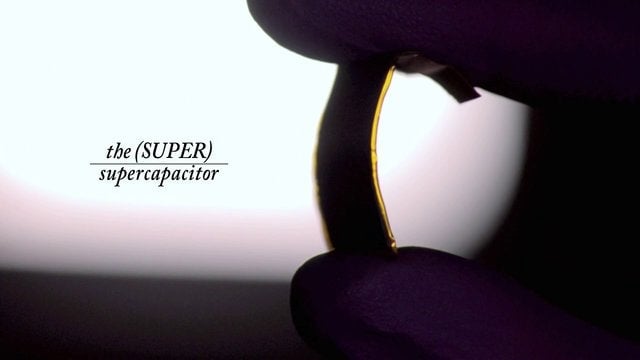
Meet the scientific accident that could change the world
Last year, researchers at UCLA made a rather fantastic, if serendipitous, discovery. A team of scientists led by chemist Richard Kaner had just finished
Gizmodo
464 points · by roachsocal · 13y ago · 104 comments
Higher energy densities aren't without issues, as Boeing found out with their 787. A battery like that is basically an explosive and it can be tricky to manage.
What often gets missed is that for it to charge fast, you need to provide a lot of power, a lot more than any current changer and laughably more than any inductive system can provide. Lithium Ion batteries can already max out the power offered by the 10W charger that comes with the iPad and charging off computer USB is often slow (USB is current limit). See Telsa's car charge times on normal wall outlets vs superchargers for another example.
To really reap the benefits of this quick charge technology you either need an infrastructure of ~1000W DC chargers throughout the world or carry something about the size of a desktop computer power supply with you at all times.
And that's when everything goes well. You would also need companies brave enough to risk the potential lawsuits if something goes wrong (user wears a pacemaker? Has some metal in his hand, e.g. in a tattoo? Charging accident releases heat that lights clothing?)
Now - what happens if you put your wallet full of credit cards on it?
"These micro-supercapacitors demonstrate a power density of ~200 W cm−3, which is among the highest values achieved for any supercapacitor."
Granted its not a legitimate energy density (wrong units) but lets guess it is 200 Ws per cubic centimeter. I make that guess based on the comment in the video that they ran an LED for 5 minutes. So an LED is like 15mA and with a forward drop of a couple of volts so 30 mW. For 5 minutes your looking at 9000 mW-seconds, or 9 Ws for the small capacitor they showed in their video which could have been about a cm ^ 2. So if the cell they had made was 1/2 mm thick then a stack of 20 of them would be 1 cm^3 and 180 W-seconds (in the ball park of the abstract). There is a fun presentation on Supercaps [1] that was given to DoE in 2011. This computation does suggest that 200 Ws for this material would be a decent jump in capacity.
That said, I immediately dug an old LightScribe CD recorder out of my junk bin to start playing around with making graphene sheets :-)
[1] http://www1.eere.energy.gov/vehiclesandfuels/pdfs/merit_revi...
You serious? Sounds interesting, do tell us more.
And here's a paper on the subject: http://evmc2.files.wordpress.com/2013/02/laser-scribing-of-h...
"The LSG-EC can exhibit energy densities of up to 1.36 mWh/cm3 , a value that is approximately two times higher than that of the AC-EC"
1.36 mWh/cm3 = 1.36 Wh/L
If we assume that 1 L of it weights very roughly 1kg. We get 1.36 Wh/kg.
From wikipedia:
"The amount of energy stored per unit weight [in ultracapacitors] is generally lower than that of electrochemical batteries (3 to 5 W·h/kg, although 85 W·h/kg has been achieved in the lab[12] as of 2010 compared to 30 to 40 W·h/kg for a lead acid battery, 100 to 250 W·h/kg for a lithium-ion battery and about 0.1% of the volumetric energy density of gasoline."
This is still less than 1% of the energy density of lithium ion batteries.
Well, cars do. As evidenced by the use of lead-acid batteries, power density > energy density for automobiles.
Of course, better power density is probably not the main obstacle to using capacitors in a car to replace the battery.
A headline like "DVD Graphene sheets store charge super fast in lab" would have helped me shift the various articles into my own working memory whilst the page loaded.
Downvote with comments please
(And I seem to get the general idea that Graphene will be big, but this is unlikely to be the killer app)
I wonder what, exactly, goes into the carbon slurry and if it's necessary to etch a particular pattern with the LightScribe.
[1] http://www.sciencemag.org/content/335/6074/1326.abstract [2] https://en.wikipedia.org/wiki/Graphene_oxide [3] http://pubs.rsc.org/en/Content/ArticleLanding/2012/JM/c2jm15...
My plan is to sell Lightscribe DVD drives and graphite oxide, like the store that sold shovels to gold miners.
No. DVD burners simply use a 630nm or 650nm red laser diode. It can not be re-tuned more than a few nm, by regulating the temperature of the diode.
You could replace the diode, but that is more effort than it's worth, and there's not much else to replace it with. If you wanted more power you might use a different diode, but the diodes are almost always buried really far in there and you would have to replace the electronics as well.
[1] http://www.scientificamerican.com/slideshow.cfm?id=diy-graph...
[2] http://www.independent.co.uk/news/science/the-graphene-story...
[1] http://www.sciencemag.org/content/335/6074/1326.abstract
http://physicsworld.com/cws/article/news/2010/nov/26/graphen...
Also, there's a lot engineering that needs to happen about how to integrate the proper charging circuits. Plus all the work that needs to go into actual mass manufacturing.
In all there's a shit ton of work for any product to actually make it to a mass market.
I suspect that the reason we are not seeing this technology in practice yet, is because of how long the design cycles take. I am not familar at all with small device manufacturing, but it seems like it would take a lot of iterations to make everything fit together so tightly, and a year may not be enough time to introduce a different battery system. Especially a battery system that your engineers have no experience with.
Having said that, batteries do seem like a pretty stand-alone component of phones, so it may be possible to design a graphine based battery that replace an existing phone battery without modification to the phone. It might involve doing more work in the battery to emulate properties of the traditional battery that the phones were designed to compensate for, but it seems like there is enough room in a battery to do that.
The other problem I can see is that standard phones would likely be incapable of charging these batteries at full speed, which would only mean the batteries need a charger external to the phone.
Again, not as good compared to designing the phones with these batteries in mind, but still useful.
The main problem I can see with pursuing these batteries is that by the time you are ready to sell them, there may not be a long enough window before they become standard for it to be worth your while.
Makers of portable phone rechargers may be the compromise to those issues.
Regardless, excluding unforeseen drawbacks to this technology, I suspect we will be seeing it within 1 or 2 generations of phone.
I am pretty sure every half-decent company has a research team on graphene right now, it is just that they don’t have results yet because results take time and making sure that these results are correct takes even more time.
Furthermore, as you said – even if we now managed to build a battery that charges in half a minute, the surrounding infrastructure is not yet there, and especially with components as critical as batteries, you don’t want them to break/blow up at your customer’s place.
I think that vendors could easily sell devices with a smaller capacity if they can charge in seconds. This seems like a benefit that is very clear, easy to explain, and understandable to a typical consumer, and it provides a near perfect solution to one of the major inconveniences of current phones. And, that inconvenience happens to be what people currently look to long battery life to mitigate.
But the dirty little secret is of course that it's not necessary. You need one day of battery life, then people get home and charge it by their nightstand. Similar with the Tesla, it has enough range to get through five times the average American commute, and the majority of people just charge at home when they sleep.
Bandaging peoples irrational fears might simply not be a very viable business model.
I can see this tech being widely used in place of current capacitor technology in a shortish timeframe- maybe 2 to 4 years. It'll also be used in novel technologies as battery replacements, especially for high discharge rate applications, within a similar time scale.
A usual home connection can handle only up to ~10A, so 190A is a lot of current. To handle this you must use very thick wires. To charge faster you need move voltage or handle more current, probably you will need even thicker wires and to be careful with the safety measures.
Additionally, this experiment use only in a tiny lab sample. To increase the size and make a big model for a car, a lot of technical details will appear, for example how to handle all the heat that the battery produces during the charge / discharge cycles.
By contrast the energy flux of a garden-variety gas pump is in the tens of megawatts.
The standard devices to handle passing from mains to battery should be able to be used.
note, I didn't downvote your comment.
Aren't debates over energy density of super conductors v. Li-Ion batteries missing the important point, relative cost?
E.g. If the energy density is 1/4 lower but the cost is 1/40th as much then electric cars get ALOT more viable. Can anyone guess at the relative cost?
Why is it ok to post again? Should I have provided the HN link?
If you'd said "You can find the previous conversation at XXX" then you'd be contributing. As it is you just added noise.