How far is it to Mars?
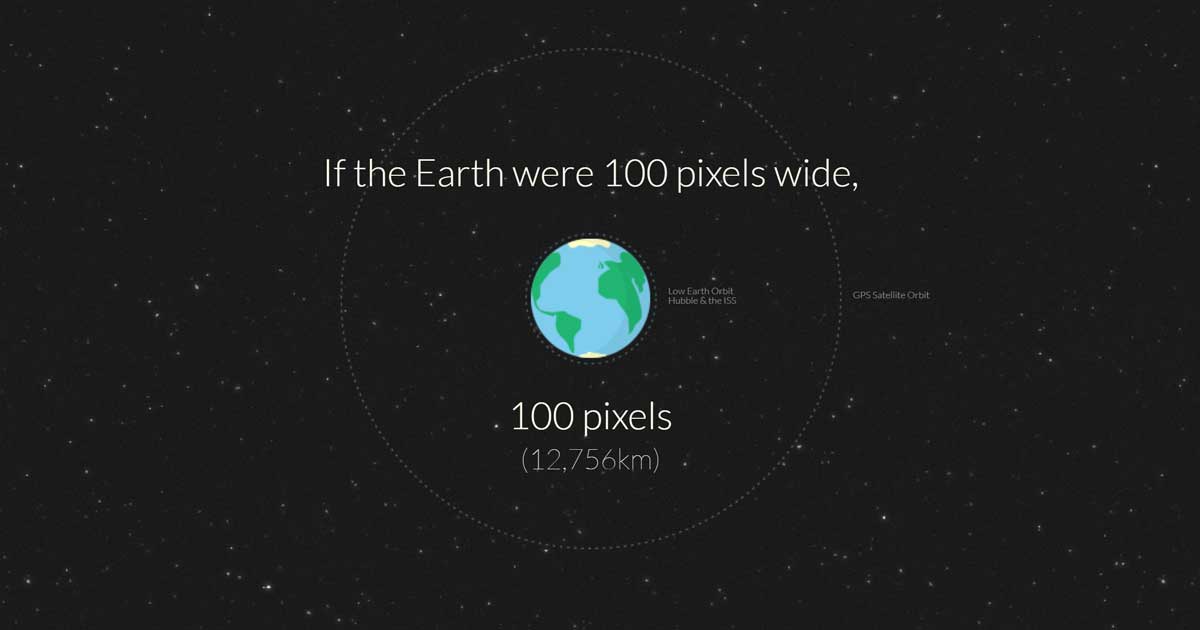
If Earth were 100 pixels wide, how far away would Mars be? Scroll through this interactive scale model to find out.
distancetomars.com
996 points · by oseibonsu · 13y ago · 208 comments
1) 3100 px: Farthest humans have been from Earth (Apollo 13, April '70: 400,171 km)
2) 10 px: Gemini 11, farthest from Earth on non-lunar mission (Sept '66: 1,374.1 km)
3) 3 px: Apogee of ISS (farthest a human has traveled for... a while: 424 km) (I'm probably forgetting something, can't find a good list of spaceflights by distance...)
Sources: http://en.wikipedia.org/wiki/List_of_spaceflight_records#Far...
http://en.wikipedia.org/wiki/International_Space_Station
http://en.wikipedia.org/wiki/Earth
Taking Earth's diameter as 12,742 km (though it bulges by about 43 km in the center), we're saying that's 100 px. So if my basic algebra is right (no promises) you can convert the above km values to px by dividing by 127.42.
Space is unfathomably big, and we are a grain of sand on the beach of the universe. But that grain of sand contains enough complexity and variety to fascinate for a practically unlimited period of time.
Mars is cool, and grand, and inconceivably different. I'd rather see the cherry blossoms in Japan, or go for a walk in the outback, or see tierra del fuego (sp?). And really, it's not even just the big things on my (long) list, but the billion other little things that one can do and see on this world given time and resources to wander from place to place exploring and experiencing.
You're forgetting STS-125, the last Hubble Space Telescope Servicing Mission, March 2009, Apogee 578 Km.
[1]: http://en.wikipedia.org/wiki/Voyager_1
[EDIT] 1000 to 10^10 :P
However, the Lorentz factor at 20% of the speed of light is ~1.02. This means the distance you travel is only about 2% shorter, so relativistic effects aren't the reason for the discrepancy.
EDIT: This has now been corrected - nice one!
So more like 1/5000 the speed of light. But as pointed out below the reported speed may be way off.
I wonder if a mistake about the speed of light was made; it's about 300,000 km per second.
(12742 km) / (100 px) * (7000 px)/s / c = 2.975They're not the only ones trying to get there.
My understanding is that the next of those will be the 2018/2020 launch windows, which is almost certainly too soon for a mission to be ready. So the following low-energy opportunities will be somewhere in the mid 2030's. That's not to say that it would be impossible to use a launch window in the mid-2020's despite the higher fuel cost (or even some other orbit entirely that didn't try to minimize fuel at all), but doing so would be substantially more difficult.
Here's a link that is useful primarily because it links to more thorough discussions: http://en.wikipedia.org/wiki/Exploration_of_Mars#Launch_wind...
The reason a mission to Mars is "scheduled" for 2030's is because that's the nearest date outside of government budgeting schedules. It would take us 10 years to put together a focused effort (like the Apollo program), there's absolutely no plan to do so right now or over the next 10 years of the government budget. So by that sketchy line of thinking, the earliest this could happen is 2013 + 20 years, or 2033.
Maybe I'm showing my age, but I remember a decade ago "the Mars landing" was scheduled for the 2020's. In the 90's we were talking about the 2010's (now!). I bet you when 2020 rolls around, it'll be the 2040's that we're looking towards.
Good idea, well intentioned. But they got the numbers wrong...
1 pixel = 0.13KM
7K pixels/s = 910 KM/s
910 * 60 * 60 = 3.3 Million KM/h
It doesn't even take 4.35 minutes, so the page must be continuing to accelerate past the 20% c measure, to superluminal speeds, in order to finish in a couple of minutes or so.
Which they don't mention.
I mean, I don't have any better ideas, but given that the whole point is to give an idea of scale I wish they'd come up with something else. :)
Edited for smiley.
So wouldn't panning across the sky from whatever vantage point actually produce that movement? Same as when you point a telescope and pan, the stars move against your view...?
By your interpretation, the camera lens is at a fixed point and then simply "swings" from pointing at Earth to point at Mars. But, from such a supposed point, both the Earth and Mars would be fixed points rather than objects with "multi-pixel" width.
So the fact that both the Earth & Mars are viewable as non-point objects implies translation rather than rotation... and so GP's gripe stands =)
[edit: oh, and what shardling says too]
1. Choose a position where the proportional sizes of the Earth, Moon and Mars are what they are on the page. This is likely far away above the ecliptic (the plane the planets are in).
2. Choose a telescope focal length to set the right scale for the planets. Ie magnification.
3. Pan and imagine there is an object in the ecliptic plane at the center of your field of view. Mention the calculated speed of the object.
This all results in a moving star field.
If the camera lens is at a fixed point and then swings from pointing at Earth to pointing at Mars, and we imagine how fast something would have to travel leaving Earth to remain at the center of the camera sensor as it pans - isn't the obvious question "how far away are we??" So it doesn't really work.
It also doesn't work because at different camera locations the Earth and the Mars would have different relative sizes... I suppose we should state that this will be an equilateral triangle formed between the Earth, Mars, and the Camera, the "height" of the equilateral triangle is x, and that Earth will be so many pixels wide on that camera when zoomed 2000x (or whatever).
This interpretation might be specific enough and also match the experience.
e: Ah, but as someone else points out, the trip must actually exceed the speed of light, so the whole thing is nonsense. The author should recast things the way you describe them, and thus solve multiple problems at once.
Now I'm confused. What happens when you pan from the moon to the sun (during a new moon, when they're ostensibly both visible)? If you do it quite quickly you are panning faster than the speed of light? (In the interpretatio: 'if a physical object remained at the center of your scope as you panned, and started at the moon, it would have to move faster than the speed of light, to follow your pan?)
So if you pan from one thing to another and they're 1 light-minute away and you take one minute to pan, does it make sense you are 'panning at the speed of light'? For something that leaves one object and goes toward another?
What do you think of this?
Since the starfield was periodic, it looked to me as if it were staying still or moving backwards at times (the wagon-wheel effect[1]) :(
But yes, while the project looks superficially nice, it seems to be riddled with small errors. Hopefully the author incorporates some of the feedback!
Bu you won't be able to place the Voyager in there. For that you'll need a car and a road trip.
I think the scale is 1 to 1 billion
pics :] https://plus.google.com/photos/106795164119213709932/albums/...
But in the process I came across this: https://en.wikipedia.org/wiki/Solar_System_model
There are a multitude of others all around the world: http://www.waymarking.com/cat/details.aspx?f=1&guid=52fe...
The one close to me is in Helsinki-Espoo: http://www.waymarking.com/waymarks/WM8AJ4_Ursa_Model_of_the_... But this one's slightly bigger, scale is o to billion. You can still see the Sun from Neptune, if you have binoculars (4487 meters, the Sun is 140cm in diameter).
http://grammar.quickanddirtytips.com/subjunctive-verbs-was-i...
</pedantry>
http://www.traipse.com/earth_and_moon/index.html
edit: just large image: http://www.traipse.com/earth_and_moon/earth_and_moon_1280.jp...
I would get that tattooed if I was into that kind of thing.
Example: http://www.astrobio.net/images/galleryimages_images/Gallery_... This is a real image and is not CG.
Another one: http://eol.jsc.nasa.gov/sseop/images/ISD/highres/AS17/AS17-1...
As portrayed, it seems like it only takes a minute or so to get to Mars at 20% of the speed of light. But really, they continue speeding up the starfield to multiples of superluminal speeds. As great as that distance seems, it's even more than an order of magnitude larger than depicted.
Thanks!
This makes it immediately obvious you haven't read a lot about proposed plans for Mars missions or even understand how transfer orbits work. 150 days is a likely practical limit for today's technology, but it's not a hard limit. Spend a little more fuel, and you could make it 149 days.
http://www.universetoday.com/14841/how-long-does-it-take-to-...
EDIT: I fear this may be worse than we had initially thought. The diameters of the Moon and Mars suffer the same problem and the pixel distances appear to be based on those wrong numbers so actually all the "apparent" distances are twice as long as they should be. (My working was to check that the Earth was indeed 100 pixels on my screen, calculate that 1 pixel = 127.42km, multiply that by the claimed "6033 pixels" to the moon to get 768724.86 which is twice as large as it should be...)
Another nitpick - presumably our view axis is perpendicular to the solar system plane. The Earth would not look like in the picture, we would see one of the poles but slightly off-centered.
Unfortunately though, on my regular setup of Firefox on Windows, the background image abruptly 'runs out' shortly after the "You're currently travelling at 70000 pixels/second" message appears, leaving me with a blank white screen. I believe this is due to this browser bug I've just found out about: https://bugzilla.mozilla.org/show_bug.cgi?id=816917
Fine on Chrome though.
Uh, no. The person who put this together obviously hasn't read a lot about proposed plans for Mars missions or even understands how transfer orbits work. 150 days is a likely practical limit for today's technology, but it's not a hard limit. Spend a little more fuel, and you could make it 149 days.
http://www.universetoday.com/14841/how-long-does-it-take-to-...
At a certain point (somewhere around 5-6 months) it makes more sense to use that energy to give yourself a bigger ship than to take another day off.
(I'm glad to see no one saying any more that the VASIMR could do it in 39 days. That was an annoying distraction.)
Landis has proposed aerostat habitats followed by floating cities, based on the concept that breathable air (21:79 Oxygen-Nitrogen mixture) is a lifting gas in the dense carbon dioxide atmosphere, with over 60% of the lifting power that helium has on Earth. In effect, a balloon full of human-breathable air would sustain itself and extra weight (such as a colony) in midair. At an altitude of 50 km above Venusian surface, the environment is the most Earth-like in the solar system – a pressure of approximately 1 bar and temperatures in the 0°C–50°C range.
Because there is not a significant pressure difference between the inside and the outside of the breathable-air balloon, any rips or tears would cause gases to diffuse at normal atmospheric mixing rates rather than an explosive decompression, giving time to repair any such damages. In addition, humans would not require pressurized suits when outside, merely air to breathe, protection from the acidic rain and on some occasions low level protection against heat. Alternatively, two-part domes could contain a lifting gas like hydrogen or helium (extractable from the atmosphere) to allow a higher mass density.
http://en.wikipedia.org/wiki/Floating_city_(science_fiction)...
http://en.wikipedia.org/wiki/Colonization_of_Venus#Aerostat_...
I also find it awesome that this man's name is Landis. Only two characters away from Lando (Calrissian), who also lived in a floating city.
Also a Venusian day is something like 5,800 hours and its surface temperature is capable of melting lead.
More of a problem is the bulk of the atmosphere being carbon dioxide (breathing even a 5% mix is excruciatingly painful for humans), but the real challenge would be dealing with the rains of sulfuric acid... at least Mars wouldn't be trying to dissolve your hermetically sealed environment.
The period of Venus's rotation is anomalously long, and whatever caused it probably wouldn't have been in effect had it been further out.
Anyway, your idea wouldn't work. If you press on one end of the stick, it would issue a pressure wave along the length of the stick near the speed of light (depending on its material), so you haven't gained anything.
This is elegant because it mixes the concept of "imagine this orange is the earth, mars would be in <nearby town>" within the constraints of a web page.
Kids have difficulty visualising distances in an abstract way - but time is much simpler. And the length of the scroll to Mars really emphasises this.
Great visualisation.
Electrons are point-like particles, ignoring their wave characteristics, so don't have a "size" per se.
Yes.
  (function () {
    var d=1;
    setInterval(function () {
       $('#Earth-Illustration').css({'webkit-transform':
       'rotate(' + ((d>36) ? d=2 : d++)*10 + 'deg)'})},100);
  }());
Mars' atmosphere has only 20 times more CO2 than Earth's does, CO2 is not a rare chemical. We don't know enough about Martian soils to be sure that we can grow crops there.
>Mars will be analogous to North America in the 16-20th centuries.
I see this analogy around a lot and I've never cared for it.
1) All successful settlements of Europeans in the new world had some economic purpose for existing. The first few attempts to settle North America by English settlers were dismal failures until they discovered that they could grow valuable tobacco there. What is Mars' tobacco? We'd need a product that is cheaper to manufacture on Mars and ship back to Earth than to make on Earth. We need this because...
2) Mars is a vastly more hostile environment than the new world. It would have been possible to set up fairly small colonisation groups that were mostly if not entirely self-sufficient and thus didn't need to find economically sustainable products to sell to the home country in trade for vital supplies. In fact, later settlement in New England followed this pattern - many people paid for their passage and bought some land and only needed a few imported goods rather than the whole-sale re-supply that the earlier settlers in Virginia had required.
The minimum local knowledge and technology base was essentially simple agriculture at first, followed by some village-level craftsmen for simple tools and such. This meant that only a small fraction of the local economy had to produce goods for export because most things could be produced locally.
That is very far from being the case on Mars. The minimum technology base required to have a mostly independent colony on Mars is a substantial fraction of our entire tech base on earth. Even if we assume that high-complexity, high value-density things like computers and other electronics are imported from Earth that still leaves us with a lot that needs to be made on Mars. If we want to build another settlement on Mars from our initial base, can we do that?
Can we build the environmental management equipment needed? Pressure envelopes, power generation and distribution? Even something like light bulbs would be hard to do. Individually, all of these things are totally possible of but when you add them all together you start to require an awful lot of machinery to take with you.
The alternative of course is to keep supplying these things from Earth but without a sustainable source of goods to export back to Earth that isn't going to be sustainable.
3) The relative cost of transportation. Early settlers of the new world could use existing ships once they knew where to go. With Mars we know where to go but we don't have the ships. A moderately wealthy merchant could pay for the passage of his whole extended family to the Americas, even if the price drops dramatically that isn't going to be the case with a passage to Mars.
None of this is to say that I don't want to see permanent human settlement on other planets, but I think that comparing it to the settlement of the Americas is very unhelpful.
Never said it was. The point is, that you can just pull it out of the Martian air in industrial quantities.
> We don't know enough about Martian soils to be sure that we can grow crops there.
Many experts would disagree.
> All successful settlements of Europeans in the new world had some economic purpose for existing.
Yes, there would be a considerable initial economic barrier. But given the potential payoff, and that it's well within the budgets of current major powers, it's bound to happen. Just a matter of time and political will.
> Even something like light bulbs would be hard to do.
With current tech, we need a population of about 500 million to sustain a comparable technological infrastructure. This is going to go down with advances in technology, however.
> None of this is to say that I don't want to see permanent human settlement on other planets, but I think that comparing it to the settlement of the Americas is very unhelpful.
Because you're mistakenly using the analogy as a descriptor of difficulty. You're right that it's much more difficult in both an absolute and comparative sense. However, it's meant entirely as a descriptor of potential payoff. Compare the investment involved in establishing initial colonies and the value of interventions that resulted in British hegemony over North America with the value generated by the US economy. For English speaking western civilization, the payoff has been astoundingly huge.
I strongly suspect that there are people in China and other emerging powers who are well aware of this as well.
You know how, for millennia, people have been drawn over the hill, to see new sites, live in places no one else has?
That's why.
It takes 13 minutes from light to get to Mars from the sun, and I think that'll also work out to be close to the "average" time from Earth to Mars.
In any case, you're right that apparently the demo exceeds the speed of light at some point, because it doesn't last for 4 minutes. Someone else suggests that the motion be interpreted as a fast pan rather than a physical motion, which is how this should have been implemented to not contradict the laws of physics. :)
plus Sun, that would be really cool!!