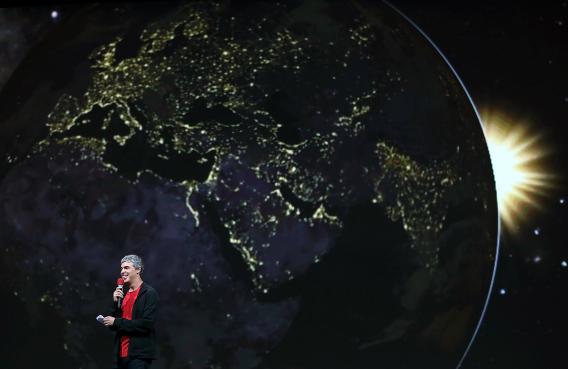
Google CEO Is Tired of Rivals, Laws, Wants to Start His Own Country
In a surprise appearance at Google’s I/O conference today, CEO Larry Page took the stage to philosophize and take questions about the company’s...
Slate Magazine
67 points · by wikiburner · 13y ago · 73 comments
* "he left out the part where Google recently sent Microsoft a cease-and-desist letter demanding that it remove the YouTube app from its Windows Phones" has nothing to do with interoperating, but rather Microsoft not showing ads (among other infractions).
* "Mozilla guy" is Dan Buchner (https://news.ycombinator.com/user?id=dandonkulous), who's working with Google on web components. http://webcache.googleusercontent.com/search?q=cache:2cpEUw1...
Larry gave an impressive non-answer to the relatively basic question ("Hey, any chance web technologies will replace Java on Android?"), and went off on quite the interesting tangent about just about everything.
I can only assume he's been wanting to say these things for a while, and jumped on basically the first open ended question he got. I bet the Google PR team was freaking out a bit.
Says who? Microsoft offered to show ads but Google refuses to give them access to the API since almost 3 years.
Perhaps you haven't read this story because Google fanboys on HN are flagging it heavily to keep HN readers like you in the dark.
Whether it's fair or not for Google to not provide a way to include ads is a different argument entirely. It sounds like it's just not even technically legal for MS to distribute their YouTube app in its current state.
Microsoft developers didn't have to read and accept the TOS to access Youtube videos. Perhaps they're trying the legal precedent of the equivalent of 'clean room reverse engineering".
Is it legal for Mozilla to distribute Adblock on their site which is a program that disables Youtube and Google ads and hurts content creators?
Would Mozilla be forced to remove it from https://addons.mozilla.org if Google sends a C&D to them?
>It sounds like it's just not even technically legal for MS to distribute their YouTube app in its current state.
So what? Google can sue them for billions and win and stop all Windows Phone users from easy access to YouTube videos despite their stated mission of "Organize the world's information and make it accessible to everyone".
Not sure why you're so worried about Microsoft's finances, they have 75 billion in the bank and some pretty good lawyers. No wonder they snuck in a "download video" button too. The WP Youtube app is the best Youtube app on mobile platforms because of that.
Microsoft's original request is for Google to create a new API which would allow querying of richer metadata about videos. It's not apparent why this new API is required to write a TOS-compliant YouTube client.
https://developers.google.com/youtube/v3/getting-started#quo...
Given the benefit of doubt, I can totally see where Larry was coming from. In fact it seemed bold and even slightly refreshing to hear him convey his thoughts without the usual restrictions. Industry wide conversations start these ways and examination of a problem is crucial before we can attempt to solve it.
This is one of the most breathtaking biased pieces I've seen in a very long time. This guy really, really doesn't like Google. Or maybe just Larry Page.
Edit:
By the same writer:
In the same vein as this "story", a bizarre caption in a "story" covering Eric Schmidt's Guardian op-ed suggesting civilian drones are a bad idea:
"Google CEO Eric Schmidt knows what's best for us."
http://www.slate.com/blogs/future_tense/2013/04/15/ban_civil...
I glanced through the first 10 pages of his other stories on Slate. They aren't all rabidly anti-Google. Though he does seem to hold the founders of Google in special disdain for some reason.
Now I'm more inclined to think this is simple link-baiting, not bias. He'll say anything for the clicks. Which seems like a common trend on Slate these days. I remember the days when Slate had some really excellent original journalism.
Personally I want more folks to spread ideas similar to Larry's. (Whether he meant it or not is impossible to know of course)
I mean, pretty much this (assuming the above was facetious). The Youtube thing really made me lose a lot of hope in Google as a company. Even though, I feel that we've made great strides in the past 10 years, I can't help but be reminded that:
1) I have people on my Facebook that I can't add to my phone without some ridiculous hacks (that essentially scrape FB, breaking the TOS) - thanks Facebook
2) I can't use GMail in the vanilla mail app on my touchscreen W8 laptop - thanks Google
3) I can't have a Metro Chrome app - thanks Google
4) My sister can't have almost anything (native) Google-related on her ARM-based W8RT tablet - thanks Microsoft
5) I can't have a distro-agnostic framework that "just works" for downloading/updating/installing/uninstalling Linux packages - thanks FOSS infighting cliques
6) I don't have full control over my Android/Apple phone, over my Android/Apple/Windows tablet, (and soon over my Google glass) unless I root said devices
This is simply a consumer-space extension of the legal battles that these companies are so fond of (see Samsung vs. Apple). The sad part is, it's probably going to get worse before it gets better. Oh, well.. c'est la vie.
3 - According to http://blog.chromium.org/2012/06/try-chrome-in-metro-mode.ht... , Chrome has supported Metro since June 2012 when running on a non-RT version of Windows. Computers running Windows 8 RT can't run any browser in Metro mode (see http://blog.mozilla.org/blog/2012/05/09/windows-on-arm-users... ), so it's not like Google has a choice there.
6 - To root a device means to gain full control over it. It's not obvious how you could have full control over your phone without rooting it.
It could come with root access enabled, just like your computer does.
Only root can install malware into the kernel or BIOS. Only root can pull keys and passwords out of /dev/mem. Only root can damage an installation beyond the ability to factory reset.
I eagerly await the day when every major OS will require jumping over some basic hurdle (e.g. rebooting into single-user mode and running /sbin/root-me-harder) before enabling root access, because that will eliminate entire categories of security risks from consumer-oriented computing.
3 - There is no native Metro Chrome app (talking x86 or x86-64 here, I address RT in my subsequent point), so I'm not sure what you're talking about. The current Metro implementation is NOT a true Metro implementation (it's just the desktop app stuck in a metro window -- no gestures, no larger fonts, etc, etc).
6 - Someone already addressed this point
3 - So your complaint is that the Metro version of Chrome does not support some Metro features? Again, that is absolutely not the same as "can't have a Metro Chrome app".
Why does the zombie company Yahoo Mail bother to a Windows Metro app while Gmail doesn't?
Or perhaps Google doesn't want to support Windows Phone and WinRT for the fear of rivaling Android phones and tablets.
You have to have consumed quite a bit of the "Goolaid" to be able to take his ramblings seriously.
Genuinely curious here, what are the things that google has done that people think are evil? Maybe as a follow-up, what corporations do you think make a greater positive impact than google?
We should all understand that google doesn't deserve relentless praise, but some of these counterpoints are more baseless and distasteful.
I want to produce food for myself and my community on my property, and build structures that make efficient use of space for occupancy, and these things are extremely illegal.
Is growing food for community is illegal? is it due to the FDA requirements?
What value is Google creating by making another subscription music service with a similar catalog size at the same price as existing companies?
What radical innovation has Google+ Hangouts incorporated that doesn't exist with Facebook Messenger, WhatsApp & Skype?
Why does the Chromebook Pixel look so much like a boxy Macbook Pro?
Just like Microsoft, they aren't trendsetters, they follow and copy what others are doing and use their brand recognition in order to gain market share.
Larry says "you can't focus on zero-sum games", but that is exactly what Google is doing. Maybe not for a specific industry ( Messaging, Music, etc ), but they are interested in winning the zero-sum game of people's attention.
If Google can spread itself across as many industries as possible, not necessary being the market leader of a specific industry, and take slices of people's attention here and there, they'll win the attention game.
Google embraces collaboration/standardization because it means a lower barrier of entry into another industry for them.
But even for Google, founding a country would be enormously difficult. So even if Page genuinely wanted to, it won't happen this decade. Whether it should is a different issue.
https://news.ycombinator.com/item?id=5715889
From Google's About page: "Google’s mission is to organize the world’s information and make it universally accessible and useful."
Last time when Google was intentionally blocking Google maps and then deprecated ActiveSync on Windows Phone someone suggested Google should updated it to the following:(which seems quite true given how much of the world's crowdsourced video content is on YouTube):
"Google’s mission is to organize the world’s information and make it universally accessible and useful, except on Windows Phone".