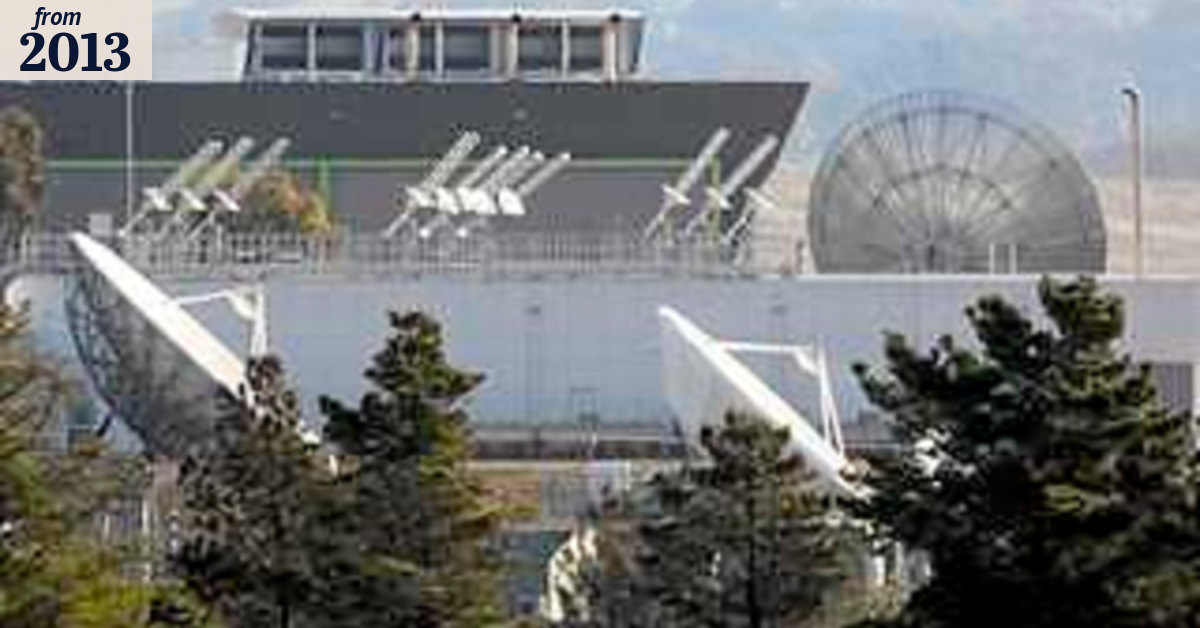
Snowden reveals Australia's links to US spy web
United States intelligence leaker Edward Snowden has provided his first disclosure of Australian involvement in US global surveillance.
The Age
245 points · by SomeoneWeird · 13y ago · 98 comments
I'm not saying it's OK, far from it. It's just that there's nothing new in this story.
[1] https://news.ycombinator.com/item?id=5884858
"Tempora is the first 'I save everything' approach ('full take') in the intelligence world. It sucks in all data, no matter what it is, and which rights are violated by it"
The other systems have always been given some degree of plausible deniability by government doing some hand-waving and suggesting that they have controlled methods by which wiretaps are only placed on specific targets, for specific reasons, etc. etc.
When you start saving everything, especially stuff that you know you are not supposed to, you are violating UK law (Human Rights Act of 1988) as well as international law (https://en.wikipedia.org/wiki/Data_Protection_Directive)
Trying to pass this off as nothing to be concerned about means that you are not paying attention, or don't care.
Tempora isn't new news either [1].
> Trying to pass this off as nothing to be concerned about means that you are not paying attention, or don't care.
Did you even read my comment? Where did I say nothing to be concerned about?
I'm pretty sure that's media sensationalism - were they get quite ahead of the facts and details, and spin the headlines. Or worse, leave out the logic of it all and replace it with something else - the narative the reader wants to believe (ex: they are gathering data on me to be used against me).
Not only does it take time to process the data, but an operational window (of that data) needs to be maintained for the next couple of days - were that data can be cross-referenced with the new feed and possibly be mind and connected to new events as they are unfolding. As otherwise it's useless.
The data is filtered for specific targets, or on specific triggers, or graph data, which is then kept. The rest (like 99.9999995% or more) is just noise that has no use to intelligence gathering - and I don't see why anyone would store it - or would want to store it.
Yes, it has been mentioned previously.
UK media is under a notice from the Department of Defence - a D notice - which is an informal arrangement where the DoD asks media not to report things which they think are strategically important, and the media agrees.
The Official Secrets Act is the legal framework for secrets. People "Sign the Official Secrets Act", but all that means is that they've been made aware that the act exists. You can be prosecuted for revealing secrets even if you haven't signed the act. (I seem to remember some protesters being prosecuted for publishing photographs of missile transport in the 80s?)
So, while the D notice system is informal and is not a prohibition I guess it's a warning about what is considered really important. There's interesting discussion about why a free media pays any attention at all to D Notices.
I think the D Notice for the full take system is an abuse of the D Notice system. (Location of troops during war, for example.)
(BTW that was a bad joke, for those who take tings seriously)
Tell you what this does mean though, our parliament has been lied too, which is supposed to be a big deal. But I guess all the opposition MP's are too worried that GCHQ know all the porn sites they visit. Lets face it, we all have something to hide, and chances are now that the gov knows about it, or can do with the right Db query.
Once the people start creating new laws, and getting them passed, we'll win. Currently, politicians hand us laws that are drafted by corporations & lobbyists, then we simply react.
It's all about us being more assertive.
We already have the bill of rights. Creating new laws won't help us. It's too late for that. Maybe repealing some laws and executive orders might help... but what we're seeing is the symptom of something bigger than governments.
We need to see the cage and step out of it. Educating ourselves and honing our common sense will help us. Becoming self sufficient will help us.
Given that, what good would a new law do? They already have everything in place to subvert any law they want, and their chief tool is mere will.
What might change things is public outrage and muscular congressional hearings, a la Watergate. I can't see that ever happening again.
There's an important step you forgot to include: Getting the new laws enforced. When most of the people in charge of the enforcement are used to (and may well have liked) the old laws, that will not be simple.
Relax and join the movement... it's going to be a long ride.
Or maybe we need to democratize the analogue of a submarine.
You will initially get depressed as you see the injustice around you.
You can deny what you see and go back to browsing Facebook.
Or, you can embrace the movement. I've been traveling the rabbit hole and I assure you that the thing is manageable if you put your time into it.
Here are some guidelines:
- You already have local communities (hacker/creative spaces) that have members who are on top of the news and working to escape the system. Find them.
- Find the commonality between libertarianism, anarcho-capitalism and anarcho-socialism. None of these ideologies are sufficient, but the conversations and debates are converging.
- Learn history and social/economic sciences. The history of debt money, the collapse of rome, today's corporate power structures, etc.
- Understand how the dollar works and how it's controlled and enforced. Support alternative currencies.
- Support open hardware. The EFF is your friend. Learn more about encryption and understand the vulnerabilities online and offline.
I could go on, share links, etc.
There is no commonality. At it's core, anarchism wishes to abolish capitalism, and libertarians/ancaps wish to keep it. It's a fundamental disagreement that starts the conversation off. There's no reconciliation here.
Please do.
The thing is, Edward Snowden was the 1st one to show us he's ready to die for this cause.
I'm sure the number of people willing to go further will only increase. And that will ultimately lead to actions.
EDIT: The movement will "only" have to make sure not be sabotaged and killed off by the surveillance state, along the way.
"Tempora is the first 'I save everything' approach ('full take') in the intelligence world. It sucks in all data, no matter what it is, and which rights are violated by it. ... Right now, the system is capable of saving three days' worth of traffic [...]. 'Full take' means that the system saves everything. If you send a data packet and if makes its way through the UK, we will get it."
"If an agency caches the data but doesn't grep the data for anything related to me has my privacy been violated?"
I would be a lot more worried if it was a US and not a UK agency.
I would also be a lot more worried if it wasn't GCHQ, but was a police force.
There are other databases in the UK that are a lot more concerning to me. All the stuff that supermarkets collect on people with loyalty cards[1], all the medical databases, the misuse of criminal records bureau checking. (These last two have real world examples of real world harm being done to individuals. But perhaps GCHQ's doesn't because it's secret and the information is shared with weird routes.)
[1] Many years ago some friends and I had a loyalty card for "Ivor Trots". He only ever bought loo roll.
If it's stored indefinitely (as they have the ambition to do, and will soon have the ability), it doesn't matter if it is not used today, or in the past. What if at some point in your life you run for parliament, or your business strikes a prominent deal with a foreign power? At that point your records can be taken out and scrutinised by whoever has access to this data at that point in time, and you won't even know, because it's secret. Information has a habit of spreading beyond the intended boundaries, and if it is collected in secret, we have no way of controlling that spread or controlling its use.
I would be a lot more worried if it was a US and not a UK agency.
You should be worried then, because this data is routinely shared with the NSA, seems to be collected under the remit of a joint program, and is probably stored indefinitely by several GCHQ partners where someone is judged to be of interest or enemy of the state/agency, the definition of which will of course vary with the agency.
I would also be a lot more worried if it wasn't GCHQ, but was a police force.
I'd be surprised if access is not given the police on some level, given their participation in counter-terrorism activities, and there's nothing to stop a secret policy change giving more access, you wouldn't even know about it. So you should be worried.
There are other databases in the UK that are a lot more concerning to me.
Given that those databases exist online, and are probably transmitted regularly as backups etc as well as accessed via the internet, you can assume that all that data is also accessible by GCHQ partners and clients. The important difference though is that, as you point out, these databases are public, acknowledged to exist, and controlled by our existing law. If you want to you can challenge the use or collection of the data in a court, sometimes you can stop using these services, or ask to see all information collected on you, but no such options are available for information gathered and shared in the name of security.
What I find troubling here is that the only limit on the indefinite storage of all this material by GCHQ is technical, not legal or moral, and that limit will soon be overcome.
Exactly. Snowden says "If you send a data packet and if [sic] makes its way through the UK, we will get it."
Given that Snowden is an NSA whisteblower, who's talking here about the "Five Eyes" intelligence alliance (U.S., U.K., Canada, Australia and New Zealand), this suggests pretty strongly that the "we" is the NSA.
I tell myself that the UK hasn't demonstrated contempt for the rule of law to the same degree as the US has.
I accept that this is probably wrong, and had I been more aware of my bias I wouldn't have used that wording in the post you replied to.
It's good that I keep challenging myself on this stuff, so thanks for pointing it out.
http://www.guardian.co.uk/world/2013/jun/17/defence-d-bbc-me...
http://www.bbc.co.uk/news/uk-23195283
Telling us how useful GCHQ is in the fight against terror without mentioning Tempora.
It keeps the news alive for a longer period of time, sure, but it also means fewer eyes are looking over it and connecting the dots between various different pieces of the revealed information.
Wouldn't it be better if everything was revealed at once, and the various investigative reporters out there all got to go through it independently and write up a cohesive summation of the results, instead of this two-three page exposé per day?
If you're dealing with a criminal, having a slight upper hand in information while playing it as though you know everything is a proven tool. Like a police interview where an accused gets presented with a crime so you can watch him or her come up with an excuse, which, in turn, might reveal information that you didn't even know before.
In fact, one minister in Germany made a pretty grave statement about how the US behavior was "monstrous". So now I'm kind of waiting for the Snowden story to get to the part where things about Germany are revealed.
[0]It seems like they did the opposite, as they usually do, doubling down in 'Merica adoration. Which is still similarly funny.
How do you propose to measure such a thing?
And ironically, Raytheon's scientist was the dude who invented microwave.
Edit: Found this post from Feb 27th. About X-Keyscore, http://www.nowtheendbegins.com/blog/?tag=xkeyscore and the interesting snippet.
What happens next looks like a 21st-century data assembly line. At the NSA’s headquarters in Fort Meade, Maryland, a program called Xkeyscore processes all intercepted electronic signals before sending them to different “production lines” that deal with specific issues. Here, we find another array of code names.
Pinwale is the main NSA database for recorded signals intercepts, the authors report. Within it, there are various keyword compartments, which the NSA calls “selectors.” Metadata (things like the “To” and “From” field on an e-mail) is stored in a database called Marina. It generally stays there for five years. In a database called Maui there is “finished reporting,” the transcripts and analysis of calls. (Metadata never goes here, the authors found.)
As all this is happening, there are dozens of other NSA signals activity lines, called SIGADS, processing data. There’s Anchory, an all-source database for communications intelligence; Homebase, which lets NSA analysts coordinate their searches based on priorities set by the Director of National Intelligence; Airgap, which deals with missions that are a priority for the Department of Defense; Wrangler, an electronic intelligence line; Tinman, which handles air warning and surveillance; and more.
Lest you get confused by this swirl of code names and acronyms, keep this image in mind of the NSA as a data-analysis factory. Based on my own reporting, the agency is collecting so much information every day that without a regimented, factory-like system, analysts would never have the chance to look at it all. Indeed, they don’t analyze much of it. Computers handle a chunk, but a lot of information remains stored for future analysis.
(1) Where do you place collection points so you get a full take of not only international traffic (moving across your borders) and domestic traffic (all traffic within your borders but that doesn't leave your borders) (2) Since the number of collection points is limited, that means there is a lot of data that has to be recorded at select points. How do you record that data to disk in real time? (3) How do you avoid the duplication of packets that travel through multiple collection points. (4) Lastly, the most difficult problem is figuring out how to query all that data and not end up with a haystack. When you have millions and millions of pieces of communication from people with no involvement in the criminal activity, then all that communication becomes noise.
2) Since you already have 100,000 disks, run 5000 of them in parallel. Each disk interface does 200MB/s, for an aggregate of 1TB/s. If necessary, use fibre to transport data from the collection point to the storage point.
3) Don't. Record the lot.
4) Spend a billion on a super computer?
I think it comes down to the bandwidth of computers now vastly exceeding the bandwidth of human thought. It is now possible to record an person's entire life, with plenty of headroom to spare, to account for any attempt to overwhelm the recording system.
It's only money, and compared with keeping a division supplied in Afghanistan or putting an enormous reconnaissance satellite in space, it's an obvious winner in the minds of the people running the security apparatus.
There is a supposed distinguishable feature between a user/self publishing website, and a publisher with editorial control. One is considered as free from responsibility regarding the content and get legal protection to said effect (with exceptions like DMCA), and the other is supposed to be responsible for the content being published. News papers has always been responsible when they publish secret information, but are protected under the freedom of the press. Self/users-publishing sites like youtube, wikileaks, facebook, twitter, flickr and so on is not responsible for the content available on their websites (again, with some exceptions). Content on those sites are published by users, and the user is responsible.
One could of course argue that Snowden is ultimate responsible for providing the Guradian the ability in publishing the information, through that would be a slight lie. "Ultimate" would mean that there aren't anyone with even more responsibility, which the term whistleblower tend to disagree with. As such, there is plenty of blame to throw around if one wishes to build a blame tree.
That said I could imagine this is enough for Russia to make their case either way.
From the article:
"Classified US National Security Agency maps leaked by Mr Snowden and published by US journalist Glenn Greenwald in the Brazilian O Globo newspaper reveal the locations of dozens of US and allied signals intelligence collection sites that contribute to interception of telecommunications and internet traffic worldwide."
It sounds like the Guardian released this information, but I'm not really sure.
Really?
My immediate thoughts when Snowden's first revelations came to light were "I wonder just how much our local Australian government has rolled over and played lap-dog to every US intelligence request, no matter _how_ illegal or immoral?"
I also have very little faith in the Australian civil rights movement - the US has some powerful, smart, and noisy civil rights activism - here I see very little that appears in any way effectual.
Encrypt all the things… -----BEGIN PGP SIGNATURE-----
iEYEARECAAYFAlHabm0ACgkQniy+nkMiY+13aQCgzAN24gQyZpyKZvw38qao2QN2 ryUAn0tLNaZWRMuExrQGHUMzgjB5ourZ =Sd2U -----END PGP SIGNATURE-----
The furore over the NSA data hoovering and the fourth amendment has no parallel in Australia. The general citizenry is completely uninformed, complacent and lazily uninterested in these matters.
http://m.heraldsun.com.au/news/law-order/victorians-private-...
http://powerhouse.theglobalmail.org/the-australian-governmen...
When you say "this shit" do you mean the negative image the USA is gaining from this? Why on earth would you prefer to remain in ignorant bliss about these happenings?
The sad thing is, our government is no better, out intelligence service is just as amoral and unaccountable, and our civil liberty movement is ineffectual to the point of being invisible. Perhaps "ignorant bliss" was preferable…