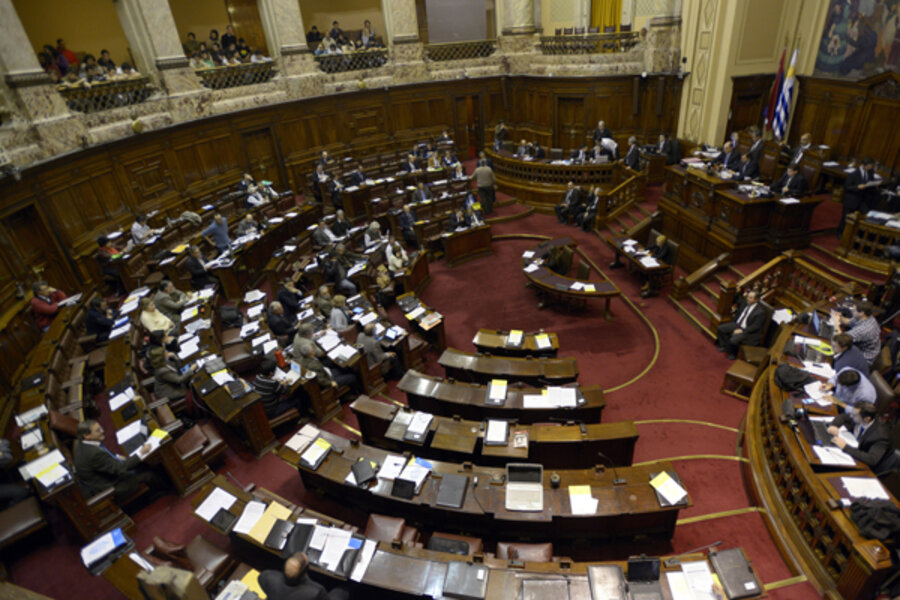
Global trendsetter? Uruguay moves to legalize marijuana.
Marijuana legalization: Uruguay's lower house of parliament set a global first last night by voting to give the state control of marijuana produc…
The Christian Science Monitor
178 points · by anigbrowl · 13y ago · 65 comments
The bill was proposed by the governing left wing Broad Front coalition, and voted by all their congressmen.
While the vote appears close, there was more consensus than is shown.
My party (Partido Independiente, the smallest of the four represented) decided not to vote the whole bill, but only some parts, because they're for legalization, but against some of the particulars of the bill.
The most troubling aspects of the bill are:
- The state will license and regulate private cannabis farms and then sell the marijuana at pharmacies.
- There will be a monthly limit of 40 grams per person and
- all consumers will have to register.
My representative, Dr. Daniel Radío (a medical doctor), had presented an alternative bill, and so had Dr. Lacalle Pou (a lawyer) from the major opposition party Partido Nacional.
The other big opposing party, Partido Colorado, is strongly against legalization, which makes sense since it mostly represents right-wing / military types and the elderly.
For a quick summary of the political positions:
Broad Front - Left wing - more akin to Democrats in U.S. (but way more left wing). They include all the spectrum from the former left wing guerrillas, communists, european-style socialists, etc.
Partido Nacional / "Blancos" - Right wing - more akin to Republicans, but pretty centrist overall. Hit very hard by corruption when they formed government.
Partido Colorado - Right wing - akin to Republicans, include most extreme right wing types. Their government led to the military dictatorship.
Partido Independiente - tries to be moderate left wing.
There are an estimate 180.000 consumers of marijuana in my country, about 5% of the population.
Edit: one of the main criticisms was about self cultivated marijuana, which was finally contemplated in the bill.
President Mujica (a very colorful character) said this:
"We are not going to say that weed is good. What happens is, consumers don't give a damn about our advice, but we won't leave them stranded because of that. And they like the adventure of buying from the drug dealer around here and there, because it is illegal. And while it's clandestine, you can smell marijuana around in many places"
"Nosotros nos vamos a decir que la maruja es buena. Lo que pasa es que los que consumen no dan bola a los consejos y no por ello hay que dejarlos en banda. Y están atrás de la aventura de comprarle al narcotraficante por aquí y por allá porque es clandestino. Y aunque es clandestino el olor se siente por muchas partes"
Curious why this is troubling... I can understand arguments for limiting government regulation, but I'm okay with cannabis being regulated much like alcohol is. Does this go beyond that? I don't have much knowledge of the inner workings of alcohol regulation, so it's hard for me to compare.
There are worries about discrimination, and pharmacies telling who their customers are (since every sale is registered under your ID).
For comparison, cigarettes and alcohol are anonymous (you might be asked to show an ID, but it's not stored anywhere).
> Yes, alcohol is freely sold everywhere
Don't stores need licenses to sell alcohol? Or are you comparing it as "any store with a liquor license" vs. "only pharmacies"? I can see that as being a bit restrictive, yeah.
> For comparison, cigarettes and alcohol are anonymous
Right, but that relates to your point about being required to register... I was just asking about concern over the first point (regulation). I agree that the registration isn't optimal.
The state has multiple monopolies on products including refining gas (there is one price for gas all over the country and its set by government), telecommunications (all phone and internet goes through Antel the government agency), water (OSE) along with a couple of others.
I think the main population concern is what this will mean for the price, quantity and quality of the product given that most of the other monopolies are known for their mediocre service, squandering of resources and mild internal corruption. I say mild because in comparison to the rest of South America Uruguay has the lowest corruption level but there is still clear favoritism within government agencies, very lazy workers (they can't get fired). The main argument against the current legislation is that allowing private companies to produce the product (like tobacco) and applying high taxes would be way more efficient and that there is little belief that the government could efficiently pull off this operation.
how does this work? if some parts get enough votes they are turned into law, but the rest of the bill scrapped?
http://www.espectador.com/documentos/Marihuana.pdf
I'll ask my representative for the alternative text from my party, but I don't think I'll be able to get the other one.
They're bills, not scientific studies, I don't know if that's what you wanted :) .
Its more 'official'
Edit: I'm not 100% sure this is what was efectively voted
It's not always a bad thing, I for instance would like a harder stance on security. But they do have some very troubling individuals, and my family knows Dr. Pedro Bordaberry (the son of the one that led to the dictatorship, and current leader of the party) extremely well, and he is extremely right wing.
My girlfriend was secretary of one of the sectors of the Partido Nacional, so I also know a lot of people there, and in my opinion they're slightly more centrist, but (also strictly IMO) they still have a huge problem with cronyism and corruption, not that the governing party doesn't, but they haven't managed to purge that yet.
Does your government limit the amount of alcohol you can purchase per month and do you have to register to buy said alcohol? Because if not, that's rather ridiculous. I personally would not want to be on any sort of registry like that.
Stores don't need licenses to sell alcohol either.
We have the dubious record of being the biggest per capita consumers of Whiskey
http://elobservador.com.uy/noticia/256478/uruguay-primero-en...
(note: not a user, Netherlands-living amateur drug policy and enforcement researcher)
By removing the profit motive from cannabis production it helps to reduce cartel receipts, helps to reduce smuggling, and separates cannabis from other, truly harmful, drugs such as cocaine, methamphetamines, and heroin.
That so many US states have already made provisions to either decriminalize medical use, and or recreational use, by individuals, serves to illustrate that cannabis is nowhere near as dangerous as governments have attempted to portray cannabis as being.
There is absolutely no reason for the DEA to classify cannabis as a Schedule One drug when legal drugs such as alcohol and tobacco are responsible for an exponentially greater amount of negative social impacts when compared with cannabis.
Case in point?
Amsterdam.
Just look at the statistics regarding "hard" drug use in the Netherlands, as well as incarceration rates, and homicide rates.
http://www.drugwarfacts.org/cms/netherlands_v_us#sthash.ta7j...
This is the country where you could just drive into its capital and buy every strain of cannabis you can possibly imagine and different strains of psilocybin magic mushrooms without so much as a howdy and an ID if you looked younger than 18.
[1] http://vorige.nrc.nl/international/article2246821.ece/Nether...
Pot heads aren't known for their violent tendencies, as compared to alcoholics.
But even apart from that (because it's a cooking-the-books level trick, really), decriminalization of drug use has other effects that lower crime rates. For example: keeping up a heroin habit is hard when you need to pay black market rates (€100 / $150 per day). So often, these people need to resort to burglary, robberies or prostitution. Regulating the market drives the prices way down (you could have retail prices for a brick of coke that are the same as that of a package of coffee if you'd let the market work unrestrained), which causes people to not have to resort to crime to fund their habits.
(note: not advocating unregulated heroin or cocaine markets, just stating the obvious socio-economic implications of prices within the bounds of affordability for regular people with a regular job, leaving aside their ability to do said job)
Same-sex marriage became legal today, actually :)
https://en.wikipedia.org/wiki/Same-sex_marriage_in_Uruguay
Edit: August 5, sorry, still, it's very close !