45 points · by daegloe · 13y ago · 53 comments
“Plaintiffs’ proposed injunction is a draconian and punitive intrusion into Apple’s business, wildly out of proportion to any adjudicated wrongdoing or potential harm. Plaintiffs propose a sweeping and unprecedented injunction as a tool to empower the Government to regulate Apple’s businesses and potentially affect Apple’s business relationships with thousands of partners across several markets. Plaintiffs’ overreaching proposal would establish a vague new compliance regime—applicable only to Apple—with intrusive oversight lasting for ten years, going far beyond the legal issues in this case, injuring competition and consumers, and violating basic principles of fairness and due process. The resulting cost of this relief—not only in dollars but also lost opportunities for American businesses and consumers—would be vast.”
http://allthingsd.com/20130802/apple-slams-feds-proposed-e-b...
While some of the remedies are related to the market that was affected by the illegal actions they were found to have engaged in, the remedies as a whole aren't limited to the ebook market, and it seems more concerned with Apple using its mobile position and related retail platforms to facilitate similar publisher schemes in other markets to the one it engaged in in the e-book market.
Which, IMO, is what you'd expect of a company that wasn't found to be leveraging a monopoly or otherwise abusing power as a dominant player in one market, but instead was found to have used a significant-but-not-necessarily unique position in one market to provide a pivotal role in a price-fixing conspiracy among producers in another market.
Wait...
So Amazon bought all their eBooks on the wholesale model, basically, they pay a fixed price for the book, maybe $5 and sell the book for whatever... including selling for a loss if they choose.
Apple came along and said we will sell for whatever the publisher of the book wants us to sell for... and then we will take a percentage of that.
Now forgive me for my shameless selfishness here...
but that immediately calls to mind the App market to me.
So I have a question...
Would "...in other markets..." mean that Apple could conceivably be barred from letting me sell my App for whatever price I wanted on the App store? Or does it mean that they would just have to provide a link to my app on another store that would be selling my app at a loss?
I hope that's not true. In this case, that would mean that Apple, Amazon and Google would get to set the price at which one could sell one's app, since they own the store, and I would be just the publisher.
Well... technically, they couldn't set the price I could sell my app at, they could only refuse to buy my app and put it on their store for anything but their "wholesale" price.
I hope none of this applies to the app market.
Sigh.
Maybe I should have gone for that Law degree.
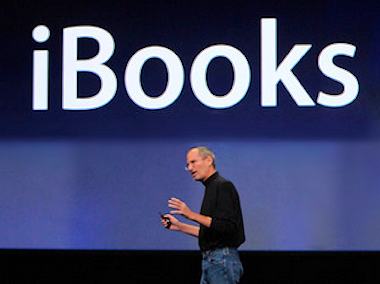
Apple has clearly overreached, but this kind of remedy is not about restoring competition.
Having that said, it's really a different case than eBook price fixing. It's almost like they're giving them a punishment for a different case...
Get your External Antitrust Monitor resumes up on LinkedIn kids, xmas is coming early this year.
http://www.amazon.com/Kobo-Inc-eBooks/dp/B004SIEZ8I/ref=sr_1...
What would be Apple's punishment? A fine? That's hardly going to deter the world's most valuable company. What they did hurt their competitors. The punishment is that they now have to help their competitors regain what they lost. This is not unprecedented by any means. In the two cases where Microsoft was deemed to have an illegal monopoly, they had to give their competitors access to their proprietary APIs (US v Microsoft, a gift to Apple and Linux vendors) and include downloads to competing browsers (EU vs Microsoft, a gift to Google, Mozilla, and Opera).
This doesn't exactly seem fair to all the other companies who would still have to give up 30% commission over to Apple but can't raise their price (e.g. Netflix, Dropbox, etc).
The term at issue is a remedy for harms done by Apple's role in the ebook publisher price fixing scheme, which isn't relevant to Netflix, Dropbox, etc.
Insofar as the kind of thing Apple did here would be relevant to app makers in markets other than the ebook market, those app makers are beneficiaries of the provisions of the propsed remedy that exist to prevent Apple from engaging in schemes that are similar to the ebook scheme in other markets.
Can someone explain what Apple 'fixing' e-book prices means and how that is illegal?
So when Apple decided to start the iBook store, all the publishers decided to use that as an opportunity to band together and force Amazon to use the agency model, which is how Apple sells apps (publishers set the price, Apple gets a cut).
The had the effect of causing book prices to go up (because, again, Amazon often sold at or below cost). Because Apple was the new player whose contracts caused this, they got in trouble.
Many people find this quite questionable. Prices will go up with this settlement because publishers get more control. Amazon had a de facto monopoly, which Apple actually broke up. Also, this wasn't Apple's idea, it was the publishers.
Of course, Apple was more than happy to take advantage of the situation, so they weren't exactly innocent.
It's a really a strange case.
They fixed prices, and theres no situation where this yields a upside to customers. And in fact, it didn't. That's why they had to pay up, and Apple, failing to come to terms with the DOJ, will now have to pay much much more dearly for ever bringing this into a court.
> They fixed prices [...]
This is something I'm not sure about. From what I've read it sounds like all the publishers already wanted to do this and Apple was just the perfect opportunity to force the issue.
But as I said above, Apple clearly knew this was the case and used it to their advantage. They didn't set out fix prices, but they weren't against it.
> And in fact, it didn't.
This is a little odd too. Because of the agency model and the most favored nation contracts, prices went up. But if prices were artificially low before hand, was this a harm to consumers or a correction that would have happened eventually anyway?
There are some interesting twists in this case that make it a lot less clear-cut than most price fixing schemes. Apple probably deserves some kind of punishment for their behavior. On a personal level I'd really like the ability to buy books in the Kindle app, that seems like a fair punishment. I love my Kindle, but I do think Amazon might have been abusing their monopoly.
Of course the publishers were all guilty as hell, but they settled quickly. If they had tried to fight this too, I wonder if we'd hear as much about Apple. They're the only ones left standing and fighting.
We've seen the music industry do it (avoiding selling to keep album sales up). We've seen the game industry do it (change the same for downloads as physical copies to keep retail happy). We've seen the movie industry try to prevent disruption many times (anti-VCR, pro-Divx, anti-Netflix, etc).
TL;DR version, the court found "that the Publisher Defendants conspired with each other to eliminate retail price competition in order to raise e-book prices, and that Apple played a central role in facilitating and executing that conspiracy."
Traditionally, book publishers sell to stores at a wholesale price. Stores then mark up the price a bit and sell it to the end consumers.
Amazon then started selling books for prices below the wholesale price, deliberately taking a loss.
The publishers got scared that this would destroy all non-Amazon channels, giving Amazon inordinate power over them.
So they got together with Apple and set up a scheme where the publishers would all use the "agent" model. Instead of selling the books to Apple for a fixed wholesale price, they would set the prices however they liked, and Apple would take a cut of 30%.
The publishers would then all refuse to sell to Amazon unless Amazon switched to the agent model.
That, however, is pretty straight-forward collusion and against the law.
What I've read is that the "below the wholesale price" didn't happen a lot until publishers started raising that price after Amazon created the market. Now, maybe the latter discovered they couldn't afford below $10 wholesale prices, but the method they used to deal with the problem as, as you noted, "straight-forward collusion", and as I add, that harmed the consumer; add the two together and you get a slam dunk anti-trust case.
Which leads straight to all but one of the remedies, like terminating all those deals with the publishers and for 5 years refraining from striking any vaguely similar deal with publishers. And extending this sort of thing to other media, seeing as how they are now a convicted (and unrepentant) price fixer.
As for the remaining remedy ... don't know about the legal basis for it, but Amazon was the main target of all the parties in the price fixing conspiracy.
There's a bit more detail here: http://en.wikipedia.org/wiki/Apple_Inc._litigation#eBook_pri...
But no one was coerced into buying those books. Where's the crime?
HN discussion: https://news.ycombinator.com/item?id=5752212
"entering new e-book distribution deals which would free it from having to compete on price"
It is interesting because I see it as a request to keep Apple from enriching itself but abolishing the fee entirely makes for a really harsh sanction. We'll see what, if anything, the court decides is reasonable.