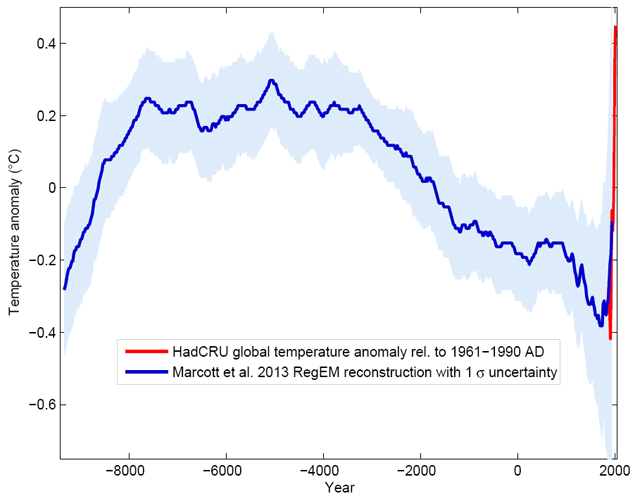
Temperature chart for the last 11,000 years
For the first time, researchers have put together all the climate data they have (from ice cores, coral, sediment drilling) into one chart that shows the “globa
kottke.org
220 points · by deusclovis · 13y ago · 173 comments
The main problem is that no one knows if the hypothesized models (temperature vs. tree ring thickness, sediment layer thickness, etc.) have any validity. Why should tree rings grow linearly with temperature- what about a huge number of other variables? The temperature “signal” is at best very weak. Decoupling the temperature signal from other variables (humidity, elevation, tree species, CO2 concentration, etc.) is a hugely difficult multivariate statistics problem and most of the researchers I've corresponded with do not seem to appreciate this fact.
Another major problem is that proxies get weighted in the temperature reconstruction based on how well they fit the hypothesized temperature model. The weighting is where things get really shaky. Right away, you have biased your results in such a way that that nonconforming data is discarded / de-weighted. Note that there is not anything wrong with these nonconforming samples that invalidates them; they just don't fit the proposed models very well. Typically researchers develop their own methods for weighting samples in the temperature reconstructions and many of these methods would make a statistician cringe. Often during the weighting phase you find that a handful of proxy samples (out of a sample size of hundreds) get the vast majority of the weight in the temperature reconstructions. Sometimes the weight of a temperature reconstruction in a location is almost completely computed from a few proxy samples taken halfway around the world at a completely different elevation.
If you try to discuss these fundamental problems with climate scientists you'll typically get told that you're not a scientist (not true) or that you're a "denialist" being paid by big oil (not true). I am convinced that these temperature reconstructions are useless at best.
The first is experimental design, much like is necessary in any aspect of science: Annual tree growth is definitely a response to a variety of regional, site-specific, and tree-specific factors for any given species in a location. So in order to increase the 'signal to noise' ratio for a given signal (temperature, precip, fire, disease or whatever reconstructions), you look for combinations of species and sites for which the factor you want to study is the limiting growth factor; in other words, other things the tree needs to grow are present in abundance and one is in shortage. If you want to make a precipitation reconstruction, you find a site that has very little soil moisture storage, such as trees basically growing out of fractures in steep bedrock. If you want to study temperature, you pick species like Bristlecone Pine that grow at high elevations (which are typically relatively wet), so that the temperature/length of growing season is the annual limiting growth factor. That sort of thing.
The second is that researchers use many other forms of measurements than simply ring width to tease these problems out. For example, many people use oxygen isotopic ratios[2], latewood (the dark outer part of the tree ring) density measurements[3], and other measurements in tree rings, both because of the unique and accessible response of the tree, and because (unlike, say, sediment cores) the tree rings are much more quickly, accurately and reliably dated at the single-year precision.
Third, there is a lot of statistical analysis thrown at the problem. I didn't work a lot with this, or see people in my lab do it, but I am aware of researchers doing multivariate statistics techniques such as principal component analysis[4]. I'm sure there is a lot more, but you can do a Scholar search as easily as I can.
Fourth, one of the strengths of the multiproxy technique is that many of them are independent, and they all show a lot of correlation to the temperature records during the instrumental calibration period. There is some divergence before this period, but not as much as would be expected otherwise. There is also the problem of weighting, like you mention, and I don't think anyone is comfortable with it but I don't think it's as ad-hoc as you make it out to be. A review (by a statistician) that discusses this is here[5]; I didn't read it in depth.
[1] http://www.uark.edu/misc/dendro/
[2] http://link.springer.com/article/10.1007/s00382-013-1674-3
[3] http://journals.ametsoc.org/doi/abs/10.1175/JCLI-D-11-00139....
[4] http://onlinelibrary.wiley.com/doi/10.1111/j.1600-0706.2010.... [5] http://www.stat.unc.edu/postscript/rs/Sensitivities-Submitte...
True, the signals from tree rings (etc.) are noisier than those from kitchen thermometers. Let's consider, for a moment, how you could verify the precision and come to a conclusion as to the accuracy of those signals: well, when you get the same information coming from multiple seemingly independent sources, it greatly increases your confidence in that information. Hence, if you're doing your modeling right, if you get tree ring data from all over the world, and soil samples from all over the world, and find that, sure enough, there is a common signal visible across all of them, then you say "well, the only thing that can explain this global correlation is the modulation of some global parameters". And you present your data and conclusions to a bunch of people whose job it is to poke holes in it and prove you wrong, and after a bunch of time eventually people whose job it is to prove each other wrong end up roughly agreeing on a small sliver of information that lies at the intersection of all their understandings of the world.
Signals in physics can be noisy too (fortunately, in physics you can take millions of samples). But to say "well, these error bars are too big, so therefore we shouldn't pay any attention to the trend at all -- we can decide to do something when we have much higher confidence in the precise figures. In the meantime, I'm going to oppose tighter fuel economy standards for vehicles, and revenue-neutral carbon taxation, and aggressive subsidization of alternative energy R+D, ... " because god forbid we should all drive around in smaller cars, or that we should stop subsidizing air travel, or that we should too quickly improve solar cell efficiency.
Excluding math, we use proxies for just about all science. With different assumptions and different criteria. I don't deny that there are politics, assumptions and margins of error but they do put effort in to minimizing them and doing real science. Take a look at pharmaceuticals, they don't even know why a lot of medicine works, in fact there is debate on if it even does... But people still buy it and take it.
There's a billion pieces of supporting evidences for global warming. As far as I have ever heard, there's not a single piece of evidence against it, just piles and piles of FUD thrown at each model that tries to explain it.
Surprisingly enough, the fear, uncertainty, and doubt about anthropogenic warming claims have come from people who receive money from carbon-intensive industry groups. It's these people who keep on claiming that it "hasn't been accomplished". And since FUD is easy to do, the FUD-purveyors are winning in the public sphere.
What kind of evidence would convince you, exactly?
I.e. maybe the climate won't spiral out of control, but it seems reasonable to be concerned about the alarming levels of CO2. As a new parent I'd love to have my dire fears of catastrophe awaiting future generations assuaged by rational hard science, but (as a layman) everywhere you look the picture is pretty bleak.
The Science paper: http://www.usu.edu/geo/physical/MarcottEtal_Science_2013.pdf
Online supplemental material: http://www.sciencemag.org/content/suppl/2013/03/07/339.6124....
The figure itself is a new plot by Potsdam University researchers for realclimate.org, though, using the same dataset, but not a graphic taken directly from the paper (the paper's Fig. 1 has some alternate versions).
(edit):
"Because the relatively low resolution and time uncertainty of our data sets should generally suppress higher-frequency temperature variability, an important question is whether the Holocene stack adequately represents centennial- or millennial scale variability. [...] The results suggest that at longer periods, more variability is preserved, with essentially no variability preserved at periods shorter than 300 years, ~50% preserved at 1000-year periods, and nearly all of the variability preserved for periods longer than 2000 years (figs. S17 and S18)."
"Had there been such a global warming before, it would very likely have registered clearly in some of these data series, even if it didn’t show up in the averaged Marcott curve."
I'm not arguing their conclusions. I'm criticizing the way they present this data. This composite reconstruction is so weak, that if you shifted 20th century AGW back 5,000 years, it would completely erase it. That's how powerful the smoothing is.
1) I think that we, as the human population, should actively move toward more efficient, less destructive industry on principle, not just because of the threat of climate change. I think making it about climate change gives too many opportunities for argument derailment. Think about when "tree hugger" was a pejorative term; i mean, who DOESN'T want to hug a tree? I think it's a lot harder for people to argue against the idea of "leave a place as you found it" than to find flaws a data set. It also allows for much broader regulation. For example, we could then start focusing on legislation against pharm manufacturers allowing meds to seep into the water supply rather than just the air pollution they're producing.
2) I'm starting to wonder why we're not focusing more on adaptation to than prevention of climate change. I've been watching a lot of TED talks lately (thanks, Netflix!) about the impact of climate change, and the one that I'm thinking of was a researcher who spent time in the arctic studying the wildlife there, and made the case that we should prevent climate change so that we can save arctic wildlife. But I wonder, if we were alive in the age of dinosaurs, would we be saying that we need to clean up the atmosphere to prevent the impact winter that would inevitably kill them? While I love wildlife, I almost feel like it's not our responsibility as humans to tamper with natural processes like extinction. In our prevention efforts, we may also be preventing natural selection and, by extension, adaptation. It could be a reality that we'll face an extinction event that wipes out all other non-domesticated mammalian life. While we can all agree that an Earth like that would suck, we know that, 600 million years from now, EVERYTHING will be wiped out. People speculate that, at this time, humans themselves will either become extinct or will have migrated off the planet. So, my question is, are we prepared to jump ship if Earth becomes uninhabitable? Is it realistic to try to change all 5,000,000,000,000,000,000 kilograms of atmosphere, or should we starting thinking about building habitats for space living?
The fundamental premise is not that extinction is bad, but that extinction we cause is bad. If a fox tramples your neighbor's garden, that's too bad. If you trample your neighbor's garden, you should fix it.
The trouble is, that at the current state of science and technology we can not engineer and control ecosystems. We can not even model ecosystems. As a result we are breaking things and we even have no idea how badly we are breaking things when we are extracting resources. Like when we are turning diverse ecologies into monocultures, when forests are being turned into these 'beautiful' fields of golden wheat.
It does NOT have to be that way. There is no natural law that says that it is necessary to destroy diversity if one wants to grow food or extract resources. It is just that our technology is very primitive and that's the only way we've been able to do it so far. With right technology one can have it both ways. But we don't have it. Not yet.
And meanwhile, well. Conservation, common sense and minimizing our damage to the ecology is probably a best that we can do...
There's a very real choice about how we want to change the environment of the earth, but lets not couch it in meaningless terms like natural vs. unnatural.
Hunter gatherer societies are no more natural/unnatural than cities.
As for the line between human actors vs. non-human actors... when it comes to players in the ecosystem, humans are simply overpowered. That is the root of the problem. Nature has struck a balance in most places, and the ecosystem shifts slowly because everything is close to balance. This gives the other players in the system time to react. Humans are very, very good at destroying balance, so we often warrant special consideration.
Think about your history. The only other actors that brought about the destruction of habitats, ecosystems, and species in as short a time and as great of numbers as humans are natural disasters.
Thank you for describing what I was trying to say much more elegantly. :)
So, given that scenario, I think the better question to ask is, what benefit would we, as humans, get from a return to a cooler Earth? IMO wildlife will take care of itself: adapt, die off, etc. the same way it always has. BUT, I think that too often the focus is put on sad-looking animals and melted snowcaps, which makes it seem like global warming is just an "environmentalist" issue rather than a serious threat to human life.
The ongoing massive extinction event driven by human activity is a real thing. Do you want to live in a world where the only animals alive are ones that humans raise as livestock, or that thrive amongst humans? Nothing but pigs, chickens, pigeons, sparrows, cockroaches, bass and such. Sounds awfully grim to me, but without serious efforts towards preserving wildlife, this is precisely what the future holds.
No penguins in the Arctic, no polar bears in the Antarctic; they have little-to-no bearing on each others population (even indirectly via seal populations). You could've chosen a better example.
Also, before someone posts a link to "that" article, let me say in advance it was written by an intern based on interviews that (in my opinion) suggest exactly the opposite of what the writer concludes.
Ticks are another matter. While birds will eat them, no species that I know of depends on them for its diet. We probably can safely eradicate ticks.
Two points:
1. The conditions on Earth which support other megafauna also, largely, are beneficial to humans. Change those conditions and it's likely that the extinctions aren't so much bad for humans as indicators of changing conditions which are bad for humans.
2. Conservation biologists have recognized that the Earth and its biosphere isn't a static system, and that conservation efforts shouldn't be aimed at "holding back the tides" so to speak. But noting when changes are happening at scales which are likely to have strongly negative impacts for humans, civilization, and the almighty economy, and deciding to take preemptive action, could be a very good thing.
There's a huge difference between wiping out all life (or much of it) within the next 200 years, and the next 800 million.
Assuming you've got an 85 year lifespan, that's the difference between living for your full life, or just 25 minutes.
My own definition of "sustainability" is "so long as the extrinsic conditions are conducive to human survival". Even with genetic drift, that's likely a few millions to tens of millions of years.
The reality is that prevention is cheaper (there is also an issue of distribution of the cost, though). Prevention of climate change effectively means not using energy from fossil fuels, while adaptation means paying extra energy cost for each unit of energy you get from fossil fuels.
This extra cost is actually greater than extra cost that would be incurred if you used non-fossil fuel source. So if you decide to continue to use fossil fuel sources at all, the total cost (savings due to cheap fuel + mitigation costs) will always be higher than the non-fossil energy sources (higher cost to get the energy but savings on mitigation).
Why is it so hard to imagine changing our lifestyle might be the easiest thing to do?
While air temperatures routinely exceed 95F (which is already hot), that's generally at much lower humidities. A wet-bulb 95F means that relative humdity is 100%, and the body effectively cannot cool itself.
You're also going to have trouble cooling yourself from your surroundings, as everything will be that warm -- water, ground, etc. http://www.tgdaily.com/sustainability-features/49635-future-...
Even swimmers have been known (or suspected) to succumb to thermal stress when swimming through warm waters. The international body governing open-water competitions has set an upper bound for competitions of 31C (87.8F): http://www.swimmingworldmagazine.com/lane9/news/Commentary/3...
Most swimming pools are heated to between 78 and 82F. The difference between the lower and upper ends of that range are pronounced: slightly cool to slightly warm if you're not very active. Many swimmers will find anything over 80F unpleasantly warm, and may prefer cooler temperatures, though lower than about 72F generally feels chilly regardless.
The problem is there are certain thresholds that cause new greenhouse effects to kick in and push temperatures even higher. For example, if temperatures rise enough to melt the Methane frost layers, they'll melt and probably kick global temperatures up another 5 or 6 degrees all by themselves. If we trigger enough of these knock on effects in a chain, well end up with an unlivable atmosphere. That's the extreme scenario, but it is not impossible.
So perhaps investing in keeping old people alive during hot and cold snaps might be a good investment and infrastructure that is impervious to same.
1) CO2 concentration has a long half-life in the atmosphere, so even if we immediately stopped emitting every molecule of fossil fuel-derived CO2 into it, we'd still see the effects of what we've done for the past century for at least another couple centuries.
2) People mostly hope to lower the rate at which our CO2 emissions rate increases, and maybe in certain countries make it negative. Both of those, however, are derivatives of the relevant value for purposes of the greenhouse effect and ocean acidification: the absolute level in the atmosphere. Which has zero chance of decrease even under the most aggressive conceivable prevention efforts.
3) The graph doesn't even cover the last major glaciation event: the last glacial maximum was around 20k years ago.
4) Biggest issue: the people who will be most adversely effected by climate change are people who don't have the resources to adapt. I don't dismiss the idea out of hand that it might be cheaper to put efforts into mitigation than prevention: we're definitely going to have to do some mitigation work. But you are not going to convince Western countries to spend trillions of dollars building levees in Bangladesh.
He said the money spent on implementing Kyoto was much better spent combating the direct effects of global warming, for example by building dikes in areas that were too poor to build them themselves and that were likely to be affected by rising sea levels, like Bangladesh.
To my layman's ears, that sounded quite reasonable.
It still does, in fact.
So Lomborg's argument isn't so much against putting a Pigouvian tax on carbon emissions, as it is earmarking the revenues derived from those emissions for mitigation efforts instead of using it to pay down deficits or pay for other services. Which is certainly something I can agree with, but it seems politically implausible. First lets get a carbon tax.
Somewhat more on topic: in the interview I saw Lomborg didn't talk about earmarking or anything like that, he merely said the money would be better spent elsewhere.
Maybe a carbon tax would indeed be the best way to go about collecting the money, come to think of it. "Want to pollute? Fine. Just pay up for the 'Dikes for Bangladesh' fund first."
That's definitely a must. But I'm not sure if it's doable, seeing the global population just keeps on growing: as long as industry is destructive and always more of it is needed, the net result still is destructive. Might sound bold, but a lot of problems would be solved by combining clean industry with a _lot_ less people to serve.
Clear cutters are given lumber rights temporarily, but since they don't own the lot, they gain nothing from replanting and controlled burning.
Another great asset of private ownership is the inherent drive toward efficiency, which has been great as far as environmental impact reduction goes.
What's wierd is that despite that fact that's you've done your best to make AGW look like a non-issue, the chart for the 100 last years looks extremely worrying.
Yes, the data is limited. BUT - I hunted it down, put it together, gave it what I considered fair context, and there it is. Don't like it? counter with your own half-million year graph, not snide religious insults.
The simple point is that CO2 levels are likely higher now than in the last 20 million years[1], and the current rate of temperature change is likely faster now than any time in the last 65 million years [2]. The prehistorical cycles are large, but they are also slow- we're acting on unprecedentedly fast timescales now. How you can be so arrogant is beyond me. Do you think that climatologists, the very people who produced our complete understanding of our Earth's past, are merely unaware of prehistorical cycles? Perhaps they're "ignoring" it? (...while continuing to publish about and do research on them). Do you think you're more clever than scientists, who somehow haven't noticed that there are long term climate cycles in their published results, despite still managing to write extensively about them? It must be a bizarre mindset which leads to your arrogance.
1. http://www.grida.no/publications/other/ipcc_tar/?src=/climat...
Here's an example.
Anthropogenic climate change is IMHO indisputably real and startlingly fast in geological terms, BUT it is dwarfed by the natural variations in climate over the long term and may even (if we don't overdo it) have saved us from another ice age in the long term. I'm not sure anyone understands what the climate is doing enough in order to make concrete predictions or to know what the interaction of our global warming with the long term cycle's cooling will do. It's great that attention is becoming more and more focused on this topic, but we don't need dire predictions and polarisation which have taken place - it is counterproductive.
It startles me how people pick sides and start using labels like denier and apologist on this topic - surely there is room for debate on what we should do about climate change? Do we have to be either for or against AGW and therefore for or against mitigating it? Isn't it reasonable to suggest looking at AGW in context, and also to show that humanity is going to have to deal with far greater swings over the long term in climate than just a few degrees?
If anything I'd say this long-term chart indicates we have to redouble our efforts to understand climate change, and if we can't control it, work on ways to mitigate its effects, because even if we control our own short term effects, long term the earth will move from ice age to tropical and we'll have to adapt.
It's just cherry picked data to make a cheap political point. The scale of the vertical axis makes it very hard to see what is happening during interglacials, which is what we are in at the moment. If we were worried about an ice age arriving in the next couple of centuries the choice of scale might have some merit, to show how much colder it could possibly get. But we are worried about rapid heating, which that scale does a good job of hiding.
I'd hate to assume bad faith on the part of a climate change denier, but I can't help but speculate that the data source was chosen specifically because it made the point s/he wanted to make.
You don't thing that isn't happening among those who raise the AGW alarm? As the morally "right" position to hold, it even grants leave to do so righteously.
Also, note the scales are totally different, and that the original link at least states sigma (uncertainty.)
I'm not saying we should not try to understand the world. I'm saying we should realize we have limits. The more complex the system we seek to understand, the more we should be skeptical. The climate of the entire planet and to the degree one particular species impacts it seems extremely complex to me. Hence, I am highly skeptical.
Let me remind you, that at any time you are free to donate any amount of your own money to thwart global warming. That's not what some people really want though. They don't want to spend their own money on the problem. They want to spend other people's money on the problem. And I contend we don't know nearly enough about the issue to cross that line.
Deal?
(I know this wouldn't capture the whole story, I'm just curious.)
EDIT: I guess the state of New York has a range of annual average temperatures from 4 °C to 12 °C, so maybe this isn't useful at all. http://en.wikipedia.org/wiki/Climate_of_New_York#Temperature...
To the eyes of the native inhabitant, the glacial retreat is shocking, with the lower altitude glaciers most affected. We've built glacier overlooks in some places, where once the glacier was a stone's throw away, and now it's barely visible, and in another few decades the only thing they'll be able to show anyone there are photos. I've seen photos from the early 1900s of glacial termini which towered over the masts of a sail-rigged steamer. Today there is a fjord there, and the glacier is more than 13km away.
And you want to know what that feels like?
How about instead you imagine how it feels to watch the Arctic melting around you, while an endless circus of millions deny that it's even happening.
[0] http://climate.gi.alaska.edu/ClimTrends/Change/TempChange.ht... [1] http://oldclimate.gi.alaska.edu/papers/Arctic62-3-295.pdf [2] http://glaciers.gi.alaska.edu/material/arendt_phd.pdf
I said in the original comment that I was well aware this wasn't the entire story.
There are some subjects where I really wish I could ask questions like someone new to the topic and not immediately be branded as some kind of enemy.
http://solargis.info/doc/_pics/SolarGIS-iMaps--World-air-tem...
http://solargis.info/doc/_pics/SolarGIS-iMaps--World-air-tem...
the only credible commentary i can find is in a nytimes article:
"Scientists say that if natural factors were still governing the climate, the Northern Hemisphere would probably be destined to freeze over again in several thousand years. 'We were on this downward slope, presumably going back toward another ice age,' Dr. Marcott said."
http://www.nytimes.com/2013/03/08/science/earth/global-tempe...
Those charts, especially those going back further, are a good argument for why we will need to control the climate at some point in the future (but please not when we have not figured out how to without significant risk).
  Over the last decades, numerous researchers have
  painstakingly collected, analyzed, dated, and calibrated
  many data series that allow us to reconstruct climate
  before the age of direct measurements. Such data come e.g.
  from sediment drilling in the deep sea, from corals, ice
  cores and other sources. Shaun Marcott and colleagues for
  the first time assembled 73 such data sets from around the
  world into a global temperature reconstruction for the
  Holocene, published in Science. Or strictly speaking, many
  such reconstructions: they have tried about twenty
  different averaging methods and also carried out 1,000
  Monte Carlo simulations with random errors added to the
  dating of the individual data series to demonstrate the
  robustness of their results.
1) The "divergence problem". The lack of correlation between model inputs like tree rings and the instrumental record over the last few decades is acknowledged by all; climate scientists generally state that it is due to anthropogenic factors, arguably assuming the consequent.
http://www.skepticalscience.com/Tree-ring-proxies-divergence...
2) Serious climate model prediction failures over the past 10 year period, as acknowledged in Nature:
http://www.nature.com/news/climate-change-the-forecast-for-2...
In other words, key model inputs used in climate reconstructions do not strongly correlate with the instrumental record over the last 30-40 years ("the divergence problem") and climate models have so far had a poor track record over the last 15 years, with average temperatures winding up below the envelope of model predictions. These predictive failures in the datasets we can check bode ill for the prospect of hindcasting global average temperatures to within 1 degree more than 8000 years ago.
I also think you misrepresent the 2nd article. The question is what and on what time scale are you trying to predict. I believe they are talking about more precision more short-term models. Just like we can predict winter and not predict weather, we can predict warming due to human forcing, but not the specific details.
In the end, however, it's completely irrelevant to AGW if there was a higher temperature in the past or not. The theory of AGW doesn't stand just on that argument (nor any other single argument, for that matter).
One is that this is based on other people's work, as the GP mentioned. Updates to those works will affect this one; the hope is that those 73 underlying datasets aren't systematically biased and any errors will cancel out. Another is that those error bars are probably 95% confidence. So we fully expect that about 550 out of the 11,000 years in this chart will fall outside of that range. A final bit is that we're only reconstructing averages here; it's a lot easier to guess the average number of shoes owned by 1000 people than the exact number of shoes owned by 1.
These extra caveats don't invalidate the data or render it useless, they just qualify it. You shouldn't look at the graph and think, "Here is the exact temperature for the last 11,000 years", you should think, "Given our current best understanding of the available data, the average global temperature for 10,450 out of the last 11,000 years probably fell into this 0.4 degree C range."
They're not supposed to. These are supposed to be caught by peer review. If you believe Nature, then you should believe Science, too (I am talking about journals here :-)).
BTW, they explicitly discuss the possibility of "missing" temperature peaks in the RC blogpost.
The legend claims one-sigma (68% confidence assuming normality)
It also seems that the red curve has no uncertainty data.
I would not dare draw any conclusion from these curves before I have satisfying explanations for these two questions.
http://www.skepticalscience.com/heading-into-new-little-ice-...
Basically none of these memes are new. They often rely on misunderstanding of context. (For those who didn't know, skeptical science rebuts these commonly found arguments against global warming.)
My personal inkling is that the alarmist reports are wrong, and the changes aren't as drastic as reported; since the same people publish results from proprietary, rigged climate models.
http://www.dailymail.co.uk/news/article-2420783/Worlds-clima...
Check the graph in the parent article.
Zoom into any 17 year period between -3000 and 1900 and it will "look flat", and during many 17 year periods the temperature temporarily went up, but nonetheless you can see there's a clear downward trend throughout that period.
It's impossible to deny that this trend has been sharply reversed.
A 17 year period is normally supposed to tell you nothing interesting - but the 17 year period up to 1996 clearly indicates something quite disturbing is going on.
Climate change is not negated by a temporary plateau.
The Daily Mail? Really?
I say this because a friend has a small barn and in it two horses, two pigs and some chickens. He said the barn doesn't use any heat source because the heat from the two horses is enough to warm the barn. Even a bucket of water in the barn won't freeze.
About those humans heating the Earth -- the effect of the GHG's we emit is tapping into solar insolation, which is huge, so it probably dwarfs the above figures (see next paragraph). Also, the energy that powers us (food) would be turned into heat by other processes anyway.
Order of magnitude: population of 7 billion * 100W/person = 9.7TW. Solar insolation 1361 W/m^2, over the projected area of the earth, which totals 175,000,000 TW.
I just throw that figure (100W) as a useful order of magnitude estimate.
A sudden, full-blown glacial period would be far more disastrous for human civilization than significant global warming. The latter would submerge densely populated coastal areas and force humans to move to the new coastlines, but the overall capacity of the Earth to support life would increase, just as it did at the start of the Holocene. The former would result in a large reduction in the Earth's carrying capacity and global famine.
Any change in the Earth's temperature is going to be disruptive to both human civilization and the existence of other species on Earth. We have reversed the effects of several thousand years of cooling in just a couple of centuries and, assuming we are able to continue extracting and burning hydrocarbons at an unabated pace indefinitely (dubious) we could significantly change the face of the world, but it will still support our civilization, just in a very changed state. Avoiding the pain of this change is ample incentive to curb the use of hydrocarbons. (Edit: It has taken centuries and a significant portion of the world's hydrocarbon reserves to produce less than a degree of warming. At this rate, even if we evaded peak-oil for another thousand years the Earth will still be in a glacial period.)
However, we should be much more aware of events that could trigger another glacial period. Megaeruptions or large meteor impacts could plunge global temperatures suddenly and catastrophically. These are far greater threats to our species, but we are both incapable of adequately predicting them or preventing them if we do predict them. The probability of this sort of event happening in a single human lifespan is remote, while global warming is a certainty, but these events will eventually occur with certainty. Managing global warming is certainly a good idea for the comfort of our civilization, but we should have more eyes on the bigger threats. (Edit: Even if we tried, we would be unable to maintain global warming indefinitely simply by burning hydrocarbons. In the ten-thousand year time-frame we will need to find other ways to combat gradual cooling.)
Orrrr we could do more than one thing at once?
In any case, a "sudden, full-blown glacial period" has never happened according to any geological record we have. The most "sudden" have happened over centuries. The actual, demonstrated suddenness of current warming trends is a major part of the problem.
There are a bunch of problems in your post (I have no idea where you get the idea that we're in a glacial period, these are just labels, but no one calls the Holocene anything but an interglacial; it is well established that Milankovitch cycles do not explain current trends; current atmospheric carbon will be there for centuries to come and will not stop warming us even if we were to stop all emissions today; you neglect ocean acidification, sea level rise, etc), but the fact remains that its ridiculous to assert that "we should have our eyes" on one threat instead of another, when we could have much more scientists and funding for asteroid detection if someone would exert some political will. That is what's necessary, not trying to minimize other threats with specious (at best) arguments.
Maybe soft ones like the sea temperature and acidity, but most people can still go out and food still grows.